


Should You Retake the GMAT or GRE? How to Decide
Retake the GMAT or GRE if a realistic improvement would move you into your target schools' range or fix a weak Quant section, and if you have time to prepare before your deadline. If you're already near the median, or a retake would crowd out your essays, the weeks are better spent on the rest of your application.
The instinct to retake is easy to understand. The test score is the one part of the application with a number on it, so it feels like the part you can fix. One more try, and the problem goes away. Since GMAC introduced GMAT Superscore in August, another attempt looks even more appealing.
But the admissions committee isn't asking whether you can score higher. It's asking whether you're ready for the work.
So the real question isn't "Can I do better?" Most people can, by a little. The question is whether doing better would change your application, and what it would cost you to get there.
If your score is below a school's median and you're weighing your options, start with my guide to applying to an MBA with a low GMAT, GRE, or GPA. This post covers one decision within it: whether to test again.
When Is a Retake Worth It?
A retake earns its place when three things are true at once.
The gain would change where you stand. Look at the median and middle-80% range for each school on your list, on the test you took. A retake that moves you from below the range into it, or from the bottom of the range toward the median, changes how the reader meets your file. A retake that moves you from the median to a few points above it mostly doesn't. If you're unsure where your score falls, my guide to whether it's worth applying with a score below the median walks through the ranges.
The gain is realistic. Be honest about the evidence. Are your recent practice-test scores consistently above your official score? Can you name what went wrong on test day, and is it something you can fix: pacing, a section you under-prepared, nerves on a first attempt? If your practice scores match your official score, another sitting is more likely to repeat it than beat it, unless you change how you prepare.
You have the time. Count the weeks between now and your round deadline, then subtract the weeks your essays, recommenders and school research need. What's left is your prep window. If it's a few weeks of rushed study, the retake will cost more than it returns.
When any one of these is missing, the stronger move is usually to apply with the score you have and make the rest of the file answer the readiness question.
Think of it this way
You're getting your house ready to sell. You've just repainted the living room, and it looks great. But the kitchen faucet leaks, the garden is overgrown and a few light fixtures don't work. You wouldn't spend the next three weekends putting another coat of paint on the living room. You'd fix the things that might stop someone from buying the house. A retake when your score is already in range is that second coat of paint. The weeks are better spent on the parts of your application that still need work.
The Blind Spot in Your Retake Decision
When you're deciding whether to retake, the gain is easy to picture: you know where your score sits against the median and what a higher one would look like. The gain that's harder to see is how much stronger your application could become with a more compelling story.
The test helps you clear a hurdle. Your story is what gets you in. Once you've demonstrated that you can handle the academic demands of the program, a higher score may do less for you than you expect. What moves a file from qualified to admitted is everything else: what you've done, where you're going, and what you'd bring to the class. Because the committee weighs the whole profile, a strong story can help offset a below-median score. No score, however high, makes up for a story the reader can't get behind.
A higher test score can strengthen your credentials. A more compelling story can change how the committee sees your entire application.
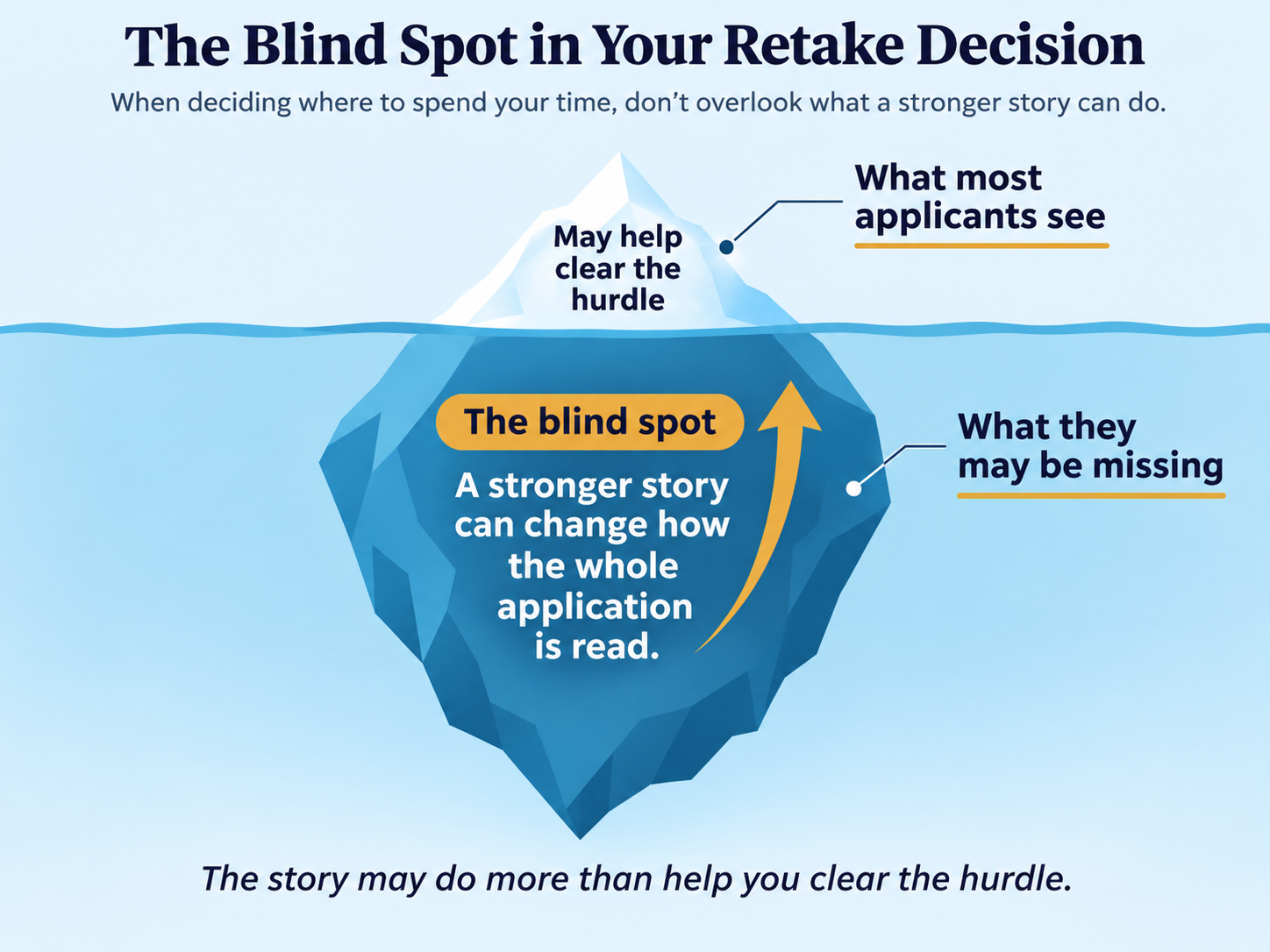
So where will your next few weeks make the biggest difference? If your score is below the range and the rest of your file is already strong, a retake may be the best investment of your time. If it's inside the range, especially near the median, there's likely more lift available elsewhere in your application.
The challenge is knowing how much. There's no class profile that tells you how compelling your leadership examples are, how convincingly you've connected your past to your future, or what the committee will remember about you. And you may have experiences and accomplishments that are far more valuable to your candidacy than you realize. That's the part of the retake decision I spend the most time on with clients, because it's where an outside read makes the biggest difference.
What a Retake Can Fix, and What It Can't
A retake is the right tool for a specific set of problems:
A total below your target schools' range. This is the clearest case, because the score is the first thing that would make a reader hesitate.
A weak Quant section. If your total looks fine but Quant lags, the reader may still wonder whether you can handle the core courses. That matters most when your transcript doesn't already show quantitative strength.
A score that doesn't match the rest of your record. A strong student with a weak score creates a question the reader will want answered. A better score answers it cleanly.
It's the wrong tool for others. A higher score doesn't erase a low GPA. Your transcript shows years of performance and your test shows a day, so a great score helps but doesn't settle the question. My post on how committees weigh a high GMAT against a low GPA covers that combination.
It's also worth remembering that the test is only one way to show readiness. Admissions committees weigh the test alongside your grades, how recent your coursework is and the quantitative work you do in your job. If the test is the weak signal and something else is strong, it can make sense to put your effort there instead. A recent, graded course in statistics or accounting is evidence a reader can see.
What GMAT Superscore Changes, and What It Doesn't
GMAT Superscore combines your best Quant, Verbal and Data Insights section scores from your attempts into a single total on the usual 205–805 scale. GMAC calculates it automatically. It counts valid attempts of the current edition, taken online or at a test center, and it leaves out expired scores and any 10th-edition scores. It doesn't replace the scores you earned on each test day. Since August 12, 2026, it has appeared on Official Score Reports as an additional data point.
GMAC's stated reason for it is score anxiety: one weak attempt can lead qualified candidates to hold back scores or shrink their school list. GMAC estimates the average gain at 20 to 50 points, and it describes that figure as a historical average, not a promise.
What Superscore doesn't change is how a school reads your file. That's up to each school, and several of the most selective programs have said plainly that they evaluate a single sitting:
| School | What its admissions site says |
|---|---|
| Harvard Business School | If you submit multiple scores, HBS looks only at your highest single test sitting. |
| Stanford GSB | Report scores from one examination, all from the same testing session. Don't average scores. |
| Kellogg | Submit a GMAT or GRE score from a single sitting. No test superscores. |
| Columbia Business School | The committee considers only your highest score and won't combine subscores from multiple exams. |
| Chicago Booth | Booth does not accept test superscores. |
| MIT Sloan | You may submit multiple complete scores, but not just your highest Quant or Verbal score. |
| Wharton | Accepts multiple scores; list your highest score first. Its 2023–24 application guide said it considered your highest section scores across sittings. The current guide doesn't repeat that. |
Wharton is the exception worth watching. If it still reads your best sections across sittings, a targeted retake helps more there than at the schools above it in the table. Until Wharton says so for the current cycle, don't count on it.
Policies change from one cycle to the next, so check each school's current admissions page before you plan a retake around Superscore. If a school on your list doesn't say, ask the admissions office.
So what does Superscore mean for your decision? It makes a retake aimed at one weak section less risky than it used to be: your best result on a section you'd already mastered still shows up, even if that section slips on the retake. But at the schools in that table, the target hasn't moved. You still want your strongest total in a single sitting. Plan your retake as if Superscore didn't exist, and treat any lift it gives you as a bonus at the schools that use it.
How Retakes Work on the GMAT and the GRE
The rules are simple, but they shape your timeline.
| GMAT | GRE | |
|---|---|---|
| Wait between attempts | At least 16 calendar days | Once every 21 days |
| Attempts allowed | Up to 5 in a rolling 12-month period | Up to 5 in any rolling 12-month period, including attempts whose scores you canceled |
| Lifetime limit | None ; GMAC removed it | None stated |
| Combining attempts | Superscore , calculated automatically | ScoreSelect lets you choose which test dates to send |
Retake, or Switch Tests?
Sometimes the better move isn't another attempt at the same exam. The GMAT and GRE test similar skills in different formats. Some applicants find the GRE's Verbal style suits them better, and others prefer the GMAT's Data Insights over GRE Quant. Most top programs accept both. HBS, for one, states no preference between them.
Switching makes sense when the format is the problem: you've taken one test twice, your scores have flattened, and practice tests on the other exam come out stronger. It doesn't make sense when the underlying skills are the problem, because those follow you to the new test, and you'd be starting your prep over. My guides to what counts as a good GMAT score and a good GRE score show the ranges you'd be aiming for on each.
Timing a Retake Around Your Deadline
Work backward from your round deadline. Leave room for the prep itself, the test date, and a buffer in case you want one more attempt: 16 days for the GMAT, 21 for the GRE. Some schools let you enter unofficial or self-reported scores when you submit. HBS accepts unofficial scores at submission, for example, as long as the official report follows. Check each school's rule rather than assuming.
The cost that applicants underestimate is the one that doesn't show up on a calendar. Test prep is draining, and the weeks before a deadline are when essays get rewritten and recommenders need follow-up. If a retake would push your essays into the last few days, it's working against you.
How Admissions Committees See a Retake
Many applicants hold off on a retake for one reason: they're afraid of what a lower score would say about them. If the second attempt comes in below the first, won't the committee notice?
It might. But it won't count against you the way you fear. I've heard the same message from admissions officers at school after school, and never the opposite: a retake reads as effort. It shows the committee you took the test seriously and were willing to put in more work, which is the kind of commitment they hope you'll bring to the program. Even when the second score comes in a little lower, most committees see the effort first. That's true whether or not a school uses Superscore.
Most applicants are surprised by this, and it should change how you weigh the decision. If a retake meets the three conditions at the top of this post, fear of a lower score isn't a reason to skip it.
How Many Attempts Is Too Many?
Effort reads well, but only up to a point. Both tests allow five attempts a year, so the limit that matters isn't the official one. Two or three sittings that show real preparation tell a good story. A long run of attempts with flat results stops adding information, and each one costs you weeks.
If you've taken the test several times and your score has stopped moving, that's usually the signal to stop testing and let the rest of your application make the readiness case.
Try this
Write down your current score, then each target school's median and middle-80% range on the same test. Next to each school, write the score you'd need to move into the range, or to the median if you're already in it. Then count the prep weeks you have before your deadline, after the essays get their share. If the gap is bigger than your recent practice scores say you can close in that time, put those weeks into your application instead. And if your story isn't where you want it yet, count that as a gap too.
The Decision Is Yours. The Reader Sees the Result.
A retake is a tool, not a verdict on you. Used well, it removes the one question a reader would otherwise ask about your file. Used out of anxiety, it takes weeks from the parts of your application that actually tell the committee who you are.
The applicants who handle this well make the call early and deliberately, and then they move on. Weighing a score against the rest of a profile is exactly what we can work through in a free consultation. In a short conversation, I'll look at your score alongside your transcript, your work and your story, and tell you whether a retake or a stronger narrative is the better use of the weeks you have.

Frequently Asked Questions
Does retaking the GMAT or GRE look bad to admissions committees?
No. Admissions officers generally see a retake as a sign of effort and commitment, even when the second score comes in slightly lower. What doesn't help is a long series of attempts with no improvement.
Will schools use my GMAT Superscore?
It depends on the school. GMAC includes the Superscore on your score report, but each program decides how to use it. HBS, Stanford GSB, Kellogg, Columbia and Chicago Booth have said they evaluate a single sitting or don't accept superscores. Check each school's admissions page.
Does Superscore replace my GMAT score?
No. It's an additional data point. Your scores from each test day stay on your record, and schools that evaluate a single sitting will look at those.
Should I switch to the GRE if my GMAT score is low?
Only if practice tests show you'd do better on the GRE's format. If the underlying skills are the gap, switching restarts your prep without solving the problem.
Should I retake the GMAT or work on my essays?
It depends on the rest of your profile. If your score is below the range and your story is already strong, a retake can be worth it. If your score is inside the range, the weeks usually do more for you on your essays. The test helps you clear a hurdle; your story is what gets you in.