Wharton: What This School Is Looking For
Wharton is looking for more than its reputation lets on: someone who can clear a genuinely high analytical bar, then do something deliberate with the unusual breadth the school hands you, and — in one of the largest classes at the top — make the people around them better. Because this is the school everyone thinks they've already categorized. The finance school. The quant factory. The place you go if you want a trading desk or a private-equity seat and can prove you can do the math. That reputation isn't wrong, exactly — Wharton's analytical bar is among the highest anywhere, and more of its graduates head into finance than at any peer. But it's woefully incomplete, and the incompleteness is the most useful thing to understand before you spend a season applying.
The same Wharton that owns finance also runs the broadest lineup in graduate business: twenty-one majors, one of the largest classes at the top of the rankings, and a second year so flexible that two classmates can graduate having taken almost nothing in common. The reputation captures the engine and misses the range.
Clearing that analytical bar is the entry ticket, not the finish line. In a class this large, what actually separates an admit is the collaborative instinct — whether you're someone a team is better for having. That isn't a throwaway. Wharton built its entire interview around it.
Wharton
Wharton is looking for more than its reputation lets on: someone who can clear a genuinely high analytical bar, then do something deliberate with the unusual breadth the school hands you, and — in one of the largest classes at the top — make the people around them better.
What Wharton Is Actually Trying to Build
Wharton's identity rests on three things that pull in different directions, and are meant to: analytical rigor, breadth, and a collaborative community at scale. Hold all three at once and the school comes into focus.
The rigor is the entry ticket. Wharton was the first collegiate business school in the country — founded in 1881 — and it has spent more than a century building the most data-driven, analytically demanding curriculum among its peers. The school assumes you can handle quantitative work, and it reads your file partly to confirm you can.
The breadth is what the reputation misses. Twenty-one majors, a flexible core that lets you place out of what you already know, and a class big enough — roughly 880 — to sustain deep recruiting pipelines into finance, consulting, tech, healthcare, real estate, and more at the same time. Size, at Wharton, isn't impersonality. It's optionality. The large class is precisely why the range can be this wide.
The third thing is the one applicants underweight, and it's where the admissions read actually turns. A class of 880 only works if its members make each other better, so Wharton organizes the experience around small cohorts and six-person learning teams — and it screens for collaborative leadership at the front door through the Team-Based Discussion (more on that below). Wharton, like other elite schools, is not looking for the most impressive individual in the room. It's looking for the person who raises everyone else's game, whose presence makes a team's output better than the sum of its parts.
Read against the question every top program asks: clearing the analytical bar gets you considered. What gets you in is evidence that you'll use Wharton's breadth with intention and strengthen the cohort you join. The application is decision support — it gives the reader what they need to see both at once.

Who Genuinely Belongs Here
When clients tell me they're aiming at Wharton, I want to pressure-test two things early, and add a third.
The first is analytical readiness — not whether you're an engineer (you needn't be; more than a third of each class majored in the liberal arts), but whether you can show you'll thrive in a quantitatively serious classroom. That evidence can come from a strong GMAT or GRE quant score, from quantitative coursework, or from work that's visibly analytical. Wharton has to believe you can do the work, because the work is genuinely hard.
The second is harder to manufacture and matters more: are you someone who makes groups better? The Team-Based Discussion (TBD) exists because Wharton decided the best single predictor of fit was watching applicants actually collaborate. The people who thrive here advance a conversation without dominating it, build on others' ideas, and lead without needing to be in charge. If your instinct in a room full of accomplished people is to listen, synthesize, and move the group forward, Wharton is built for you. If your instinct is to win the room, the TBD surfaces that quickly.
The third is intention. Wharton hands you more freedom than almost any peer — 21 majors, a flexible core, an enormous elective catalog, even a semester available at its San Francisco campus. That freedom rewards applicants who arrive knowing roughly what they'd build with it, and quietly underserves those who don't. You don't need a rigid plan. You need a point of view about where you're headed and why Wharton's particular blend of rigor and range is the right tool for it.
The Class Profile, Read Honestly
The most recent confirmed class — the Class of 2027, entering Fall 2025:
Where They Worked Before
Other industries include finance, technology, healthcare, and more. Bars show share of the entering class.
What They Studied
A near-even split across the three. Bars show share of the entering class.
A few things that are easy to misread in these numbers:
The admit rate
At roughly 20%, Wharton's acceptance rate is the highest of the HSW trio (HBS around 10%, Stanford around 6%) — and it leads some applicants to file Wharton under "safer M7." Don't. The higher rate is a function of the large class, not a lower bar. With an average GMAT of 735 and a pool this strong, the candidate competing for the marginal seat is every bit as serious as at the smaller schools. More seats, same bar.
The test range
The 735 legacy GMAT average sits in a middle-80% band of roughly 700–770. A score in the low 700s is inside the range; the score is confirming analytical readiness, not winning the seat on its own. Wharton reads it in the context of the rest of your file.
The undergrad mix is the quiet rebuttal to the whole "quant robots" stereotype
Business, STEM, and the liberal arts each account for roughly a third of the class. Wharton is not screening for engineers. It's screening for people who can demonstrate quantitative readiness somewhere — and a history major who aced their stats course and works in an analytical role can clear that bar just fine.
The industry mix shows the breadth the reputation hides
Consulting, not finance, is the single largest pre-MBA feeder, and the class arrives from a genuinely wide range of backgrounds. The finance reputation is about where graduates go, not only where they come from — and even that is broader than the stereotype, as the outcomes section shows.
The profile isn't a checklist to match. It's a picture of who Wharton admitted last year and why. Your job is to give the reader evidence that places you in it clearly.
Common Myths About Wharton
"Wharton is just a finance school."
It's the most finance-heavy of the M7 by destination — but "just" is wrong. Finance is the largest single outcome at roughly 38%, with consulting close behind near 28% and technology around 15%, plus real estate, healthcare, social impact, and more. The school offers 21 majors and the broadest curriculum at the top of the rankings. Wharton owns finance; it is not limited to it.
"The 20% acceptance rate makes Wharton the easy M7 admit."
No. That rate reflects a large class, not a soft bar. The average GMAT is 735 — among the highest anywhere — and the analytical screen is real. More seats is not a lower standard.
"Wharton is cutthroat and cold."
This one is mostly inherited from the finance reputation, and the structure argues against it. First-years are sorted into small cohorts and six-person learning teams that do much of the early coursework together, and the admissions process literally interviews you in a group to test collaboration. The culture is intense and pre-professional, yes — but it's organized around making teams work, not around individual combat.
"You need a finance or hard-quant background to get in."
No. More than a third of each class majored in the liberal arts, and consulting is the top feeder industry. What Wharton needs is evidence you can handle quantitative coursework — provable through a strong quant score, prior classes, or analytical work. A finance résumé is neither required nor, by itself, sufficient.
"You need a 740 to be competitive.”
The average is 735, with a middle-80% range that runs into the low 700s. A strong overall application with a 720 beats a thin one with a 760. Wharton reads holistically.
Identity and Program Basics
The Wharton School at the University of Pennsylvania, in Philadelphia, PA. Two-year, full-time MBA. Class size approximately 880 — the largest at the top of the rankings alongside HBS. Founded in 1881 as the first collegiate business school in the United States. The first year runs on a cohort structure (large clusters subdivided into cohorts of roughly 70, plus six-person learning teams) with a flexible core; the second year is almost entirely elective, with the option of a semester at Wharton's San Francisco campus. The MBA is STEM-designated, which matters for international students' post-graduation work eligibility. Notable dual degrees include the Lauder MBA/MA in international studies, the MBA in Health Care Management, and the Carey JD/MBA.
The Curriculum, and What It Reveals
Wharton's first-year core is flexible by design. Students can waive or place out of material they already know — an experienced banker isn't sitting through introductory finance — and shape even the first year around where they're trying to go. The second year is almost entirely elective, drawn from one of the deepest catalogs in business education and, if you want it, courses across Penn's other graduate schools.
Two structural features reveal what Wharton believes about learning. The first is the learning team: a small, deliberately diverse group you're assigned to in year one, which does much of the early coursework together. It's Wharton's bet that you learn management by managing the friction of a real team, not by reading about it. The second is the sheer range of majors — twenty-one of them — which signals a school that would rather let you specialize deeply than funnel everyone through a single mold.
Beyond the core, Wharton leans experiential and global: Global Modular Courses (short, intensive courses taught around the world), leadership ventures, and the San Francisco semester for students pointed at tech and venture. The through-line is optionality with rigor underneath it.
What the curriculum reveals: Wharton assumes you'll drive. It hands you a high floor of analytical training and an enormous amount of room above it. Applicants who arrive with a sense of what they want to build use that room to construct something distinctive; applicants who don't can find the freedom diffuse.
Culture and Community, Beyond the Marketing
Wharton's culture is intense, pre-professional, and — contrary to the stereotype — structurally collaborative. The cohort and learning-team system means you spend your first year embedded in a small group whose success is bound up with yours, and the social and professional life of the school is built on a dense club ecosystem: industry clubs (finance, consulting, tech, healthcare, real estate, energy), affinity groups, the student-run conferences that draw real industry attention, and traditions like the Wharton Follies — the student-written, -produced, and -performed musical comedy that has parodied (and celebrated) the MBA experience every year since 1977, and one of the largest productions of its kind at any business school.
The honest texture: it's a big school, and a big school is what you make of it. You won't know all 880 classmates by name — but you don't have to, because the cohort, the learning team, and two or three clubs become your Wharton. Students who lean into that structure find a tight community inside a large one; students who wait for the school to hand them belonging can feel lost in the scale. The energy is unmistakably ambitious and career-forward; if you want a small, contemplative cohort, that's a different kind of school.
The “I got in” Instagram photo: the glass-and-brick facade of Huntsman Hall, the LOVE statue on Locust Walk, or — for the cinematic version — the top of the “Rocky” steps at the Art Museum with the skyline behind you. Any of the three tells your feed exactly where you landed.
Life at Wharton
What it's actually like to spend two years here, beyond the campus-tour highlights — and a quiet case for a city that gets underrated.
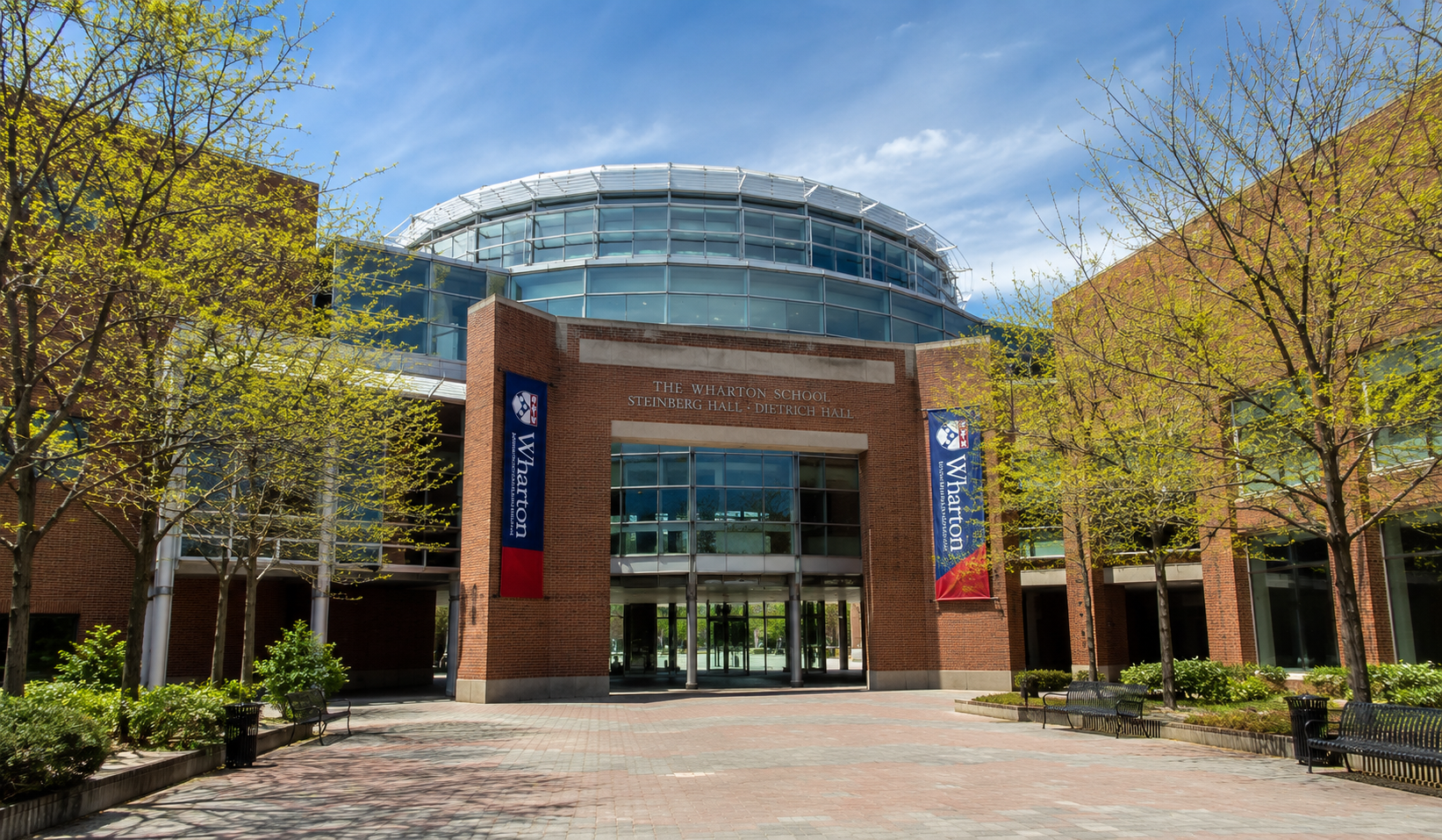
Wharton sits in the University City neighborhood of West Philadelphia, on Penn's campus, with the business school anchored by Jon M. Huntsman Hall — the big glass-and-brick building most people picture. Locust Walk runs through the middle of campus past the LOVE statue and the Ben Franklin "bench" everyone poses with; College Green is the front lawn. It's a real urban university campus, not a self-contained pod.
Here's the part that doesn't make the rankings but changes daily life: Philadelphia is a genuine major city, and it's dramatically more affordable than New York, San Francisco, or Boston. That gap is real money over two years and a real difference in quality of life — many MBAs live in Center City or Rittenhouse Square in apartments that would be impossible near their peers' campuses. Center City is walkable and dense; Rittenhouse Square is the leafy, restaurant-rich heart of it. The food scene punches hard, with a famous BYOB culture that makes going out cheaper than it should be, the Reading Terminal Market for everything under one roof, the Italian Market, and — yes — the cheesesteak debate you'll be obligated to have an opinion on. The Schuylkill River Trail is the running-and-biking spine of the city; the Art Museum steps (the "Rocky" steps) and Fairmount Park are a few minutes out; Old City has the Liberty Bell and Independence Hall when visitors come.
The strategic geography matters too. New York is about ninety minutes by train — close enough that finance recruiting trips and weekends in the city are routine, far enough that you're not paying Manhattan rent to get them. Washington, D.C. is a similar hop south. Philadelphia is also a sports-obsessed town; if you adopt the Eagles, the city will adopt you.
The honest caveats: winters are gray and cold (milder than Boston or Ithaca, but real), summers are humid, and parts of West Philadelphia are grittier than a glossy viewbook lets on — the campus is safe and well-patrolled, but it's a city, with a city's texture.
The "I got in" Instagram photo: the glass-and-brick facade of Huntsman Hall, the LOVE statue on Locust Walk, or — for the cinematic version — the top of the "Rocky" steps at the Art Museum with the skyline behind you. Any of the three tells your feed exactly where you landed.
The point underneath it: Philadelphia is the most underrated piece of the Wharton pitch. It buys you a real city, near the industries you're recruiting into, at a cost of living that quietly improves two years of your life.
Research, Faculty, and Intellectual Identity
Wharton is a research powerhouse across the board, with particular depth in finance, marketing, operations, real estate, health care management, and behavioral science — and a fast-growing investment in the business of AI, marked by a new MBA major in AI for Business launched in 2025. Its faculty include some of the most publicly visible thinkers in the field — the kind whose books and research reach well beyond campus, often before an applicant realizes the work traces back to Wharton. Knowledge at Wharton, the school's research-to-public pipeline, is part of how that output reaches the wider world.
Part of what defines a school's intellectual identity is the presence of thinkers whose work shapes the broader business conversation, and Wharton carries an unusual concentration of them. Adam Grant, the organizational psychologist behind a string of bestsellers on motivation, generosity, and rethinking, has been among the school's top-rated teachers for years. Katy Milkman's research on behavior change — how people actually get from intention to action — reaches far past campus through her book and her Choiceology podcast. Ethan Mollick has become one of the most-read voices anywhere on what generative AI means for how we work, and co-directs Wharton's Generative AI Labs. They're examples, not a roster; the point is the density of the bench.
You may or may not end up in any given professor's classroom, and that's not really the point. MBA applicants aren't choosing a dissertation advisor — what matters from faculty is whether they're reachable, teach well, and remember who you are, and that holds up at Wharton's scale better than the size suggests. Naming the marquee thinkers just establishes that the intellectual gravity is real. And it runs deeper than the famous names: Wharton's twenty-one majors map onto genuine departmental strength, which is why you can go truly deep in a specialization here in a way that smaller programs can't always support. Studying where the people shaping today's business conversation actually work is its own kind of education.
What Wharton Essays Are Actually Testing
Wharton's application is built around tight word counts that reward precision and leave nowhere for vagueness to hide. (These reflect the confirmed 2026–2027 cycle; confirm current prompts on the Wharton site before drafting.)
Short answer — immediate goal (50 words)
"What is your immediate post-MBA professional goal?"
Fifty words is barely four sentences, which is the point. Name the function, the industry, and ideally a role or a few target firms. There is no room for throat-clearing or vision statements — just clarity about where you're pointed the day after graduation.
Medium- and long-term goals (150 words)
"Describe your medium- and long-term professional goals after your Wharton MBA."
Wharton reworded this slightly for 2026–2027, and the shift is worth reading: it now asks explicitly for a medium-term step and a longer-term horizon, not a single distant destination. Here you show trajectory — how the immediate goal compounds into something larger through a logical next stage — in language that doesn't read as a résumé recitation.
Community contribution (350 words)
"Taking into consideration your background — personal, professional, and/or academic — how do you plan to add meaningful value to the Wharton community?"
This is Wharton's signature MBA essay, and it maps directly onto the school's whole thesis: it isn't about you, it's about what you'll add. The version that falls flat just names clubs you'd join. The strongest versions identify two or three specific, concrete contributions — a perspective you've earned, a community you'd build, a capability you'd bring — and show why you, specifically, are positioned to make them. This is the essay where "enrich the cohort" stops being a slogan and becomes evidence.
Reapplicant essay (250 words, required for reapplicants)
"Please use this space to share with the Admissions Committee how you have reflected and grown since your previous application and discuss any relevant updates to your candidacy."
A "no" the first time doesn't carry forward as a verdict, but it does set the bar for this essay: if they passed before, you have to give them a reason to say yes now — and that reason has to be something genuinely new. A higher score, a promotion or expanded scope, coursework that closes a gap, a sharper and more specific goal, deeper engagement with Wharton itself. Two hundred fifty words is enough to show concrete movement and not much else, which is the point — name what's changed and what it now lets you do, rather than re-arguing the case you already made.
Optional essay (500 words)
Use this for genuine context — an unexplained gap, a choice of recommender, an academic blip a reader might otherwise wonder about — not as a fourth pitch. If nothing on your record genuinely needs explaining, leaving it blank is the stronger move.
The deeper job across all of them is to make it easier for the reader to make an informed decision about you. A reader can't see what you don't put in front of them, so every prompt is a chance to hand a busy person exactly what they need to advocate for you, with nothing to wade through. Applicants who treat each one as decision support tend to land. Applicants who try to be impressive in fifty words tend not to.
What the Community Essay Should Actually Do
In 350 words, Wharton's contribution essay needs to do three things: name specific, concrete ways you'll add value to the community; ground each in something real from your background, so it reads as earned rather than aspirational; and show that you understand Wharton as a particular place — its clubs, its cohort culture, its actual resources — rather than as one interchangeable name in the "Harvard-Stanford-Wharton" tier people recite regardless of the rankings. Treating it as just another top-three brand exposes a shallow read of the school, and hints that you're there for the name rather than for what makes this program different. The details are what prove you did the work.
Where this tends to go wrong is flattery and vagueness ("I'll bring my passion and diverse perspective"). Wharton readers want to picture you doing specific things: leading this club, mentoring that group, starting the thing that didn't exist before you arrived. Make it easy for them to see you in the room, and easy to repeat what you'd add when your file comes up in committee.
Recommendations
Wharton recently moved from two MBA recommendations to one, and now uses the GMAC Common Letter of Recommendation. The shift matters more than it looks: with a single letter, there's no second voice to balance a flat or generic one, so each word your recommender writes carries more weight. Choose someone who knows you well enough to offer real third-party insight into who you are — that counts for far more than an impressive title, even at a school as prestigious as Wharton. The instinct to land the CEO's signature usually backfires: a senior name who can only speak about you in generalities tells the reader less than a direct manager who can show you in action. The same logic settles the question applicants ask most here — does an alumni recommendation help? It might, a little. But you won't be the only one submitting one, so it isn't a differentiator. A recommender who knows you well and didn't go to Wharton will always do more for you than a Wharton alum who knows you only vaguely.
The Common Letter has three parts worth reading for what they're after. First, a grid of leadership and character traits where your recommender is asked, for each cluster, to pick the single descriptor most characteristic of you — drive and results in one set, how you take and apply feedback in another, how you lead and whether you share credit and hold to your principles in a third. Wharton is forcing a priority call, not collecting praise: the exercise reveals what's most true of you, not everything that's nice to say. Second, a comparative question — how your performance, potential, and qualities stack up against other strong people in similar roles, with specific examples. Wharton wants you placed against a real peer set, not described in a vacuum. Third, an optional but telling prompt asking for the most important piece of constructive feedback your recommender gave you and how you responded. That's a direct read on coachability, which maps onto everything the TBD and the learning team are built to test.
The practical implication: brief your recommender on the substance, not the script. Given Wharton's collaborative emphasis, the recommender who can speak concretely to how you work with and through other people — and to a moment you took feedback and changed — tends to serve you best.
The Interview: Wharton's Team-Based Discussion
This is the most distinctive evaluation in MBA admissions, and the single thing to understand before you apply to Wharton. Every other top school interviews you one-on-one. Wharton puts you in a room with other applicants and watches.
The format: invited applicants join a Team-Based Discussion — a group of five or six candidates given a prompt in advance, who then collaborate in real time (about 35 minutes) to produce a recommendation or solution. You prepare a brief individual opening, but the heart of it is the collaboration: how you contribute, how you respond to ideas that aren't yours, whether the group is better for your being in it. A short individual interview with an admissions team member (roughly 10 minutes) follows. Wharton currently conducts both the TBD and the individual MBA interview virtually, over Zoom — historically it ran in person, so confirm the current format when you're invited.
The prompts tend to center on Wharton's own programs rather than abstract business cases. The 2025–2026 group was asked to propose a new Leadership Intensive within the McNulty Leadership Program on a $25,000 pilot budget; the 2024–2025 prompt asked teams to identify resources to advance Wharton's Social Equity and Environment "Impact Communities." The specifics change every year, but the shape holds: a concrete, open-ended problem with no single right answer, built to make the group actually decide together.
What it actually evaluates: collaborative leadership, which is hard to fake and impossible to fully script. The committee is watching whether you advance the group's thinking or just perform for the evaluators, whether you make space for quieter voices or steamroll them, whether you can disagree without derailing, and whether — when the clock is running and the group is stuck — you help it move. It is, in miniature, the learning-team experience you'd have for two years.
The weak versions are predictable and worth naming. Dominating the discussion reads as exactly the wrong thing. So does going silent to avoid risk. So does arriving so over-rehearsed that you can't actually respond to the people in front of you. The applicants who do well treat it as a real working session with future classmates, not a competition to be won — and part of that work is actively supporting the group: drawing in someone who hasn't spoken yet, building on a half-formed idea instead of waiting for your own turn, naming where the group agrees so it can move forward. The evaluators are watching whether you make the room better, and empowering a quieter voice is one of the clearest ways to show it. This is the rare admissions component where practicing the dynamic — not the answer — genuinely helps, because almost no one has done a group interview before.
Application Logistics
Tests: GMAT or GRE accepted, with no stated preference. There is no minimum score.
Application fee: approximately $275 (confirm on the current application).
Video component: None separate from the TBD.
Transcripts: Self-reported at application; official copies required upon admission.
Deadlines and Round Strategy
Wharton runs three rounds. The most recent confirmed cycle (2025–2026, Class of 2028):
Round 1: September 8, 2026 — interview invitations October 28, 2026 — decision December 17, 2026
Round 2: January 5, 2027 — interview invitations February 19, 2027 — decision March 31, 2027
Round 3: March 31, 2027 — interview invitations April 16, 2027 — decision May 11, 2027
Deferred Admissions Round (current undergraduates, via the Moelis Advance Access route): April 21, 2027 — decision July 1, 2027
Wharton posts the each new cycle's dates over the summer; confirm current deadlines on the Wharton site before you plan.
On round strategy
R1 and R2 carry the class at Wharton, as at most peers. R1 offers a modest edge and the most scholarship runway; R2 remains fully viable and is the right call if another few weeks would meaningfully sharpen your essays or your TBD readiness. By Round 3 more of the class is set and the scholarship pool is thinner — those are real tradeoffs worth knowing. But R3 isn't a scraps pile. By the final round the committee has a clear picture of who's already in the class and is, in effect, shopping for the specific ingredients that round it out — which means a candidate who fills a genuine gap or brings a clearly differentiated value proposition can do well in R3, and I've seen it happen with previous clients. There are plenty of good reasons to land there: your timeline didn't allow an earlier round, you only recently decided this is the year, or your candidacy strengthened late. The thing that actually sinks a Wharton application isn't the round — it's submitting before the thinking is done.
What I tell clients
The worst version of a Wharton application is a rushed one, because the tight word counts and the TBD both reward applicants who've done the thinking and expose those who haven't. Pick the round you can be genuinely ready for — and if that's R3 and you're ready, R3 is a real path.
Employment Outcomes, Read for What They Signal
For the Class of 2025, 69% of graduates sought traditional employment; of those, about 91% had at least one offer and 87% accepted. Financial services was again the largest destination at roughly 38% of placements (investment banking around 14%, private equity and related around 13%), with consulting close behind and rising to about 28%, and technology at roughly 15%. Median base salary climbed to a record $185,000 — finance and consulting medians sat near $175,000 and $190,000 respectively, with technology around $164,000, and legal/professional services posting the highest median at $235,000. Wharton reports less compensation detail than its M7 peers, but the median signing bonus landed around $33,750. Roughly 94% of graduates took jobs in the United States, with a heavy Northeast concentration.
What this signals: Wharton is finance-first and Northeast-dense, and the ninety-minute train to New York reinforces both. That gravity is a genuine advantage if your goals sit in finance, consulting, or East Coast corporate roles — the network and recruiting pipelines are as strong as any in the world. If your target is West Coast tech or the founder track, Wharton supports it (the technology share is real and the San Francisco semester exists for exactly this), but you'll be working with the current somewhat less than a classmate headed to a New York bank. Worth knowing which one you are.
Cost and Financial Aid
Annual tuition (2025–2026): approximately $87,970
Estimated total cost of attendance: approximately $132,000 per year for a single student
Aid approach: Both need-based and merit-based. Applicants are automatically considered for most Wharton fellowships at the time of application — no separate form required.
Wharton's aid model is a real differentiator from HBS and Stanford GSB, which award need-based aid only. Because Wharton offers merit fellowships, strong candidates can receive awards regardless of financial need, and admitted applicants weighing offers across schools sometimes have more room to compare. As always, the largest awards tend to be allocated in the earlier rounds.
Rankings, in Context
Wharton sits consistently at the very top of global and U.S. rankings — the Financial Times has named its MBA the best in the world more times than any other program, including the most recent edition — and it trades the top U.S. positions with Stanford, HBS, and Chicago Booth year to year. The variance is small and largely meaningless for applicants. The schools worth comparing Wharton against are Booth and Columbia, not the programs below the top tier.
The relative newcomer LinkedIn Top MBA Programs 2025 ranked Wharton 4th globally — and 3rd among U.S. programs, behind only Stanford and Harvard — notable because this ranking focuses almost entirely on alumni outcomes (such as hiring success, career progression, and network quality) using LinkedIn's own platform data. Traditional media ranking methodologies blend job/career criteria with academic criteria like faculty, research, reviews, and test scores. Wharton has now held that 4th-place spot for three years running, which is the more telling detail: on the measures that track where graduates actually land and how fast they rise, it sits in the top handful worldwide — right where the finance-and-consulting engine would predict.
How Wharton Differs From Booth
This is the most substantive Wharton comparison — two analytically rigorous, flexible powerhouses that finance-minded applicants weigh against each other constantly. The differences that matter sit below the rankings.
Curriculum and structure
Both are flexible, but they express it differently. Booth is the more radically individual — its core is famously close to optional, and the school's ethos is "here are the tools, build your own education." Wharton offers deep flexibility too, but inside a more structured community: the fixed first-year cohort, the assigned learning team, the shared early experience. Booth optimizes for individual freedom; Wharton optimizes for freedom inside a team.
Intellectual texture
Booth carries the University of Chicago's economics DNA — analytical, theory-forward, intellectually contrarian. Wharton is more applied and pre-professional: rigorous, but pointed squarely at what you'll do with the analysis in a career. Neither is "more serious." They're serious about different things.
Finance and network
Both are elite for finance. Wharton's edge is the size and density of its finance network and the ninety-minute proximity to New York; Booth's is its quant-and-econ depth and a Chicago finance ecosystem of its own. If your target is a New York banking or PE seat, Wharton's gravity is hard to beat; if you want maximal curricular freedom and the Chicago analytical culture, Booth is the stronger fit.
Size and place
Wharton enrolls roughly 880 in Philadelphia, with New York a train ride away and a distinctly Northeast, coastal orientation to its network and its energy; Booth runs smaller, in Chicago, with the more grounded, understated texture people associate with the Midwest. Both sit in major American cities that wear their real-world complexity openly — and both treat that as an opportunity rather than something to look past, with deep channels for students who want to engage the communities around campus. At Wharton, that runs through programs like the Golub Capital Board Fellows, which places MBAs as visiting members on the boards of Philadelphia nonprofits, and Wharton Community Consultants, which does pro bono consulting for local organizations. If giving back to the city you study in matters to you, both schools make it genuinely available. And the interviews differ in kind — Wharton's group Team-Based Discussion versus Booth's conversational one-on-one.
How wharton differs from Columbia
Briefly, since it's the other big finance cross-shop: Columbia trades on being in New York — total immersion in the industry, and a January-entry option — while Wharton offers the larger cohort community and a full campus experience with New York close by. The choice is usually immersion-in-the-city versus community-plus-proximity.
Signals You Might Be a Strong Fit
MBA School Fit is hard to feel from the outside, so here are concrete, checkable signals. If two or three of these sound like you, you're probably reading Wharton correctly.
You can show you'll thrive in a quantitatively serious classroom — through your score, your coursework, or your work — even if your background isn't in finance or engineering.
You make groups better. In a room of accomplished people, your instinct is to build on others and move the discussion forward, not to win it. (If so, the Team-Based Discussion is your format, not your hurdle.)
You have a point of view about what you'd do with real freedom. Twenty-one majors and a flexible core read as opportunity, because you roughly know what you'd build.
Your goals sit where Wharton's gravity is strongest — finance, consulting, or East Coast corporate roles — or you specifically want the analytical depth Wharton is known for.
You want a big school you can make small. A dense club ecosystem — from the industry clubs to the student-written Wharton Follies, where you can let out a creative side and have some fun — plus a cohort and a learning team sound like the way you'd find your people, not like noise to get lost in.
Signals You Might Not Be the Best Match
The honest counterpart. None of this means you wouldn't be a strong applicant here or elsewhere — it means the specific match with Wharton is worth examining before you apply.
Wharton may not be the best match if you want a small, intimate cohort where you'll know everyone by name. At roughly 880, it's one of the largest programs at the top, and while the cohort and learning-team structure create closeness, the whole is genuinely big. If a tight, all-in-one-room community is what you're after, a smaller program (Tuck, Stanford, Cornell) will deliver it more naturally.
It's a harder fit if the idea of a group interview fills you with dread you can't work past. The Team-Based Discussion is central, not optional, and it rewards real collaborative instinct. For the right person it's a gift; if collaborating in front of evaluators is genuinely not how you operate, that's worth weighing honestly rather than discovering on interview day.
It's worth questioning whether Wharton is the right tool if you arrive without any sense of direction. The school's strength is the freedom it hands you, and freedom is most valuable to people who know roughly what they'd do with it. If you're still figuring out the basic shape of your goals, either do that work before applying or look at programs whose structure carries more of the load.
And it may be a softer fit if your goals point hard at West Coast tech or the founder track. Wharton can absolutely get you there, and the San Francisco semester helps — but you'd be using the network somewhat against its Northeast, finance-weighted grain rather than with it.
If two or three of these land, treat it as a prompt, not a verdict — and ask honestly whether the schools that fit you more naturally are ones you're just as excited about.
When Working With Someone Helps, and When It Doesn't
Wharton's application has two features that genuinely benefit from outside input. The first is the word counts: writing a sharp 50-word goal and a 350-word contribution essay is harder than writing long, and most early drafts I see are either padded or generic. A good reader helps you find the few words that actually carry weight. The second is the Team-Based Discussion. It's the rare admissions component where practicing the dynamic — not memorizing answers — measurably helps, because almost no applicant has done a group interview, and the instincts that serve you (advancing the group, making space, disagreeing gracefully) are practiceable.
That said, there's a real line between what a consultant can and can't do, and it's worth being precise about because it cuts both ways. No one can hand you collaborative instinct or a clear sense of direction you don't have. If making a group better genuinely isn't how you operate, or you haven't begun to work out where you're headed, that's work to do before the application rather than something a reader supplies.
But a great deal of what a consultant actually does is the opposite of manufacturing — it's surfacing evidence you already have and have dismissed, or didn't think to mention. That matters most for the candidate who reads as against the grain for Wharton. If you're coming from a liberal-arts or otherwise non-quant background, you may assume you can't credibly signal quantitative readiness, when in fact the stats course you aced, an analytical stretch of a role you think of as "soft," or a project with real numbers behind it can be drawn out across your MBA résumé and essays to show you'll handle the work. The story of how a non-engineer thrives in a quantitatively serious program is one of the most useful things a second reader helps you tell. The same dynamic shows up with leadership: the applicant who feels short on it has often led plenty — the club they ran years ago and discount as too far back, the early competition they won and leave off because it feels small. Sometimes what you've decided "doesn't count" is exactly the proof point a reader is looking for. It extends to background, too. Schools genuinely value cross-cultural range, and applicants routinely leave out the experiences that demonstrate it — sometimes mentioning them only in passing, after the application is already in, when it's too late to use them. The work here isn't invention; it's helping you recognize what you're already sitting on and put it where the reader can see it.
If you'd like to talk through whether your application is at the stage where outside input would help, a free consultation is a low-pressure way to find out. We'll talk about where you are, what Wharton is likely to weigh in your case, and what matters most before you draft.