Harvard Business School: What This School Is Looking For
Ninety students sit in a tiered horseshoe, a printed name card propped in front of each one. At the front stands a professor who can call on any of them — by name, with no warning — to crack open a business problem that has no clean answer. That's the room that defines Harvard Business School. When the professor turns, maybe to you, you make the call and defend it to the section, and tomorrow morning it happens again. Across two years, you'll do this with close to five hundred cases. Almost everything that makes HBS distinctive runs through that room: the section is where the case method lives, where the friendships form, and where alumni still locate themselves twenty years out ("I was a Section B person"). The case method isn't a teaching style HBS happens to favor. It's the school's entire theory of how leaders are made — by deciding, out loud, in front of the same ninety people, over and over.
That theory is also the lens the admissions committee reads through. What HBS is looking for, in its own language, is a habit of leadership — and the word that matters is habit. HBS isn't only looking for leadership potential, or for people who plan to lead someday; it's also looking for evidence that you already do: a track record of taking responsibility for outcomes larger than yourself, repeatedly, in ways other people noticed and followed. The whole job of your application is making that pattern visible.
Hold onto that idea, because it explains almost everything below: what the essays are testing, who thrives in the section, why a glittering résumé without the pattern doesn't clear the bar. The numbers — roughly 9,400 applications, 943 seats, about a 10% admit rate — tell you it's hard. They don't tell you what it's hard at. That's what this page is about.
Harvard
What HBS is looking for, in its own language, is a habit of leadership — and the word that matters is habit. HBS isn’t only looking for leadership potential. It’s also looking for evidence that you already lead.
What HBS Is Actually Trying to Build
HBS frames its read around three criteria — business-minded, leadership-focused, and growth-oriented. The labels are easy to misread, so it's worth taking each one literally.
Business-minded doesn't mean you come from business. It means you believe business can be a force for good and you think in terms of impact on the organizations and communities you serve. A military officer, a public-health researcher, a documentary producer can all read as business-minded in HBS's sense. What the school is screening out is aimlessness — people who want the credential but can't connect their choices to where they're trying to go.
Leadership-focused is the criterion that does the most filtering, and it's where I'd point you first. This is the habit of leadership in the admissions language. HBS isn't asking what you aspire to. It's asking what you've already done — repeatedly, in consequential settings, in ways visible to others. The case classroom is built on the assumption that you arrive ready to lead in the room, not waiting to be developed into someone who can.
Growth-oriented means curiosity that produced change — a question that led you to act, learn something hard, or revise a view that mattered. And here's a candid read worth having: HBS lists growth, but if you're drawn to the program that markets itself on personal transformation, that's more Stanford GSB's territory. The GSB is the introspective, self-discovery school. HBS's version of growth is more buttoned-up — closer to white-collar-and-wingtips than to anything California-new-age. The growth HBS rewards looks like curiosity with a result attached, not a journey of self-actualization.
Read against the question every top program is asking: HBS isn't selecting for the highest test score, the most prestigious employer logo, or the most elegant essay craftsmanship. It's selecting for evidence that you've already led, consequentially, where others could see it. The application is decision support — it gives readers what they need to see the pattern clearly. This is what makes HBS unusually hard to apply to with a manufactured story. Readers have seen every version of "I led my team through a difficult project." They're looking for leadership that compounded: initiative no one assigned you, responsibility that was real, other people's outcomes riding on your judgment, and the pattern showing up across more than one chapter of your life. If you have it, the work is finding the right examples and presenting them clearly. If you don't, no amount of polish creates one.

Who Genuinely Belongs Here
When clients tell me they're targeting HBS, my first conversation is usually about two things that turn out to be the same thing: whether they have a habit of leadership, and whether they'd thrive in a case classroom.
They're linked because the case method is leadership practice in disguise. Eighty cases a semester, you're asked to take a position on incomplete information, defend it to your section of ninety, and stay open enough to change your mind in public when someone makes a better argument. The students who flourish are the ones who already operate that way at work — who form a view, own it, advance the group's thinking, and don't need to dominate the room to do it. HBS admits people who have already been doing the thing HBS develops, just at smaller scale, and the case classroom is where that habit either shows up or doesn't.
So if you're unsure whether your background reads as a habit of leadership, the test isn't whether you held leadership titles. It's whether you can describe two or three situations where you took ownership of an outcome larger than your formal role, moved other people toward a result, and would do it again tomorrow. Titles don't create that pattern; initiative does. Some of the strongest HBS applications I've seen came from candidates who never held a senior title but who kept creating leadership where none was assigned — at work and well outside it, in their families and communities as much as their jobs — and who, you could tell, would be the voice that moved a section discussion forward rather than the one waiting to be called on.
The Class Profile, Read Honestly
The most recent confirmed class — the Class of 2027, entering Fall 2025:
Where They Worked Before
Other sectors include consumer/retail, military, healthcare, manufacturing, nonprofit, government, and media. Bars show share of the entering class.
What They Studied
STEM backgrounds (engineering plus math/physical sciences) make up roughly 43% of the class. 283 undergraduate institutions represented.
A few things that are easy to misread in these numbers:
The test range is wider than the medians suggest
The middle 80% on the GMAT Focus runs 645–735, and on the 10th edition, 690–760. A 685 Focus is the median, not the floor. The score filters for academic readiness, not bragging rights, and HBS's holistic reading means the rest of your file does real work for or against a number sitting off the median.
And don't read all the GMAT talk on this page as a preference. HBS takes the GRE on completely equal footing — 44% of the Class of 2027 applied with it, and the class's median GRE was 164 verbal and 164 quant. There's no scoring bonus for the GMAT and no penalty for the GRE; the school doesn't even state a preference. Submit whichever test you'll score best on, and aim to land inside the relevant middle-80% band rather than agonizing over which exam "looks better." (One mechanical note: the GMAT Focus has no writing section, so if you submit only that, HBS will ask you to complete a separate writing assessment at the interview stage — the GRE and 10th-edition GMAT already satisfy that requirement.)
Work experience rewards a specific seasoning
The 4.9-year average sits in a band that mostly runs three to seven years. Below three years, you need a strong case for why a full-time MBA now — and HBS built the 2+2 program for exactly that question (covered below). Above seven, you aren't shut out, but you have to show the program will still develop you rather than just credential you.
The industry mix tells you which leadership signals translate easily
Consulting, VC/PE, tech, and financial services together make up nearly 60% of the class — not because HBS prefers those logos, but because those jobs manufacture the track record HBS reads as a habit of leadership: high-volume ownership, exposure to senior decisions, results under pressure. Applicants from atypical backgrounds get in every year. They just need the same leadership evidence, expressed in a different setting.
The undergrad mix is broader than people assume
STEM majors are 43% of the class, with economics and business close behind — but social sciences (11%) and arts/humanities (5%) are real shares, drawn from 283 universities. HBS doesn't screen out humanities majors. It screens for academic strength in whatever you studied, plus quantitative readiness demonstrated somewhere on the application.
The 10% first-generation share signals that HBS reads context
A 3.4 from a state school where you worked thirty hours a week reads differently from a 3.4 at a private school with no work obligations — and HBS reads it that way. The additional-information section is the place to supply that context, briefly and without complaint.
The profile isn't a benchmark to clear. It's a picture of who HBS read as ready. Your job is to give the reader evidence that places you in that picture clearly.
Common Myths About HBS
"HBS only admits consultants and bankers."
No. Roughly 60% of the class comes from consulting, finance, tech, and traditional industry — which leaves 40% from everything else. HBS admits military officers, nonprofit leaders, founders, scientists, journalists, and athletes every year. What they share with the consultants isn't industry. It's the leadership pattern.
"You need an elite pedigree — a top-five undergrad and a brand-name employer."
This is the worry I hear most from strong candidates talking themselves out of applying, and it misreads what HBS screens for. The Class of 2027 came from 283 different universities, and one in ten students was the first in their family to attend college. HBS isn't counting logos. It's reading for the leadership pattern — and that pattern shows up as clearly in someone who ran operations for a regional company or led a platoon as in a McKinsey associate. A brand-name résumé with no evidence of habitual leadership is the weaker application. Pedigree is neither necessary nor sufficient.
"HBS isn't for entrepreneurs."
Quite the opposite. HBS is one of the most productive founder factories in business education. The Arthur Rock Center for Entrepreneurship — endowed by venture capitalist Arthur Rock, MBA 1951 — runs the New Venture Competition (six figures in prize money each year), keeps Entrepreneurs-in-Residence and venture-capital advisors on hand for students, and offers a loan-reduction program for graduating founders. More than half of HBS alumni start a venture at some point in their careers, and the Class of 2025 set a school record with 17% launching companies straight out of graduation. The alumni roster backs it up: Rent the Runway (Jennifer Hyman and Jennifer Fleiss, both MBA '09, who built it as students), Stitch Fix (Katrina Lake, MBA '11, founded while enrolled), Birchbox, Gilt Groupe, and Bloomberg (Michael Bloomberg, MBA '66). Stanford carries a higher founder density, and the comparison section below is honest about that — but "HBS isn't for entrepreneurs" is simply false.
"You need a 740 GMAT."
The median 10th-edition GMAT is 730, which means half the class scored below it; the median Focus score is 685. A strong application with a 700 is more competitive than a weak one with a 780. HBS reads the score in context.
"The case method is brutal if you're not extroverted."
The method demands participation, but introverts thrive at HBS every year. It rewards prepared, substantive contributions, not the loudest voice — and a well-prepared introvert often outperforms an extrovert who improvises. If this is your worry, it's worth reading current and recent students writing candidly about it — the Harbus student paper's "Thriving at HBS as an Introvert" is a good place to start, and the HBS MBA Voices blog has more in the same vein. (Where it genuinely is a harder fit, see the signals section near the end.)
"HBS is just for future CEOs."
HBS graduates run companies — but they also start them, invest in them, advise them, and lead well beyond business. The alumni roster cuts across all of it: Stephen Schwarzman (MBA 1972) co-founded the private-equity firm Blackstone; Bill Ackman (MBA 1992) built the activist hedge fund Pershing Square; Michael Bloomberg (MBA 1966) founded a financial-data company and then served three terms as mayor of New York. Founders, investors, operators, public servants — even a U.S. president (George W. Bush, MBA 1975, the only one to hold the degree). The future-CEO framing oversimplifies what the school is actually building.
Identity and Program Basics
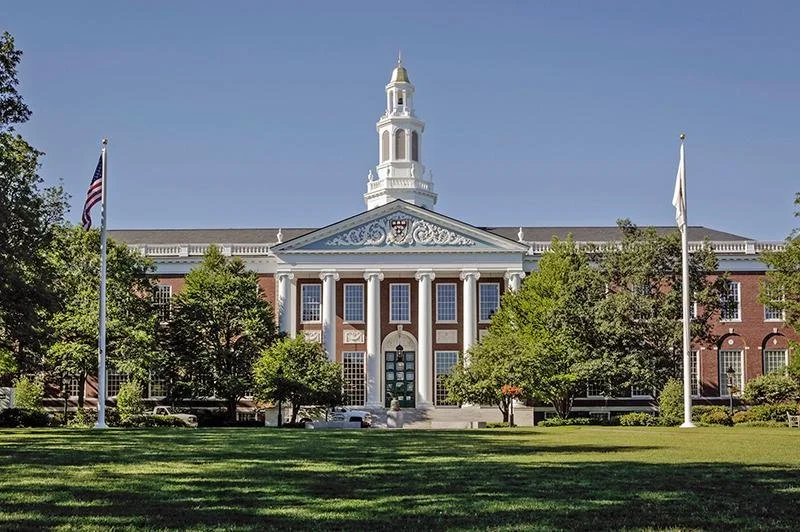
Harvard Business School, on its own leafy campus along the Charles River, directly across the water from Harvard's main campus in Cambridge. Two-year, full-time MBA. Class size roughly 930. The first year is fixed, taught entirely by the case method in a 90-student section; the second year is almost entirely elective. The case method is the school's defining pedagogy and the single biggest thing distinguishing HBS from its peers.
The Curriculum, and the Case Method
The case method shapes everything about the HBS experience, and any applicant weighing fit should understand what it actually involves. You prepare a written case (typically 15 to 30 pages) the night before, identify the central decision, and arrive ready to be cold-called and defend a position. Participation is structured, graded, and accounts for roughly half of most course grades. Across two years, you'll discuss close to 500 cases.
What this selects for in admissions: people who can think under pressure, take a position on limited information, change their mind in public, and add to a group's reasoning without steamrolling it. The section structure — the same 90 people in every first-year class together — means your contribution becomes legible to the whole group over weeks, and the texture of how you show up shapes how the section sees you. Applicants who freeze in cold-call settings, or who can't tolerate having their reasoning challenged in front of others, struggle here regardless of how strong they are on paper.
What it doesn't do: it doesn't build deep specialist expertise in one function, it doesn't teach quantitative modeling at the level of MIT Sloan or Booth, and it doesn't customize to your background. That's by design. First and foremost, HBS is a general management program — built to make you a broad, adaptable leader who can walk into any function and run it, not a specialist in one. Everyone takes the same first-year core. If you want the most flexible MBA in the M7, or deep technical depth in a single discipline, that isn't HBS.
The second year opens up substantially — a wide elective catalog, FIELD experiential courses and global immersions, and joint degrees with the Kennedy School, Harvard Medical School, Harvard Law, and other Harvard programs. The contrast between the lockstep first year and the open second year is itself part of the design: discipline first, autonomy second.
Culture and Community, Beyond the Marketing
The section is the central cultural fact at HBS. Your section — 90 people — becomes the community you spend most of your first year inside, and the community you'll define yourself against professionally for decades; HBS alumni still introduce themselves by section letter twenty years out. The culture is unusually peer-shaped because of it.
That produces something more structured and more communal than at smaller, less section-driven schools. Your section organizes social life, rallies around members through whatever happens during the program, and develops its own inside jokes and identity. The flip side: section assignment is essentially the luck of the draw, and section cultures vary. Most students end up loving theirs. The ones who don't have a harder first year than they would at a school with looser structure.
Beyond the section, the broader class operates as a professional layer, and the clubs are where it organizes itself. They're numerous, well-funded, and substantive, and which ones dominate tells you where the class's energy actually goes: the Women's Student Association (by its own count the largest student organization on campus), the Tech Club, the Entrepreneurship Club, the Venture Capital & Private Equity Club, the Management Consulting Club, and the Finance Club sit among the most active, with a large Health Care Club and fast-growing AI and FinTech clubs reflecting where student interest is heading. The industry and affinity clubs host conferences that draw real outside attention. The social scene is more present than at some peers, partly because the section makes it almost impossible to coast through socially.
The “I got in” Instagram photo: Baker Library, columns lit, shot from the HBS lawn — or from across the river, with the dome reflected in the Charles. For the insider version, the HBS sign at the back entrance. Either way, the feed knows exactly where you landed.
Life at HBS
Here's the part the website and the campus tour underplay: what it's actually like to spend two years here.
Start with geography, because it's the defining fact. HBS sits on its own campus in Allston, on the Boston side of the Charles River, physically separated from the rest of Harvard. It's a self-contained world — your classrooms (Aldrich), your student center and food court (Spangler, with its country-club lounge, fireplaces, and high vaulted ceilings), your gym (Shad), your dorms, and the world-famous Baker Library all within a short walk. The first thing most people notice is the sense of arrival. The campus reads like the movie-set version of what a prestigious business school is supposed to look like — red brick, white columns, manicured lawns, the dome of Baker reflected in the river. Walk it for the first time and the message is hard to miss: you've arrived, you're going places, and the legacy and tradition are something you can feel. The upside is real: you can roll out of bed and be in class in ten minutes, and everything you need is on one forty-acre campus. The honest downside is that the same self-containment makes the campus a bubble — it's entirely possible to go a week without crossing the river — and that bubble is part of what makes the section feel as all-encompassing as it does. As with a lot of HBS, the intensity and the insularity are the same fact.
Then there's the thing the rural top programs can't offer: a real city. Boston is right there. Cross the elegant Weeks Footbridge (or hop the free Harvard shuttle) and you're in Harvard Square in Cambridge, with its bookstores, bars, and the closest thing to an undergrad night out — from Charlie's Kitchen, the self-styled "Double Cheeseburger King," a 1951 dive that has been turning out its namesake burger, salt-and-pepper fries, and cheap beer in a back beer garden for generations of students, to the ever-popular Russell House Tavern, where students, faculty, and locals crowd into a polished but lively Harvard Square staple for burgers, oysters, craft cocktails, and one of the neighborhood's best people-watching perches. The Charles is your front yard for running and sculling, and for one weekend each October the Head of the Charles — the largest two-day regatta in the world — turns it into a spectacle: hundreds of racing shells in a riot of school colors stroking under the stone bridges, crowds banked along both shores, the whole city out along the water. Yes, the winters are genuine Boston winters — gray, cold, and long — but you're trading that for a metro of two million people, an airport twenty minutes away, and a recruiting market on your doorstep.
The "I got in" Instagram photo: Baker Library, columns lit, shot from the HBS lawn — or from across the river, with the dome reflected in the Charles. For the insider version, the HBS sign at the back entrance. Either way, the feed knows exactly where you landed.
The point underneath all of it: HBS gives you a small, intense, self-contained community and a major city to escape into when you need one — a combination most of its peers can only offer one half of. Whether the bubble feels like focus or confinement is worth knowing about yourself before you commit.
Research, Faculty, and Intellectual Identity
HBS faculty research concentrates in strategy, leadership, organizational behavior, finance, entrepreneurship, and increasingly technology and society. The case-writing engine is the school's most distinctive intellectual product: HBS faculty write the cases the rest of the world teaches from, and that production cycle keeps the curriculum unusually current.
Faculty are accessible for a school of this scale, and engagement with section life is part of the cultural fabric. What MBA applicants actually want from faculty isn't a marquee name to study under the way a science PhD applicant chooses an advisor — it's professors who teach well, are reachable, and remember who you are. At HBS that access is real, and it's strongest inside the section, where a first-year professor sees the same ninety students every day for a semester.
What you're also choosing, though, is a campus where some of the people who shaped how business itself is taught actually work. This is the home of Michael Porter, whose Five Forces framework for competitive strategy is taught in virtually every business school on earth — when you analyze an industry's structure in a first-year class, you're using the vocabulary he invented here. And the faculty's reach extends past strategy into how people actually live: Arthur Brooks, a professor of management practice who teaches a wildly popular course on leadership and happiness and writes The Atlantic's "How to Build a Life" column, has built much of his work around a deceptively simple idea — that we should love people and use things, because the modern instinct to do the reverse is what quietly makes us miserable. You may never sit in either professor's classroom, and that's not really the point. The point is that studying where this kind of thinking gets made is its own education, and it's part of what you're choosing when you choose HBS.
What HBS Essays Are Actually Testing
HBS overhauled its essays for the 2024–2025 cycle and streamlined them again for 2025–2026. The current set is three short essays — 300, 250, and 250 words — plus a 500-character career-goals short answer (about 85–90 words). The shift from the old single open-ended prompt isn't cosmetic. HBS is asking for specific evidence of specific traits, and the tight word counts force discipline. There's no room to circle the point. And don't mistake short for easy: a 250-word essay gives you nowhere to hide, so every word has to carry weight that a longer essay could afford to spread out. (These reflect the most recent confirmed cycle; confirm current prompts on the HBS site before drafting.)
Career Goals short answer (500 characters)
A compressed statement of where you're headed. Treat it as the spine the Business-Minded essay then explains — not a throwaway field.
Business-Minded Essay (300 words)
"Please reflect on how your choices have influenced your career path and aspirations."
This maps to the business-minded criterion. It's asking why your trajectory looks the way it does and what it points toward. Where this one tends to go wrong is a résumé in paragraph form. The strongest versions show the decision-making logic behind the moves, not just the moves.
Leadership-Focused Essay (250 words)
"What experiences have shaped how you invest in others and how you lead?"
This maps to the leadership criterion, and the phrasing matters: HBS isn't asking for your leadership accomplishments. It's asking how you invest in others — a different question. The strongest versions land on concrete moments where your leadership was about someone else's growth or success, not your own highlight reel.
Growth-Oriented Essay (250 words)
"Curiosity can be seen in many ways. Please share an example of how you have demonstrated curiosity and how that has influenced your growth."
This maps to the growth criterion. It's tempting to read "curiosity" as a synonym for "interest" and write about a hobby; the stronger move shows curiosity producing real growth — a question that led you to act, learn something hard, or change your mind in a way that mattered.
A note worth sitting with, because applicants can get this one wrong in a particular direction. People assume that because it's HBS, the essay has to be buttoned-up — a polished story about a stretch assignment or a consulting project. But what the readers are after is a genuine sense of who you are, and the corporate-sounding answer often reveals the least. Some of the strongest growth and curiosity essays aren't about work at all. A small, true, personal moment — handled with real reflection — frequently does more than an impressive professional one, because it shows what actually shaped you, what drives you, and how you think. Don't reach for the safe, important-sounding example over the honest one. The honest one usually does more.
Note that HBS has no traditional "Why HBS?" essay. The connection to HBS is implicit: career aspirations in the Business-Minded essay should be calibrated to what HBS actually develops, and the kind of leader you're becoming should align with what the case method builds. The fit signal is read even though it's never asked for directly.
The deeper job each essay does is help the reader make an informed decision — to understand who you are beyond your MBA résumé, your grades, and your scores. The committee reads thousands of these; three short essays let them triangulate quickly across the three criteria. So treat each one as evidence for the criterion it maps to, in language a reader could carry into a committee room. I can't be in the room when your file is read, and I have no say in the decision. What I can do is make sure each essay is actually doing its job — clear, specific, and grounded in real evidence — so the reader comes away with an accurate picture of you. That's what makes an essay effective. Trying to be impressive across all three at once works against it.
Recommendations
HBS requires two recommendations. The prompts ask recommenders to compare you to a relevant peer group, describe how you give and receive feedback, and name your most important developmental need.
The first thing to get right is who you ask, and here applicants tend to chase the wrong thing. Seniority is not the point. A C-suite name who barely knows you writes a thinner letter than a direct manager who has watched you work for two years. What HBS wants is a clear picture of you from someone else's vantage point — how you actually show up, told by a person with the specifics to back it up.
It helps to think about the pedagogy when you choose. HBS runs on the case method, so the most useful recommenders can speak to the behaviors that translate into a case classroom. The strongest letters give the reader proof points they can almost picture in a section: this person makes sure everyone gets heard rather than dominating the discussion; this person takes a conversation and elevates it; this person can challenge a point of view respectfully and add grey to what had been a black-and-white debate. A recommender who can describe that kind of contribution is doing far more for you than one offering warm but generic praise.
The prompts are unusually direct, and the strongest letters answer them directly — including the developmental question. An honest read on where you still have room to grow reads as credible; uniform praise with no growth area reads as less so. Recommenders sometimes hesitate there, worried it will hurt you. It does the opposite.
The Interview and Post-Interview Reflection
HBS's MBA interview process is structurally different from any peer school, and worth understanding before you're invited.
The interview is conducted by an HBS admissions board member — not by alumni, as at Stanford and most peers — runs about 30 minutes, and is sharp. The interviewer has read your full file closely, and the questions are specific to it. Applicants who show up braced for generic behavioral questions are often surprised by how much the conversation drills into the actual contents of their résumé and essays. The interviewer is testing whether the person in the room matches the person on the page.
Here's the number that should shape how you treat it. Roughly 20% of applicants are invited to interview, and of those, about half are admitted — close to a coin toss. So the invitation is a real accomplishment, but it isn't a formality on the way in. Half the people sitting where you'll be sitting don't get the offer. The interview is where you have to convince them you belong in the half that does, which means it deserves real preparation, not the assumption that the hard part is already behind you.
The post-interview reflection is unique to HBS and consequential. Within 24 hours, you submit a written reflection — no formal word limit, though most successful ones run 400 to 800 words. The functional prompt is something like "What else would you like us to know?"
It is not a thank-you note. It's an application component the board reads, weighs, and uses. The strongest reflections add something material the interview didn't surface — a story, a perspective, a piece of context that genuinely changes the picture. The weakest recap the interview or thank the interviewer. The difference shows up in admit rates. What I tell clients: write it like you wrote your essays — with care and concrete evidence — even though you're doing it in a day. The applicants who treat it as a low-stakes follow-up give away real ground.
Application Logistics
Tests: GMAT, GMAT Focus, or GRE accepted, with no preference. If you submit only the GMAT Focus (which has no writing section), HBS requires the separate GMAC Business Writing Assessment at the interview stage.
Application fee: $250 ($100 for current college students applying through 2+2).
Video component: None required.
Transcripts: Self-reported at application; official copies required upon admission.
Deadlines and Round Strategy
HBS runs two rounds for the full-time MBA, where most peers run three. The April deadline competitors use as Round 3 is, at HBS, reserved for the 2+2 deferred-enrollment program.
The most recent confirmed cycle (2026–2027, Class of 2029):
Round 1: September 9, 2026 — decision December 10, 2026
Round 2: January 5, 2027 — decision March 25, 2027
HBS 2+2: April 22, 2026 — decision June 25, 2026 (Dates for the 2026-2027 cycle not yet released)
HBS typically opens the next cycle's application over the summer, with deadlines in early September and early January; confirm current dates on the HBS site before you plan.
On round strategy
With only two rounds, the R1-versus-R2 decision carries more weight than at three-round schools. R1 is the larger round, and HBS fills a substantial share of the class through it. R2 stays meaningfully competitive, but the pool is more concentrated and the school is reading against a class already taking shape.
What I tell clients deliberating between rounds
If your application is genuinely ready in early September, R1 is the call. If the choice is between rushing R1 with a half-formed essay set and submitting a strong R2, take R2 — the cost of a tighter pool is smaller than the cost of submitting before your essays show what they need to. R2 is actively preferable for applicants whose strongest leadership evidence comes from a project landing in the fall, those waiting on a promotion or a test retake, and those whose trajectory shifts in autumn in a way the application should reflect. Outside those cases, R1 carries a real but modest edge.
Employment Outcomes, Read for What They Signal
For the Class of 2025 (929 graduates): 65% sought traditional employment, and of those, 90% had an offer within three months of graduation (closer to 94% by mid-November) and 84% accepted. The other 35% didn't seek a traditional job — a record share — and within that group, 17% launched their own companies (the highest in HBS history, up from 13% two years earlier) and 14% were company-sponsored or returning to an employer.
Median base salary rose to $184,500. Fifty-eight percent reported a signing bonus (median $30,000) and 67% a performance bonus (median ~$46,100), pushing total median compensation to about $232,800. And for the first time in recent memory, technology was the top hiring industry at 22% of those who took jobs, narrowly ahead of consulting (21%), with private equity at 14%.
What the data signals: HBS's center of gravity still sits at the intersection of consulting, finance, and corporate leadership, with the densest network in the Northeast — but the tech share has climbed to the top of the table and the entrepreneurship rate is at a record. If your goals sit inside that territory, the HBS network is unmatched. If your goal is specifically Bay Area founder-and-VC density or a niche outside the school's recruiting gravity, HBS will support you — Stanford still carries the higher founder density — but you'll be using the network differently from the median graduate. Worth knowing going in.
Cost and Financial Aid
Annual tuition (2025–2026): $78,700
Mandatory fees: approximately $8,900
Estimated total cost of attendance: approximately $126,500 per year for a single student (HBS lists $126,536 for 2025–2026)
Aid approach: Need-based. HBS does not offer merit scholarships.
Aid reach: About 50% of students receive need-based scholarships, averaging roughly $100,000 over two years; about 10% receive full-tuition scholarships based on need.
HBS's aid model is consistent with its admissions posture: the school doesn't buy stats with merit money. Admission is need-blind, and aid is set by a standardized formula weighing income, assets, undergraduate debt, and family circumstances. Middle-income scholarships were expanded to widen access for applicants from middle-class backgrounds who don't qualify for full need-based aid but for whom the sticker price is genuinely prohibitive.
Rankings, in Context
HBS typically ranks in the top three to five across US News, the Financial Times, Bloomberg, and Poets & Quants, with little year-to-year variance. HBS, Stanford, and Wharton trade positions at the top of most U.S. rankings, and the gaps in any given year are largely meaningless for applicants. The schools worth comparing HBS against are Stanford and Wharton — not the ones below them.
How HBS Differs From Stanford GSB
This is the most-searched comparison in MBA admissions, and the one most often misframed. The two schools are roughly matched on selectivity, outcomes, and starting pay. The differences that matter sit a layer below that.
Pedagogy
HBS is built on the case method: ~500 cases over two years in a section of 90, with cold-calls and participation that counts substantially toward your grade. It develops decision-making under uncertainty, in groups, at scale. Stanford GSB uses cases too, but its signature pedagogy is experiential and small-group — Interpersonal Dynamics ("Touchy Feely"), Startup Garage, the global requirement, the customizable core — and it develops self-knowledge and originality before management instinct. This is the same contrast as the growth point earlier: HBS is wingtips; Stanford is the introspective coast.
Class size and texture
HBS enrolls roughly 930; Stanford roughly 430. At HBS your section of 90 is your central community, with the broader class as a professional layer above it. At Stanford the whole class is effectively the section. Both are real communities — they just feel different, and the physical spaces tell you how. Baker Library has the atmosphere of a historic academic club: dark wood, leather chairs, old-world gravitas. That's the larger HBS feeling — a big, established institution with deep tradition that you join for life. Stanford feels more like a startup: smaller, more open, contemporary, and unmistakably Californian — the kind of place whose whole culture seems to broadcast that anything is buildable. Neither is better. They pull different people.
Essay style
HBS's three short essays reward strategic, operational framing and concrete evidence of leadership across three named criteria. Stanford's "What matters most to you, and why?" rewards reflective writing about who you are. Both are uncomfortable in different ways, and don't assume HBS's are the easier assignment because they're shorter — the brevity is its own difficulty, since every word has to count and there's no room to build up to a point. I tell clients deciding between the two to draft a rough version of each and notice which one came out feeling more like them. The answer is usually clear within a draft or two.
Recruiting and geography
HBS is densest in the Northeast and across traditional power industries; Stanford is densest in the Bay Area and across tech, VC, and the founder track. Either school will place you anywhere, but the network has gravity, and gravity matters. Choosing HBS to break into Bay Area tech is choosing the harder version of that path, and vice versa. And there's the matter no one puts in a brochure: weather. Palo Alto's year-round sunshine is genuinely hard to beat against a long New England winter — though if that gives you pause, take some comfort that HBS connects its residence halls to its academic buildings through a tunnel system, so on the coldest, grayest days you can get from your dorm to class without ever stepping outside.
The cross-admit decision
Every year a meaningful slice of applicants get into both. Those who pick HBS tend to value the larger network and the structured pedagogy; those who pick Stanford tend to value the customization and the proximity to founders and capital. Neither is correct — they optimize for different things. The wrong move is to let prestige make the call, since the prestige gap between the two is functionally zero.
The 2+2 Program
HBS 2+2 is the school's deferred-enrollment pathway, for college seniors and final-year graduate students who know they want an MBA but are a few years from matriculating. You apply in your final year of school, defer for at least two years (typically up to four) while you work, then enroll. It's a separate application from the regular MBA, and worth understanding even if you're not a senior, because it shapes who's in the regular pool later.
Eligibility for the most recent 2+2 cycle: graduating between October 1, 2025 and September 30, 2026, with an April 22, 2026 deadline and a June 25, 2026 decision. The essays parallel the regular application's leadership and curiosity prompts, plus a question about how your career plans fit your longer-term vision and what you hope to gain in the deferral period — tuned for younger applicants who can't yet point to professional leadership at scale. The leadership essay carries even more weight here, because the work-experience signal is necessarily lighter.
Who 2+2 is for
Undergraduates and master's candidates who already know they want an MBA, have shown leadership in school or early roles, and want HBS's commitment now. Who it isn't for: candidates hoping to figure out what they want after they start working. The application requires the same clarity about direction the regular one does; applying as a hedge against future uncertainty isn't the right reason. If you're a senior who can't yet articulate what you want or why an MBA would help, the stronger move is to work and apply later, when the picture is clearer.
Signals You Might Be a Strong Fit
MBA School Fit is hard to feel from the outside, so here are concrete, checkable signals. If two or three of these sound like you, you're probably reading HBS correctly.
You can point to two or three times you took ownership beyond your formal role — and drove an outcome other people depended on. Not a title you held; a thing you made happen that wasn't your job.
The case classroom sounds energizing, not terrifying. The idea of being cold-called to defend a position in front of ninety peers — and changing your mind out loud when someone's right — reads as how you already like to think.
Your career choices tell a story you can explain. You can connect the dots from past to future in a sentence or two, which is exactly what the Business-Minded essay and the 500-character goals field demand.
You invest in other people's growth, visibly. You can name specific people you've developed, mentored, or pulled up — because the Leadership-Focused essay is about precisely that.
You want a big, structured, brand-name network and a real city around your campus. If the section system and a campus on the Charles with Boston and Harvard Square at hand sound like the point rather than the price — and if the idea of walking into a Harvard Club in New York or Boston years from now and instantly belonging appeals to you — that's a signal.
Signals You Might Not Be the Best Match
The honest counterpart to the section above. None of this means you wouldn't be a strong applicant somewhere, or that you shouldn't apply here — that's your decision. It means the specific match with HBS is worth examining before you spend a cycle on the application.
HBS may not be the best match if your leadership story is more potential than pattern. If the application reads as someone who could lead rather than someone who already has, HBS's filter tends to catch that. Several excellent programs read potential more generously; if that's where you are, either build the track record before applying or weight your list toward schools that develop leadership rather than requiring it on arrival.
It's a harder fit if you want a customizable MBA. The first year is fixed, the section is assigned, the pedagogy is the case method, and the daily rhythm is non-negotiable. If tailoring your first year to your prior experience matters to you, Booth and Stanford offer the flexibility HBS doesn't — worth a serious look.
And it's worth questioning whether the pedagogy suits you if cold-calls and the public defense of half-formed thinking are a genuine no for you. The case method works for introverts every year, but it asks for real investment in getting comfortable with section dynamics. If being called on mid-discussion to defend an unfinished position sounds like something you'd dread for two years rather than grow into, a program whose pedagogy matches how you learn will serve you better.
If two or three of these land, treat it as a prompt, not a verdict. The most useful next step is usually to widen your list and ask honestly whether the programs that fit you better are ones you're equally excited about.
When Working With Someone Helps, and When It Doesn't
HBS's essays look simple. They aren't. Each of the three has a specific job, and most strong-looking drafts I see early are doing two of the three well at most. Getting all three to land what they're each asking takes pattern recognition that's hard to build in isolation. The post-interview reflection is another place applicants under-invest, and an outside reader can tell you fast whether yours is doing real work or just thanking the interviewer.
That said: no consultant can hand you a habit of leadership. If the pattern isn't already in your background, no amount of essay craft creates it. The work is yours; the help is in pattern recognition and in pressure-testing what you've written against what HBS actually reads.
If you'd like to talk through whether your application is at the stage where outside input would help, a free consultation is a low-pressure way to find out. We'll talk about where you are, what HBS is likely to weigh in your case, and what matters most before you draft.