MIT Sloan: What This School Is Looking For
MIT has been a technology powerhouse since long before tech was fashionable, and Sloan is the business school built inside that engine. So what is it looking for? Above all, proof — evidence of what you've actually built and analyzed, and that you're a doer, not just a thinker. Sloan is a tech-first, quant-heavy school, and its motto tells you how it works: mens et manus, "mind and hand." You learn management by doing it, and Sloan reads applications the same way. Show what you've done, and what you'd build with the tools an MBA gives you.
The application reflects that. Instead of a traditional "career goals" essay, Sloan asks for a 300-word cover letter, a one-minute video, an organizational chart of where you sit at work, and one short essay about where you come from. Every piece is built to surface the same two things: evidence, and doers. The question worth asking before you start isn't "can I get in?" — it's whether that's how you actually work.
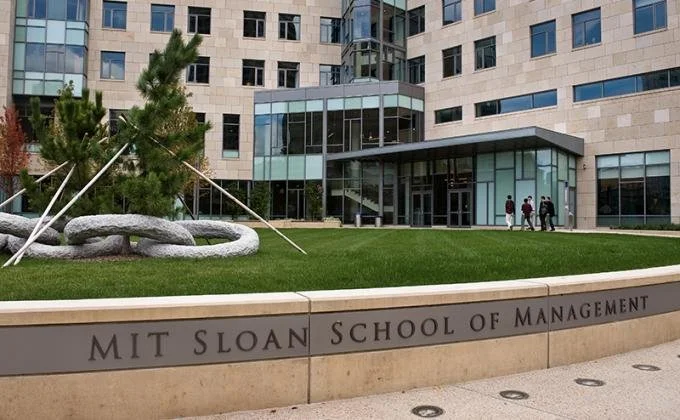
MIT Sloan
So what is Sloan looking for? Above all, proof — evidence of what you've actually built and analyzed, and that you're a doer, not just a thinker. Sloan wants people who think rigorously and then go make something.
What MIT Sloan Is Actually Trying to Build
It's the question thousands of applicants turn over every year, usually meaning some version of "what do I need to look like to get in." The more useful version turns it back on the school: what is Sloan actually trying to assemble, and what does that mean for the file in front of the reader?
Start with the mission: to develop principled, innovative leaders who improve the world, and to generate ideas that advance management practice. What stands out is how specific it is about what Sloan wants, and the throughline is action — putting ideas to work in the real world, the way technology puts science to work.
Three things follow, and they're the lens for the rest of this page.
The rigor is real, and it's technological. Sloan is MIT's business school, so the quant runs deep — and it's rooted in technology, not just finance. This is where some of the first work on artificial intelligence happened, in the 1950s, and those labs are still right next door. That proximity is why Sloan is ahead of most schools in teaching managers to actually use AI, not just talk about it. You don't need an engineering degree. You do need to show you can handle serious analytical work, and that you enjoy it.
Action over theory. The signature of a Sloan education is Action Learning: more than fifteen lab courses that drop student teams into real companies to solve real problems. Sloan is looking for doers, and it reads applications for exactly that. A claim about your leadership counts for less than a moment when you turned an idea into something real.
People who build together. Action Learning is team-based, so Sloan isn't hunting for lone geniuses; it wants people who make a team better. That's the heart of the "it's not about you" idea: your application's job isn't to prove you're impressive on your own, it's to show what you'd add to the group. In a class of around 450, that's what the school is really assembling.

Who Genuinely Belongs Here
Here's the simple version: Sloan is a serious numbers school. Before anything else, you have to make clear you can handle the quant — that part isn't negotiable, and it's why, with Sloan specifically, the first thing I check with a client is whether their credentials are strong enough to prove it. The good news is that once that's settled, the rest of the picture is what really decides things — and it's the more interesting part. And if you want a front-row seat to how technology is remaking business, there's no better place to be. Two qualities matter most.
They want "true doers." That's Sloan's own phrase, and it's easy to grasp: people who turn an idea into something that exists in the world because they pushed it there. The strongest applications show a pattern of it — you built a product, started a program, fixed a broken process. Not grand scale, just real evidence that you act on ideas instead of only having them. It's the instinct Action Learning rewards, and the kind of business builder a small, hands-on class is assembled around.
They want genuine analytical confidence — not just a test score. The applicant who fits Sloan is energized, not intimidated, by a hard quantitative problem, and can show it: a quant-heavy role, a technical project, coursework that demanded real rigor, a habit of reaching for data to settle a question. The school says plainly that it wants to know you're ready for a demanding, quantitative curriculum. If numbers are something you'd rather avoid, this is a program you'd be pushing against from day one — and that's worth being honest with yourself about.
Put the two together and the picture is clear: Sloan wants people who think rigorously and then go make something — and who want to do it next to others wired the same way.
The Class Profile, Read Honestly
The most recent confirmed class — the Class of 2027, entering Fall 2025. These figures include the LGO dual-degree students Sloan reports alongside the MBA:
Where They Worked Before
Bars show share of the entering class.
What They Studied
Other majors include social sciences and humanities. Bars show share of the entering class.
A few things that are easy to misread in these numbers:
The acceptance rate
At around 19%, Sloan's admit rate is meaningfully higher than the very top of the M7 (HBS near 10%, Stanford near 6%), and for a candidate who genuinely fits the analytical-builder profile, that gap is real and useful — the odds here are better than the M7 label alone suggests. But a higher rate is not lower selectivity. Sloan's applicant pool is smaller and more self-selected than its peers': the people who apply tend to already want the quant-forward, hands-on version of business school, and the candidates who'd be uncomfortable with it mostly don't apply. The rate also ticked up this year partly because applications fell about 8.5%. So the number is genuinely encouraging for fit-matched candidates, and the analytical bar is still real. Both are true at once.
Engineering isn't required
It's the most common major (27%), which makes people assume Sloan wants engineers. It doesn't. Right behind it come business (23%) and economics (17%), with social sciences and humanities in the mix too. What Sloan is really after is a way of thinking — structured, quantitative, problem-solving — and you can bring that from any major. The mindset matters more than the diploma.
The test scores describe the pool, and the narrow band is itself a signal
A 720 median (10th edition) sits below the very top M7 medians, but look at how tight the middle 80% is — 710 to 760. That compression tells you something other top schools' wider bands don't: Sloan is less inclined to compromise at the low end of the range. The score isn't a hard cutoff, and people well below the median are admitted every year — but at Sloan, more than at some peers, a lower number has to be answered. If your GMAT or GRE score sits toward the bottom of that band, you'll need to prove the quantitative ability another way (a quant-heavy transcript, a technical role, real analytical work) and the rest of the file has to be genuinely compelling. One planning point that differs from many peers: Sloan requires a GMAT or GRE. There's no test-optional path and no waiver. If testing isn't your strength, that's a real constraint here in a way it isn't at schools that have gone test-optional.
Consulting, not tech, is the largest feeder — and destination
Thirty-five percent of the class came from consulting, well ahead of finance and tech. That surprises applicants who assume an MIT business school must be wall-to-wall engineers headed back into technology. It isn't. Sloan is analytically intense across industries, and the consulting concentration on both ends — who comes in and where they go — is the clearest evidence that the school's center of gravity is rigorous general problem-solving, not any one sector.
So don't read the profile as a checklist to match. Read it as a picture of how Sloan thinks — and show them you think that way too.
Common Myths About MIT Sloan
"MIT Sloan is only for engineers and techies."
Surprisingly, no. Engineering is the largest undergraduate background (27%), but most of the class studied something else, and consulting — not tech — is the top industry students come from. What Sloan needs is proof you can do rigorous analytical work, and that comes from any major. The mix is the whole point: HubSpot was founded by two people who met at Sloan — Dharmesh Shah, the technical engineer, and Brian Halligan, the business-and-marketing mind who later coined "inbound marketing" (and now teaches at Sloan). One technical, one not; the company needed both. That's Sloan in miniature.
"MIT Sloan is mostly for tech jobs."
Not really. Tech is a major destination, but consulting places more graduates, and Sloan sends people into finance, healthcare, biotech, energy, and beyond. The honest read is that Sloan is analytical across industries — and notably strong in product management, where its tech-plus-business blend pays off most.
"If your score isn't a 730, don't bother."
Not true — the median is 720, and Sloan reads your score next to your transcript and your track record, not as a wall. The honest, Sloan-specific caveat: the score range is tight, so a lower number draws more attention here than at some schools. You can still get in with one — but you'll need to prove the quant another way, and the rest of the application has to be strong. The number is something to answer, not something to wave away.
"Your classmates will be brilliant at math and hopeless with people."
This is the stickiest myth about MIT, and it's simply false — of the engineering school and of Sloan. The students are remarkably well-rounded; it turns out you can have serious quantitative horsepower and still be the person everyone wants on their team. The caricature tends to fall apart the moment someone visits and sits in on a class or a club. If it's quietly shaping your picture of the place, come see for yourself — most people leave surprised by how human it feels.
Identity and Program Basics
MIT Sloan School of Management, in Kendall Square, Cambridge, Massachusetts — on the Charles River, directly across from Boston, in what's often called the most innovation-dense square mile in the world. Two-year, full-time MBA; the degree is simply the "MBA." Class size around 450, mid-sized among the M7 (HBS enrolls roughly 930, Wharton roughly 870, Stanford roughly 430).
The school carries the name of Alfred P. Sloan, the legendary General Motors chief — and, fittingly, an MIT-trained electrical engineer. The tech-to-business thread runs right through the namesake: Sloan was the engineer who gave GM its market-segmentation strategy, the "ladder" of brands from Chevrolet up to Cadillac built on his principle of "a car for every purse and purpose." An engineer's mind applied to a business problem; the school has been producing that combination ever since.
Sloan's a member of the M7, and its MBA is STEM-designated, which lets international graduates extend their U.S. work authorization by up to 24 months — a genuinely consequential detail given that 42% of the class is international. Beyond the full-time MBA, Sloan runs a deep bench of programs that share the same DNA: the LGO (Leaders for Global Operations) dual degree with the MIT School of Engineering, the well-regarded Master of Finance and Master of Business Analytics, an Executive MBA, the Sloan Fellows MBA, and an MBA Early deferred-admission path for college seniors and graduate students — several of which are covered below.
The Curriculum, and What It Reveals
Sloan's curriculum is light on requirements and heavy on doing. A focused first semester covers the analytical core — economics, data and models, communication, organizational processes, accounting — and after that it's mostly electives, which you can organize into a track (Finance, Entrepreneurship & Innovation, or Enterprise Management) or a certificate (Sustainability, Healthcare, or Business Analytics). There are no required majors. Sloan hands you the tools and expects you to build the rest yourself.
The centerpiece is Action Learning: more than fifteen lab courses that send student teams into real companies to solve real problems. G-Lab places teams with startups around the world; other labs focus on analytics, entrepreneurship, or regions like India and China. You don't write a paper about a company's problem — you go fix it, on a deadline, with a team, and you're graded on what you actually delivered. For someone who learns by doing, that's the whole appeal. For someone who'd rather absorb frameworks in a lecture hall, it's worth noticing now.
Two MIT touches round it out: the Independent Activities Period in January, when students can dive into anything from a technical course to a startup sprint, and the Sloan Innovation Period, a built-in week of hands-on learning that's a graduation requirement.
The flexibility reaches across the river, too. Sloan students can take a few electives at other MIT departments or at Harvard — so a quant-focused Sloanie who wants a taste of the Harvard Business School case method can go do it for a course or two. The analytical core stays Sloan's; sampling another style is just a benefit of the location.
What does all this reveal? Sloan assumes you arrive ready to build and to steer your own path. It gives you a rigorous foundation and then a big, hands-on menu. The students who thrive know roughly what they want to make and use the labs and electives to make it.
Culture and Community, Beyond the Marketing
Sloan's stated culture is collaborative, hands-on, and mission-driven, and the reality mostly matches — with the texture you'd expect from a school inside MIT. The dominant note isn't competition; it's a shared, slightly nerdy enthusiasm for hard problems. Students describe a community that's intellectually intense without being cutthroat, where the instinct in a study group is to build the model together rather than to guard the answer.
The clearest expression of the culture is the entrepreneurship ecosystem, which is genuinely woven through the place rather than bolted on. The Martin Trust Center for MIT Entrepreneurship is open to students around the clock, with a makerspace, free coffee and ramen, and a working philosophy it calls being an "honest broker" — the center takes no equity in the companies it helps, because its only stake is the student's success. From there the ladder runs through the t=0 entrepreneurship festival that opens the year, the MIT $100K competition, the MIT Sandbox innovation fund, and the delta v summer accelerator. There's a useful way to hold this against the West Coast: Stanford GSB tends to be the reflexive answer for entrepreneurship, but MIT produces founders at serious scale, and it does it on the East Coast, within reach of Boston's and New York's capital and talent. If you want to build but want to do it in the Northeast rather than the Bay Area, this is the program that's purpose-built for it. You do not have to want to found a company to fit at Sloan. But the builder's mindset that this ecosystem runs on is the same one the school reads for in applications, and the applicant who lights up at it is reading the culture correctly.
For fit research, the student-run conferences and clubs are the most honest signal of where the community's energy goes — the analytics, fintech, sustainability, healthcare, and entrepreneurship groups are especially active, and the labs themselves create tight, project-forged subgroups inside the larger class. What you'll notice, scanning it all, is how much of campus life is organized around making something rather than just discussing it.
The “I got in” Instagram photo: the Great Dome above Killian Court with the Charles in the foreground, or the skyline shot looking back across the river toward Boston from the MIT side. Either one tells your feed exactly where you landed — and reads as MIT, not generic-business-school, which is the point.
Life at MIT Sloan
Let's talk about what it's actually like to live here for two years — including the parts the brochure skips. Those iconic shots of sailboats on the Charles with the Boston skyline behind them? Real, and glorious in spring and fall. The same river also sends a frigid wind across campus in February that finds every gap in your parka.
Start with the honest part. This is New England, and winter is long, gray, and genuinely cold — January and February test your commitment to the bit. If your image of business school is year-round patio weather, adjust it now. The flip side is real seasons: a spectacular fall along the river, and a Cambridge spring that the whole city seems to exhale into.
Now the part that's hard to oversell, because it happens to be true. Sloan sits in Kendall Square, which over the last two decades has become possibly the densest concentration of technology and biotech on earth — the kind of place where the startup in the next building might be the one your classmate joins or the one your lab works with. You can walk out of class and into the actual ecosystem you came to study. The campus runs along the Charles, with MIT's iconic Great Dome and the green sweep of Killian Court on the river side, and Boston's skyline directly across the water. Cross one of the bridges and you're in Back Bay; the Red Line gets you to downtown Boston, Harvard Square, and the rest of the city without a car, which is a real quality-of-life difference from more suburban programs.
The food rewards exploration. Kendall Square has gone from lunch desert to genuine destination, and Cambridge institutions like Toscanini's ice cream are a short walk or train ride away. Cross into Boston's North End for the Italian you'll know about by week two — grab a cannoli at Mike's Pastry — and Chinatown, the Seaport, and Cambridge's own Central and Harvard Squares fill in the rest. When you want out of the city, the same commuter rail carries you up the North Shore: Singing Beach in Manchester-by-the-Sea, named for sand that genuinely squeaks underfoot, and Rockport, whose little red fishing shack — "Motif No. 1" — is often called the most-painted building in America. In winter, the skiing runs north into New Hampshire and Vermont, where a town like Stowe looks straight out of a Norman Rockwell painting.
And don't miss the bridge itself. The Harvard (Mass Ave) Bridge that connects Cambridge to Boston is marked off, end to end, in "Smoots" — a unit equal to the height of one Oliver Smoot, an MIT fraternity pledge laid down repeatedly across the span in 1958 to measure it (364.4 Smoots, "plus or minus one ear"). The marks are repainted every year, and Cambridge police have used them to locate accidents. It is the single most MIT thing about the walk to Boston, and more on what it signals below.
And if you follow sports, you've landed in a serious sports town. Across the river, the CITGO sign glows over Fenway Park and the Red Sox; the Garden, home to the Celtics and Bruins, sits just over the bridge; the whole city takes its teams personally. There's a Sloan angle here that's pure MIT: the school is, more or less, where sports analytics was invented. The MIT Sloan Sports Analytics Conference — co-founded by Daryl Morey (Sloan MBA '00), now president of basketball operations for the Philadelphia 76ers — grew out of a class into the field's defining annual gathering, sometimes called the Davos of sports. Bringing rigorous analysis to something as human and fun as a faceoff or a fourth-down call is about as good a snapshot of the Sloan mind as you'll find.
The "I got in" Instagram photo: the Great Dome above Killian Court with the Charles in the foreground, or the skyline shot looking back across the river toward Boston from the MIT side. Either one tells your feed exactly where you landed — and reads as MIT, not generic-business-school, which is the point.
Here's the thing to understand about the setting: the location is part of the curriculum. The reason Action Learning and the entrepreneurship ecosystem work is that the companies, labs, and founders are right there, a walk away across a square that's been called the most innovative on the planet. New England winters are real. And long. So is the proximity to the thing itself. For the right applicant, that trade is not close.
Research, Faculty, and Intellectual Identity
Sloan's intellectual identity is anchored in a few distinctive traditions: the economics and strategy of technology, the digital economy and analytics, finance, and system dynamics — the study of how complex systems behave over time, a field that originated at Sloan — all reinforced by the broader MIT research apparatus that surrounds the school.
Part of what defines a school's intellectual gravity is the presence of thinkers whose work shapes the wider conversation. Two examples capture the range. The first is the cleanest illustration of the tech-meets-finance point you could ask for: the Black-Scholes-Merton model — the formula that priced modern options markets and won the 1997 Nobel — was born at MIT, and its central equation is mathematically the very same one physicists use to describe how heat diffuses through a material. Finance, solved with the math of thermodynamics. Robert C. Merton, who shared that Nobel, is still on the Sloan finance faculty. The second is Simon Johnson — the Ronald A. Kurtz Professor of Entrepreneurship, a co-recipient of the 2024 Nobel Prize in Economics for work on how institutions shape national prosperity, and a co-founder of the G-Lab Action Learning course — whose current work on the future of work and "pro-worker" AI sits squarely in the questions the moment is asking. The school's dean since 2025, Richard Locke, is himself a scholar of labor standards and political economy who co-built G-Lab with Johnson — a small detail that says something about how central the hands-on, real-world ethos is to the institution's leadership, not just its brochures. And the system-dynamics tradition that originated at Sloan is still a signature lens, carried forward by faculty like Nelson Repenning, who directs the MIT Leadership Center.
That said, the practical point for an MBA applicant is the one worth keeping in view: what you actually want from faculty isn't a marquee name to study under, it's professors who are reachable, teach well, and remember who you are. At Sloan's scale that access is real. The Nobel laureate down the hall is part of the intellectual atmosphere you're choosing; the teaching faculty you'll work with week to week — and the MIT brand on the diploma — are what you're really buying.
What MIT Sloan Essays Are Actually Testing
Sloan's application looks unlike the others, and understanding why each piece exists is most of the battle. There's no traditional career-goals essay. Instead, the school assembles a portrait from a few unusual components — a cover letter, two videos, an organizational chart, one short reflective essay — each pointed at the same thing: evidence. (The application components are unchanged for the 2026–2027 cycle; confirm current requirements on the Sloan site before drafting.)
The cover letter (300 words, to the Admissions Committee)
Sloan asks for a real business cover letter "seeking a place" in the class, with one or more concrete professional examples that show you meet its stated criteria — thoughtful leaders with strong analytical ability and the drive to make a mark, independent and "fearlessly creative" people who redefine solutions to conventional problems. Why a cover letter and not an essay? Because Sloan wants to see you make a tight, evidence-backed case under a strict word limit — the same discipline an Action Learning project demands. The version that falls flat skims the surface and asserts strengths instead of showing them. The strongest approach is almost mechanical: take the prompt apart, identify each quality it names, and back every one with something specific you actually did. Prove, with evidence, that you're the rigorous, creative problem-solver this school is built around.
The two videos
The first is a 60-second introduction to your future classmates — one take, no editing. It's simply a chance to be a person, not a résumé: what you care about, what you'd bring to a section beyond your work. There's a real reason it matters. For all the talk of quant and AI, business is still about people — and a school built on teamwork has to know you can connect, communicate, and carry yourself with others. The second video is a response to a randomly generated question, with about ten seconds to prepare. It's not testing polish; it's a small simulation of being called on in class and having to think on your feet. Composure and authenticity are the point.
"The World That Shaped You" (250 words)
Once optional, now a required short answer: how the world you come from shaped who you are. Read it as the school's way of getting at the breadth of perspective you'd bring — the formative environment, experience, or vantage point that's yours and no one else's. That matters because a Sloan class is assembled, very deliberately, from a wide range of backgrounds so that members learn as much from each other as from the faculty; the more distinct the perspective you bring, the more you add to that exchange. So this isn't a personal-history exercise for its own sake. The strongest responses draw a clear line from where you come from to what you'd contribute to the cohort — connecting your background to the value you'd add, which is the through-line of the whole application.
The organizational chart
A one-page chart showing where you sit at work — your manager, your reports if any, your key cross-functional relationships. It exists to give the reader fast, verifiable context on your actual scope and influence, stripped of résumé inflation. Keep it honest and legible; it's a fact-check and a context-setter, not a place to inflate a title.
Notice the pattern: cover letter, videos, short essay, org chart, résumé. Together they make it hard to get through on polish alone, because each one asks, in its own way, what have you actually done, and who are you really? That's Sloan's whole reading philosophy, made concrete.
Recommendations
Sloan requires one letter of recommendation, plus the names of two additional professional references the school may contact. Requiring a single letter is unusual at this tier, and the implication is the same as it is anywhere the number is low: that one letter carries real weight, so choose the recommender who can speak with specificity. Given how Sloan reads — for demonstrated behavior over general praise — the strongest letters come from someone who has watched you actually do the work and can tell concrete stories about how you operate on a team, how you handle a hard analytical problem, and what changed because you were there. Generic warmth is far less useful than one vivid, behavior-grounded example.
The Interview, and What It Actually Evaluates
Sloan interviews are by invitation only, and the invitation itself means something: roughly a third of applicants are invited, and a large share of those are admitted, so an invite moves your odds substantially. Interviews are conducted by trained members of the admissions committee — not alumni or students — who have read your entire application, using a structure the school calls a Behavioral Event Interview. Instead of asking how you would handle a situation, the interviewer asks how you did — specific past episodes, with follow-ups about what you were thinking, what you did, and how it turned out.
There's also a distinctive piece of pre-work: invited candidates submit a short written response (around 250 words) shortly before the interview, drawn from prompts that lean into Sloan's identity — typically one about using data to make a decision and analyze results, and one about contributing to a more welcoming, inclusive environment. The two prompts ask for two different proofs. The data prompt is the analytical, evidence-first culture showing up one more time. The inclusion prompt is easy to misread, especially for international applicants unfamiliar with how U.S. schools talk about this — so read it plainly: it's asking how your experiences and actions equip you to contribute to a cohort whose whole value comes from its breadth. Sloan assembles a class from many backgrounds precisely so members learn from one another; the question is really "what do you bring to that exchange, and how have you added to a group's range before?" Answer it concretely, with something you've actually done, and it stops feeling like a checkbox and becomes what it is — another way of asking how you'll enrich the cohort.
What's it really evaluating? Whether the doer in the file is the doer in the room. Because the interviewer knows your application cold and is listening for specific, verifiable behavior, the thing that trips people up isn't nerves — it's vagueness. Someone who can only speak in generalities about "driving impact," who can't go deep on a real situation when pressed, raises the exact question the whole process is designed to answer. The fix: arrive with a handful of real stories you can tell in detail, and be the same person in conversation that you were on the page.
Application Logistics
Tests: GMAT (10th edition or Focus) or GRE required. No test-optional path and no waiver; scores must be less than two years old.
Application fee: $250.
Videos: Two required (see the application section above).
Recommendations: One letter required, plus two additional professional references.
Organizational chart and one-page résumé: Required.
Transcripts: Submitted with the application; official copies required upon admission.
English proficiency: No separate English test required; proficiency is assessed in the interview.
Confirm the fee and any test-policy updates when the new cycle posts.
Deadlines and Round Strategy
For the 2026–2027 cycle (entry in August 2027), Sloan moved to two rounds and dropped Round 3. Both are due by 3:00 p.m. Eastern on the deadline date:
Round 1: September 29, 2026 — decisions by mid-December 2026
Round 2: January 12, 2027 — decisions by early April 2027
Deadlines and decision windows are refreshed annually; confirm them on the Sloan admissions site before you plan.
On round strategy
The change worth registering this year is structural: with Round 3 gone, there's no late-spring entry point at Sloan, so the real decision is Round 1 versus Round 2. Round 1 is the cleaner choice for fellowship consideration and for international applicants who need runway for visa processing. But the deeper point is one Sloan's own reading rewards: because the application turns on specific, well-chosen evidence rather than a goals essay you can draft quickly, readiness matters more than the calendar. A Round 2 application whose cover letter is sharp and whose examples are right will outperform a Round 1 application rushed before its evidence was in focus. Losing a round narrows the runway; it doesn't change the standard. Apply in the round where your evidence is genuinely in focus — and if that's Round 2, submit there without treating it as a fallback.
MBA Early: The Deferred-Admission Path
Worth understanding even if you're applying in the regular round, because applicants frequently ask about it. MBA Early is Sloan's deferred-admission option for current college seniors and graduate students with no full-time work experience. You apply now, and if admitted, Sloan holds a seat while you work two to five years before matriculating. Admitted MBA Early students are automatically considered for merit-based fellowships in the year they choose to enroll. It runs on its own timeline, separate from the regular MBA rounds. Who it's for: strong students who want to lock in a path to Sloan early and then go gain the kind of real-world experience the program is built to draw on. It is not a shortcut around the work experience that makes a Sloan MBA valuable — it's a way of sequencing it deliberately.
Employment Outcomes, Read for What They Signal
For the Class of 2025,
91% of job-seeking graduates had an offer within three months of graduation.
Median base salary was $175,000 (average $173,132), with a median signing bonus of $30,000 (average $40,192) and substantial additional compensation on top for many graduates.
Top destination industries
Consulting (32.3%)
Technology (23.3%)
Finance (20.6%)
Healthcare/Biotech/Pharma (8.1%)
By function, the class clustered in:
Consulting and Strategic Planning (38.5%),
Finance (15.9%)
Product Management and Development (13.6%)
The highest median salaries came in consulting ($190,000), manufacturing ($180,000), and finance ($175,000).
Top employers included Boston Consulting Group, McKinsey, Amazon, Bain, and Verizon — the same firms recruiting hardest at every M7. About 94% stayed in the U.S., with the Northeast (Boston and New York) drawing just over half the class and the West Coast drawing roughly a fifth.
What this signals
A few signals worth reading. First, consulting is the single largest destination, not technology — confirmation that Sloan's analytical training travels across industries rather than funneling everyone into tech. Second, and more distinctive: product management and development is a top-three function, materially higher than at most peer schools. That's the Sloan blend showing up in the outcomes — the analytical-plus-technical profile that makes a graduate credible building and shipping products, not just advising on them. If a product leadership path is where you're headed, Sloan's placement into it is a genuine, and genuinely underrated, strength.
So: if your goals sit in consulting, technology, product, finance, or the analytical corners of healthcare and industry, Sloan's outcomes are strong and its recruiting relationships are with the firms applicants associate with top placement. If your goals run toward a sector or geography outside that center of gravity, Sloan can support you, but you'll be working with the network more deliberately than the median student does.
Cost and Financial Aid
Annual tuition (2025–2026): $89,000 (includes a mandatory $2,200 program fee; required course packs are included).
Estimated total cost of attendance: roughly $140,780 per year.
Aid approach: Admission is need-blind. Incoming students are automatically considered for fellowships, including merit-based awards, with no separate application; additional need-based aid and external fellowships are available. Veterans meeting the criteria can access a Yellow Ribbon benefit (a $25,000 Sloan award matched by the VA).
The strategic point is the merit-fellowship piece. Because Sloan considers all admits for merit-based awards rather than gating aid purely on financial need, a strong candidate whose family circumstances wouldn't generate a need-based package at HBS or Stanford can still receive meaningful support here. For that profile of applicant, it's a real and often-overlooked difference among the M7.
Rankings, in Context
Sloan sits at the top of the table by any measure, and in early 2026 it reached number one in the world in the Financial Times Global MBA ranking for the first time — a placement widely read as reflecting the rising premium employers put on analytical rigor and technology fluency, exactly where MIT's depth gives Sloan a structural edge. It also lands in the top tier of the U.S. rankings (around the top ten in U.S. News, the low teens in Bloomberg Businessweek), with the usual methodology-driven variation between lists.
The relative newcomer LinkedIn Top MBA Programs 2025 ranked MIT Sloan 7th globally — and 5th among U.S. programs — notable because this ranking focuses almost entirely on alumni outcomes (such as hiring success, career progression, and network quality) using LinkedIn's own platform data. Traditional media ranking methodologies blend job/career criteria with academic criteria like faculty, research, reviews, and test scores. One line worth reading for signal: Sloan placed in the top five worldwide on LinkedIn's "ability to advance" pillar, which tracks how quickly alumni reach director- and VP-level roles — a quiet confirmation that the analytical training carries into senior positions, not just first jobs.
The honest read on all of it: Sloan is unambiguously an M7 program with M7 outcomes, and the FT's top placement says more about what the market is currently rewarding than about any sudden change in the school. Use rankings to confirm Sloan is in your tier, which it plainly is, not to adjudicate between it and its closest peers — that decision should turn on fit, which is what the next section is for.
How MIT Sloan Differs From Harvard Business School
This is the comparison applicants run most, and the place to start is the contrast, not the two-mile walk between them. Harvard Business School has long embodied the establishment model: polished general management and the leadership of large institutions. MIT Sloan offers a distinctly different path — one rooted in technological innovation, iterative experimentation, and rigorous analytical problem-solving. Get that distinction right first. The proximity is a bonus on top of it: because the two schools share a cross-registration agreement, a Sloan student who wants a taste of the HBS case-method culture can cross the river and take a course or two. You get the tech core, with optional access to the other tradition — not the reverse.
Pedagogy
HBS is built on the case method — roughly 500 cases over two years, in a section of about 90, with cold-calls and graded participation, developing decision-making under uncertainty by repeatedly putting you in the protagonist's chair. Sloan is built on Action Learning and analytical coursework — labs that send you into real organizations to build real answers, on top of a quantitatively rigorous core. One develops managerial judgment through discussion of others' decisions; the other develops it through doing the work yourself, with the data, under time pressure. If the daily discipline of preparing and debating cases sounds like the point, that's HBS; if rolling up your sleeves on live problems sounds like the point, that's Sloan.
Scale and texture
HBS enrolls roughly 930; Sloan roughly 450. At HBS your section is your central world, with the broader class layered above it; Sloan's mid-sized class feels less like a large structured organization and more like a dense, hands-on community. Both are preparing leaders for a business world being reshaped by technology — they just bet on different things. MIT leans into innovation and putting technology to work in business; HBS leans into the leadership skills that matter as technology advances.
What they read for
HBS's criteria-mapped application and case classroom reward strategic, generalist leadership framing. Sloan's evidence-first application and behavioral interview reward demonstrated, specific, analytical doing. An applicant whose strongest material is a track record of building things with rigor often finds Sloan the more natural showcase; one whose strength is broad leadership judgment and presence often finds HBS's format fits better. Many strong candidates could thrive at either, which is exactly why the choice should turn on how you prefer to learn and work, not on a ranking.
Sloan vs. Booth
A note on the other comparison applicants run: Sloan and Chicago Booth. These two get weighed against each other most by analytically minded applicants, and they share the trait that defines both brands — serious intellectual rigor, inside a flexible, build-your-own curriculum. The difference is what the rigor is rooted in. At Booth (and at Wharton), the quant grows out of economics and finance; at Sloan, it grows out of technology and engineering. Place follows from that: Booth's center of gravity is economics and finance in Chicago, Sloan's is the tech-and-startup ecosystem of Cambridge, with Kendall Square at its center. Want the deepest immersion in economics-driven thinking? Look hard at Booth. Want to build inside the densest tech square mile in the world? That's Sloan. Most cross-admits want some of both — worth sitting with rather than rushing.
Signals You Might Be a Strong Fit
MBA School Fit is hard to feel from the outside, so here are concrete, checkable signals. If two or three of these sound like you, you're probably reading Sloan correctly.
A hard quantitative problem sounds fun, not scary. You're energized by the analysis, not just tolerating it on the way to a brand-name degree — and you can show the habit, in your work, your transcript, or how you reach for data to settle a question.
You'd choose Action Learning over a lecture hall. Spending a semester inside a real company solving a live problem sounds like the reason to go, not the hard part.
You redefine solutions to conventional problems. That's Sloan's own language. You don't have to be a "builder" in the literal sense — plenty of grads head to consulting and beyond — but you can point to times you turned an idea into something real, or cracked a problem in a way others hadn't.
You'd smile at the Smoot marks. The story of a fraternity measuring a bridge in units of one short pledge — who later, fittingly, went on to run the international standards organization — strikes you as delightful rather than pointless. That playful, tech-minded streak runs through MIT.
You'd be more impressed by a vending machine that dispenses circuit boards than one that dispenses candy. MIT is built for function. If a place that optimizes for what you can make and learn appeals to you, you're reading it right.
Signals You Might Not Be the Best Match
The honest counterpart to the section above. None of this means you wouldn't be a strong applicant somewhere, or that you shouldn't apply here — that's your decision. It means the specific match with Sloan is worth examining before you spend a cycle on the application.
It may not be the best match if quantitative work is something you endure rather than enjoy. Analytical rigor is the baseline at Sloan, built into the core and the culture. If a quant-heavy environment sounds like something to tolerate, a program where analytics is one strength among many — rather than the foundation everything sits on — may fit you better, and that's worth weighing honestly.
It's a harder fit if you'd rather be taught than turned loose. Sloan's Action Learning and light-requirement curriculum reward people who arrive ready to make things and steer their own path. If you'd prefer a more structured, discussion-driven program that hands you the case and leads the conversation, that's a real preference worth naming — and it points toward a different kind of school.
It may not be the best match if you want the iconic ivy-campus buildings you see in movies. MIT is built for function, not for the photo — if part of what you want from business school is the look of a Yale, the polish of HBS, or the grounds of a Stanford GSB, be honest about that. Sloan is oriented around what you'll learn and make, not around the group selfies in front of stately Georgian buildings that fill your friends' feeds. For some people that's exactly the appeal; for others it genuinely isn't.
And it's worth weighing carefully if your goals sit well outside Sloan's analytical center of gravity. Sloan can support a wide range of paths, but for goals far from consulting, tech, product, and finance, you'd be working with the network more deliberately than the median student. If you recognize yourself here, look honestly at programs better matched to your goals that you're equally excited about, rather than choosing Sloan and spending two years working against the grain.
If two or three of these land, treat it as a prompt rather than a verdict. Fit is a weighted sum, not a checklist, and the most useful next step is usually to ask whether the schools that fit you better are programs you're genuinely as excited about — and to do that fit work honestly now, while it can still shape where you apply.
When Working With Someone Helps, and When It Doesn't
Sloan's application has features that genuinely benefit from outside input, precisely because it's so unlike the others. The 300-word cover letter is the clearest case: the drafts I most often see need help with grammar, they fall short on rigor — they assert that the writer is capable rather than demonstrating it, and they don't convince the reader that this is the kind of person Sloan describes wanting, such as someone who redefines solutions to conventional problems. A good outside reader pushes the letter to make 300 words carry real evidence. The videos and the behavioral interview reward a different kind of preparation — not scripting, but identifying the real stories that show how you operate and learning to tell them with specificity under questioning.
That said: no consultant can manufacture a track record of building, or invent analytical rigor you haven't demonstrated. If the underlying academic evidence isn't there, no amount of editing will conjure it. Where the real value lies is in helping the person reading your file picture you — in a Sloan classroom, on an Action Learning team, in conversation with the professors and classmates you'd be joining. The applications that succeed are the ones that prove intellectual horsepower. Getting them to that point, clearly and quickly, is the work.
If you'd like to talk through whether your application is at the stage where outside input would help, a free consultation is a low-pressure way to find out. We'll talk about where you are, what Sloan is likely to weigh in your case, and what matters most before you draft.