Chicago Booth: What This School Is Looking For
What Chicago Booth looks for, above all, is a self-directed, analytically serious thinker — someone who can handle an unusual amount of academic freedom and knows what to do with it. Start with the fact that surprises people: Booth has exactly one required course. One. It's called LEAD, it runs at the very start of the program, and after that the curriculum is yours to build. Booth calls itself the most flexible MBA in the world, and on the academic side, the claim holds up better than most school taglines do.
Most applicants read that as a perk. Freedom sounds good. But freedom is also a test, and it's worth understanding why before you apply, because the same flexibility that draws people to Booth is the thing a lot of applicants haven't fully thought through. A program that hands you the keys is wonderful if you know where you want to drive. It's disorienting if you were hoping the school would tell you.
So the question worth sitting with isn't "can I get into Booth?" It's closer to two questions stacked together. Can you clear a genuinely high analytical bar? And do you have enough of a point of view about your own development that radical freedom reads as opportunity rather than a void? Booth is built around people who want to understand how things actually work and then go build something with that understanding. The reputation — finance school, cold, quant-for-quant's-sake — gets the first part half right and the rest badly wrong.
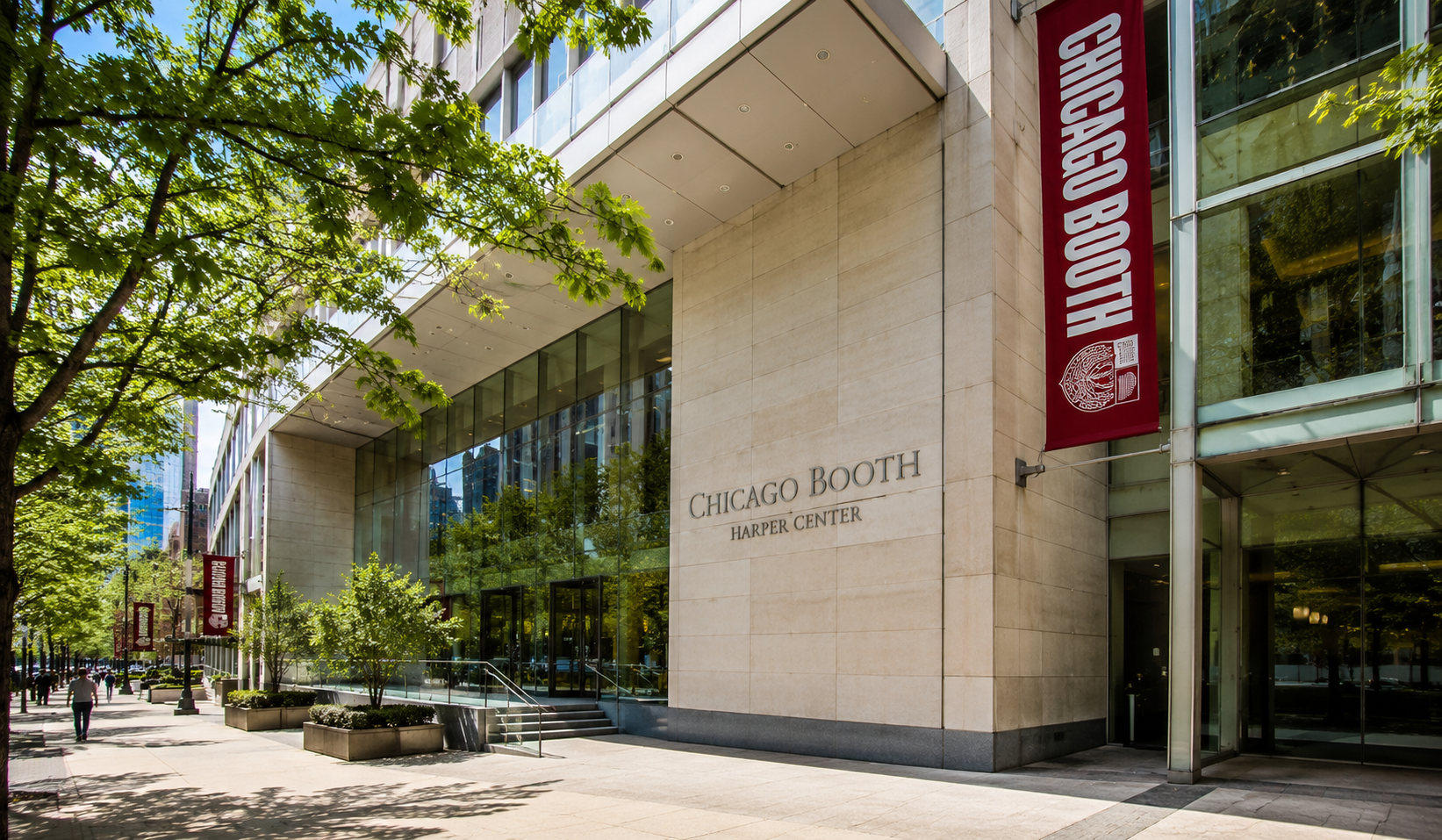
Chicago Booth
What Chicago Booth looks for, above all, is a self-directed, analytically serious thinker — someone who can handle an unusual amount of academic freedom and knows what to do with it.
What Booth Is Actually Trying to Build
Booth's identity runs straight back to the University of Chicago, and you can't read the school accurately without that. This is the institution associated with more Nobel laureates in economics than any other, and that intellectual DNA — evidence over assertion, ask why before you act, test the idea against the data — is the water Booth swims in. The school's own term for it is the "Chicago Approach": a multidisciplinary, empirical way of working that it pioneered as an alternative to the case-method model. In plainer terms, Booth is trying to build people who don't take the conventional answer on faith.
That produces a particular kind of graduate, and a particular kind of admissions read.
The analytical rigor is the entry ticket. Booth assumes you can handle quantitative work and reads your file partly to confirm it. This is where the "finance school" reputation comes from, and it isn't baseless — Booth's quant depth is real and its finance placement is among the strongest anywhere. But the rigor isn't about finance specifically. It's about a habit of mind. Booth wants people who reach for the analysis instinctively, whatever field they're in.
The flexibility is what the reputation misses entirely. With one required course and a catalog you assemble yourself, Booth is making a bet about who you are: that you're the kind of person who learns more when you're trusted to direct your own education than when a school marches you through a fixed core. The flexibility isn't a convenience the school offers. It's a statement about the student it wants — independent, self-directed, clear enough about your own goals to spend that freedom well.
And the third thing is the one applicants most often get backwards. Booth's culture is not as cold as a Chicago winter. (More on that later.) It's one of the most genuinely collaborative communities at the top of the field, organized around what students call a "pay-it-forward" ethic: second-years run much of the recruiting prep for first-years, for free, on their own time, because someone did it for them. Hold that against the stereotype for a second. A school this analytically intense could easily be cutthroat. Booth deliberately isn't, and it screens for people who'll add to that culture rather than just draw from it.
Put the three together and the admissions question comes into focus. Clearing the analytical bar gets you considered. What gets you admitted is showing that you'll use the freedom deliberately and make the community better while you're in it. That's the value proposition Booth is reading for — not how impressive you are alone, but what you'll do with a place that trusts you this much.

Who Genuinely Belongs Here
Set the stats aside for a moment, because the more useful question isn't whether your numbers clear the band. It's whether Booth is the right next chapter of your development.
The applicant who thrives at Booth tends to share two traits. The first is genuine intellectual curiosity — not the version people perform in essays, but the real thing: you like understanding why a system behaves the way it does, you're drawn to the analysis underneath the decision, and you'd take a hard, interesting course over an easy, resume-friendly one. Booth's whole design rewards that disposition and offers less to those without it. People who want a credential and a network, and aren't especially interested in the learning, can have a fine two years here, but they're leaving the most valuable thing on the table.
The second is self-direction. Because Booth hands you the wheel, the students who get the most out of it arrive with a working sense of where they want to go — not a locked-in five-year plan, but enough of a thesis about their own growth that they can make the curriculum serve it. The most common reason applicants give for choosing Booth is simply that "it's flexible," and it's worth pushing on that the way the application will. Flexible toward what? The answer to that question is, in a real sense, the heart of a strong Booth application.
Look at who actually fills the class and the picture sharpens. The Class of 2027 came in with undergraduate backgrounds spread across business (26%), economics (24%), engineering (21%), liberal arts (13%), and the physical sciences (9%). That's not a finance monoculture. It's a room full of analytically serious people from a wide range of starting points, which is exactly what you'd expect a school built on the Chicago Approach to assemble.
The Class Profile, Read Honestly
The most recent confirmed class — the Full-Time MBA Class of 2027, entering Fall 2025. Booth set an application record this cycle (5,876, up about 13%) and enrolled one of the largest classes in the country:
A note on the test numbers: Booth's class split across three formats — about 14% submitted the legacy GMAT, 39% the GMAT Focus, and 42% the GRE — so each average reflects a different slice of the class, not one common scale.
Where They Worked Before
Bars show share of the entering class.
What They Studied
Bars show share of the entering class.
A few things that are easy to misread in these numbers:
the GMAT
An average of 736 is high — among the highest Booth has reported — but the band underneath it is wide, and that width is the point. A GMAT score below the average is not a verdict. Booth reads holistically, and a genuinely strong file with a 710 gets in every year while a 760 with no coherent story does not. The number that rattled your confidence on a forum is rarely the number that decides an application. If you've ever talked yourself out of applying over a single test score, that's worth noticing: self-elimination is the one outcome in this process you fully control, and it's the one that helps you least.
The admit rate
Booth's acceptance rate has historically sat around 30% — higher than the single-digit rates at Stanford or HBS — and it's tempting to read that as a softer bar. It isn't. Booth is a large program drawing a deep, self-selected pool; the rate reflects class size, not a lower standard. The analytical expectations are as serious as anywhere.
Common Myths About Booth
"Booth is just a finance school."
The most persistent misread. Finance placement is genuinely strong, but consulting has been Booth's single largest destination every year since 2019, and the curriculum's flexibility makes it a serious home for tech, entrepreneurship, marketing, and more. The finance reputation describes one strong engine and misses the range.
"Booth is cold and cutthroat."
Almost the opposite of the truth. The pay-it-forward culture, the second-years who run recruiting prep, the Random Walks before the program even starts — these aren't marketing. They're the texture of the place. Booth is analytically intense and socially warm at the same time, and applicants who assume rigor means ruthlessness have the place backwards.
"The flexibility means there's no community."
The opposite, again. Because study groups and classes constantly reshuffle, students meet far more of their classmates than they would in a fixed-cohort program. The flexibility widens the social network rather than fragmenting it.
"You need a finance or engineering background to compete."
No. A quarter of the class studied economics, but a quarter studied business, and meaningful shares came from liberal arts and the sciences. What Booth reads for is analytical capacity and curiosity, which show up across backgrounds.
Identity and Program Basics
The University of Chicago Booth School of Business runs its Full-Time MBA as a two-year program based at the Harper Center in Hyde Park, on Chicago's South Side, with additional space at the Gleacher Center downtown. Founded in 1898, it's the second-oldest business school in the country, and the school that pioneered the empirical, research-driven "Chicago Approach" to business education — the origin of the intellectual identity that still defines it. The entering Class of 2027 numbers 635, among the largest at the top of the rankings.
The Curriculum, and What It Reveals
Here is the design in one line: Booth requires LEAD — a leadership and team-development course taken in cohorts of roughly 60 at the start of the program — and effectively nothing else. You choose how to satisfy the foundational areas, you can test out of material you already know, and you build the rest of the 2,000 required units yourself from one of the broadest catalogs in graduate business.
What that reveals about the school is everything. A fixed core says "we know what you need." Booth's near-empty requirement list says "you know what you need, and we trust you to assemble it." That's not a neutral structural choice; it's a philosophy about students. It rewards people who arrive with intellectual independence and a sense of direction, and it offers less scaffolding to those who were hoping to be guided.
The flexibility also explains a cultural feature that surprises applicants: because your classes and study groups keep reshuffling, you end up working alongside a much larger slice of the class than you would at a cohort-locked program. The freedom that looks individualistic on paper produces, in practice, a wider web of relationships.
Beyond coursework, the experiential ecosystem is deep — the Polsky Center and the New Venture Challenge for entrepreneurs, extensive lab courses, and the chance to draw on the wider University of Chicago. The students who get the most out of Booth treat the catalog as raw material and build something deliberate. The ones who drift through it taking the path of least resistance still get a good education, but one that looks like everyone else's, which rather misses the reason to come here.
Culture and Community, Beyond the Marketing
"Pay it forward" is the phrase you'll hear from Boothies, and unlike a lot of culture slogans, the structure backs it up. Recruiting preparation — mock interviews, case prep, the unglamorous hours of getting first-years ready — is run largely by second-year students who get nothing tangible for it. They do it because someone did it for them. A culture either has that reciprocity built into its bones or it doesn't, and Booth's does.
The social fabric starts before classes do. Random Walks — student-led trips to destinations around the world, plus a "mystery" option and one in Chicago — let incoming students bond in small groups weeks before orientation; roughly 85% of the class goes. Once the program begins, the traditions pile up: the annual ski trip, the Friday-afternoon social gatherings students still call Liquidity Preference Functions, an unusually active partners-and-families club, and programs like Booth Voices where students talk about the things business school usually keeps offstage.
The honest read on fit: Booth's warmth is real, but it's the warmth of intellectually serious people who like each other, not the warmth of a small, everyone-knows-everyone village. It's a big program in a big city. If your ideal is a cohort small enough to know everyone by name by February, that's a different school — Booth's class of 635 is built for breadth, not for that kind of total intimacy. If you want a wide, generous, analytically alive community where you'll build your own corner of it, that's Booth.
The “I got in” Instagram photo: the Winter Garden inside the Harper Center, all glass and light, with the city beyond. It earns the post, and your feed will know exactly where you landed.
Life at Booth
Let's talk about what it's actually like to spend two years here, because the viewbook shows you the Harper Center atrium in golden light with students working and congregating happily, not students bundled up in parkas and ski masks battling a January blizzard in Chicago.
Start with the building, because it earns the attention. The Harper Center is one of the best business school facilities anywhere — a soaring glass-and-stone Rafael Viñoly design with a vaulted central Winter Garden that students more or less live in.
Now the geography. Booth sits in Hyde Park, about ten miles south of the Loop, on the shore of Lake Michigan. Hyde Park is leafy, intellectual, and a little self-contained — the University of Chicago's neighborhood, home to the Robie House (Frank Lloyd Wright at his best), the Museum of Science and Industry, and the kind of bookstores and coffee shops a serious university generates. Grab a meal at Valois ("See Your Food," cash-friendly, a Hyde Park institution) or the Medici, then take the Metra Electric line up to downtown in about fifteen minutes when you want the full city.
And the full city is the point. Chicago is, by a wide margin, the best urban value in this tier of schools. Boston, New York, and the Bay Area are serious cities too — they're also seriously expensive, and Chicago rivals them on culture at a fraction of the cost of living. You get a genuine world capital of food, architecture, music, and theater: Millennium Park and the Bean, the Art Institute, the river architecture cruise, the lakefront trail that runs for miles, summers the whole city spends outdoors. The music scene alone is reason to love the place — Lollapalooza takes over Grant Park every summer (just before classes start), and the live music runs deep year-round.
If you follow sports, you've landed well: two baseball teams in the Cubs and the South Side's White Sox, the Bulls in basketball, the Blackhawks in hockey, the Bears in football, and — for the soccer faithful — the Fire, for real football too.
And the food. Deep dish is the tourist headliner, and Lou Malnati's and Gino's East are the names to know. But ask a local what they actually order and it's usually tavern-thin — cracker-crisp, cut into squares, from South Side institutions like Vito & Nick's and Home Run Inn, practically in Booth's backyard. You will have the deep-dish-versus-tavern argument at least once. Pick a side.
Then the honest part: the winter. Chicago winters are real — cold, windy, the lake doesn't help, and from January into March you'll earn the spring. Nobody who's done it will pretend otherwise. But the cold also concentrates the community indoors, the city knows how to live through it, and the people who love Chicago tend to love it precisely because they made it through February together.
The "I got in" Instagram photo: the Winter Garden inside the Harper Center, all glass and light, with the city beyond. It earns the post. The real test of fit, though, isn't the selfie spot — it's whether everything around it sounds like a place you'd actually want to live.
Research, Faculty, and Intellectual Identity
Booth's intellectual center of gravity is economics and analytics, and the faculty is the reason the Chicago Approach isn't just branding. This is the school associated with the deepest bench of Nobel laureates in business academia, and that orientation — rigorous, empirical, intellectually contrarian — shapes what gets taught and how. The most relatable window into what that means is probably behavioral economics: Booth is where Richard Thaler won a Nobel Prize for showing, in plain terms, why real people don't behave like the perfectly rational actors textbook models assume — work that produced the bestseller Nudge and anchors the school's Roman Family Center for Decision Research. The research centers reach from there across finance, entrepreneurship through Polsky, and more. For applicants, the signal is straightforward: Booth invests in understanding why things work, and it wants students who find that as compelling as the faculty does. What you should expect from the faculty isn't a marquee name to study under — it's teaching and access that take the ideas seriously.
What Booth Essays Are Actually Testing
Booth's written application is four short-answer prompts, each capped at 300 characters — roughly fifty words apiece — plus an optional essay for clarification. (Reapplicants answer one additional question.)
Most applicants meet that limit one of two ways. Some panic: there's no room to tell my story. Others relax: four little boxes, this is the easy part. What's actually being read for sits underneath both. At 300 characters, the constraint is the test. Booth is the most data-forward program in its tier, and the application asks you to demonstrate the exact skill it prizes — saying the true thing in the fewest words. Fifty words leaves nowhere to hide a goal you haven't thought through, or a value proposition you haven't worked out yet. If you know what you bring and where you're headed, that clarity reads instantly. If you don't, that reads instantly too.
The two goal prompts (300 characters each)
"What is your immediate post-MBA career goal?" and "What is your long-term post-MBA career goal?"
You have room for a role, a lane, maybe a named target or a reason — and nothing else. The instinct is to compress a paragraph until it fits. The stronger move is to know the one true thing each answer is for and write only that. A reader should finish the two lines able to repeat your goal back in their own words; that's the whole job. Vague verbs — "leverage," "drive impact," "transition into a leadership role" — are what fill the space when the thinking isn't done, and here there's no space for them to fill.
The image and the fun fact (300 characters each)
"Upload an image and explain its significance to you" and "Share a fun fact or something unique about yourself."
These two carry the question underneath every application: who are you beyond the résumé, and what will you add to the class? The image prompt asks you to show a value rather than assert one, and it's tempting to choose the picture that looks impressive. The one that works is true and a little revealing — the photo you can explain in a way no one else could. Same discipline on the fun fact: it isn't a quirk contest, and a forced-quirky answer reads as exactly that. The bar is memorable and real — the detail a classmate would repeat when describing you to someone else, the thing that makes you easy to picture in the room.
Optional essay (300 words maximum)
For genuine clarification only — a gap, a grade, a recommender choice, context the reader would otherwise be left guessing about. It isn't a fifth prompt for the accomplishment that didn't fit elsewhere. Use it only if leaving the question unanswered would leave a question in the reader's mind.
Prompts and limits current for the 2026–2027 cycle; confirm against Booth's application and refresh each summer.
Recommendations
Booth asks for one letter of recommendation, preferably from a current supervisor, and lets you add a second if it genuinely helps. That's a quiet but real shift — many peer programs require two — and it changes the math on the letter you're certain to submit. When only one voice is guaranteed to speak for you, the choice of recommender carries more weight, not less.
Given Booth's culture, the most effective MBA recommenders are people who can speak concretely to how you think and how you work with others — the analytical habits, yes, but also whether you make the people around you better. A letter that simply confirms you're smart and hardworking is a missed opportunity at a school that prizes the pay-it-forward disposition. Brief your recommender on specifics, and choose the person who knows your work, not the most senior name you can attach.
On the optional second letter: add it only when it opens a genuinely different window — someone who has seen a side of you the first recommender can't. A second letter that echoes the first doesn't strengthen your case; it dilutes it. One vivid, specific letter does more than two that overlap.
The Interview, and What It Actually Evaluates
Booth interviews by invitation, and the interview is "blind" — your interviewer has read your résumé but not your essays or the rest of your file. It's a single conversation, typically conducted by a current student, an alum, or a member of the admissions staff.
The blind, résumé-based format tells you what it's evaluating. Because the interviewer is working only from your résumé, the conversation is genuinely a conversation — they're getting to know you from a near-standing start, the way a classmate would. That puts a premium on being able to walk through your story clearly and naturally, without leaning on essays the interviewer never saw. It also rewards the thing the whole school is built around: can you think on your feet, take a position, and engage like someone other people would want in their study group? The MBA interview is a preview of how you'll show up in a Booth classroom and on a Booth recruiting team. They can't admit you, try you out, and send you home if it doesn't work, so the interview is the closest they get to a test drive.
Application Logistics
Tests: GMAT or GRE accepted; no stated minimum. Booth has leaned increasingly GRE-friendly, with 42% of the latest admitted class submitting the GRE.
Recommendations: one required; a second is optional.
Application fee: $250.
Materials: résumé, four 300-character short-answer responses (plus the optional essay), one letter of recommendation (a second is optional).
Confirm the fee and any test-policy updates when the new cycle posts.
Deadlines and Round Strategy
Current cycle (2026–2027, Class of 2029):
Round 1: September 15, 2026 — decision by December 3, 2026
Round 2: January 7, 2027 — decision by March 25, 2027
Round 3: April 1, 2027 — decision by May 20, 2027
Chicago Booth Scholars (deferred enrollment, for current students/recent grads): April 1, 2027 — decision by June 24, 2027
All deadlines are 11:59 p.m. Central. Booth posts the next cycle's dates over the summer; refresh on release.
On round strategy
Booth admits meaningful numbers in both Round 1 and Round 2, so the choice between them should turn on whether your application will genuinely be stronger in January than in September.
What I tell clients
If it's ready in the fall, Round 1 carries a modest edge on scholarship availability and lets you settle early; if another month of work would make a real difference, Round 2 is the largest round and entirely viable, and it's often the practical choice for international applicants needing more time on scores or visas. Round 3 is small and real but tighter on seats and aid — worth it mainly when you have a compelling reason for the later timing, not as a default.
Employment Outcomes, Read for What They Signal
For the Class of 2025, Booth posted a median base salary of $175,000 and a median signing bonus of $30,000 (received by roughly 65% of graduates). The industry split:
Consulting: about 37% — the single largest destination, as it has been every year since 2019, with the highest function median (near $190,000).
Financial services: about 32%.
Technology: about 14%.
Law and healthcare: roughly 4–5% each; legal and professional services posted a notably high median.
Geographically, Booth is Midwest- and Northeast-heavy: roughly a third of the class stayed in the Midwest (overwhelmingly Chicago), about 29% went to the Northeast (New York leading), and close to 20% headed West, with about 5% going abroad.
What this signals
The consulting-and-finance gravity is real, and Booth's integration into Chicago's professional-services economy is a genuine advantage if your targets sit there — the recruiting pipelines into the top consulting firms and banks are as deep as any. (For the Class of 2025, BCG, McKinsey, and Bain alone hired well over a hundred Booth grads among them.) Tech is a real but smaller share, below its pre-2022 peak, in line with the broader cooling across elite programs. The honest read for an applicant: if your goal is consulting, finance, or a Chicago or Northeast corporate seat, you're moving with Booth's current; if it's West Coast product management or the founder track, Booth absolutely supports it, but you'll be working with a smaller pipeline than a classmate headed to a bank. Worth knowing which one you are before you write your goal statements.
Cost and Financial Aid
Annual tuition and MBA fees (2025–2026): approximately $84,198; total two-year tuition approximately $168,396.
Estimated cost of attendance (nine months, 2025–2026): approximately $129,403, before the additional cost of Random Walks, treks, and travel that are central to the experience.
Aid approach: Booth awards merit-based scholarships, some up to full tuition, and applicants are considered automatically; need-based federal and private loan options are available.
Booth's merit-aid model is worth understanding strategically. Unlike HBS and Stanford, which award aid on need alone, Booth competes for strong candidates with merit money — which means a compelling applicant can receive a substantial award regardless of financial need, and admitted candidates weighing offers sometimes have real room to compare. As is typical, the largest awards tend to be allocated earlier in the cycle. Tuition for 2026–27 is released in Spring 2026; refresh these figures then.
Rankings, in Context
Booth sits consistently among the very top U.S. programs — recently ranked as high as #2 by Poets&Quants, #1 for part-time MBA by U.S. News, and inside the top tier of the Financial Times global ranking — and it has held or shared the U.S. number-one spot in various rankings over the years. Placements move a few spots year to year depending on methodology, and that variance is largely meaningless for your decision. The schools worth weighing Booth against on fit are Kellogg and Wharton, not the programs a few rungs down a list.
How Booth Differs From Kellogg
This is the comparison Chicago applicants actually wrestle with — two outstanding programs a few miles apart, and the differences that matter sit below the rankings.
Curriculum and philosophy
Booth allows its students to radically individualize their curriculum: one required course, build-your-own-path, "here are the tools." Kellogg is flexible too, but more structured and more deliberately team-oriented from the start. Booth optimizes for individual intellectual freedom; Kellogg optimizes for collaborative, team-based leadership development.
Intellectual texture
Booth carries the University of Chicago's analytical, economics-forward, evidence-over-intuition DNA. Kellogg's center of gravity is leadership, marketing, and general management, with a famously warm, high-EQ culture. Neither is "more serious" — they're serious about different things, and the right answer is genuinely about which one matches how you think and work.
Recruiting
Both place powerfully into consulting and beyond. The instinct that Booth "is finance" and Kellogg "is marketing" is dated on both ends; consulting is the top destination at each. And the marquee careers cut against the shorthand anyway: Booth, the supposed finance school, produced James Kilts (MBA '74), who ran Kraft, Nabisco, and Gillette — about as marketing a résumé as exists — while Kellogg, the supposed marketing school, produced finance leaders like Michael Sacks (MBA '88), CEO of the Chicago alternative-asset giant Grosvenor Capital Management. Look at the specific function and firm pipelines for your goal rather than the reputational labels.
Campus and setting
The two buildings tell you something. Kellogg's Global Hub, opened in 2017 on the Evanston lakefront, is a gleaming, hotel-like showpiece — tiered indoor gathering steps, glass everywhere, Lake Michigan out the windows. Booth doesn't try to win you over architecturally; the modern Harper Center sits inside the University of Chicago's Gothic, ivy-laced campus, and what tends to stay with visitors is the intellectual gravitas — the Nobel plaques along the corridors quietly reminding you what this place has produced. The settings differ too: Kellogg sits in leafy, suburban Evanston just north of the city, while Booth is in Hyde Park, a real urban neighborhood on the South Side. Both have their appeal, and which one feels like home is worth a campus visit to find out.
The cross-admit decision
If you want maximal curricular freedom, analytical depth, and a culture that's warm but intellectually intense, that points toward Booth. If you want structured team-based leadership development and a culture that leads with collaboration and people skills, that points toward Kellogg. Many strong applicants fit both, and the essays are where you show you understand the difference rather than treating the two as interchangeable.
How Booth Is Different from Wharton
Briefly, since it's the other major cross-shop for analytically minded applicants: both are rigorous and flexible, but Wharton expresses its flexibility inside a more structured community (fixed cohorts, learning teams) and offers the density of a finance network ninety minutes from New York, while Booth offers the more radically individual curriculum and the Chicago analytical culture. Freedom-inside-a-team versus freedom, roughly — and most cross-admits want elements of both, which is worth sitting with rather than resolving too quickly.
Signals You Might Be a Strong Fit
MBA School Fit is hard to feel from the outside, so here are concrete, checkable signals. If two or three of these sound like you, you're probably reading Booth correctly.
You're drawn to the analysis, not just the outcome. You like understanding why a system behaves the way it does, and you'd take the harder, more interesting course over the easy win.
You have a working thesis about your own development. "Flexible" reads as opportunity because you roughly know what you'd build with it — not a rigid plan, but a direction.
You're the pay-it-forward type. In a team, your instinct is to make the group better, and a culture organized around helping the people behind you sounds like home rather than an obligation.
You can clear a high analytical bar — through your score, your coursework, or your work — and you're energized rather than drained by quantitatively serious classrooms.
A big, intellectually alive program in a real city sounds better to you than a small cohort in a college town.
Signals You Might Not Be the Best Match
The honest counterpart to the section above. None of this means you wouldn't be a strong applicant here or elsewhere — it means the specific match with Booth is worth examining before you spend a cycle on the application.
Booth offers less scaffolding than most programs, and if you're hoping the program will tell you what to take and where to aim, that freedom can feel more like a void than a gift. Schools with a fixed first-year core — HBS, for one — provide more structure, and for some applicants that's a feature worth weighing rather than a weakness to overlook.
It's worth questioning whether you've done the positioning work yet if you're drawn to Booth mainly because "it's flexible," without an answer to flexible toward what. That's work to do before applying, not a reason to rule the school out — and doing it now is what turns the flexibility from a risk into the reason to come.
It may not be the best match if a tight-knit, everyone-knows-everyone cohort is what you're after. A smaller program — Tuck, Cornell — may suit that better; Booth's community is wide and generous rather than small and total. And it's a harder fit if quantitatively intense coursework sounds like something to endure rather than enjoy, because Booth's rigor isn't a hurdle you clear once. It's the daily texture of the place.
It's also worth being honest with yourself if personal safety weighs heavily on you. Hyde Park is a genuine residential neighborhood, and the University runs one of the largest private safety operations in the country — its own police force, late-night shuttles, a door-to-door evening ride program — precisely because it sits in a big-city setting where some surrounding areas can feel uneven. Most students settle in quickly and come to love the neighborhood. But if a setting where you stay aware of your surroundings would wear on you over two years, that's a real input worth weighing now rather than discovering after you arrive.
If two or three of these land, treat it as a prompt rather than a verdict. The most useful next step is usually to ask whether the schools that fit you better are programs you're genuinely as excited about — and to do that fit work honestly now, while it can still shape where you apply.
When Working With Someone Helps, and When It Doesn't
Booth is one of the schools where the most important decisions get made early, before any essay gets polished — specifically, the work of clarifying flexible toward what. Applicants who arrive at the essays already clear about their direction and their value proposition write strong Booth applications almost regardless of help. Applicants who haven't done that reflection tend to produce essays that read as capable but unfocused, and no amount of line editing fixes a positioning problem.
That's the work worth investing in, with or without a consultant: knowing your own goals well enough to spend Booth's freedom deliberately, and helping the reader to make informed decisions by showing them, clearly and quickly, who you are and what you'd build here.
If you'd like a clear-eyed read on whether Booth fits — and on what you'd need to clarify before you apply — that's what a conversation is for.