Tuck: What This School Is Looking For
Message a Tuck graduate cold — a LinkedIn note, an email asking for advice or an introduction — and you're likely to hear back. That reflex is reliable enough, and unusual enough, that Tuck has long been known for one of the most loyal, highest-participation alumni networks in business. The loyalty isn't sentimental decoration. It's the clearest downstream evidence of what the school selects for.
So what is Tuck looking for? The Tuck School of Business at Dartmouth — a small, residential, general-management MBA in rural Hanover, New Hampshire, and the oldest graduate business school in the world — reads every application against four published criteria: smart, accomplished, aware, and encouraging.
The part worth slowing down on is that last word. Most applicants arrive at a page like this asking how impressive they need to be — how high the score, how brand-name the employer. Tuck cares about those things; "smart" and "accomplished" are right there in the list. But two of its four criteria have nothing to do with raw horsepower, and the final one, encouraging, is something almost no other school grades you on out loud. Tuck does. It's the clearest statement of what this place is built around, and the single most useful thing to understand before you decide whether to apply.
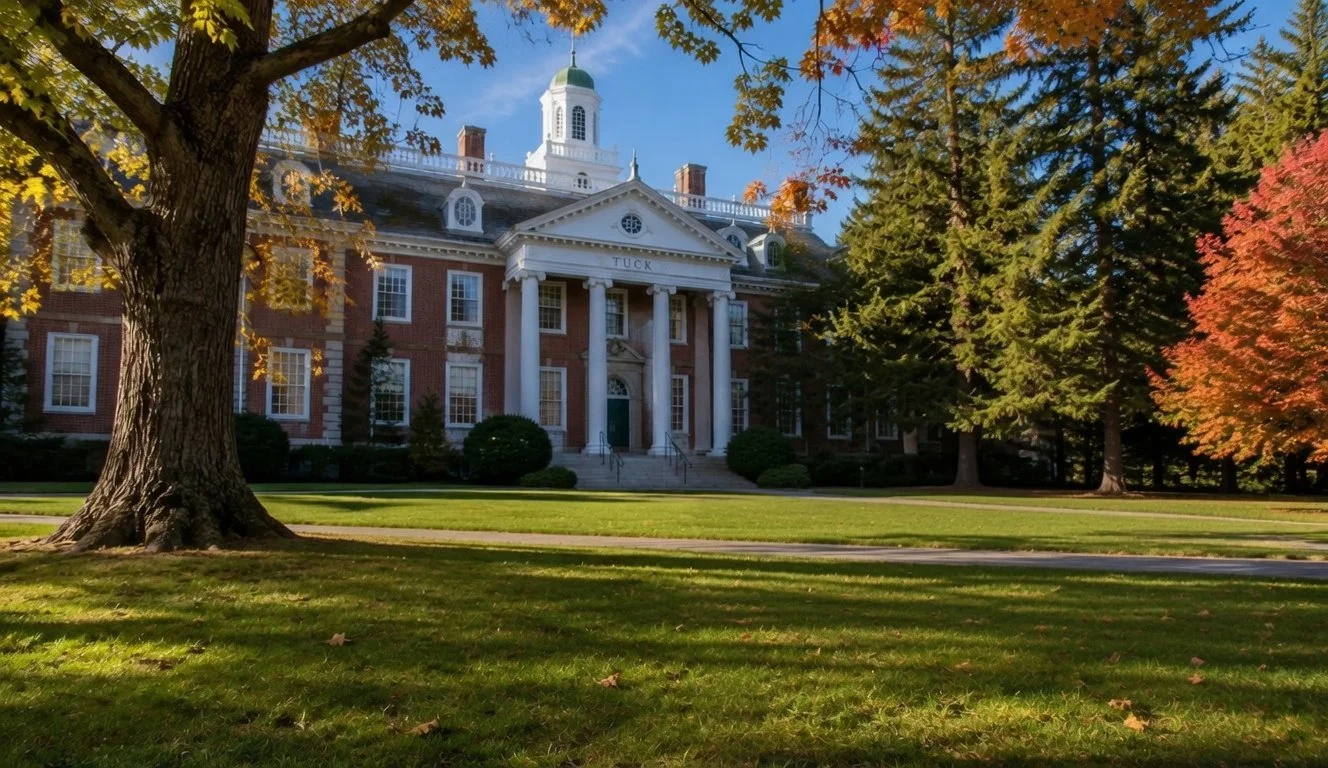
Tuck
The Tuck School of Business at Dartmouth — a small, residential, general-management MBA in rural Hanover, New Hampshire, and the oldest graduate business school in the world — reads every application against four published criteria: smart, accomplished, aware, and encouraging.
What Tuck Is Actually Trying to Build
It's the question thousands of applicants turn over every year, usually meaning some version of "what do I have to do to get in." Tuck has answered it more plainly than most schools dare to. You already have the four criteria — smart, accomplished, aware, and encouraging. What's worth knowing is that Tuck also tells you which part of your file is meant to carry each one: your transcript and test scores show that you're smart, your résumé shows that you're accomplished, and your MBA essays are where you demonstrate that you're aware and encouraging. Few schools are that explicit about how the pieces map.
Two of those four are table stakes at this level. Everyone in the pool is smart and accomplished; if you weren't, you wouldn't be reading this page. So the decision gets made primarily on the other two, and they're worth understanding on their own terms.
Aware, in Tuck's vocabulary, means self-aware, ambitious, and purposeful — you understand who you are, where you're headed, and why. Encouraging means collaborative and empathetic: you go out of your way to help the people around you, even when it isn't convenient or rewarded. Tuck devotes an entire required essay to that quality, asking you to describe a time you invested in someone else's success without immediate benefit to yourself. Sit with how unusual that prompt is. Most schools ask what you've achieved. Tuck asks what you've done for someone else when there was nothing in it for you.
That's the reframe this whole page sits inside. Tuck isn't simply assembling a class of the most individually accomplished people it can find — its students are plainly that, and then some. It's building a community. With around 300 students living for two years in the same small New England town, set in the hills of the Upper Valley where the Connecticut River divides New Hampshire from Vermont, the entire value of the place depends on whether each person makes the others better. The school has simply made that selection criterion explicit. Which means your application's real job isn't to prove you're remarkable in isolation — it's to give the reader evidence that the class will be stronger, warmer, and sharper with you in it. It's not about you in the way most applicants assume. It's about what you add to the people around you.

Who Genuinely Belongs Here
When a client asks me whether they belong at Tuck, I move them off the question they usually arrive with — "are my stats good enough?" — because at Tuck more than almost anywhere, the numbers, while genuinely important, settle less of the decision than people expect. The more useful question is whether the way Tuck works is the way you actually want to spend two years, and whether the things it reads for are things you can show rather than claim.
Here's the through-line. Tuck is small, rural, residential, and built around general management rather than early specialization. Those four facts shape everyone who thrives here. The student who gets the most out of Tuck tends to be someone who wants to be known — not to show off, but to be seen and counted on: by classmates, by faculty, by the second-years who will interview them and later mentor them. You don't slip into the background here. You're a visible part of a community, and for the right person that's the appeal, not the cost. The intimacy isn't a marketing layer on top of the program. In a class this size, in a town this small, it's simply the physics of the place.
The "encouraging" criterion points at the same kind of person from another angle. Tuck is looking for people who treat helping others as a reflex, not a performance — the classmate who organizes the study group, walks a struggling peer through a recruiting case, or quietly does the unglamorous work a team needs. If you can already picture two or three moments where you did that without being asked and without keeping score, you're reading Tuck correctly. If you're straining to invent one, that's worth noticing now rather than in the middle of the third essay.
The setting is part of the same honest calculation. Hanover is beautiful and genuinely rural, and the winters are long. But don't over-read the word remote — this is not the middle of nowhere. Boston is a little over two hours away by car, Montreal about three, New York around four, so a change of scene is a weekend drive rather than an expedition. For a lot of people the setting is exactly the appeal — the whole class is in one place, weekend plans are with classmates, and there's nowhere for the community to dissipate to. For others it isn't, and that's genuinely worth knowing about yourself before you apply, not after.
The Class Profile, Read Honestly
The most recent confirmed class — the Class of 2027, entering Fall 2025, drawn from a record 3,267 applications. One of the smaller, more close-knit cohorts among top programs:
Tuck doesn't headline an acceptance rate, but applications hit a record for the second straight year — pushing the admit rate to about 28%, one of its lowest ever, and down from 31% a year earlier. Still meaningfully more accessible than M7 rates for a well-matched applicant.
Where They Worked Before
Bars show share of the entering class, across 252 unique employers. Financial services and consulting are tied as the top feeders — both down from last year, while nonprofit/government rose.
A few things that are easy to misread in these numbers:
The acceptance rate
Around 28% looks generous next to M7 rates, and applications have surged two years running, pushing the rate to one of the lowest in Tuck's history. But a higher acceptance rate than Stanford's isn't lower selectivity — it reflects a more self-selected pool. People who want a 900-person program in a major city don't apply to Tuck. The ones who want the small, rural, tight-knit version do. The result is a pool where the marginal applicant is already a serious fit, and the decision is closer than the headline suggests. The odds are genuinely better here for a fit-matched candidate. The bar still has to be cleared.
The GMAT
A 727 average is strong, but the range runs down to 690 on the 10th edition, and the school states plainly that there is no minimum GMAT score. That range is the tell: a score in the low 700s sits comfortably inside the class, and a strong overall file can carry it. Tuck reads the score as evidence toward one question — can this person handle the work — not as a ranking. And if testing genuinely isn't your strength, Tuck offers a GMAT/GRE waiver to applicants who can demonstrate quantitative and analytical ability another way, through a quant-heavy transcript, relevant work, or an advanced degree. One honest caveat: a waiver solves the application, but some employers still screen on scores in recruiting, so weigh it against where you're headed, not only against whether you'd rather skip the test.
The GPA
A 3.6 average reads in context, and the range down to 2.8 proves the point — someone gets in near the bottom of that band every year. Tuck calibrates grades against the rigor of your program and the trajectory of your record. A lower number paired with a demanding major, an upward trend, or clear quantitative evidence can be absorbed by a file that's strong elsewhere.
The background mix
This is where Tuck quietly differs from its reputation. Consulting and finance lead the pre-MBA pool, as they do almost everywhere — but nonprofit and government together make up 14%, a larger share than at many peers, and the undergraduate majors skew heavily toward the arts, humanities, and social sciences (48%) over business (25%) and STEM (22%). Tuck is not a school that quietly prefers one kind of background. It reads the general-management instinct across all of them.
The profile isn't a benchmark to match line by line. It's a picture of who Tuck admitted last year. Your job is to give the reader evidence that places you in that picture clearly.
Common Myths About Tuck
"Tuck is a finance school."
Not by the most recent numbers. Consulting was the single largest destination for the Class of 2025 at 41% of the class, ahead of financial services at 27%. Tuck's strength in general management feeds consulting especially well, and the firms recruit Tuck heavily. The finance reputation is real but partial.
"Hanover is too remote to recruit from."
The same firms that recruit at M7 schools — McKinsey, Bain, BCG, Goldman Sachs, Morgan Stanley, Amazon, Google, Microsoft — hire Tuck graduates every year, and the school's placement numbers track with programs at the top of the top-15. Boston is only a little over two hours away, and Tuck's career-services-to-student ratio is among the highest of any top program — its own kind of advantage. There's also a subtler edge the school is proud of, and I saw it on a recent campus visit: when a recruiter or a visiting executive comes to teach in Hanover, they have the room's undivided attention. There's no city outside the door pulling students in five directions the way there is in New York or Boston, so visitors tend to stay longer and engage more deeply. Students say the same thing — that one of the best parts of Tuck is how much real time visiting executives spend with them. The distance is real; the career constraint it looks like it should create, from the outside, mostly isn't.
"You need a 727 to be competitive.”
That's the average, which means roughly half the class came in below it, and the range runs to 690 with no stated minimum. A strong, coherent application with a score in the low 700s beats a thin one with a higher number.
"Everyone from Tuck ends up in Boston or New York."
The Northeast is genuinely the center of gravity — more than half the class lands there, and the employment section below is honest about it. But the network reaches well past the headline regions, and the surprises are part of the fun. Greg Thompson (T'92) took his Tuck MBA to Los Angeles, started writing screenplays with a roommate on nights and weekends, and became an Emmy-winning writer and executive producer on Bob's Burgers. A Tuck degree doesn't sort you into one of two cities. It connects you to people inclined to help you get wherever you're actually trying to go.
"The nice-school reputation means it's easy."
"Encouraging" is a real evaluation criterion, not a personality note. Tuck reads hard for it, devotes an essay to it, and trains its interviewers to draw it out. Warmth is part of the bar here, not a discount on it.
Identity and Program Basics
The Tuck School of Business at Dartmouth, in Hanover, New Hampshire. A two-year, full-time, residential MBA — and only that. Tuck offers no part-time, executive, or online program, though joint and dual degrees are available with Dartmouth and partner institutions. Founded in 1900 by Edward Tuck, it is the oldest graduate school of business in the world and marked its 125th year in 2025. Class size is around 300 (304 in the Class of 2027), similar in scale to Cornell Johnson (around 276) and a fraction of the M7 programs. The dean is Matthew J. Slaughter, an economist. Tuck's stated mission is to develop "wise, decisive leaders who better the world through business," and its three core values — personal, connected, transformative — are the ones the rest of this page keeps circling back to.
The Curriculum, and What It Reveals
Tuck's first year is a structured, sequential, integrated core focused on general management — the functional foundation every leader needs before specializing. The class is divided into sections of about 70 who take their required courses together, which is part of how the community forms so fast: you spend the first year shoulder to shoulder with the same group. It opens with Tuck Launch, a two-week experiential orientation, and runs through the standard management disciplines — capital markets, managerial economics, marketing, financial accounting, strategy, managing people, analytics, managerial communication.
Two required experiences reveal what Tuck values. The First-Year Project puts teams of students in front of a real client — a startup, a nonprofit, a Fortune 500 company, domestic or global — to solve an actual business problem over the spring, doing primary research and delivering recommendations directly to the organization. It's a structured consulting engagement built into the degree, with an entrepreneurship track for students who want to work on their own venture instead. TuckGO, the global requirement, ensures every student takes at least one course in a country new to them, through faculty-led Global Insight Expeditions, a term exchange at one of 25-plus partner schools, or faculty-supervised independent study.
What the design reveals:
Tuck deliberately does not hand you a major. There are no formal concentrations — students choose from more than 100 electives across eleven fields, and can earn formal recognition for a concentration of quantitative coursework if they want it, but the school's posture is general management first, specialization second. That's a real philosophical choice. Where a school like Booth hands you the keys and a large menu, Tuck builds a common foundation and assumes you'll lead across functions rather than retreat into one. The applicant who wants to go deep and narrow from day one should notice that; the applicant who wants range and a shared core will find the structure works with them.
Culture and Community, Beyond the Marketing
Tuck's culture is its product. A lot of schools say "collaborative"; Tuck has built a place where collaboration is close to unavoidable — a class small enough that there's nowhere to hide, a residential setting where your classmates are also your neighbors, and a town where you'll see the same faces at the coffee shop, the gym, and the pond. The word students reach for is "tight-knit," and unlike at most schools that use it, the structure makes it true rather than aspirational. Dean Matthew Slaughter draws the contrast by scale: where a school like HBS divides each class into roughly ten separate sections, Tuck's entire class is closer to the size of a few of them — and the first-year structure, with its shared core and study groups that reshuffle each term, is built so that you finish the year having worked closely with much of the class rather than a single fixed slice of it. The architecture exists to keep the class one community, not a set of parallel ones.
The texture is genuinely supportive rather than cutthroat. Second-years run a remarkable amount of the place — including, notably, the MBA admissions interviews — and the ethos of helping the next person along is strong enough that Tuck named it as an admissions criterion. The alumni network is the most-cited evidence: Tuckies are famous for responding to a cold note from a current student or fellow alum, and that habit isn't an accident of temperament. It's what you get when a school admits for "encouraging" and then spends two years rewarding it. The roll it has produced leans heavily toward exactly the kind of broad, general-management leadership the program is built for — Christopher Sinclair, who ran PepsiCo and later Mattel; Peter Dolan (T'80), the former chief executive of Bristol-Myers Squibb; Sarah Ketterer (T'87), who co-founded and runs the investment firm Causeway Capital Management. What unites them isn't a single industry. It's the generalist's path to the top that Tuck deliberately trains for — and, by the network's reputation, the instinct to reach back and pull the next Tuckie up behind them.
Where applicants sometimes over-read the culture is in mistaking "supportive" for "soft." It isn't. The core is demanding, recruiting is competitive, and the people here are ambitious. The collaboration coexists with all of that. What Tuck has decided is that the two aren't in tension — that you can build hard-charging leaders inside a culture that expects them to lift each other. Whether that combination is what you want is one of the more useful things to test before you apply.
The “I got in” Instagram photo: Baker Tower rising over the Dartmouth Green at golden hour — the universal Dartmouth shot — or, for the Tuck-specific version, the brick Georgian quad of the Tuck campus on its bluff above the Connecticut River. Either one tells your feed exactly where you landed.
Life at Tuck
Let's talk about what it's actually like to live here for two years, because the brochures show you autumn foliage on the Green and quietly skip February.
Start with the honest part. Hanover is rural, and the winters are long, cold, and real — this is northern New England, not a city with a campus in it. The nearest airport is small. If your idea of business school is a downtown grid with a city at your door, sit with that honestly before you commit, because the geography here is not something you opt out of. That said, a change of scene is closer than the map suggests: Boston is about two hours by car, New York around four, and Montreal only about three — close enough that a weekend of a different city and a different language is an easy road trip, not a production.
Now the part that's genuinely wonderful, because it happens to be true. Hanover is regularly named one of the best places to live in the country, and the Upper Valley — the stretch of the Connecticut River where New Hampshire meets Vermont — is spectacular. And here's a small winter mercy the brochures underplay: much of the Tuck campus — classrooms, the dining hall, the library, and a good share of student housing — is linked by interior passageways and arcades, so on a bitter February morning you can get from your room to class to a hot lunch without once stepping outside. Winter is the season Tuck leans into rather than apologizes for. Dartmouth keeps an ice rink on the Green itself, across from the Hanover Inn, and Occom Pond — the college's "backyard," run by the legendary Dartmouth Outing Club — freezes into a skating rink with push-carts for the beginners. The Dartmouth Skiway is fourteen miles up the road in Lyme, with two mountains; Oak Hill has cross-country trails and night skiing. In the warmer months the river is right there for canoeing and kayaking through the Ledyard Canoe Club, and the Appalachian Trail runs straight through downtown.
The food scene is small but beloved. Lou's Restaurant & Bakery has been serving all-day breakfast and pie since 1947, with a green-and-white awning on Main Street and a student tradition — the "Lou's Challenge" — of staying up all night to be there when it opens. Murphy's on the Green is the tavern everyone ends up at; Molly's is the other one, famous for its bread; Dirt Cowboy is where the studying happens over coffee. For culture, the Hopkins Center for the Arts — "the Hop" — brings touring music, theater, and film to campus, and the Hood Museum of Art is free and a short walk away. None of it is a big city. All of it is the kind of place where you'll keep running into the people you're building your two years with.
The "I got in" Instagram photo: Baker Tower rising over the Dartmouth Green at golden hour — the universal Dartmouth shot — or, for the Tuck-specific version, the brick Georgian quad of the Tuck campus on its bluff above the Connecticut River. Either one tells your feed exactly where you landed.
Here's the thing to understand about all of it: the geography is the community. In a city, your classmates are one option among thousands for an evening. In Hanover, you'll see them on the pond, at Lou's, on the trail — and that constant, unavoidable overlap is exactly what produces the closeness Tuck is known for. The remoteness and the intimacy are the same fact seen from two angles. Whether that's a feature or a cost is one of the most honest questions you can ask yourself before applying.
Research, Faculty, and Intellectual Identity
Tuck's faculty is small — around 57 full-time professors for a class of 300 — and the absence of a doctoral program means MBAs aren't competing with PhD students for faculty attention. At Tuck's scale, with no PhD layer in between, that access is unusually real, and it's a genuine small-program advantage.
Part of what gives a school its intellectual gravity is the presence of thinkers whose work shapes the conversation well beyond campus, and Tuck's bench runs deeper than its size suggests. Kenneth French — the finance economist whose Fama-French model, developed with Nobel laureate Eugene Fama, became one of the most influential frameworks in modern investing — anchors the markets-and-data tradition. On the leadership side, Sydney Finkelstein, author of the bestsellers Why Smart Executives Fail and Superbosses, is the most visible face of the school's work on how leaders develop and how talent compounds around them. You may or may not end up in either professor's classroom, and that isn't really the point. What MBA applicants actually want from faculty isn't a marquee name to study under; it's professors who are reachable, teach well, and remember who you are. At Tuck, you get both — real intellectual gravity, and genuine access to it.
The school's intellectual energy concentrates in its centers, which double as the practical on-ramps into specific industries: the Center for Private Equity and Venture Capital, the Center for Digital Strategies, the Center for Health Care, the Revers Center for Energy, the Center for Entrepreneurship, and the Center for Business, Government & Society, which works at the intersection of business and public purpose. For applicants weighing fit, the centers are a better signal than any ranking of "research strength" — they tell you where Tuck has built the connective tissue between the classroom and a career.
The Center for Private Equity and Venture Capital
The Center for Private Equity and Venture Capital is a useful place to see what that connective tissue actually does, because it tends to surprise people who assume a small, rural, general-management school can't be a serious launchpad for investing. In the spring of 2026, a team of six Tuck second-years won the Venture Capital Investment Competition — a global field of 75 MBA programs in which student teams act as venture capitalists, running diligence on real early-stage startups, talking with founders, and defending a term sheet to a room of working VCs.
After taking the New England regional and advancing through the semifinals at UNC Kenan-Flagler, they beat teams from Chicago Booth, BYU, Colorado, Korea University, and the National University of Singapore to take Tuck's first global VCIC title. The work behind it ran through the center: an early-stage VC workshop and months of practice on live deals, organized by Jim Feuille (D'79), a former Crosslink Capital investor and Forbes Midas List honoree who now leads the center.
What the win signals for fit is less the trophy than the texture — the team has described the experience as learning to get fluent in an unfamiliar industry in hours, to reframe a deal from "how could this go wrong" to "what happens if this goes right," and to disagree hard and then commit, which is the collaborative-but-demanding disposition the rest of this page keeps describing, pointed at a deal instead of a case. The honest caveat the students themselves offer is the real fit signal: these opportunities sit alongside the core rather than inside it, and they reward the person who seeks them out and asks. If you're coming to Tuck for venture or entrepreneurship, that's the posture to bring — the door is open, but you're expected to take the initiative to walk through it.
What Tuck Essays Are Actually Testing
Tuck's essay set is three prompts, each capped at 2,000 characters — roughly 350 words. The tight limit is deliberate: the school says plainly that distilling your point into a small space is itself part of what's being tested, and it warns against gimmicks to stretch the count. For the Class of 2029, all three prompts were rewritten. That's worth knowing if you've read last year's version or an older competitor guide, because the emphasis has genuinely moved.
One structural change sits underneath all of it, and it reshapes how the first essay works. Tuck now collects your short-term and long-term goals in a separate short-answer field — 300 characters each, where the school asks you to be "factual and direct." The goals themselves live there now. That frees the first essay to do something more interesting than restate them.
Essay 1 — how you arrived, and why Tuck (2,000 characters)
"Your professional goals are described elsewhere in your application. What led you to those goals and to your understanding of where you need to grow? Why is Tuck the right environment to support that growth and help you achieve your ambitions?"
Read the prompt closely and it asks for three things, none of which is "what are your goals." It wants the origin — what led you here; the self-knowledge — where you know you need to grow; and the fit — why Tuck, specifically, is the place to close that gap. This is the "aware" criterion in its truest form: not a polished statement of ambition, but evidence that you understand your own trajectory well enough to name what's missing, and are honest enough to say it out loud.
The instinct is to spend the space re-selling the goals you already entered in the short-answer box. That's the version that falls flat — it burns your best real estate telling the reader something they've already read. The stronger move is to treat the goals as settled and spend your characters on the two things only you can explain: the path that produced them, and the growth you're actually reaching for. Then the "why Tuck" half has to clear a bar Tuck has long set, and it's the right one — write something that would fall apart if you swapped in another school's name. A line about small classes and a supportive community could describe a dozen programs. A line about a specific course, a center you'd plug into because of where you've been, or the way Tuck's general-management core serves the particular pivot you're making — that could only be about you, and about Tuck.
Essay 2 — the person behind the résumé (2,000 characters)
"People are often shaped by experiences that are not fully reflected in their resume. Tell us about an important aspect of who you are that has shaped you as a person. How will your perspective enrich the Tuck community?"
This is the identity essay, and it also maps to "aware" — here the self-understanding side rather than the forward-looking one. The prompt is generous enough to name its own pitfall in the first line: it points you away from your résumé. Tuck already has your titles and your accomplishments; this is the space for the part of you a bullet point can't hold. The second half is the one applicants under-weight, and it's the one that carries the whole thesis of this work: how will your perspective enrich the community? That word isn't decoration. Tuck is asking you to connect who you are to what the cohort gains by having you in it — which is the question the entire application is really asking, compressed into one essay.
What it reads for is the person who will show up in Hanover, not a catalog of clubs you plan to join. The strongest responses leave the reader feeling they've met someone — that they could describe you to a colleague in a sentence that isn't your industry and your title.
Essay 3 — support when it was hard (2,000 characters)
"Describe a time when supporting another person was not easy or straightforward. What made it difficult, how did you respond, and what did you learn?"
This is the prompt that most defines Tuck, and it's the one that changed most. The old version asked about investing in someone's success with nothing in it for you. The new one asks a harder, more honest question — about support that was difficult: complicated, inconvenient, maybe unsuccessful at first. Three beats, and you need all three: what made it hard, how you responded, and what you took from it. That last beat folds "aware" into an "encouraging" prompt. The school isn't only asking whether you show up for people; it's asking whether you learned something when doing so wasn't clean.
Here's where this tends to go wrong. The instinct is to reach for a story where you supported someone and it worked out beautifully — a tidy arc where you were patient and generous and the ending was a triumph. But the prompt specifically asks for the situation that was not easy or straightforward, so the tidy version quietly sidesteps the question. The stronger story has friction in it: the person resisted, or you misjudged what they needed at first, or helping cost you something real. Tuck isn't looking for the moment you were effortlessly good to someone. It's looking for the moment support demanded something of you — judgment, patience, the willingness to be wrong — and for the honesty to say what that taught you. This is the "it's not about you" temperament turned into a prompt, and the reflection at the end does as much work as the story itself.
The optional and reapplicant essays
The optional information essay is for genuine context — a gap, a dip, an unusual recommender choice — and Tuck is reassuring about it: most applicants won't need it, and leaving it blank costs you nothing. Use it only when something on your record would otherwise leave a reader guessing, because silence tends to get filled with the wrong assumption. Reapplicants write one additional essay on how they've strengthened their candidacy since last time.
What "Why Tuck" Essays Should Actually Do
The first essay is where most "why school" answers fall flat, and the fix is the bar Tuck has long held out: write something that would break if you swapped in another school's name. That's demanding, and it's correct. A sentence about small class size and a collaborative community could describe a dozen programs. A sentence about a specific course you'd take, a center you'd plug into because of where you've been, a particular way Tuck's general-management core serves the pivot you're making — that could only be about Tuck, and about you.
What's changed is where the essay starts. Because your goals now sit in a separate short-answer field, the first essay isn't the place to state them — it's the place to show how you arrived at them and where you know you need to grow. The deeper move is to make those two halves one argument: when the path that produced your goals and the reasons Tuck is right to pursue them explain each other, the essay reads as a person who has thought it through, which is the whole point of the "aware" criterion. The job, as always, is to make the reader's work easy — walk them cleanly from where you've been to what Tuck offers, so they can advocate for you without having to connect the dots themselves.
Recommendations: What Tuck Is Looking For
Tuck requires two letters and uses the GMAC Common Letter of Recommendation questions, which ask your recommender to describe their interaction with you, to compare your performance against other strong people in similar roles, and — the revealing one — to describe the most important piece of constructive feedback they've given you and how you responded.
That third question — the one about the most important constructive feedback they've given you — is where recommenders most often underserve their candidates. A letter that only praises tells Tuck nothing about whether you can take feedback and grow from it, which is exactly the self-aware, coachable disposition the school selects for. Brief your recommenders to answer it honestly and specifically, with a real example and your real response. If possible, one letter should come from your current direct supervisor; Tuck asks you to explain it if not. And across both criteria the school is reading — accomplished and encouraging — the most useful letters are specific and behavioral, not warmly generic. Choose recommenders who can tell stories, not just vouch.
The Interview, and What It Actually Evaluates
Tuck's interview process is distinctive in two ways, and both are worth understanding because they shape strategy. First, every admitted applicant interviews before receiving an offer — there are no admits without an interview. Second, there are two routes to one: a guaranteed interview if you submit a complete application (including scores and letters) by the early guaranteed-interview deadline, and an invitational interview for everyone else. Tuck is emphatic that the two are weighted identically — a guaranteed interview is not a lesser interview, and the timing of an invitation says nothing about your standing.
Most interviews are conducted by trained second-year students — Tuck Admissions Associates — which is itself a signal of how much the school trusts its community. They run 30 to 45 minutes, are based only on your résumé (the interviewer hasn't read your file), and are behavioral, built to draw out evidence that you're smart, accomplished, aware, and encouraging. Because it's résumé-based, your résumé needs to be a clean springboard for conversation, not a wall of bullet points.
What it's actually evaluating: whether the person in the room is the person on the page, and whether you'd add to the community a current student is, in a real sense, helping to choose. The applicant who has engaged with Tuck — talked to students, understood the general-management model, can speak to why the place fits — comes across as a fit. The applicant who learned about Tuck from a rankings table tends not to.
Application Logistics
Tests: GMAT or GRE, all versions accepted, with no preference and no minimum score. A test waiver is available to applicants with at least two years of work experience who can demonstrate quantitative ability another way (see the GMAT note in the class profile for when it's worth using).
Application fee: $250, with automatic waivers for a wide range of groups (U.S. military and veterans, Pell Grant recipients, first-generation graduates, members of numerous fellowship and access programs, and others) and additional waivers by request.
Video component: None required for the application itself. Non-native English speakers submit a proficiency test (Duolingo, TOEFL, IELTS, or PTE) unless they qualify for a waiver.
Résumé: One page recommended.
Transcripts: Self-reported at application; official copies and verification required upon enrollment.
Consortium: Tuck is a member of the Consortium for Graduate Study in Management; Consortium applicants apply through that application on a parallel timeline.
Confirm the fee and any test-policy updates when a new cycle posts.
Deadlines and Round Strategy
Tuck's 2026–2027 application (Class of 2029) runs three rounds:
Round 1: submit by September 24, 2026 — decision December 10, 2026
Round 2: submit by January 5, 2027 — decision March 18, 2027
Round 3: submit by March 24, 2027 — decision April 29, 2027
The guaranteed-interview deadlines fall earlier: September 1, 2026 for Round 1 and December 1, 2026 for Round 2. Consortium applicants apply on a parallel track, with Consortium 1 closing October 15, 2026 and Consortium 2 on January 5, 2027, sharing those same guaranteed-interview dates. One piece of timing that's easy to miss: if you intend to request a GMAT/GRE test waiver, the waiver request closes well before the round itself — August 12, 2026 for Round 1, November 9, 2026 for Round 2, and March 5, 2027 for Round 3. Miss it and you'll need to submit a score to apply in that round.
On round strategy
Tuck offers something almost no other top program does right now, and it's worth planning around rather than treating as fine print: a guaranteed interview. Submit a complete application by the early deadline and you lock in an interview regardless of how the committee reads your file, which removes one real source of uncertainty from the process. The school weights guaranteed and invitational interviews equally, so an early submission buys certainty, not an edge in evaluation — but certainty is itself worth having.
What I tell clients
If your application will be genuinely ready by the guaranteed-interview deadline, take the guarantee. Just don't rush a half-formed file to hit it — a polished Round 1 or Round 2 application that earns an invitational interview is far stronger than a thin one submitted early for the lock-in. International applicants should lean toward Round 1 or Round 2 for visa runway. And Round 3 is a real opportunity. Fewer seats remain by then, but a candidate who fills a genuine gap in the class can do very well — some of my best client success stories are Round 3 admits, including at Tuck. The honest tradeoff is timing against readiness. If you're simply running late and the file would be meaningfully stronger with more time, a strong Round 1 next cycle usually wins. But if you're ready and you bring something the class is missing, don't let the round number talk you out of applying.
Employment Outcomes, Read for What They Signal
For the Class of 2025 (292 graduates), 92% were seeking employment; of those, 90% had an offer within three months of graduation and 87% accepted. Median base salary was $175,000 and the median signing bonus $30,000, for a combined median compensation of $205,000 — a Tuck record — with 83% of graduates reporting a signing bonus. Top employers included Amazon, Bain, BCG, McKinsey, Goldman Sachs, Morgan Stanley, Citi, Bank of America, Google, Microsoft, Nvidia, Nike, Colgate-Palmolive, and General Mills.
By Industry
Consulting was the single largest (41%) — also paid the highest median base, at $190,000.
Financial services next (27%)
Technology (13%)
By Function
Consulting (42%)
Finance (27%)
Marketing (13%) — reflecting a genuine Tuck strength in general management and consumer-facing roles that the finance-and-consulting headline can obscure (the consumer-goods names on the employer list — Colgate, General Mills, Nike — are not an accident).
What this signals about fit
The geography is the other signal that matters for fit. The Northeast accounted for 55% of the class, split almost evenly between New York (27%) and Boston (27%), with the West a distant second (15%). That concentration shapes the school's strongest recruiting pipelines and alumni network.
If your goals lie in consulting, finance, general management, or established roles in tech, health care, or consumer goods — especially in the Northeast — Tuck's outcomes are strong and its connections run deep. You can absolutely reach the Bay Area or other markets from Tuck — graduates do every year — but if your ambitions depend on West Coast founder networks or a specifically Silicon Valley-centered career, you'll be working with a thinner alumni base than you would at a school rooted closer to that ecosystem.
Cost and Financial Aid
Annual tuition (2025–2026): $84,250
Estimated total cost of attendance: approximately $135,329 per year for a first-year student living off-campus (slightly less on-campus)
Aid approach: Both merit-based and need-based. All applicants are automatically considered for scholarships upon submitting a completed application — no separate scholarship form.
Scholarships: Range from $10,000 to full tuition, averaging around $34,000 per year, and automatically renewed in the second year for students in good standing. Roughly 86% of students receive some form of aid (scholarship, fellowship, or loan).
Notable awards: The McGowan Fellowship (full tuition for a small number of second-years in the top of the class who demonstrate leadership and public-service commitment), the Bollenbach Fund, Consortium fellowships, and the Yellow Ribbon Program for veterans.
The strategic point is that Tuck's merit awards are decided at admission and don't require demonstrating financial need — which matters for strong candidates whose family circumstances wouldn't qualify them for need-based aid at the schools that offer only that. Because the scholarship review happens automatically with your application, the quality of the application itself is what drives the award. There's no second process to optimize; there's just the case you make.
Rankings, in Context
Tuck sits firmly in the top tier, but where it lands depends heavily on which list you read, and the spread is itself informative. As of the most recent rankings, Tuck placed #4 in the Poets & Quants composite, #6 in Bloomberg Businessweek, #7 in Fortune, and #9 in U.S. News — but #12 among U.S. schools (and #26 worldwide) in the Financial Times.
One newer list is worth pulling out on its own. LinkedIn's Top MBA Programs 2025 — a relative newcomer that ranks almost entirely on alumni outcomes (hiring and demand, career advancement, network strength, leadership reach), drawn from LinkedIn's own platform data, while the traditional media rankings blend career results with academic inputs like faculty, research, reviews, and test scores — placed Tuck 6th in the U.S. and 8th in the world. The number isn't the whole story; what's telling is that on a measure built heavily around network strength, Tuck edges out several M7 programs. For the school whose calling card is the alumni who answer the call, that's the ranking that most directly corroborates the reputation.
That gap is worth understanding rather than averaging away. The FT methodology weights international and salary-progression metrics that systematically disadvantage a small, U.S.-focused, general-management program — it isn't measuring a weakness in the education so much as a mismatch with what Tuck is built to be. The rankings that lean on student and alumni satisfaction and on career outcomes — Bloomberg, P&Q, Fortune, LinkedIn — place Tuck considerably higher, which tells you something real: Tuck's graduates are unusually happy with the experience and unusually well-connected after it, and those are exactly the dimensions the FT doesn't reward. Read the spread, not the single number.
How Tuck Differs from Darden
The most useful comparison for Tuck is often a fellow general-management program rather than an M7 — though plenty of applicants weigh Tuck against M7 schools too, and there's nothing unusual about that. UVA Darden is the closest peer on the dimensions that actually drive the choice: both are general-management programs with intense, community-driven cultures in smaller settings, and the two trade places near the top of the qualitative rankings. The differences that matter are real.
Pedagogy
Darden is built almost entirely on the case method — a demanding daily rhythm of preparing cases and discussing them in section, closer to HBS in intensity. Tuck uses cases too, but as part of a blend that also includes lecture, team-based work, and experiential learning like the First-Year Project. If the all-in, every-day case immersion sounds like the point, Darden leans harder into it; if you want a general-management foundation delivered through a mix of methods, that's Tuck. Many applicants want elements of both, which is worth sitting with rather than resolving too quickly.
Setting and texture
Charlottesville is a small city with a milder climate; Hanover is a smaller town tucked into the hills of northern New England, with real winters. There's an institutional flavor difference, too: Tuck is the business school of an Ivy League college, while Darden belongs to the University of Virginia — a public flagship so highly regarded it's exactly the kind of school people have in mind when they reach for the phrase "public ivy." Both produce close communities, but the daily texture differs, and the weather and geography are not interchangeable. This can be the deciding factor for cross-admits, and it should be an honest one.
Recruiting gravity
Both place strongly into consulting and finance. Tuck's network pulls toward the Northeast — New York and Boston above all. Darden's runs strong into the Northeast and the South/Mid-Atlantic. If a specific region is central to your goals, the alumni density is a real input.
How Tuck Differs From Cornell Johnson
The other natural peer comparison, and a frequently searched one. Both are small, rural, community-first programs of nearly identical size, and both sit inside Ivy League universities — Dartmouth and Cornell — which gives them a shared pedigree as well as a shared temperament.
Curriculum philosophy
This is the cleanest difference. Cornell Johnson is built around its immersion model — a semester-long, industry-specific deep dive that rewards an applicant who already knows the direction they want to go. Tuck is built around general management and deliberately holds off on specialization, with a shared core and a consulting-style First-Year Project. If you arrive knowing exactly the industry you're targeting, Johnson's structure compresses your preparation; if you want a broad foundation and the option to lead across functions, Tuck's posture fits better.
Setting
Hanover and Ithaca are both rural, both beautiful, and both snowy — neither is a substitute for the other. The more vivid difference is what's out the door in winter: Hanover sits in serious ski country, with the Dartmouth Skiway up the road and the big Vermont and New Hampshire mountains within easy reach, while Ithaca's signature landscape is its gorges and the Finger Lakes. The choice often comes down to which community, and which corner of the Northeast, you can actually picture living in for two years.
Fit, not verdict
Both schools build their brand on the same promise — a close-knit, community-first culture — and both weight community and fit heavily relative to programs that read primarily for raw horsepower. Both reward the applicant who can show contribution rather than just credentials. The cross-admit decision usually turns on the curriculum philosophy and the setting, not on a difference in quality. Neither choice is wrong; they optimize for different things.
Signals You Might Be a Strong Fit
MBA School Fit is hard to feel from the outside, so here are concrete, checkable signals. If two or three of these sound like you, you're probably reading Tuck correctly.
Being known sounds like the appeal, not the cost. A class small enough that faculty and classmates know your name — and a town where you'll see the same people at the pond and at Lou's — reads as the point of going, not a compromise you'd tolerate.
You want general management, not early specialization. You're drawn to a broad foundation and the ability to lead across functions, and a program that holds off on majors sounds like a feature rather than a limitation.
You can already tell the Essay 3 story. A time you supported someone when it wasn't easy — when it cost you something, or the person resisted, or you had to work out what they actually needed — comes to mind without much digging, because that's simply how you operate. The "encouraging" criterion describes you rather than challenges you.
You'd actually use the network the way Tuck's works. You're the kind of person who'd drive two hours to Logan at midnight to collect a classmate whose flight got in late — and the kind who'd let someone do the same for you. That instinct, running in both directions, is what builds the network Tuck is known for.
The Northeast fits your goals, or the setting genuinely appeals. Either your target market aligns with where Tuck's gravity runs, or the rural, residential, four-season life is something you actively want — you like that winter means hockey, skiing, and skating, and Hanover is built for exactly that.
Signals You Might Not Be the Best Match
The honest counterpart to the section above. None of this means you wouldn't be a strong applicant somewhere, or that you shouldn't apply here — that's your decision. It means the specific match with Tuck is worth examining before you spend a cycle on the application.
Tuck may not be the best match if you want the option to be anonymous in a large program. Tuck's community is dense and inescapable by design — you'll see the same people constantly, and there's nowhere for the cohort to dissipate to. If you'd want the choice to blend into a crowd of nine hundred, a larger urban program may suit the way you like to work, and that's worth weighing honestly.
It's worth questioning whether the fit is there if your instinct is to put your head down and optimize for your own outcomes. Tuck's whole design rewards the opposite — showing up for other people, visibly and repeatedly — and "encouraging" is a graded criterion, not a nicety. You can thrive in plenty of business schools while keeping your focus mostly on yourself. A program that runs this much on community may simply ask more of that muscle than you're looking to give, and there's no shame in knowing that about yourself before you apply.
It's a harder fit if you want to specialize hard and early. Tuck's general-management core and absence of formal majors are deliberate. If you already know you want to go deep and narrow from day one, you have options that lean into exactly that — the flexibility of a Booth or a Wharton, or the early, industry-specific focus of Cornell Johnson's immersion model — each worth a look alongside Tuck.
It's worth questioning whether the setting suits you if a city at your door is non-negotiable. A small New England town with real winters is the trade. For the right person that's the whole appeal; for someone who needs a dense urban grid and a major airport at hand, it's a genuine cost, and better weighed now than after a year of wishing it were otherwise.
If two or three of these land, treat it as a prompt rather than a verdict. The most useful next step is usually to ask whether the schools that fit you better are programs you're genuinely as excited about — and to do that fit work honestly now, while it can still shape where you apply.
When Working With Someone Helps, and When It Doesn't
Tuck's application has features that genuinely benefit from outside input, and they're not the ones applicants expect. The deepest value isn't line-editing — it's what I think of as MBA story-detective work: going back through a quarter-century (more or less) of your life to surface the specific, true stories that show you're smart, accomplished, aware, and encouraging, and that you're the kind of wise, decisive leader Tuck says it's trying to build. Most people have far more of this material than they remember; the strongest examples are often the ones they've stopped noticing because they're so used to themselves. A good reader's job is to find them, and then help you tell them so the person reading your file sees what you see.
Two specific spots reward that work. The third essay — support that wasn't easy or straightforward — looks simple and is hard to do well, because the instinct is to reach for a story where everything worked out, when the prompt is asking for the one that didn't come easily and what you learned from it. And the first essay's "couldn't-swap-the-school-name" bar is genuinely difficult to clear alone: it's hard to hear your own generic sentences, and easy for someone else to point at them.
That said — no consultant can manufacture the raw material. If the stories genuinely aren't there, no amount of editing conjures them. But in my experience they almost always are there, waiting to be dug out and put into words. The question is rarely whether you have an example of being a wise leader, or an encouraging teammate, or a self-aware one — across twenty-five years you have many. It's which of your real examples does the most work for each of Tuck's criteria, and how to tell it so a stranger reading quickly understands exactly what it shows. The reflection is the work; the support is in the questions that get you there faster and push you further.
If you'd like to talk through whether your application is at the stage where outside input would help, a free consultation is a low-pressure way to find out. We'll talk about where you are, what Tuck is likely to weigh in your case, and what matters most before you draft.