UVA Darden: What This School Is Looking For
Every weekday at 9 a.m., the whole school stops for coffee. Students and faculty gather in the Darden hall for First Coffee — a ritual unbroken since 1955 — and for a few minutes the professors teaching the most decorated classes in business education are just there, mug in hand, asking how your case prep went. The Economist named Darden the No. 1 educational experience in the U.S. ten years running; the Princeton Review ranks its professors No. 1 in the country. At most schools, faculty like that are a name on a syllabus. At Darden, they're the person next to you in the coffee line.
That coffee says most of what you need to know about what UVA Darden is looking for: people who want to learn this way — closely, in person, with world-class teachers and a small community of classmates, in a place built for it. Darden runs on the case method, where you don't sit through lectures but work real business problems alongside your peers until the room lands on a better answer than any one person walked in with. So the school reads applications for the person who'll make that room better — prepared, generous, the kind of classmate a graduate later describes as the most interesting person they met.
And the place itself is part of the pull. Darden sits inside "Mr. Jefferson's University" — founded by Thomas Jefferson in 1819, a UNESCO World Heritage Site — in Charlottesville, in the foothills of the Blue Ridge, ringed by vineyards, mountain trails, and two centuries of academic heritage. It is, by design, a genuinely beautiful place to spend two transformative years. Darden even makes the process unusually welcoming: it's one of only a handful of top programs with an Early Action round, and the rare one where you can simply schedule your own admissions interview rather than wait to be invited.
So this page assumes you might fall for the place — and then turns to the more useful question: how do you earn a seat? The short answer, and the through-line of everything below, is a reframe most applicants miss. It's not about you. Not in the way that sounds. It's the single most useful idea for understanding how Darden chooses, and how to give yourself your best shot.
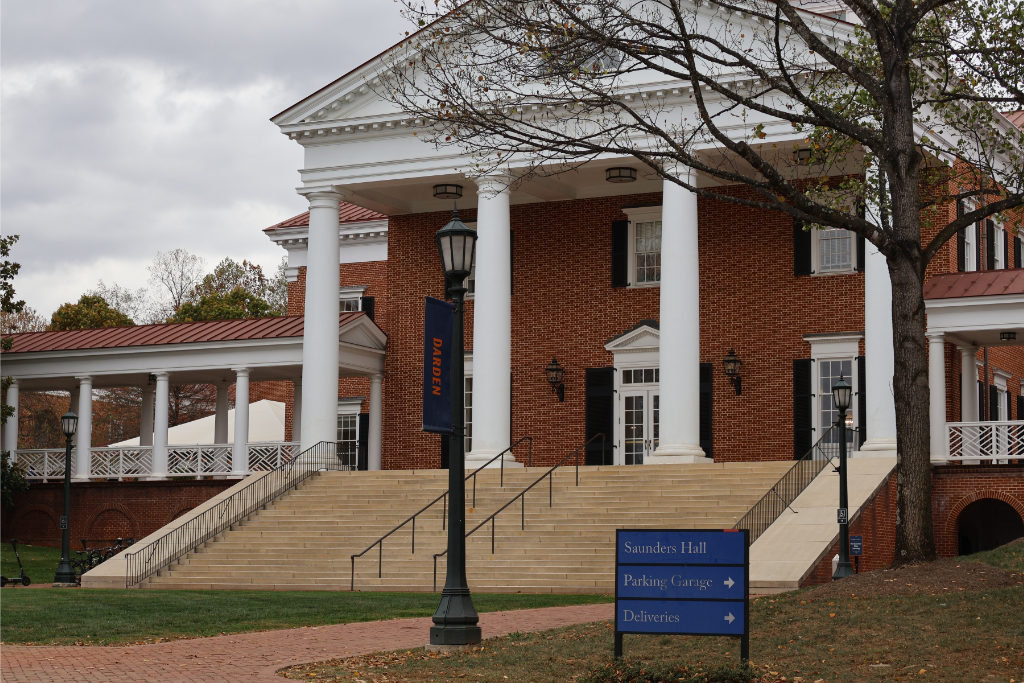
UVA Darden
The Economist named Darden the No. 1 educational experience in the U.S. ten years running. Darden is looking for people who want to learn this way — closely, in person, with world-class teachers and a small community of classmates, in a place built for it.
What Darden Is Actually Trying to Build
Start with the room, because everything follows from it. A Darden class isn't a lecture you absorb; it's a conversation you join. You prepare a real case the night before with your learning team, then spend class working it through with sixty or seventy classmates while a master teacher guides the discussion. The point isn't to win the argument — it's that, again and again, the group arrives at a sharper answer than anyone brought in alone. Students describe the moment it clicks: just when you think you've seen every angle, a classmate or professor opens one more, and together you land somewhere better. That's the engine of a Darden education, and it's why the school is so deliberate about who's in the room.
It's also why Darden's mission talks about developing "responsible leaders" rather than simply high achievers. The case method rehearses, three times a day, exactly what real leadership asks for: read an ambiguous situation, commit to a decision on incomplete information, and bring people with you — all inside a community tight enough that you learn as much from your classmates as from the faculty. Set against the gravitas of Jefferson's grounds and seventy years of teaching tradition, it adds up to something that feels less like a credential you collect and more like a community you join.
Which brings us back to the reframe — the one idea that, once it clicks, changes how you approach the whole application. Darden isn't trying to find the most impressive people in the pool and rank them. It's assembling a class — a deliberately small one — where the people around you are the point of the place, and where part of the appeal for every admit is the caliber and range of the classmates beside them. So the most useful thing your application can do isn't to prove how accomplished you are in isolation. It's to help the admissions committee picture the classmate you'd be: the perspective you'd add, the discussion you'd sharpen, the section that's more interesting because you're in it. That's what "it's not about you" really means here — the surest way to earn a seat is to show how you'd make the class better for everyone else in it. Get that right, and you've made it easy for the committee to do the thing it's actually trying to do: build a dynamic, fascinating class. The rest of this page is about how.

Who Genuinely Belongs Here
When a client asks me whether they belong at Darden, I move them off the question they usually arrive with — "are my numbers good enough?" — because that's rarely what settles it here. Darden admits across a wide range of stats. What it's far less flexible about is the kind of learner, and the kind of teammate, you'll be.
Here's the through-line that connects the rest of this page. Darden is built around the case method, the learning team, and a small residential community, and all three reward the same disposition: someone who is energized by preparing hard and thinking out loud with other people, rather than someone who'd rather absorb material alone and be assessed on the output. That isn't a personality test you either pass or fail. It's a description of who tends to get the most out of the place.
A useful self-test: picture your best learning experiences. If they were seminars, debates, and teams — rooms where you sharpened your thinking against other people's — Darden's method will feel like coming home. If your best learning has been independent and self-directed, and group work reads as friction you tolerate, that's worth sitting with honestly, because at Darden the group is the curriculum. You can't opt out of it the way you can at a more lecture-and-elective program.
The setting is part of the same honest calculation. Darden is small, around 360 per class, and Charlottesville is a college town in central Virginia, not a major metro. For a lot of people that's precisely the appeal — you'll know your classmates, run into them at First Coffee and on the Downtown Mall, and build a network dense enough to feel like family. For others, the size and the setting are a real tradeoff. Better to weigh that now than to spend two years wishing the place were bigger or closer to a city.
The Class Profile, Read Honestly
The most recent confirmed class — the Class of 2027, entering Fall 2025:
Darden doesn't publish an acceptance rate in its class profile. Third-party estimates drawn from U.S. News data put it in the mid-30s percent in recent years — meaningfully higher than M7 rates, and a reason a strong-fit applicant shouldn't rule Darden out on selectivity alone.
Where They Worked Before
Bars show share of the entering class, drawn from 33 industries and roughly 300 employers. Government's 11% share runs notably higher than at most peers.
A few things that are easy to misread in these numbers:
The acceptance rate
A rate in the mid-30s is genuinely advantageous for a fit-matched candidate, and that advantage is real — the odds here are better than at the most selective programs, and worth taking seriously. But a higher rate is not a lower bar. It reflects a more self-selected pool: applicants who specifically want the case method, the small community, and Charlottesville tend to apply, and applicants who want a 900-person class in a major city tend not to. The marginal candidate in that pool is already a serious fit. The decision is closer than the headline number suggests, and the application still has to make the fit credible.
The test scores
A 725 average GMAT (665 on the Focus scale) is competitive and sits a notch below M7 medians, and the range matters more than the average. The middle of the class spans roughly 690–750 on the 10th edition, a spread wide enough to tell you scores don't decide outcomes here on their own. A GMAT score in the low 700s sits comfortably inside the band, and a strong overall file can carry it. As noted up top, Darden reads the score as evidence you can handle a quant-heavy, fast-moving case load — not as a ranking — and the test waiver is a real path for candidates who can show their readiness another way (a strong analytical transcript, an advanced quantitative degree, several years in a quant-heavy role). One honest caveat: a strong score can still help with consulting and finance recruiting, where some employers screen on it, so weigh the waiver against where you're headed, not just whether you'd rather skip the test.
The GPA
A 3.54 average reads in context, not against a cutoff. Darden states plainly that it reads the whole record — rigor of program, trajectory, quantitative coursework — and admits from a wide spread of undergraduate institutions. A lower GPA paired with a demanding major, an upward trend, or clear quant ability can be absorbed by a file that's strong elsewhere. The question is whether you can do the work, and the GPA is one input toward answering it.
The pre-MBA-to-post-MBA pivot
This is the most revealing line in the data, and it's easy to miss. Consulting is only 13% of the incoming class by background — but it's the top post-MBA destination at well over a third. In other words, Darden is a major consulting-pivot school: a lot of people arrive from government, the military, healthcare, the nonprofit world, and industry, and use the two years to move into consulting and finance. If your goal is a pivot, that's a feature, not a stretch. The center of gravity is built for it.
The public-sector and military threads
Government is 11% of the incoming class and the military share is 12% — both higher than you'd guess from a school known for consulting and finance outcomes. Darden's proximity to Washington (about two hours north) and its DC-area Grounds are part of why. If you're coming from public service or the armed forces, Darden integrates those backgrounds well and deserves a closer look than its ranking position alone might suggest.
The profile isn't a benchmark to match line by line. It's a picture of who Darden admitted last year. Your job is to give the reader evidence that places you in that picture clearly.
Common Myths About UVA Darden
"Darden is just the case method, like a smaller Harvard."
The case method is the shared headline, but the experience is different. Darden runs the method more completely — the entire first-year core, every day — and in a much smaller community where your learning team and your section are the center of your life. The teaching reputation is the distinguishing fact: Darden's brand is built on faculty who teach exceptionally well, not on being a junior version of anyone.
"It's a finance school."
Finance is a major destination, but consulting is the single largest one, and technology placements nearly doubled in the most recent class. The bigger truth is that Darden is a pivot school — its method and career center are built to move people into consulting, finance, and tech from wherever they started.
"Charlottesville is too remote to recruit from."
The firms applicants associate with top placement — McKinsey, Bain, BCG, Amazon, the bulge-bracket banks — recruit at Darden, and outcomes sit at the top of the top-15. The career constraint the location appears to create from the outside is mostly not real. The lifestyle tradeoff (a college town, not a city) is real, and worth weighing on its own terms.
"The first year is brutal."
Darden's first year is genuinely demanding — three cases a day, daily preparation, cold calls. That intensity is real and shouldn't be waved away. But the structure that produces it — the learning team you prep with every night — is also what produces the community Darden is known for. The workload and the closeness are the same fact seen from two angles.
"Darden gives less money than the M7."
Often the reverse, and the difference is structural. Darden leads with merit aid: all admits are automatically considered for Darden Excellence Scholarships, up to full tuition and fees, with no separate application for many awards. HBS and Stanford use need-based aid, which offers little to candidates whose finances don't qualify. For an applicant who wouldn't draw need-based aid at an M7, Darden's merit model can produce a meaningfully better offer.
Identity and Program Basics
The University of Virginia Darden School of Business, in Charlottesville, Virginia, founded in 1955. The school is named for Colgate W. Darden Jr. — a Virginia governor, U.S. congressman, and UVA president who championed public education and drove the school's creation; fitting lineage for a program whose identity rests on public-spirited, responsible leadership. Two-year, full-time, residential MBA, roughly 360 students per class — similar in scale to Tuck (around 290) and Cornell Johnson (around 276), and a fraction of HBS (around 930). The first-year core is taught entirely by the case method; the second year is almost fully elective. Sixteen combined and dual-degree options are available across UVA (including JD, MD, and a data-science master's). Darden also runs Part-Time and Executive MBA formats out of its Washington, D.C.-area Grounds — distinct programs from the full-time MBA this page covers.
The Curriculum, and What It Reveals
Darden's curriculum is the clearest statement of what the school values, because the method is the message.
The first year is a fixed, integrated core taught almost entirely through cases, on a quarter-based calendar. There's very little lecturing. You read two or three cases the night before, work them through with your learning team, and then spend class building toward a decision while a faculty member guides the room. The cases span the standard fundamentals — finance, accounting, marketing, operations, strategy, leadership communication — but the through-line is the same every day: take incomplete information, commit to a recommendation, and refine it together with peers who've prepared just as hard.
The learning team is the structural heart of the first year. You're assigned to a group of five or six students, drawn from across the first-year sections, and you prepare together before nearly every class. It is the single experience Darden alumni reach for when they describe what made the program. It also tells you something about what the school is selecting for: people who can be relied on by a small group, late at night, under deadline, when the quality of everyone's classroom day depends on the quality of the prep.
The second year opens up almost entirely into electives, plus consulting projects, live-action cases, and global coursework. Every full-time student completes a Darden Worldwide global experience, funded for all students through an endowment from longtime benefactor Frank Batten — international exposure treated as core to the education, not an add-on for the few.
What the curriculum reveals:
Darden assumes you want to learn with people, by doing, out loud. For the applicant who's energized by that, the method compresses an extraordinary amount of reps — hundreds of decisions, made and refined, in two years. For the applicant who learns best alone and dreads thinking on their feet, the same structure that rewards engagement can feel relentless. Which is exactly why the disposition question, not the stats question, is the one worth settling first.
Culture and Community, Beyond the Marketing
Darden's culture is unusually communal, and unlike at many schools that claim it, the structure makes it close to inevitable. A class of 360, a first year spent on the same learning team and in the same section, a residential college town with limited distractions — the arithmetic produces closeness whether or not anyone puts it on a banner. (First Coffee, from the top of this page, is the daily emblem of it.)
The daily dynamic is more peer-supportive than cutthroat. The case method depends on people building on each other in real time, and the learning team depends on genuine reciprocity, so the culture rewards generosity in a way that's structurally enforced rather than merely encouraged. The honor system that runs across the University of Virginia shapes how work and trust operate here too. The newer Forum Hotel on Grounds — with its restaurants, classrooms, and the surrounding Arboretum and botanical gardens — has become a gathering spot that, in the school's own words, is "all about the people and the experience." For fit research, the clubs, section traditions like Resilience Week and Global Week, and the student-run conferences are good signals of where the community's energy goes — and the admissions and student blogs (Discover Darden) read as honest windows into daily life rather than glossy marketing.
There's a flip side worth naming honestly, because it's the same coin: this is a place where you'll be known. Your classmates, your professors, and the staff will learn your name, and you'll learn theirs. For most Darden students that's the whole appeal — two years of belonging to a real community rather than passing through a big one. If what you want from business school is the option to be anonymous in a large crowd, that's a genuine preference worth weighing; Darden is close-knit by design, and it doesn't pretend otherwise.
The “I got in” Instagram photo: the Rotunda or the UVA Lawn for the universal “I’m a Hoo now” shot, or the sunset deck at Carter Mountain Orchard with the whole valley and the Blue Ridge behind you. For the Darden-specific version, the school’s brick colonnade with the mountains rising behind it. Any of them tells your feed exactly where you landed.
Life at Darden
Let's talk about what it's actually like to live here for two years, because the tour shows you Jefferson architecture and Blue Ridge sunsets and quietly skips the part about how much of your social life will happen within a few miles of the same college town.
Start with the setting, because it's genuinely lovely. Charlottesville sits at the foot of the Blue Ridge Mountains in central Virginia — Thomas Jefferson's town, home to Monticello and to a university whose Rotunda and Lawn are among the most photographed places in American higher education. The Darden Grounds (UVA says "Grounds," not "campus") are a short distance from the historic core, red brick and colonnades with the mountains behind them. Fall is spectacular; spring on the Lawn is the kind of thing alumni get sentimental about. Mild winters, four real seasons, no rural-Northeast deep freeze.
Now the honest part. This is a college town, not a city. The dining and nightlife are very good for the size, but they're a walkable pedestrian mall and a few neighborhoods, not a metro grid — and you'll want a car. If your image of business school is a downtown high-rise with a city at your door, that's not Darden, and it's better to know it now.
What the setting buys you is a genuinely outdoor, food-and-wine kind of two years. Eating starts at Bodo's Bagels, the bagel institution that feeds thousands of Cville students and locals a day, with a location right on the Corner across from UVA. The Downtown Mall — a brick pedestrian street lined with restaurants — is where you'll end up most weekends: Brazos Tacos for breakfast tacos, Citizen Burger Bar for the obvious, The Alley Light (a James Beard–recognized hideaway) when someone's visiting and you want to show off. In the Belmont neighborhood, Lampo turns out some of the best Neapolitan pizza on the East Coast (no reservations, worth the wait) and Mas Tapas is the long-running Spanish standby. The Dairy Market food hall covers the quick-and-casual end. And Carter Mountain Orchard, perched on a ridge minutes from town, is the local rite of passage — apple picking and cider donuts in the fall, and a sunset view over Charlottesville and the Blue Ridge that even Jefferson's Monticello, just up the road, can't quite match.
Beyond town, the Blue Ridge means Shenandoah National Park, Skyline Drive, and Humpback Rock within a short drive, with the Rivanna Trail looping closer to home for runners and cyclists. The surrounding county is one of the East Coast's real wine regions: King Family Vineyards runs Sunday polo matches in season, Pippin Hill is the postcard, and Blenheim belongs to Dave Matthews — whose band, fittingly, got its start in a Charlottesville bar before it filled stadiums. Breweries and cideries (Three Notch'd, Champion, South Street, Bold Rock) come with patios the mild weather actually lets you use. Each fall the Virginia Film Festival, presented by UVA, brings premieres and filmmakers to town. For a splurge there's Marigold by Jean-Georges at Keswick Hall; for a slice of history, Michie Tavern near Monticello. And UVA is a real sports town — the Cavaliers, the "Hoos," whose men's basketball team won the 2019 national championship and whose baseball and lacrosse programs are perennial contenders — so fall Saturdays and winter weeknights come with a team to follow. Washington, D.C., is about two hours north when you need a bigger city, an airport with range, or a public-sector recruiting trip.
The "I got in" Instagram photo: the Rotunda or the UVA Lawn for the universal "I'm a Hoo now" shot, or the sunset deck at Carter Mountain Orchard with the whole valley and the Blue Ridge behind you. For the Darden-specific version, the school's brick colonnade with the mountains rising behind it. Any of them tells your feed exactly where you landed.
Here's the thing to understand about all of it: the setting is the community. In a city, your classmates are one option among thousands. In Charlottesville, you'll keep running into them — on the Mall, at a vineyard, at First Coffee — and that constant overlap is exactly what produces the closeness Darden is known for. The small-town quiet and the tight community are the same fact, seen from two sides. Whether that's a feature or a cost is one of the more honest questions to ask yourself before applying.
Research, Faculty, and Intellectual Identity
At Darden, the faculty story isn't about marquee names to study under — it's about teaching. The school's defining reputation, across a decade of student surveys and rankings, is that its professors teach exceptionally well and connect with students personally, which is precisely what a case-method program lives or dies on. For an MBA applicant, that's the faculty quality that actually matters: not whose name is on the most-cited paper, but whether the person running your section can make a finance case unforgettable and remember who you are.
That said, part of what gives a school intellectual gravity is the presence of thinkers whose work shapes the conversation well beyond campus, and Darden has two who genuinely did. R. Edward Freeman — the Olsson Professor of Business Administration and an academic director of the Institute for Business in Society — is the scholar who, in 1984, originated stakeholder theory: the now-mainstream idea that a company answers to its employees, customers, suppliers, and community, not to shareholders alone. It's hard to find a cleaner intellectual match for a school whose whole identity is responsible, purpose-driven leadership. Saras Sarasvathy, the Hammaker Professor, built the theory of "effectuation" — the logic expert entrepreneurs actually use to create ventures from the means at hand — in one of the most-cited entrepreneurship papers ever written; it anchors the Batten Institute's entrepreneurship work. You may never take a class with either, and that isn't the point. Studying where the people shaping the stakeholder and entrepreneurship conversations actually work is its own kind of education.
The school is also entering a notable chapter in its leadership. Scott Beardsley — a former McKinsey senior partner who, as dean from 2015, brought real-world energy and a record $632 million fundraising campaign to the school — became UVA's president in early 2026. His successor, taking office in August 2026, is Yael Grushka-Cockayne, the school's 10th dean and the first woman to lead Darden in its 70-year history. She's a fitting choice for a teaching-first school: a multiple-time winner of Darden's top teaching awards and a leading scholar on decision-making, forecasting, and the use of AI in business, who helped launch Darden's work on ethical AI. Her own description of the place doubles as the cleanest summary of what Darden is selling — "the deeply human approach to business education: rigorous, student-centered, grounded in discussion, community, and committed to developing responsible leaders." For an applicant, the signal is continuity in what matters: the school is investing in research and in its data-and-AI future while protecting the teaching-first, student-centered identity that is its actual brand.
What Darden Essays Are Actually Testing
Darden's written application is short — two 200-word short-answer questions — and for the 2026–2027 cycle the school added a new video essay. (Confirm the current prompts and video format on Darden's site before drafting, and check whether an optional or reapplicant essay applies to you.) The brevity is the point — 200 words forces you to choose one true thing and ground it, rather than narrate. And the set as a whole is reading for the same thing the classroom is: who you'll be in the room.
"Relationships Matter Here" (200 words)
What would you want your classmates to know about you that is not on your resume?
This is the school asking who you are off the page — the human your learning team will spend a year with at 9 p.m. It's tempting to use it for a second résumé bullet. The stronger move is to show a genuine, specific facet of who you are: a formative experience, a relationship, a passion you've actually pursued. Pick something the reader couldn't get from anywhere else in your file, and make it concrete enough to picture.
"Careers with Purpose" (200 Words)
Your short-term post-MBA goal — industry, function, geography, company size, mission — and how it aligns with your long-term vision.
A goals essay, compressed. In 200 words there's no room to be vague: the readers want a destination specific enough that they can see Darden getting you there, and a long-term vision that makes the short-term step make sense. Given how many Darden students pivot into consulting and finance, this is also where you show you understand the path you're choosing rather than gesturing at a title. Darden has no standalone "Why Darden" prompt, so your written case for the school now lives here — connect the goal to what Darden specifically gives you.
The video essay (new this cycle)
Darden added a video component so the committee can see how you think and communicate, not just read it. The school's own framing is that it's a chance to share your voice and communication style and to show your critical thinking — a complement to the written application. Read it for what it plainly is: a small preview of how you'd show up in a case discussion, where the whole point is engaging with an idea in real time. It rewards being a clear, warm, genuine version of yourself far more than a polished performance. Format, timing, and prompts are released when the application opens, so check the current details — but the preparation that helps isn't scripting; it's getting comfortable thinking out loud and sounding like a person.
Across both the writing and the video, the underlying job is the same: help the committee picture you as one of the people who make the class worth being in — the classmate a graduate later calls one of the most interesting people they met. Make it easy for them to assemble the dynamic, fascinating cohort Darden is built around, with you in it.
Recommendations
Darden requires one MBA recommendation and accepts up to two. That's unusual at this tier — most peers require two — and the implication matters: each letter carries more weight, so choose carefully. The strongest recommender for Darden can speak specifically to how you operate with other people — how you collaborate, how you handle disagreement, how you show up on a team — because that's what predicts the learning-team-and-section experience the school is built on. Generic praise is far less useful than a recommender who can tell a particular story about how you work.
The Interview, and What It Actually Evaluates
Darden MBA interviews are required before any offer, and the format tells you what the school cares about. They're blind (the school calls them anonymous): your interviewer has not read your application or résumé, so the conversation starts fresh. They run up to 45 minutes, conversational rather than interrogative, and are conducted by either Admissions Committee members or trained second-year students, with both weighted equally. Most are on Zoom; some are held in person at Darden.
What it's actually evaluating is straightforward once you know the method: whether you'd be a good participant in a case classroom and a good teammate on a learning team. Communication, judgment, the ability to be clear and generous in real time — the in-person preview of how you'll show up. One distinctive feature, and a sign of how applicant-friendly Darden's process is: Early Action applicants can self-schedule an "open" interview (typically August through late September) without waiting for an invitation, which makes EA a genuine option for candidates who know Darden is their top choice. For all other rounds, the interview is by invitation after the committee reviews your file.
Application Logistics
Tests: A standardized test score or an approved test waiver is required. Darden accepts the GMAT, GRE, Executive Assessment, LSAT, and MCAT, and views scores equivalently. Waivers are evaluated case by case (strong analytical transcript, an advanced quantitative degree, or several years in a quant-heavy role help).
Application fee: $250 (fee waivers available in select circumstances).
Short answers + video essay: Two 200-word short-answer questions plus a video essay (new for 2026–2027); format and prompts are posted when the application opens.
Résumé: One page is sufficient for most applicants with under ten years of experience.
Recommendations: One required, up to two accepted.
Transcripts: Unofficial accepted in the application; official required upon admission.
Confirm the fee and any test-policy updates when the new cycle posts.
Deadlines and Round Strategy
The 2026–2027 cycle (Class of 2029) runs six deadlines:
Early Action: September 9, 2026
Round 1: October 7, 2026
Round 2: January 7, 2027
Round 3 – March: March 1, 2027
Round 3 – April: April 1, 2027
Round 3 – May: May 1, 2027
Two things changed this cycle. Darden added a video essay (covered in the essays section above), and it expanded the spring window into three Round 3 deadlines — March, April, and May — explicitly to give strong candidates who enter the process later more room to apply. It's of a piece with the rest of Darden's unusually applicant-friendly process. Confirm current dates on Darden's admissions site before you plan.
On round strategy
Darden is explicit about two things worth internalizing. First, the school's own advice is to apply in the round where you can put together the strongest application — and it notes plainly that with each passing deadline, fewer seats and less scholarship money remain. Second, historically most applicants apply in Round 2, so R2 is fully competitive, not a fallback. The Early Action round is the strategic lever: it's for candidates who know Darden is their top choice (it offers binding and non-binding options), and it's the only round with self-scheduled open interviews. The three spring Round 3 deadlines (March, April, May) are a real path for candidates whose timing genuinely requires it — and welcome flexibility — but the spring is where seats and merit dollars are tightest.
What I tell clients
If Darden is clearly your first choice and your application is ready, Early Action is worth serious thought for the scholarship and interview advantages. If you need another few weeks to make the file strong, a polished R2 beats a rushed EA or R1. R3 makes sense when the timing genuinely works best for you right then — not as a way to recover from running late, where a strong R1 next cycle usually serves you better.
Employment Outcomes, Read for What They Signal
For the Class of 2025 (352 graduates; 327 sought full-time employment): 90.2% received at least one offer within three months of graduation and 89.3% accepted within that window, rising to about 94% with roles by six months. Median base salary held at $175,000 — the fifth straight year at that figure — with a median signing bonus of $30,000; the average base was $162,578 and the average signing bonus $36,906.
Industry Breakdown
Consulting was the top destination at 37.3%,
Financial services next at 26%,
Technology at 16.1% (tech placements nearly doubled from the prior class).
Top employers included Amazon, Bain, BCG, McKinsey, Bank of America, Barclays, and American Express — the same firms applicants associate with top placement.
Recent U.S. News data ranks Darden No. 1 among the top-20 U.S. programs for employment rates at graduation and three months out.
What this signals about fit
One quiet signal worth reading: the median base ($175,000) sits above the average ($162,578). That's the reverse of the usual pattern, and it tells you something — a large cluster of graduates land at the consulting-and-finance standard, pulling the median up, while a tail of lower-paying roles in government, nonprofit, and industry pulls the average down. In plain terms: the typical Darden grad lands at the top-tier compensation band, and the school still makes real room for people headed somewhere other than the highest-paying industries.
The 20,000-strong alumni network reflects that same range. It runs from operating chiefs to founders to public servants to sports executives — LendingTree founder Doug Lebda (MBA '14), McKinsey partner and former chief of staff to the Secretary of Defense Eric Chewning (MBA '08), Washington Capitals general manager Chris Patrick (MBA '06), and former PepsiCo chairman Steven Reinemund (MBA '78) among them — and it's known for being approachable: Darden alumni famously pick up the phone. What the data signals, taken together: Darden is a consulting-and-finance powerhouse with a fast-growing tech channel, and a genuine pivot engine, given how few students arrive from consulting relative to how many leave for it. So if your goals sit in consulting, finance, or established tech roles, Darden's outcomes are strong and the method prepares you directly. If your goals are in West Coast tech entrepreneurship or a founder track, Darden can support you, but you'd be working with channels built primarily for other destinations.
Cost and Financial Aid
Annual tuition and fees (2025–2026): approximately $84,600 for out-of-state and international students; roughly $79,600 for Virginia residents (UVA's Board of Visitors sets rates annually).
Estimated total cost of attendance: roughly $121,000 per year.
Aid approach: Primarily merit-based, with a need-based program (AccessDarden) also available.
Darden's merit-forward model is the strategic point. All admits are automatically considered for Darden Excellence Scholarships — up to full tuition and fees, with no separate application for many awards. On top of that sit several competitive, full-tuition fellowships that involve a supplemental process and a binding commitment: the Jefferson Fellowship (UVA's premier graduate fellowship — full tuition and fees, health insurance, a living stipend, and a faculty-advised research project), the Oculus Fellowships, and the Batten Scholars Program (for candidates strong in entrepreneurship, innovation, and technology). Because merit aid isn't gated on financial need, a strong candidate who wouldn't qualify for need-based aid at an M7 can sometimes do meaningfully better here — and can use a Darden merit offer as leverage in a way that simply isn't possible at need-based programs.
Rankings, in Context
Darden sits firmly in the U.S. top 10–15 and consistently atop the public programs. Recent cycles: No. 9 among U.S. programs in the 2026 Financial Times ranking (a new high, and No. 19 globally); No. 1 public and No. 5 overall in the 2025–2026 Poets & Quants composite; a strong showing in Bloomberg Businessweek; and, in U.S. News, top marks for employment outcomes among the top 20. The throughline across all of them is the teaching-and-outcomes story — the Economist named Darden the No. 1 educational experience in the U.S. for ten consecutive years before retiring that ranking, and the Princeton Review still ranks it No. 1 for Best Professors.
One newer entrant is worth understanding on its own terms. The relative newcomer LinkedIn Top MBA Programs ranking placed Darden around No. 18 globally in 2025 — notable because this ranking focuses almost entirely on alumni outcomes (hiring success, career progression, and network quality) using LinkedIn's own platform data, while traditional media rankings blend job and career criteria with academic measures like faculty, research, reviews, and test scores. Read alongside Darden's No. 19 global placement in the Financial Times, it tells a consistent story: on the measures that track where graduates actually end up, Darden lands solidly in the global top 20.
How Darden Differs from Duke Fuqua
This is the peer comparison that does the most honest work, because Darden and Duke Fuqua are genuinely similar — both top programs known for collaborative cultures, both strong in general management and consulting, both outside the biggest cities and only a few hours apart in the broader Southeast. The differences that matter are about texture and method.
Pedagogy
Darden runs the case method more completely than almost anyone — the entire first-year core, every day. Fuqua uses cases but blends in more lecture, team projects, and experiential coursework, and its terms move fast in six-week blocks. If the all-in case method is the thing that energizes you, Darden leans hardest into it; if you want a more varied mix of formats, Fuqua offers it.
Community texture
Both are warmly communal, and both sit at big-time sports universities — basketball blue-blood Duke and a UVA program that won the 2019 national title — so school spirit is part of the fabric at each. The cultures express community differently, though. Fuqua's "Team Fuqua" ethos is built around its team-based culture and a larger class; Darden's closeness is produced by the learning team and the small residential setting — more uniformly intense, harder to be anonymous in. Neither is better; they're different versions of "collaborative."
Setting and strengths
Charlottesville and Durham are both mid-sized and outside a major metro, but they're not interchangeable — Blue Ridge college town versus Research Triangle. And if healthcare is your goal, Fuqua's Health Sector Management program is a genuine reason to weight it heavily, with depth few schools match. Picture yourself in each.
Most cross-admits choosing between them are really choosing on method (how much case immersion you want) and feel (which community texture fits you), not on outcomes or prestige, which are close. That's a decision worth making on your own priorities rather than a clean either/or.
Darden vs. Harvard Business School
A note on the Darden–HBS comparison, since the case method invites it: both are case schools, but Darden is more thoroughly case-based, far smaller, rural rather than urban, and built around its teaching reputation rather than the scale and brand of HBS. There's also a difference in feel that's hard to overstate — Darden is the kind of place where, if you wander onto Grounds unannounced, someone will stop and ask if they can help you find your way. If the case method is the specific thing drawing you in, Darden arguably delivers a purer, warmer version of it — in a community where you won't be one of 930.
Signals You Might Be a Strong Fit
MBA School Fit is hard to feel from the outside, so here are concrete, checkable signals. If two or three sound like you, you're probably reading Darden correctly.
Your best learning has happened in discussion. Seminars, debates, teams — rooms where you sharpened your thinking against other people's. The case method will feel like the format you've been waiting for.
You'd actually enjoy the learning team. The idea of prepping cases with the same five or six people, late, before a 9 a.m. cold call, reads as the good part — the camaraderie — not the cost.
You can name a real pivot or destination. You have a specific post-MBA direction (very often a move into consulting, finance, or tech) and can explain why the next two years are the right bridge to it.
A small, residential, run-into-everyone community reads as the appeal. Knowing your whole class, building a network in a college town, First Coffee every morning — that sounds like the point of going, not a compromise.
The setting actively pulls at you — a place of rolling hills and vineyards, historic Jeffersonian architecture, mountain and river trails to bike and run, and a real college-sports town to belong to. If that sounds like where you want these two years to happen, that's a signal.
You're drawn to "responsible leadership," not just the paycheck. Darden's purpose-and-leadership framing lands as a description of what you want, not marketing you'd tolerate.
Signals You Might Not Be the Best Match
The honest counterpart to the section above. None of this means you wouldn't be a strong applicant somewhere, or that you shouldn't apply here — that's your decision. It means the specific match with Darden is worth examining before you spend a cycle on the application.
It may not be the best match if you learn best alone and dread thinking on your feet. The case method and the learning team aren't a side feature at Darden; they're the whole structure. If absorbing material independently and being assessed on output is how you do your best work, and group discussion reads as friction, a more lecture-and-elective program may fit the way you like to work better — worth weighing honestly rather than ruling Darden out on one axis.
It's a harder fit if you specifically want a big-city program with a metro at your door. Darden's network can support most goals, but the daily experience is a college town, and a chunk of your social and professional life will run through Charlottesville. If the city itself is central to what you want from business school, programs in or near a major metro are worth a serious look alongside Darden.
It's worth questioning whether the intensity suits you if a demanding, prep-heavy first year sounds draining rather than energizing. Darden's first year is real work — multiple cases a day, daily preparation, cold calls. For the right person that intensity is the point; for someone who'd rather a gentler ramp, it's worth being honest about before committing.
If two or three of these land, treat it as a prompt rather than a verdict. Fit is a weighted sum, not a checklist, and the most useful next step is usually to ask whether the schools that fit you better are programs you're genuinely as excited about — and to do that fit work honestly now, while it can still shape where you apply.
When Working With Someone Helps, and When It Doesn't
Darden's application has features that reward outside input. The short answers are deceptively hard — two 200-word questions with no room to hide a vague goal or a generic "I'm collaborative" behind length, so every word has to earn its place. A good outside reader helps you find the one true thing each prompt is really asking for and cut everything that isn't that; the "Careers with Purpose" essay in particular tends to need a second set of eyes, because a goal that feels clear in your head often reads as fuzzy on the page until someone presses on it. The new video essay rewards a different kind of preparation — not scripting, but getting comfortable thinking out loud and being a clear, genuine version of yourself on camera, which is exactly what a mock run or two is for.
That said: no consultant can manufacture fit. If the case method and the small-community life aren't actually how you want to spend two years, no amount of editing will make the essays ring true to a reader whose whole job is detecting that. The work before the MBA essay is being honest with yourself about whether Darden's way of teaching is your way of learning. The essay then becomes a record of that clarity, not a substitute for it.
If you'd like to talk through whether your application is at the stage where outside input would help, a free consultation is a low-pressure way to find out. We'll talk about where you are, what Darden is likely to weigh in your case, and what matters most before you draft.