NYU Stern: What This School Is Looking For
Picture business school with all of New York City as its campus. That's NYU Stern: instead of a gated quad, you get Greenwich Village out the front door, Washington Square Park as the commons, and the trading floors, startups, runway shows, and recording studios your classmates are chasing all sitting a subway ride away rather than a plane flight.
As you'd expect with Wall Street fifteen minutes downtown, Stern is one of the country's strongest finance schools. But if you picture it as all numbers and trading floors, that's only half the equation — literally. So what is Stern looking for? In its own long-running shorthand: IQ + EQ. The IQ is the analytical horsepower to do the work. The EQ is the emotional intelligence to do it with and through other people — and Stern is the rare school that turned that second half into an actual admissions requirement.
That second half is the pleasant surprise about a place you'd assume runs purely on P&L. For all its Wall Street wiring, Stern is betting that the people who go furthest in finance — and in media, and in tech — are the ones who can read a room as well as a balance sheet. Grasp that, and you understand the thing most applicants miss, and what the rest of this page is about.
NYU Stern
So what is Stern looking for? In its own long-running shorthand: IQ + EQ. The IQ is the analytical horsepower to do the work. The EQ is the emotional intelligence to do it with and through other people — and Stern is the rare school that turned that second half into an actual admissions requirement.
What NYU Stern Is Actually Trying to Build
Start with the vision, because it's more interesting than the usual mission-statement boilerplate. Stern is trying to build a class of people who are formidable with a spreadsheet and just as formidable with a room — because in New York's markets, media, and boardrooms, the analytical work only pays off if you can also persuade, collaborate, and lead. That conviction is old at Stern, and it has a name: IQ + EQ.
Here's the evidence it's real and not a slogan. Apply to enough schools and the applications blur together — the same recommendation forms, the same prompts. Then you hit Stern, which asks for something no other top program does: an EQ Endorsement, a recommendation whose whole job is to give one specific, concrete example of your emotional intelligence. When a school builds an extra piece into the application, it's telling you what it refuses to leave to chance. Stern is saying the interpersonal half of your candidacy will be read as closely as the analytical half.
The school sits in the densest professional market on earth, which is exactly why EQ carries so much weight here. Stern graduates spend their careers pitching — a deal to a client, a valuation to a skeptical investment committee, a strategy to a board that can kill it in one sentence. Self-awareness, empathy, communication, reading the person across the table: in that world these aren't soft skills, they're the difference between a brilliant idea that dies in the room and one that gets funded. Stern's careers team says employers now hire its MBAs precisely for that blend. This is a school reading for the exact trait its graduates get paid on.
Stern isn't assembling a class that looks impressive in a spreadsheet. It's assembling people who can run the numbers and move the humans — and it drops them into the one city where both get tested daily. You can see the range on the alumni roll: Dan Schulman (MBA) built PayPal into a payments engine used by hundreds of millions and made financial inclusion its banner; Tom Freston (MBA) co-founded MTV and rewired popular culture before running Viacom; Bob Greifeld (MBA) spent more than a decade turning Nasdaq into the template for a modern electronic exchange. Finance, media, markets — different arenas, the same Stern combination of analytical firepower and the people skills to deploy it.
And the school is placing a live bet on where business goes next. Its new dean, Bharat Anand, arrived in 2025 from Harvard — where he helped invent large-scale online business education — and his own work is about how digital businesses win attention and get paid. In other words, Stern hired someone whose entire career is the disruption now reshaping every industry its students are walking into. Expect the program to push harder into digital strategy, AI, and new ways of teaching. Worth watching as you weigh fit.
So your application's real job is decision support: give the reader evidence not just that you can do the work, but that you'll make the cohort — and the room — better. It's not about you in the way most applicants assume. It's about what you'd add.

Who Genuinely Belongs Here
When a client asks me whether they belong at Stern, we move past the stats pretty quickly — not because numbers don't matter here (they do; this is a finance school) but because clearing the bar on paper is table stakes. What actually decides fit is how you feel about the other half of the equation. Two traits carry the most weight, and they map onto IQ + EQ.
The first is a genuine appetite for the analytical work — not just tolerance for it. Stern's gravity is finance, and even well outside finance the curriculum assumes you're at home with numbers. You don't need a quant pedigree; plenty of admits arrive from marketing, media, the military, the arts. But the reader wants evidence you'll attack a hard quantitative problem rather than flinch from it — that a valuation model or a stats-heavy core reads as satisfying, not as the toll you pay for the New York zip code.
The second is the one Stern weighs more heavily than almost any peer, and the one its whole application is engineered to surface: real interpersonal range. Remember, this is the school that makes a recommender put your emotional intelligence on the record. It's reading for people who are self-aware, who collaborate by instinct, who can read a room and move it — and who can prove it with a specific story rather than a claim. The applicant who can point to a moment their EQ changed an outcome — a conflict they defused, a team they steadied, a client they won back — is speaking Stern's first language.
Here's a self-test that doubles as a preview of the fun part. Stern lets you introduce yourself in six images — the famous "Pick Six" — and finish the sentence "Change: ___ it" with a word that's genuinely yours. If you've been grinding out long goals essays for other schools and the idea of telling your story in pictures sounds like a relief rather than a chore, that's a good sign. Stern is, in the best way, a place where the admissions process itself gets to be creative, and that creativity is a clue to who thrives here.
Which points to the type Stern is really built for: people who love finance (among other things) but don't want to spend two years with their head buried in a spreadsheet. If markets and models excite you, and so do people, stories, and a city full of both, you're reading the school right.
Here's what to calculate honestly if you're weighing Stern. The city is the campus, and that cuts both ways. On one side: access and energy you simply can't get behind a campus gate. On the other: New York is a professional temptation machine. You set out for the library and pass a gallery opening in SoHo, two restaurants you've been meaning to try, and a friend texting from a rooftop downtown — and the cohort feeling becomes something you build on purpose rather than something the geography hands you. The applicant energized by that thrives. The one who quietly wants a contained, everyone-on-one-quad experience may spend two years feeling the city compete with the class. Better to know which you are before you apply, not after.
The Class Profile, Read Honestly
The most recent confirmed class — the Class of 2027, entering Fall 2025. Applications have climbed roughly 60% in two years, and it shows in the numbers — a record GMAT among them:
Where They Worked Before
Bars show share of the entering class. Financial services jumped this cycle while consulting and tech slipped — a finance tilt you'd expect from a school two blocks from Wall Street's talent pipeline.
What They Studied
Bars show share of the entering class.
A few things that are easy to misread in these numbers:
The GMAT
A 737 average is the highest in Stern's history, and the obvious reading is that the bar has quietly become an M7 bar. The more accurate reading is that the average climbed while the range stayed wide — the middle 80% still runs from 690 to 760, and the school accepts six different tests with no stated preference and no minimum. Roughly half the class came in below 737. A strong overall file with a score in the low 700s, or a GRE, or an Executive Assessment (a shorter exam originally built for executive-program applicants, now accepted here), competes in a way a single number doesn't capture. The high average describes who Stern's pool attracted; it isn't the cutoff the pool had to clear.
The test flexibility is real, and it's a strategy question, not just a stat
Sixteen percent of the class came in on a test waiver, and Stern accepts the GMAT, GRE, EA, and even the LSAT, MCAT, or DAT. NYU undergraduates with a strong GPA qualify for an automatic waiver. The waiver suits candidates who can demonstrate quantitative readiness another way — a quant-heavy transcript, relevant analytical work, an advanced degree. The honest caveat: a waiver solves the application, not necessarily recruiting, since some finance and consulting employers still screen on scores. Weigh it against where you're headed, not just whether you'd rather skip the test.
The GPA
A 3.64 average reads in context, not against a line. The 80% range dips to 3.36, and the school reads the whole academic record — rigor, trajectory, quantitative evidence. A lower GPA paired with a demanding major or a clear upward trend can be absorbed by a file that's strong elsewhere. The question Stern is answering is whether you can handle the work, and the GPA is one input toward that answer, not the answer itself.
The acceptance rate
At around 24%, Stern's rate is higher than M7 single-digit and low-double-digit rates — and for a fit-matched candidate, that gap is real and worth knowing. But don't mistake it for softness. The pool is large, sophisticated, and largely self-selected toward people who specifically want finance, New York, or both, so the marginal candidate is already serious. Strong-looking applicants get passed over here every cycle. The rate reflects the shape of the pool, not a lower bar — this is still a genuinely competitive admit.
The industry mix
Financial services leads the pre-MBA backgrounds — unsurprisingly, for a school fifteen minutes from Wall Street and a short walk from the offices of JPMorgan, Morgan Stanley, Goldman Sachs, and Citi — and finance and consulting dominate the post-MBA destinations. Applicants from other backgrounds — tech, media, the arts, nonprofit, the sciences — get in every year, and the class is more varied than its finance reputation suggests. But the center of gravity is clear, and if your goals sit far outside it, the work is in showing how Stern's resources and your direction connect.
The profile is a picture of who Stern admitted last year, not a benchmark to match line by line. Your job is to give the reader evidence that places you in that picture on the dimensions that actually decide it.
Common Myths About NYU Stern
"Stern is only for finance people."
Finance is the single strongest thread — the school is a genuine Wall Street feeder, and investment banking alone took 28% of recent offers. But consulting is nearly as large a destination, tech is substantial, and Stern owns real, distinctive strength in areas peers don't: it runs a one-year Andre Koo Tech MBA and was the first top-tier school to launch a dedicated Fashion & Luxury MBA, on top of full-time strengths in media and entertainment, real estate, and fintech. The finance reputation is earned. It's also incomplete.
"A 737 average means I'm out with a 710."
Not necessarily. The middle 80% runs down to 690, half the class is below the average, and Stern reads scores inside a whole file. But here's the honest caveat, because this is a quant-serious school: a lower GMAT score isn't a free pass, it's a bill that comes due elsewhere. If your number sits below the median, you need to prove your quantitative chops another way — a transcript heavy in calculus, statistics, or finance; a demonstrably analytical role; a CFA level or similar. Clear that, and a strong 710 application competes with a thin 750 one. Leave it unaddressed, and the score does become the problem.
"The EQ Endorsement is just a second recommendation."
It isn't, and treating it that way is a missed opportunity. It's a purpose-built ask for one concrete story about your emotional intelligence, and it can come from a peer or colleague, not only a boss. A recommender who simply repeats your MBA résumé in praise-form underuses it. A recommender who tells one specific story of how you handled people well does the job.
"The Pick Six is a creativity test."
It's a self-awareness test wearing a creativity costume — and, importantly, it is not a test of your Photoshop skills. A plain photo from your phone works fine; Stern isn't grading production value or rewarding the glossiest, most perfectly curated feed. It's reading what you choose to show and what those choices reveal. The version that lands is six honest, specific things that add up to a real person. The version that falls flat is superficial — six polished but generic images that could belong to anyone. Authenticity beats art direction here every time.
"Stern lacks the prestige of its Ivy League neighbor uptown."
Columbia carries the Ivy name, and for some applicants that matters — fair enough. But on the measures that actually shape a career, the two run neck and neck: they sit tied in the most recent U.S. News ranking, place into the same Wall Street firms (Stern trails only Columbia for alumni at Goldman Sachs — 147 to 157), and each offers a genuinely different program, not a lesser one. Cross-admits pick Stern over Columbia and Columbia over Stern every year, for real reasons on both sides — covered in detail below.
Identity and Program Basics
The Leonard N. Stern School of Business at New York University, in Greenwich Village, Manhattan. Two-year, full-time MBA. Class size around 336. NYU's business school traces back to 1900, but its identity today is built on two things: its New York City location and the IQ + EQ philosophy that runs through admissions, curriculum, and culture. Stern also runs two one-year specialized MBAs — the Andre Koo Tech MBA and the Fashion & Luxury MBA — covered separately below, since applicants frequently weigh them against the two-year program.
The Curriculum, and What It Reveals
Stern's curriculum is built for customization. A first-year core establishes the fundamentals; after that, the program opens into more than 200 electives and the option to formally specialize in up to three of roughly twenty areas — from Finance and Corporate Finance to Real Estate, FinTech, Entertainment/Media/Technology, Tech Product Management, and Luxury Marketing. Few peers offer that range of named specializations, and the breadth is itself a signal: Stern assumes you'll arrive with enough direction to build a focused path through a large menu, rather than be carried through a fixed sequence.
The experiential layer is where the city does its work. Stern Solutions puts students on real consulting engagements with real clients. The "Doing Business in…" courses pair a semester of study with an international immersion. Signature Projects let students go deep on a problem with a sponsoring organization. These aren't bolt-ons; they're how a school in the middle of a business capital turns proximity into coursework.
What the curriculum reveals:
Stern rewards the applicant who knows roughly where they're pointed and wants to assemble the pieces themselves. The flexibility is a gift to someone with a plan and a faint frustration to someone hoping the program will hand them one. That's worth knowing before you arrive, because the structure compresses well around a clear goal and sprawls a bit without one.
Culture and Community, Beyond the Marketing
Stern's stated culture is collaborative, and the IQ + EQ framing is the reason. There's a subtext worth naming diplomatically: finance has an image problem — the Wolf of Wall Street caricature of the operator who wins by steamrolling everyone — and Stern is quietly determined to prove the opposite, that you can thrive in markets and still be someone people actually want to work with. That's the EQ half doing cultural work, not just admissions work.
It pairs with the school's other signature idea: change. Stern's brand call to action — the same "Change: ___ it" that anchors the application essay — isn't decoration. Finance is being remade in real time by crypto, blockchain, AI, and whatever's next, and Stern casts itself as the school that trains people to lead through that churn rather than defend the status quo. In a traditionally buttoned-up industry, that's a real point of view, and inside the building it shows up as a community that reads social, friendly, and markedly less cutthroat than the finance reputation would suggest.
Now the honest caveat, and it's the opposite of the one you'd write for a small college town. The challenge at Stern isn't isolation; it's congestion and noise. You're in the city a hundred movies and shows use as a backdrop — this is Friends' West Village, a short walk from where Monica's impossible apartment supposedly sat — and the same energy that makes New York thrilling also scatters your classmates across five boroughs the minute class ends. So community here is a choice you make, not a default the geography hands you. The students who lean in find it fast: Stern's "blocks" of about sixty students move through the first year together (yes, there's an annual Block Olympics), and the neighborhood does its part — Greenwich Village has been a haven for artists, writers, and originals for more than a century, Little Italy and its cafés sit a few blocks east, and there's always a reason to linger over dinner rather than head home. The closeness isn't handed to you here. It's built.
So while the city that never sleeps keeps you busy outside of class, the clubs and conferences are right at your fingertips inside it — and they're the clearest signal of where the class's energy goes. The Graduate Finance Association and the consulting clubs are large and serious; the annual Stern Women in Business Conference is a flagship; the Luxury & Retail Conference has drawn keynotes like the Deputy CEO of L'Oréal and the COO of Sotheby's; and there are active groups for media and entertainment, tech, real estate, entrepreneurship, and social impact. Scan that list and you'll know quickly whether your corner of the world has a home here.
The “I got in” Instagram photo: the Washington Square Arch, NYU’s unofficial symbol, framing Fifth Avenue with the fountain in front. Caption it however you want — your feed will know exactly where you landed.
Life at NYU Stern
Let's talk about what it's actually like to live here for two years, because the glossy version sells you "New York City!" and quietly skips the part where the city is also expensive, crowded, and loud.
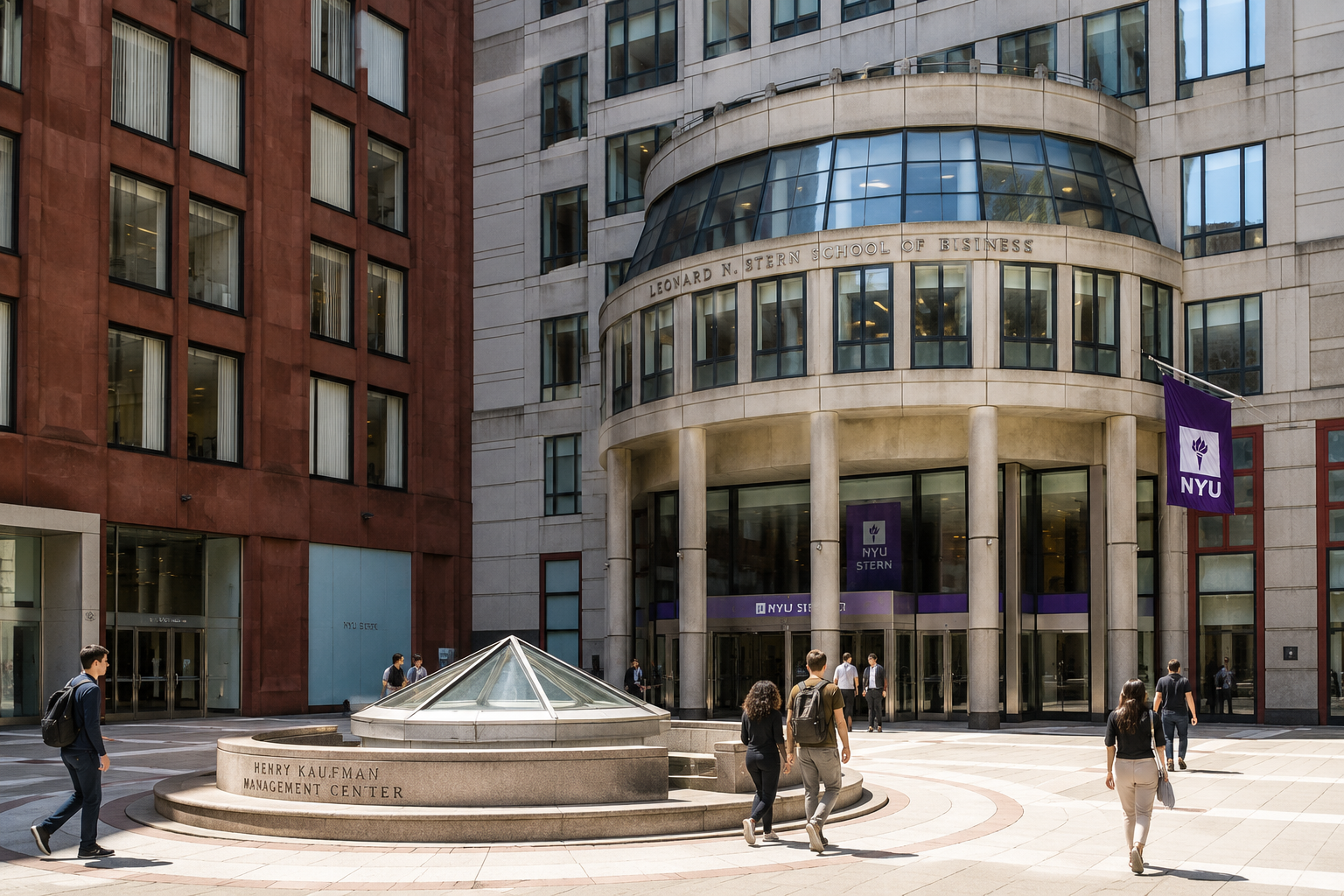
Start with the honest part. There's no campus in the traditional sense — no leafy quad, no stadium, no gates. Stern's MBA home is the Henry Kaufman Management Center (KMC to everyone here) at 44 West 4th Street, with Gould Plaza connecting it to the rest of NYU's downtown buildings. Your "quad" is Washington Square Park, which you share with street performers, the lone grand piano, the chess hustlers, NYU undergrads, and a steady current of tourists. New York is one of the most expensive cities in the country to be a student in, and it won't slow down for your finals. If your image of business school is a self-contained world where the whole class lives on one street, this isn't it — better to know now.
Now the part that's genuinely hard to get anywhere else. Greenwich Village is one of Manhattan's great neighborhoods for a reason: low-rise, tree-lined, and walkable in a city that mostly isn't, with more history and character per block than most cities can muster downtown. The food alone rewards two years of exploring — Joe's Pizza on Carmine for the classic slice, John's of Bleecker for the coal-oven pie, Mamoun's on MacDougal for falafel at 2 a.m., Murray's Cheese on Bleecker for the picnic you'll carry into the park, and Caffè Reggio for the old Village over an espresso. Think Coffee near campus is where study groups actually land between classes. And a couple of blocks from KMC, the Blue Note runs world-class jazz nightly while the Comedy Cellar on MacDougal is the room where the comedians you already know test new material — the kind of weeknight only this location offers.
Then there's the reason a lot of people come, and it deserves its own line: the recruiting is next door. Where classmates at other schools wait for firms to fly in, Stern students walk to them. Goldman Sachs, Morgan Stanley, JPMorgan, Citi, Evercore, Lazard, McKinsey — the offices you're targeting are a subway stop away, which is why internships here can run through the school year rather than only the summer, and why recruiters don't just interview on campus but sit on panels and host events all year. It's proximity Columbia shares and almost no one else can touch, and it may be the single most practical argument for doing your MBA in the middle of the financial capital.
The "I got in" Instagram photo: the Washington Square Arch, NYU's unofficial symbol, framing Fifth Avenue with the fountain in front. Caption it however you want — your feed will know exactly where you landed.
Here's the thing to understand about all of it: the city is the program. The same density that makes New York exhausting is what puts the firms, the alumni, and the experiential coursework within reach. The abundance is the appeal and the cost, seen from two angles. Whether that energizes you or wears on you is one of the more honest questions to ask yourself before applying.
Research, Faculty, and Intellectual Identity
What does Stern give you besides an enviable location? Start with two of the most recognizable professors in business. Aswath Damodaran — the finance world's "Dean of Valuation," whose corporate finance and valuation courses fill Stern's MBA classrooms and whose analysis turns up on CNBC and Bloomberg whenever a big IPO or a frothy market needs explaining — is the rare academic students keep following for years after they graduate. So is Scott Galloway, the marketing professor turned cultural fixture: co-host of the Pivot podcast with Kara Swisher, host of the Prof G pod, and a bestselling author who has become one of the sharpest public voices on tech and business.
The point isn't celebrity for its own sake. What MBA applicants actually want from faculty isn't a marquee name to study under — it's professors who are reachable, teach well, and stay with you — and at Stern the biggest names are, by reputation, also among the best teachers.
Behind them sits real intellectual gravity: a Nobel laureate in finance, Robert Engle, whose work on market volatility anchors Stern's Volatility and Risk Institute, and Jonathan Haidt, the Thomas Cooley Professor of Ethical Leadership, whose writing on moral psychology and technology's effect on a generation reaches well past business. And the city keeps the classroom stocked with people doing the work right now. Futurist Amy Webb, ranked among the world's top management thinkers, teaches Strategic Foresight to MBAs; former BuzzFeed president Greg Coleman teaches digital media; and Stern's adjunct bench runs deep with practitioners who might spend the morning on a trading floor or in a boardroom debating a merger and the afternoon teaching the students who want to do exactly that. For a school built on proximity to industry, that pipeline is part of the intellectual identity, not separate from it.
What NYU Stern Essays Are Actually Testing
Stern's written application is compact and unusually personal. (These reflect the most recent published cycle; confirm current prompts on the Stern site before drafting.)
Short Answer — Professional Aspirations (150 words)
"What are your short-term career goals?"
Stern doesn't ask why you need an MBA; it assumes you do. So don't spend words justifying the degree. Spend them showing that your goal is specific, credible, and connected to what you've already done — ideally with enough concreteness (a role, an industry, even a target firm) that the reader can picture the path. In 150 words, vagueness is the only real failure mode.
Essay 1 — "Change: ___ it" (350 words)
It can seem odd that a finance school — an industry practically built on tradition and the status quo — leads with change. That's rather the point. Stern's read on the moment is that finance and business are being rewritten by technology, and it wants people who lead through that rather than cling to the old playbook. The essay asks you to complete the school's brand line, "Change: ___," with a verb of your own — dare it, drive it, dream it, whatever is genuinely yours — then explain why it resonates and how you'd live it at Stern. Where this goes wrong is the word chosen to impress rather than to fit; an obscure or grandiose verb that doesn't match the rest of your file reads as a costume. The stronger move is the honest word, backed by real evidence, with a specific picture of how it shows up at Stern. The prompt tests clarity of thinking and self-awareness at once — the IQ and EQ halves in one short essay.
Essay 2 — Personal Expression, the "Pick Six" (PDF)
You introduce yourself in six images with a short intro (no more than three sentences) and a one-sentence caption for each. The medium is open — photos, infographics, drawings, collage — but content carries it, not production value. The version that works tells a small, coherent story about who you are, with images that don't duplicate the rest of your application. The version that falls flat is a scattered greatest-hits reel or a set of generic "I love to travel" stock shots. Choose six things that, together, let the reader understand you as more than a résumé and a transcript.
Optional essay
Space to give context on anything a reader might otherwise wonder about — a gap, a dip in the transcript, an unusual circumstance. When there's a real reason, give it, because a reader who doesn't know why something happened tends to fill the silence with a worse explanation than the truth. When there isn't, leaving it blank is the stronger move; this isn't a bonus essay. (Confirm the current word limit on the Stern site.)
A Note on "Why Stern" — Because There Isn't One
Applicants regularly search for Stern's "Why Stern" essay and come up empty. There isn't a standalone one, and that changes the strategy rather than removing it. The fit case has to live inside the pieces you do submit: the short-answer goals, where you can tie your direction to specific Stern resources, and the "Change" essay, where "how will you live this at Stern" is an open door to show you understand the place. The misstep here is assuming that because Stern doesn't ask "why us?" directly, fit doesn't need to show up. It does — it just has to be demonstrated through specificity rather than declared in a dedicated essay. The reader should still finish your file understanding why this school, for you.
Recommendations: The EQ Endorsement
Stern requires one MBA recommendation, which it calls an EQ Endorsement, and accepts an optional second. The single-letter requirement (most peers ask for two) means the one you submit carries real weight — choose with care.
What makes it distinctive is the framing. Stern asks for a specific, compelling example that demonstrates your emotional intelligence — self-awareness, empathy, communication, self-management — not a general endorsement of your competence. A current supervisor is preferred, and if you choose someone else you're asked to explain why; but the school is clear that the right endorser is whoever can tell the most genuine, specific story about how you work with people, even if that's a peer or colleague rather than the most senior name available. Brief your endorser accordingly: one real moment, told concretely, does far more than a paragraph of warm adjectives. The instinct to chase the impressive title is the thing to resist here.
The Interview, and What It Actually Evaluates
Stern MBA interviews are by invitation only, conducted by the admissions team, and held virtually. Unlike the blind interviews at some peer schools, Stern's are application-based — the interviewer has read your file. Decisions typically follow within a few weeks.
What it's actually evaluating: whether the person in the conversation matches the person on the page, and whether the EQ the application asserts shows up live. Because the interviewer knows your file, this isn't a fresh start — it's a check on coherence and presence. The applicant who wrote a thoughtful "Change" essay and then can't talk naturally about themselves introduces a question mark; the one whose in-person self confirms the written one removes it. The fix is simple to say and harder to do: make sure the self you put on the page is one you can actually be in a room.
Application Logistics
Tests: GMAT, GMAT Focus, GRE, Executive Assessment, LSAT, MCAT, or DAT accepted, with no stated preference and no minimum. Scores valid five years.
Test waiver: Available by request to Full-Time MBA applicants who can demonstrate quantitative readiness; the request deadline in the most recent cycle was April 1. NYU undergraduates with a strong GPA qualify automatically.
Application fee: $250.
Recommendations: One required EQ Endorsement; an optional second is accepted.
Transcripts: Self-reported at application; official copies required upon admission. International applicants whose instruction wasn't in English submit TOEFL, IELTS, or Duolingo scores.
Confirm the fee and any test-policy updates when the new cycle posts.
Deadlines and Round Strategy
For the 2026–2027 application cycle (Fall 2027 entry), NYU Stern has four deadlines for the Full-time MBA:
1st Deadline: September 15, 2026 — initial notification by December 1, 2026
2nd Deadline: October 15, 2026 — initial notification by January 1, 2027
3rd Deadline: January 15, 2027 — initial notification by April 1, 2027
4th Deadline: April 15, 2027 — initial notification ongoing
The "initial notification" is one of three outcomes — an interview invitation, a waitlist offer, or a denial; final decisions follow the interview and committee review. Stern typically posts the next cycle's dates in early summer; confirm on the Stern site before you plan. The Andre Koo Tech MBA and Fashion & Luxury MBA run on their own timelines (below).
On round strategy: What i tell clients
Stern's round calendar has a quirk worth understanding: a Round 2 deadline in mid-October, just a month after Round 1. Most schools jump from a September R1 to a January R2, which leaves applicants who miss R1 facing a long wait. Stern's October round is a genuine early option for someone who couldn't quite finish for September but doesn't want to slip to January. As at most schools, earlier is generally better — more scholarship runway, more time for international visa processing, and a stronger signal of planning — and international applicants should aim for R1 or R2, since R3 is the last round open to them. But the more important variable is readiness. A polished R2 or R3 application does more for you than a rushed R1 one, and the "Change" essay and Pick Six in particular reward the time it takes to get them right rather than fast.
The Specialized MBAs: Tech and Fashion & Luxury
Worth understanding even if you're applying to the two-year MBA, because applicants frequently weigh them.
Stern runs two one-year, focused MBAs. The Andre Koo Tech MBA is a STEM-designated, technology-focused program built for applicants who want a compressed degree pointed squarely at tech, with Stern Solutions experiential work at its core. The Fashion & Luxury MBA is a one-year program (running roughly May to May) for applicants targeting those industries, pairing a general-management core with fashion- and luxury-specific coursework and immersions — an area where Stern's New York location and industry ties are a genuine differentiator.
Who they're for: applicants who already know they want tech, or fashion and luxury, and want to spend one year going deep rather than two years ranging widely. Who they aren't for: applicants who want the full two-year experience, a summer internship to pivot industries, or the breadth of the traditional MBA. If you're undecided, the two-year MBA is usually the safer default — it's broader, includes the internship, and still lets you specialize. The focused programs are the right call when you specifically want what they offer.
Employment Outcomes, Read for What They Signal
For the Class of 2025, the median base salary was $175,000 — a record for the school, matched across the last three years — with average total compensation around $210,000, and roughly 85% of graduates accepting an offer within three months.
Where they landed
Financial services was the top destination at about 37% of the class, with investment banking alone accounting for 28% of offers, the highest in six years. Consulting followed at about 33% (down from roughly 42% two years earlier, reflecting an industry-wide hiring slowdown more than anything specific to Stern), and technology rebounded to about 14%. Together, finance and consulting took more than 70% of the class.
What this signals about fit
The geography is the single most important data point for fit. Stern's outcomes are heavily concentrated in the Northeast — more than 80% of the class — and overwhelmingly in New York City. That's not a limitation so much as a defining feature: Stern's network is densest exactly where its graduates cluster, and they cluster in New York. If your goal is a New York career in finance, consulting, or a Stern-strong specialty, the program runs with the current. If your goal requires the West Coast or a specific non-coastal hub, you can get there from Stern, but you'll be working against the gravity rather than with it.
One quiet signal in the consulting number is worth reading correctly. The drop from 42% to 33% looks alarming in isolation, but it tracks a frozen consulting hiring market across all top programs, not a Stern-specific problem — and finance and tech absorbed the shift. The pattern that holds steady is the one that matters: Stern places into the highest-compensation roles in the country's biggest market, and does it on the strength of recruiting relationships that are right outside the door.
Cost and Financial Aid
Annual tuition (2025–2026): $89,524
Estimated total cost of attendance: approximately $135,840 per year, reflecting New York City living costs
Aid approach: Merit-based. Roughly 20–25% of admitted full-time students receive scholarships, considered automatically upon admission. Teaching fellowships, assistantships, and outside scholarships supplement. Loan options exist for both domestic and (via partners) international students.
The practical point: because Stern's aid is merit-based rather than need-based, strong candidates can receive scholarship offers regardless of financial need — an advantage for applicants whose finances wouldn't qualify them for the need-based aid at schools like HBS or Stanford. The honest counterweight is the cost of living: New York is among the most expensive places in the country to spend two years, and the full cost of attendance reflects that. Budget for the city, not just the tuition.
Rankings, in Context
Stern's rankings tell an interesting story when you read them side by side rather than one at a time. On the U.S.-focused lists it sits near the top: around #7 in the most recent U.S. News ranking — up from 12th just three years earlier, and level with Columbia — and around #6 in the Poets & Quants composite, with a top-tier placement (~#12) in Bloomberg Businessweek's U.S. ranking. On the global lists it reads more modestly: roughly #23 in the most recent Financial Times Global MBA ranking (after a sharp drop the prior year and a partial recovery) and around #21 in LinkedIn's global ranking.
That LinkedIn placement is worth pausing on, because the ranking is a useful one. LinkedIn's Top MBA Programs list is built almost entirely on real alumni outcomes — hiring demand, how quickly graduates reach director- and VP-level roles, and the strength of the alumni network — drawn from its own platform data, rather than on the input metrics (test scores, acceptance rates) and reputation surveys that drive the traditional media rankings. Read next to Stern's strong U.S. showings, the pattern is consistent and says something real: Stern's outcomes are excellent in the market where its graduates concentrate, while the more globally weighted methodologies soften a bit for a New-York-anchored program that clusters its alumni in one very large, very lucrative market rather than spreading them across the map.
The read I'd give a client: Stern is unambiguously a top-tier program with elite outcomes in its core markets, and the year-to-year movement says more about methodology than about the school. Use rankings to confirm a school is in your range, not to break a tie between two programs you're genuinely choosing between. For that decision, the comparison below does more honest work than any number.
How NYU Stern Differs from Columbia Business School
This is the most-searched Stern comparison, for the obvious reason: two top business schools in the same city, both strong in finance, both feeding the same Wall Street firms. Let's name the elephant first. Columbia is Ivy League and Stern isn't, and if that distinction genuinely matters to you — the brand, the association, what it signals to certain audiences — that's a real and legitimate reason to weight Columbia. On the outcomes that actually shape a career, though, the two are peers, so the more useful differences are about the programs themselves, not the name on the diploma.
Location and texture
Stern is downtown, in Greenwich Village around Washington Square — a denser, more bohemian, more neighborhood-feeling slice of Manhattan. Columbia is uptown, in its newer Manhattanville campus in Morningside Heights, more self-contained and more classically "university." Both are New York, but they feel like different New Yorks, and that daily texture is a real input.
Structure and entry
Stern is a fall-entry, two-year program with a summer internship built in. Columbia offers both an August start and a January (J-Term) start, the latter a shorter track without a traditional summer internship that draws sponsored candidates and family-business students. If you need the internship to pivot industries, that difference matters.
Identity and application
Both schools are finance-serious and expect a polished, professional file — that part they share. Where they diverge is expression: Stern's IQ + EQ identity, its EQ Endorsement, and its "Change" and Pick Six prompts make for a more personality-forward application, while Columbia's set stays more conventional. Neither is better; they reward slightly different instincts.
Specialization
Both are finance powerhouses. Stern has built distinctive strength in luxury and retail, media and entertainment, and tech product areas, with dedicated specialized MBAs. Columbia has its own depth in finance, real estate, and value investing, plus a strong global brand. The right question isn't which is stronger overall, but which is stronger where you're headed.
The cross-admit decision
Applicants choosing between them usually decide on location feel (downtown Village vs. uptown campus), structure (two-year with internship vs. the J-Term option), and which school's particular strengths match their goals. Most cross-admits want elements of both, which is exactly why this is worth sitting with rather than resolving on rank order. Neither choice is wrong; they optimize for different things.
Signals You Might Be a Strong Fit
MBA School Fit is hard to feel from the outside, so here are concrete, checkable signals. If two or three of these sound like you, you're probably reading Stern correctly.
You can name a real moment your emotional intelligence changed an outcome. Not "I'm a people person," but a specific situation — a conflict you defused, a team you steadied — that you'd be comfortable having a colleague describe in your EQ Endorsement.
New York itself is a top reason you're applying — Wall Street access included. You want the city woven through your two years: recruiting a subway ride from the trading floors, weeknights out in a Village that's been the set of a hundred movies, and the quiet thrill of getting to live there the way you've always pictured. It's a plus that Penn Station and Grand Central put your friends at Wharton or HBS a train ride away, that three airports make a spur-of-the-moment trip with classmates genuinely doable, and that the bagels and pizza are, in fact, that good. The cost and the crowds read as a fair price, not a dealbreaker.
You're analytically serious and want to be. Quant-forward coursework sounds like the point, not the price of admission, whether or not your background is technical.
The "Change" essay and Pick Six sound like a chance, not a chore. Telling your story in one word and six images strikes you as a welcome break from formulaic goals essays. That instinct usually means you'd enjoy how Stern reads people.
Your goals point at finance, consulting, or a Stern-strong specialty. You can connect your direction to where Stern actually places — finance, consulting, luxury and retail, media, real estate, tech — in a way that uses the network as it's built, not against the grain.
Signals You Might Not Be the Best Match
The honest counterpart to the section above. None of this means you wouldn't be a strong applicant somewhere, or that you shouldn't apply here — that's your decision. It means the specific match with Stern is worth examining before you spend a cycle on the application.
It may not be the best match if your goals pull strongly toward the West Coast or a specific non-coastal hub. Stern's network and recruiting gravity run through New York and the Northeast. You can reach other markets from Stern, but you'd be working against the current rather than with it, and a program anchored closer to where you're headed is worth weighing honestly.
It's a harder fit if you want a contained, all-on-one-campus experience. Stern's community is real, but the city competes for your attention in a way a self-contained program's doesn't. If the idea of building your cohort connections against the pull of New York sounds draining rather than energizing, a more contained program may suit the way you like to work — and that's worth sitting with.
It's worth questioning whether the environment suits you if you're at your best in quiet. This is the city that never sleeps — sirens, crowds, construction, and canyons of tall buildings are the daily texture, not the exception. If you do your clearest thinking in calm and open space, if constant noise wears you down rather than charging you up, or if you need to be able to step outside and touch grass, that's real self-knowledge worth honoring. Plenty of excellent programs sit in calmer places, and choosing one of them over Stern isn't settling — it's matching the setting to how you actually recharge.
And it's worth questioning whether Stern's expressive, EQ-forward application fits you if the Pick Six and the "Change" essay feel like obstacles rather than openings. Those prompts aren't decoration; they reflect how the school reads people, and that emphasis continues once you're enrolled. If they make you want to opt out, that reaction is itself information — a more conventionally structured program might be a more comfortable home.
If two or three of these land, treat it as a prompt rather than a verdict. The most useful next step is usually to ask whether the schools that fit you better are programs you're genuinely as excited about — and to do that fit work honestly now, while it can still shape where you apply.
When Working With Someone Helps, and When It Doesn't
Stern's application rewards outside input in a few specific ways, and none of them is about polishing prose. The first is the hardest thing about the whole file: revealing your authentic self. The Pick Six and the "Change" essay ask you to be genuine in a way most accomplished applicants instinctively resist — we're trained to present, not to reveal — and an outside reader earns their keep right there, helping you find the true version rather than the impressive-sounding one. The second is a positioning problem specific to Stern. If you come from a non-quant background, the work is convincing a leading quant school that you belong in it. And if finance and New York are your obvious draw, the work is making sure you don't read as someone applying just to live in Manhattan or land a Wall Street job — because Stern wants to know you're there for the school, not only the city and the paycheck. Those are strategy questions, and they're easy to get subtly wrong on your own.
That said — no consultant can manufacture self-awareness, and Stern's application is largely a self-awareness test. If you haven't done the reflective work, no amount of editing produces an honest Pick Six or a "Change" word that's actually yours. The work is yours; the support is in the questions that get you there faster and the outside eye that tells you when you've arrived.
If you'd like to talk through whether your application is at the stage where outside input would help, a free consultation is a low-pressure way to find out. We'll talk about where you are, what Stern is likely to weigh in your case, and what matters most before you draft.