Berkeley Haas: What This School Is Looking For
Berkeley Haas tells you what it's looking for more plainly than almost any school in the country, and it does it in four short phrases: Question the Status Quo, Confidence Without Attitude, Students Always, Beyond Yourself. These are the Defining Leadership Principles, and they aren't a marketing tagline you can safely skim past. They're carved into the stone of the courtyard, they shape how the admissions committee reads files, and they're what your alumni interviewer will actually ask you to demonstrate with specific examples. So the literal answer to "what is Haas looking for" is people who already live those four principles.
Which is the layer where a lot of strong applications quietly lose ground. It's tempting to read four named principles as a checklist to perform — one tidy anecdote per phrase, dutifully labeled. Haas can see that coming, and it has told applicants directly not to do it: don't force your stories into a box or announce "I demonstrate Beyond Yourself because X, Y, Z." The principles aren't four boxes to tick. They describe a single kind of person, and the application's job isn't to claim the labels. It's to give the reader evidence that the person behind the file already is that kind of person — the same shift that runs underneath every strong MBA application. Not "here is how impressive I am," but "here is how I'll add to this community, in language a reader can carry into the room and advocate for."
Hold onto the four principles, because almost everything below follows from them — what the essays are testing, who thrives here, why a glittering résumé without the cultural signal doesn't quite land.
Berkeley Haas
Berkeley Haas tells you what it's looking for more plainly than almost any school in the country, and it does it in four short phrases: Question the Status Quo, Confidence Without Attitude, Students Always, Beyond Yourself.
What Haas Is Actually Trying to Build
Haas frames itself around culture more deliberately than most of its peers, and there's a reason the Defining Leadership Principles feel load-bearing rather than decorative. They were codified by Rich Lyons during his time as Haas dean — and Lyons is now the Chancellor of UC Berkeley. The person who built the school's culture framework now runs the entire university. When a school's stated values and its leadership are that continuous, you can take the culture statements at face value in a way you can't everywhere. The current dean, Jenny Chatman, is herself an organizational-culture scholar, which tells you the school treats this as a serious operating system rather than wall art.
You can see the principles in who the school produces. Years of Haas graduates have built mission-driven companies — Revolution Foods, the healthy-school-lunch company founded by two Haas MBAs who met on their first day of the program, is a clean example of what Beyond Yourself looks like carried into a career. So it's worth reading the four principles as what the school is genuinely selecting for, not as slogans.
Question the Status Quo reads for people with a track record of challenging a process, a market, or an assumption and building something better — the entrepreneurial instinct the Bay Area both attracts and amplifies. Confidence Without Attitude is the principle Haas talks about particularly warmly, and it's a paired requirement: real conviction in your own judgment, held without the ego that needs to dominate a room. Students Always reads for intellectual humility and curiosity that didn't stop at graduation — the disposition that makes a small, collaborative cohort work. And Beyond Yourself is the contribution principle: leadership in service of something larger than your own advancement, and where the school's deep social-impact and sustainability threads live.
A word on how to use these: applicants sometimes decide one principle — usually Question the Status Quo — is "the one to write about." It isn't. None of the four is the password. They describe a single kind of person, and the strongest applications let all four show up naturally across real stories rather than building one anecdote per phrase.
Set against the question every top program is answering, Haas isn't selecting for the highest score or the most recognizable employer. It's selecting for evidence that you already operate the way its culture runs — confident but coachable, driven but generous, willing to question what others accept. Dean Chatman has framed the school's ambition as doubling down on "what makes us high-impact humans" across four priority areas: AI, entrepreneurship, sustainability and social impact, and health. That's the backdrop your application is read against. The work is to show the reader the principles already in you, through real stories, rather than to announce them.

Who Genuinely Belongs Here
When clients tell me they're drawn to Haas, I move them off the question they usually arrive with — "are my numbers good enough?" — because at Haas, more than almost anywhere, culture eats credentials for breakfast. The more useful question is whether the way you already work matches the way Haas works.
The cleanest test is the one the school built into its own language: Confidence Without Attitude. Picture how you actually show up in a team. The applicant who fits Haas holds a real point of view but wears it lightly — sure of their judgment without needing the room to know it, quick to credit others, comfortable changing course when a teammate has the better idea. It's a distinctly Californian register, low on the sharp-elbowed, prove-it-to-me edge you find at some stiff-collared East Coast programs. That profile sounds easy to claim and is hard to fake, because recommenders and interviewers are asked about it directly, and the people who've worked with you know which version you are.
The second marker is genuine curiosity with a result attached. Students Always isn't about academics; it's about whether you treat every room, every project, every person as something to learn from. If you've ever taken a strengths assessment and "Learner" sat near the top, you know the disposition — the reflex to keep getting better rather than to arrive. The strongest Haas files show someone who has consistently questioned how things were done and then did the work to build something better — the entrepreneurial reflex the school's first principle names, applied at whatever scale you had access to. You don't need a startup. You need a pattern of not accepting the default.
Read against the whole frame, the applicant who belongs at Haas is someone whose colleagues would describe in almost exactly the school's own words without ever having seen them — confident, humble, curious, generous. If that portrait feels like a stretch you'd be performing rather than a description of how you already operate, that's worth sitting with honestly. If it feels like a relief to read, you're probably reading the school correctly.
The Class Profile, Read Honestly
The most recent confirmed class — the Class of 2027, entering Fall 2025. Haas has one of the smaller cohorts among top programs, which shapes much of what daily life here feels like:
Where They Worked Before
Other industries include government, entertainment, real estate, and energy. Bars show share of the entering class.
What They Studied
Other majors include math/physical sciences, natural sciences, and arts/humanities. Bars show share of the entering class.
A few things that are easy to misread in these numbers:
The class is small, and that changes what the numbers mean
At 273 students, Haas runs one of the smallest classes in its tier — closer to Stanford or Tuck than to the 900-plus cohorts at HBS or Wharton. That's a design choice: the school is genuinely assembling a group, not filling a hall, and a single person who's out of step with the culture is felt more in a small community than a large one. Your application's job is to show what you'd add to a specific small room.
The test ranges are wider than the medians suggest
The GMAT 10th-edition middle 80% runs 669 to 767, and the Focus band 637 to 725 — the 730 median is not a floor. Haas reads test scores as evidence of academic readiness, and weighs the quant side particularly closely as the clearest signal you can handle the curriculum, but a number off the median is absorbed by a file that's strong elsewhere. There's no published minimum, and the GMAT and GRE are read on equal footing — pick your stronger test and aim to land inside the relevant band.
Work experience tracks what you did with the time, not the clock
The 5.6-year average sits in a wide band (roughly three to eight years). Haas reads for impact commensurate with experience: four years with a real record of consequence reads stronger than eight years of competent coasting.
The background mix is broader than the Silicon Valley reputation suggests
Consulting, tech, and finance lead — together about two-thirds of the class — but that leaves a real share from healthcare, nonprofit, the military, and government. And the 18% first-generation figure tells you Haas reads context: a 3.4 earned while working through school reads differently from a 3.4 with no such obligations, and the application gives you room to supply it.
The profile isn't a bar to clear. It's a picture of who Haas read as a fit. Your job is to give the reader evidence that places you in it.
Common Myths About Haas
"Haas is the Berkeley hippie school — it's all activism and social impact."
Here's the honest answer: the first half is more true than applicants expect, and the second half is the misread. Sustainability and social impact aren't a marketing veneer at Haas — they're ingrained in the culture, woven into Beyond Yourself, the curriculum, and the way the place thinks about business. That's real, and it's not going anywhere. What's false is the assumption that this is in tension with commercial seriousness. The same school sends 39% of graduates into technology, 27% into consulting, and 16% into financial services, at compensation that competes with any program in the country. Caring about impact and being commercially serious aren't opposites here. The school is built on the premise that they're the same thing — and activism, for most people who hold these values, was never the day job anyway.
"It's a tech-only school."
Tech is the largest single destination, but consulting is the top function at graduation, ahead of finance, general management, and tech, and the firms hiring most here include Bain, BCG, Deloitte, and McKinsey alongside Adobe, Amazon, Google, and NVIDIA. If your goals sit outside tech, Haas is a strong fit with a tech-heavy zip code, not a stretch.
"Haas is in Silicon Valley."
A small but common one, and worth correcting because it shapes expectations about daily life. Haas is in Berkeley, in the East Bay — not in the Valley. Silicon Valley sits about an hour south by car or train, depending on traffic, which can be heavy. The network reaches deep into the Valley and the proximity is a genuine asset, but your two years are lived in the East Bay, with San Francisco across the water, not in Palo Alto.
"Public school means it's easier to get into and less prestigious."
The first half doesn't hold: Haas is consistently among the more selective programs in the country, and its small class makes seats genuinely scarce. The Full-Time MBA now sits at #10 in U.S. News — the top public program in the country — with strong showings across the Financial Times and Bloomberg Businessweek rankings. But there's a real consideration the "public" label points to, and it's not prestige: scholarship resources. As a public school, Haas's aid budget is more exposed to state funding than a wealthy private peer's endowment-funded aid. The University of California has been navigating significant state budget pressure, and that's worth factoring into how you think about merit money and timing (more in the cost section below). The caliber of the room isn't the question. The predictability of the aid pool is the more honest one.
"The Defining Leadership Principles are just branding."
The opposite of decorative. They're carved into the building, they organize the interview, and the dean who created them now runs the entire university. Treat them as the actual evaluation framework — and treat that as useful information, since few schools hand you their rubric this directly.
Identity and Program Basics
The Haas School of Business at the University of California, Berkeley, on the Berkeley campus in the East Bay, across the water from San Francisco and about an hour north of Silicon Valley. Founded in 1898 — the second-oldest business school in the United States, the oldest at a public university, and notably the only one founded by a woman, Cora Jane Flood. Two-year, full-time MBA, with a small class of roughly 270. The school is part of the broader UC Berkeley research university, which shapes much of what makes the program distinctive: MBA students can take up to two courses (six units) in other top Berkeley graduate schools, including Law, Engineering, Public Health, and Information.
The Curriculum, and What It Reveals
Haas runs a general-management MBA with a flexible structure — a foundational core, a wide elective catalog, and the latitude to reach well beyond the business school. That cross-campus reach is the curricular feature that most reveals the school's identity. Taking graduate courses at Berkeley Law, Engineering, Public Health, or the School of Information isn't a marketing line; it's a structural advantage of sitting inside a leading public research university, and the students who thrive here are the ones who use it.
Entrepreneurship is where that reach becomes most concrete, and it's a bigger part of the Haas experience than the rankings alone convey. The Berkeley Haas Entrepreneurship Program and its eHub are the front door to one of the deepest startup ecosystems in higher education — UC Berkeley is regularly ranked the number-one university in the world for producing startup founders. Students plug into SkyDeck, Berkeley's accelerator (a joint venture of Haas, the College of Engineering, and the research office), pitch for early grants through funds like the Trione Student Venture Fund, and work alongside engineers and scientists across a campus built for exactly that kind of collaboration. If building something is part of why you want the MBA, this is a real differentiator rather than a line item — and the new Haas Ventures fund, in the works to back Berkeley-affiliated founders, signals where the school is investing.
The other priorities show where else the school is heading. Under Dean Chatman, Haas has leaned into AI, sustainability and social impact, and health alongside entrepreneurship: a Haas AI certificate is rolling out with a flagship course launching in 2026, built for every student rather than just the engineers. Sustainability isn't an afterthought, either — the school's Chou Hall was built to be one of the greenest academic buildings in the country, a fitting home for a program where environmental and social impact run through the culture.
The throughline is a school that assumes you'll customize and expects you to reach. The flexible core and open campus hand you a large menu; the applicant who arrives knowing what they want to build gets enormous leverage from it, and the passive one underuses the place.
Culture and Community, Beyond the Marketing
Haas talks about culture more than most schools — and to its credit, the culture mostly matches the talk, in part because the program is small enough that it has to. With a class of around 270, you'll see the same people repeatedly across two years, and the Defining Leadership Principles function less as wall art than as a shared social contract: collaborative by default, low on the zero-sum jockeying that defines some larger or more finance-heavy programs.
Read the marketing with one caveat, though. "Collaborative" is true, but it isn't the same as "easy." A small, principles-driven community can be quietly demanding about how you show up — it notices the person who takes more than they give, or who performs the principles rather than living them. For the right person, that accountability is the appeal. For someone who'd rather blend into a big class, it can feel like more visibility than they wanted.
The clubs and conferences cluster around the school's identity — technology, entrepreneurship, social impact, sustainability, and finance, alongside the affinity groups that anchor an unusually diverse cohort. Scanning which organizations are most active tells you more about the day-to-day texture than any brochure.
The “I got in” Instagram photo: the Campanile (Sather Tower) framed against the bay with San Francisco in the distance, or the Haas courtyard with a Defining Leadership Principle carved in the stone at your feet. Either one tells your feed exactly where you landed.
Life at Haas
Here's the part the campus tour underplays: what it's actually like to spend two years here.
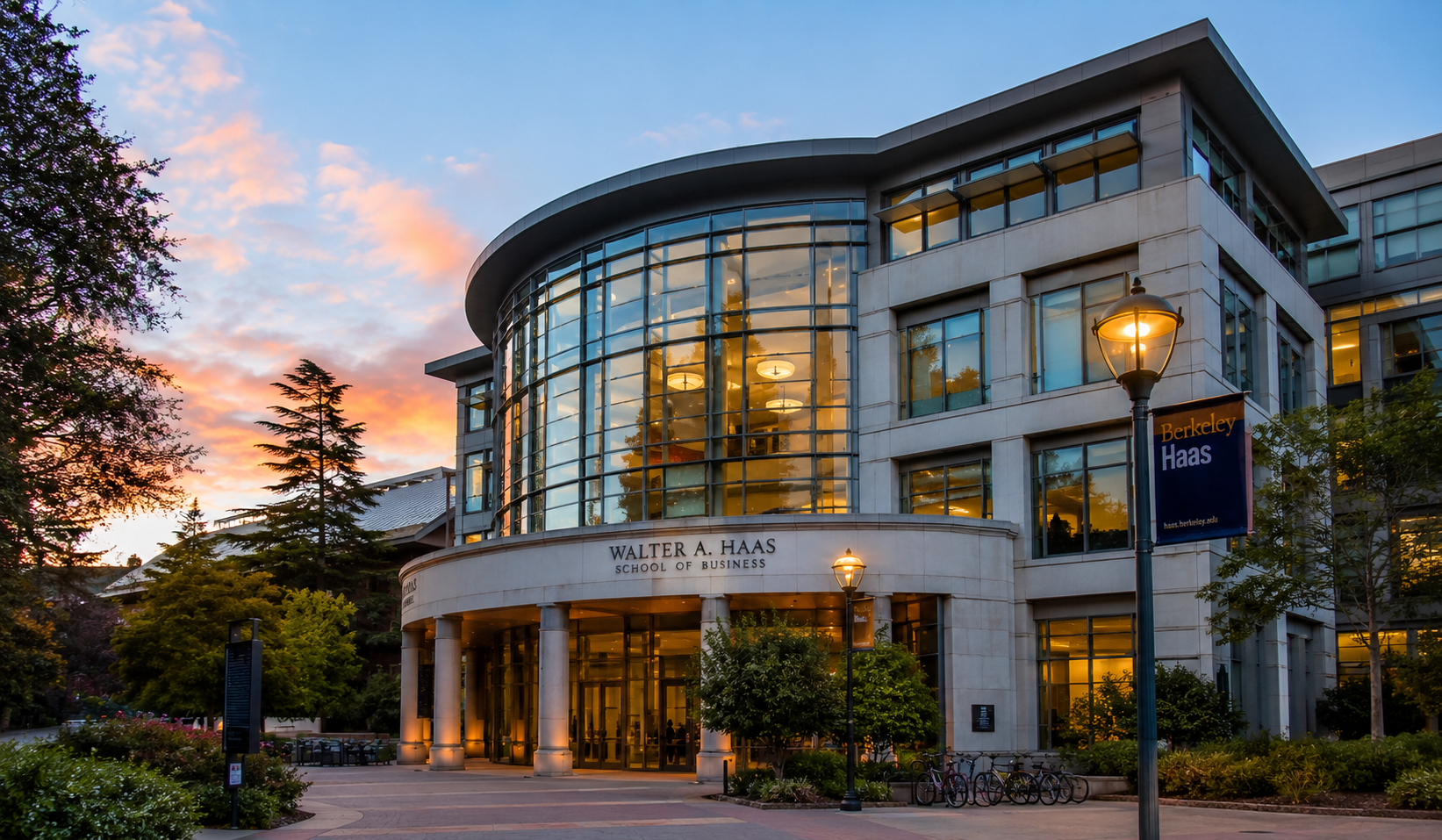
Start with the setting, because it's a genuine draw. Berkeley sits in the hills on the east side of San Francisco Bay, and the campus is one of the prettier ones in American higher education — Sather Tower (the Campanile) rising over everything, eucalyptus and bay views, a February afternoon more likely to be sunny and sixty than gray. The Haas complex itself, three connected buildings wrapped around a central courtyard, is where you'll spend most of your time, and where the Defining Leadership Principles are literally set in stone underfoot. Telegraph Avenue and the student neighborhoods give Berkeley its character — bookstores, cheap and excellent food, a counterculture streak the city has never shed and doesn't want to. Cheese Board Pizza, the collective up on Shattuck with a single rotating pie each day and a line out the door, is the kind of local institution that tells you you're somewhere specific.
Now the honest part. The Bay Area is one of the most expensive places in the country to be a student, and Berkeley is no exception — budget seriously for housing, and know that a car makes life easier even with BART running into San Francisco in about half an hour. The city is gritty in patches; the romance is real but not polished. And a word for international applicants in particular: Berkeley weather is not Los Angeles weather. It's genuinely pleasant — mild, often sunny — but it runs cooler and grayer than Southern California, with a real chill in the mornings and evenings and a damp, foggy stretch that surprises people who pictured palm-tree warmth, especially in spring. None of this is a dealbreaker. It's the texture you're signing up for, better weighed now than discovered in October when you arrive on campus with suitcases in hand.
What the location buys you is proximity to the thing itself. San Francisco is across the bay; the venture firms and the companies your classmates will join or start are a short drive south. For the applicant who wants to be where technology and business actually get built — without paying Palo Alto prices to live there — Berkeley is a hard combination to beat.
The "I got in" Instagram photo: the Campanile (Sather Tower) framed against the bay with San Francisco in the distance, or the Haas courtyard with a Defining Leadership Principle carved in the stone at your feet. Either one tells your feed exactly where you landed.
Research, Faculty, and Intellectual Identity
Berkeley's intellectual horsepower is part of what you're buying. The broader university counts multiple Nobel laureates among its economists, and Haas faculty are visible well beyond campus on culture, behavioral economics, finance, and the strategy of technology. What MBA applicants actually want from faculty isn't a marquee name to study under the way a PhD applicant chooses an advisor — it's professors who teach well, are reachable, and remember who you are. At a class size of 270, that access is real.
It's also worth knowing the kind of thinking that gets made here. This is the campus where David Teece developed the theory of "dynamic capabilities" — a framework for how firms adapt and compete that's taught in business schools around the world, the kind of foundational idea that signals a school's intellectual weight the way Porter's Five Forces does at Harvard. Dean Chatman's own field — organizational culture and how it actually drives performance — is part of why Haas treats its culture as a serious operating system rather than a slogan, and former dean Laura Tyson, who chaired the Council of Economic Advisers under President Clinton, still anchors the school's reach into public and economic policy. You may or may not end up in a given professor's classroom, and that's not the point. The point is that studying inside a research university doing work at this level, across many fields and not just business, is its own kind of education.
The alumni base tells the same story in a different register — a network of more than 40,000 across 80-plus countries, weighted toward people who built things. Shantanu Narayen (MBA) chairs and runs Adobe; John Hanke (MBA) founded Niantic, the company behind Pokémon Go, after his earlier company became Google Earth and Maps; Kristin Richmond and Kirsten Tobey (both MBA) built Revolution Foods into a national healthy-school-lunch company; Paul Otellini led Intel as CEO. The through-line isn't an industry. It's people who questioned a status quo and built something — which is exactly what the school says it's selecting for.
What Haas Essays Are Actually Testing
Haas reviews its essay questions every year and made small adjustments for the current cycle while keeping the core intact. The current set is two required essays plus an optional supplemental. (Confirm exact wording and limits on the Haas site before drafting — the school tunes these annually.)
The video essay (required, up to two minutes)
Haas asks you to introduce yourself, share what makes you feel alive, and surface one thing about yourself that isn't evident elsewhere in the application. This moved from a written essay to video a couple of cycles ago, and the introduction component was added this year — and the shift is worth understanding, because it's part of a broader pattern. Schools are increasingly worried that AI-assisted writing flattens an applicant's real voice, smoothing essays into something polished and generic that tells the reader nothing true. Video is harder to outsource that way, which is much of why Haas and others are leaning into it.
So here's the frame to keep in mind, because it takes the pressure off. Step back and remember the decision the admissions committee is actually trying to make. They want to see who you really are. They already know you're a work in progress — everyone applying is — and that's fine. What they need is to understand you well enough to judge how you'll contribute to the cohort. That means the video isn't a test of polish, and it isn't a test of your verbal skills. Don't freak out thinking it has to be flawless. It's an opportunity to let them see the real you and make a better-informed decision about you — which, done honestly, is the whole point.
The career-goals essay (required, roughly 300 words)
This asks about your post-MBA goals, the Berkeley resources you see helping you get there, and how you'll stay adaptable as your career evolves. A meaningful change for this cycle: the school has placed more emphasis on short-term goals and trimmed the long-term-goals question, on the reasoning that plans shift once you're inside the program and the economy keeps moving — so adaptability is now part of what's being tested. Where this essay goes wrong is spending its scarce words explaining Berkeley back to Berkeley. The readers know their own school. The stronger version uses your knowledge of Haas to choose which specific resources connect to a credible short-term goal, and treats adaptability as a real disposition you can evidence, not a throwaway line.
The optional "Distance Traveled" supplemental (roughly 300 words)
This is the one that trips people up — "optional" makes some applicants anxious that they're supposed to submit something, and others rush to manufacture a hardship to fill the space. Neither is the move, and understanding why the school asks clears it up. Haas builds its class very deliberately from a wide range of backgrounds, on the premise that students learn as much from each other as from the faculty. This prompt exists to surface the formative context that shaped you — the experience, environment, or vantage point that's yours and helps the reader understand the perspective you'd bring to the cohort. It's also where you can give context for something the rest of the file might raise a question about, like a dip in undergraduate performance or a nonlinear path. So the direction is simple: if you have a real story — where you come from, an obstacle you navigated, a turn that explains how you got here — and it adds something the rest of your application can't, use the space, and draw the line from that experience to what you'd contribute. If you don't, leave it blank. It's genuinely optional, and a manufactured story is worse than none.
One thread runs through all three: the Defining Leadership Principles. They aren't named in the prompts, but they're central to how the essays are read, and Haas has said directly that it doesn't want you forcing your stories into the four labels. The principles should show up the way they show up in real life — in the choices you describe, not in the headings you write.
What "Why Haas" Belongs Inside Your Career Goals Essay
Haas doesn't run a standalone "Why Haas" essay; the fit case lives inside the career-goals essay, which makes the connection easy to underweight. Don't. The school has said plainly that a strong connection to Haas is what separates a compelling goals essay from a generic one — and that the way to build it is to understand what makes Berkeley distinctive and tie it to how the MBA will move you toward your short-term goal.
Where most applicants fall short is the name-drop — a club, a professor, a course, listed to prove they did the reading. Every applicant can name a club. The version that lands is the one where the detail does real work: if cross-registration with Berkeley Engineering is the actual mechanism for the pivot you're making, say so and say how. And if you're building something, this is where Haas's entrepreneurship ecosystem earns its place in the MBA essay — not as a logo to mention, but as the specific path you'd take. An applicant who can name how they'd use the eHub, take a venture through SkyDeck, or tap the Trione fund to test a prototype is describing a plan, not admiring a brochure. The test is whether the detail could be swapped for a different school's and survive. If it could, it's research. If it couldn't, it's fit.
Recommendations
Haas requires two recommendations and uses the GMAC Common Letter of Recommendation — the shared question set that many schools have adopted, so your recommenders answer the same questions regardless of where you apply. The reason schools ask for letters at all is that they want to see how others see you. In a world where your own footprint is all over the internet, an outside account still carries real weight — especially from someone who knows you well. Haas made a deliberate point about this recently: too many letters had started to read as AI-smoothed, sanding off the specific observations that make an MBA recommendation useful. The common form is meant to push recommenders back toward real stories.
Which tells you exactly how to choose and brief them. Seniority is not the point; specificity is. A direct manager who has watched you work and can describe how you actually show up — how you take feedback, where you lead, how you treat the people around you — does far more for you than a senior name offering warm generalities. Given the culture, the most valuable letters speak to the Defining Leadership Principles without naming them: the recommender who can describe you holding a strong view and then changing your mind gracefully, or pulling a struggling teammate up, is handing the reader evidence of Confidence Without Attitude and Beyond Yourself in action. Have the real conversation with your recommenders — about your goals, what the MBA means to you, where you've had impact — so the letter has something specific to say.
One practical caveat about the common letter. Because the same letter goes to every school that uses it, the Haas-specific framing above only works cleanly if Haas is the one school your recommender is writing for — or if you ask them to write a tailored version, possibly using a different recommender for it. Don't load a single common letter with Defining Leadership Principles language and then send it to Haas plus eight other programs; the DLP framing won't land at the others, and the letter can read as oddly Haas-shaped everywhere else. The common letter is built to spare recommenders from writing the same thing nine times, which is genuinely useful — but the tradeoff is exactly that lost ability to tailor. Decide which letters you want general and which (if any) you want school-specific before your recommenders start writing.
The Interview, and What It Actually Evaluates
Haas interviews are by invitation only, conducted by alumni and current students, and typically behavioral. They're often held remotely and may pair a live conversation with a recorded video component.
What it's actually evaluating is fit with the culture, made concrete. This is where the Defining Leadership Principles do explicit work: interviewers are asked to probe for specific examples of how you've demonstrated impact and lived the principles. The interviewer will frequently have only your résumé in front of them, which is part of why Haas tells applicants to treat the résumé as the table of contents for the whole application — it's often the document the conversation runs on. The applicants who do well arrive with real stories already in hand, not principle labels to recite. The test underneath is whether the confident-but-humble, curious, generous person described in the file is the same person who shows up in the room.

Application Logistics
Tests: GMAT or GRE accepted, no preference; quantitative performance weighted closely as a readiness signal. No published minimum.
Recommendations: Two, via the GMAC Common Letter of Recommendation.
Résumé: One page preferred; two can be acceptable with substantial experience (roughly the ten-year mark), but concise is better. Haas provides a formatted template in its Application Boot Camp.
Application fee: Confirm the current figure on the Haas site (recent sources list both $200 and $250).
Transcripts: Required; English-proficiency evidence required where the undergraduate degree was taught in another language.
Deadlines and Round Strategy
Most recent published cycle (2026–2027, Class of 2029):
Round 1: September 10, 2026
Round 2: January 7, 2027
Round 3: April 1, 2027
Confirm exact dates on the Haas site, since they can shift slightly.
On round strategy
Haas encourages applying as early as you're genuinely ready, and there's a concrete reason beyond the usual: the school awards most scholarship funding on a rolling basis tied to the round you apply in, and it recommends applying sooner rather than later if aid is a significant factor in your decision. That makes the earlier rounds meaningfully more attractive for fit-matched candidates who need scholarship support — a real, school-specific consideration rather than a generic "apply early" nudge.
That said, the school's own framing is the right one: a strong application matters more than a fast one.
What I tell clients deliberating between rounds:
If your essays and your test are genuinely ready in early September, R1 is the call, and the scholarship timing reinforces it. If readiness means rushing a half-formed video essay or a goals essay that hasn't found its short-term throughline, a strong R2 beats a thin R1. Round 3 is a real path at Haas — the school keeps it open and fills genuine gaps from it — but it's the round where the class is most formed, so it makes the most sense when the timing genuinely works best for you and the application can be fully ready by the deadline.
Employment Outcomes, Read for What They Signal
For the Class of 2025 (229 graduates, 182 seeking traditional employment): 86% had an offer within three months of graduation and 84% had accepted. Mean base salary was $164,930 and median base was $167,250, with a mean signing bonus of $35,829 (75% of those reporting salaries received one). Notably for a Bay Area program, 45% of graduates received equity in their compensation, at a median value of $90,000 — a data point that reflects how many head into technology and startups.
Where graduates go:
By industry: technology 39%, consulting 27%, financial services 16%, with energy, consumer/retail, healthcare, public/nonprofit, and real estate filling out the rest.
By function: consulting 28%, finance/accounting 19%, general management 16%, information technology 15%, marketing/sales 9%.
Top employers: Adobe, Amazon, Bain, BCG, Deloitte, Google, McKinsey, Microsoft, Morgan Stanley, NVIDIA, and ServiceNow.
What the data signals
Haas's center of gravity is the intersection of technology and consulting, with finance a strong third, and the Bay Area network is densest precisely where its graduates cluster. Two reads matter for fit. First, the tech share is real and the equity figure underlines it — if your goal is a product, strategy, or operating role in technology, or a Bay Area startup, the network has genuine pull. Second, consulting is the single largest function, which corrects the "tech-only" assumption: the top consulting firms recruit heavily here. If your goals sit in the school's gravity, the network runs with you. If they require, say, New York finance specifically, Haas can get you there, but you'll be using the network somewhat against its grain — worth knowing going in.
Cost and Financial Aid
Annual tuition and fees (2025–26): approximately $76,788 for California residents; $89,033 for non-residents.
Estimated total cost of attendance: roughly $121,410 (resident) to $133,655 (non-resident) per year, including living expenses.
Aid approach: both merit-based and need-based. Haas awarded approximately $13 million in scholarships to entering full-time MBA students for 2025–2026.
Two features are worth weighing. First, the resident-versus-non-resident split is real money, and California residency is something some domestic applicants can establish over time — worth understanding early. Second, and more strategically: Haas offers merit aid, which several of its most prominent peers do not. HBS and Stanford run need-based-only models, which means an applicant whose finances don't qualify them for need-based support can face the full sticker price there. At Haas, a strong fit-matched candidate can compete for merit money regardless of need — and because most of that money is awarded at admission and tied to your application round, the earlier-round timing discussed above is part of the financial calculus, not separate from it.
Rankings, in Context
Haas has been on a clear upward trajectory across the major rankings. In the 2026 U.S. News ranking it sits at #10 — the top public business school in the country. The 2026 Financial Times Global MBA ranking placed it #9, and the 2025 Bloomberg Businessweek ranking saw it jump to #3, with a #2 showing in entrepreneurship. Its Poets & Quants composite position runs a bit lower than its strongest individual lists, which is normal for a school whose results vary by what each ranking weighs.
The useful read isn't the precise number. It's the direction and the texture: Haas is a school the rankings are flagging as rising, and it tends to score especially well on the qualitative and outcome measures — reputation among peers, career results, entrepreneurship — that matter more to most applicants than a single composite rank. Use rankings to understand where a school is strong and where it's heading, not to settle a decision a notch or two of difference can't actually settle.
How Haas Differs From Stanford GSB
This is the comparison Bay Area applicants search most, and the one worth getting right, because the two schools share a region and a tech-forward reputation while differing in ways that matter for fit. The honest framing isn't "is Haas the Stanford alternative." It's that these are two distinct programs that happen to occupy the same corner of the map.
Public versus private
This is the structural difference underneath the others. Stanford is a private university; Haas is the business school of a public one, which shapes cost, aid, and even institutional exposure. The upside for Haas is access and price (especially for California residents) and a merit-aid option Stanford GSB doesn't offer. The flip side is that a public school's resources — including financial aid — are tied to state funding, and California's budget cycles in Sacramento are a real variable in a way a large private endowment isn't. Neither is better; they're different bets.
Culture and how it's named
Both are small and collaborative, but Haas codifies its culture into four explicit principles and reads against them at every stage, while Stanford's signature is the introspective, feedback-heavy "know thyself" ethos built around Interpersonal Dynamics. Haas's Confidence Without Attitude and Stanford's Touchy Feely are cousins, not twins: both reward self-awareness, but Haas frames it as a leadership disposition and Stanford as personal excavation. If a school telling you plainly how it'll evaluate you is reassuring, that leans Haas; if deep interpersonal introspection sounds like the point rather than the price, that leans Stanford.
Setting
Worth naming honestly because it's visible the moment you arrive. Stanford's campus is manicured and serene — sandstone, palms, a kind of polished calm. Berkeley is a college town with more of the rough edges of an urban area, including visible homelessness in parts of the city. But you also get that unmistakable panorama over the Bay and the San Francisco skyline that carries a kind of scale and immediacy you don't quite get the same way elsewhere. And there's something about proximity, too: the vineyards and rolling hills of world-famous Napa and Sonoma wine country, with its restorative spa culture, feel closer in reach than Palo Alto, which sits firmly within Silicon Valley. Both settings have genuine charm; they're just different kinds of place, and which one feels like home is worth weighing rather than ignoring.
Selectivity, geography, and outcomes
Stanford is the hardest admit in the world, with a single-digit rate; Haas is genuinely selective but more accessible to a fit-matched candidate. Both place densely in Bay Area tech, but Stanford's network skews further toward the founder-and-venture track, while Haas's largest single function at graduation is consulting. They overlap heavily and diverge at the edges; where you want to land should inform the read more than prestige does.
The cross-admit choice, where it happens, rarely sorts cleanly — most people drawn to one see something in the other. The wrong move is to let a ranking make the call. The right one is to weigh culture, cost, setting, and career gravity against your own priorities.
A note on other comparisons worth running
Stanford is the obvious neighbor, but it isn't always the most instructive comparison. For the culture specifically, Kellogg is a closer cousin than its Midwest address suggests — its "low ego, high impact" ethos is nearly a paraphrase of Confidence Without Attitude, and applicants drawn to Haas for the collaborative, ego-light culture often find Kellogg speaks the same language. For the small-cohort experience, Tuck and Duke Fuqua make for sharper comparisons than the big M7 programs, since class size shapes daily life as much as curriculum does. And running Haas against any of these surfaces the variables that a same-region Stanford comparison can hide: weather, region, public versus private, and how much the surrounding city is part of the experience.
Signals You Might Be a Strong Fit
MBA School Fit is hard to feel from the outside, so here are concrete, checkable signals. If two or three sound like you, you're probably reading Haas correctly.
Your colleagues would describe you in something close to the four principles without prompting — confident but easy to work with, curious, quick to give credit. The culture isn't an aspiration for you; it's roughly how people already experience you.
You can point to times you questioned how things were done and built something better — a process, a product, a norm. Question the Status Quo reads as a description of your instincts, not a phrase you'd be reaching for.
You hold strong views and change your mind well. You can name a moment you argued a position hard and then dropped it because someone had a better case — and it felt like a win, not a loss.
You're drawn to the Berkeley ecosystem specifically, not just the Bay Area generally. The chance to take graduate courses across a leading research university, or to plug into the entrepreneurship and AI build-out, reads as a reason rather than a footnote.
Sustainability and social impact are part of how you think, not a box to check. If environmental and social values genuinely animate you, you'll feel at home fast — it's visible everywhere, from a campus built around one of the greenest academic buildings in the country to the compost bins, refillable-bottle stations, and paper straws that signal a community that takes this seriously rather than as a slogan.
A small, accountable community sounds like the appeal, not the constraint. You'd rather be legible to 270 people who'll know how you show up than anonymous in a class of 900.
Signals You Might Not Be the Best Match
The honest counterpart to the section above. None of this means you wouldn't be a strong applicant somewhere, or that you shouldn't apply here — that's your decision. It means the specific match with Haas is worth examining before you spend a cycle on the application.
Haas may not be the best match if the culture feels like something you'd perform rather than something you already live. The Defining Leadership Principles run through admissions, interviews, and daily life, and the small class makes performance easy to spot. If Confidence Without Attitude and Students Always read as a script you'd have to maintain, a program whose culture sits closer to how you naturally operate will serve you better — and you'll be happier in it.
It's a harder fit if you want the visibility and resources of a very large program. Haas's class of roughly 270 is a deliberate strength, but it's smaller than HBS, Wharton, Booth, or Kellogg, which means fewer sections, a more concentrated recruiting calendar, and a tighter alumni base in some industries. If breadth of network and scale of programming are what you're optimizing for, the larger M7 programs offer something Haas doesn't, and that's worth weighing honestly.
And it's worth questioning whether the geography fits if your goals point firmly away from the West. Haas will place you across the country, but its network has gravity, and that gravity is strongest in Bay Area technology, consulting, and West Coast roles. If your goal specifically requires New York finance or another non-Western hub, you can get there from Haas, but you'd be working somewhat against the current — and a school whose network clusters where you want to land may give you more lift.
One more is worth sitting with: how central sustainability is to the experience. It's deeply embedded in the Haas ecosystem — coursework, faculty focus, clubs, and the broader way the community talks about business impact. If that lens isn't something you naturally engage with, or you'd prefer a program where sustainability sits more at the periphery than the center, it may register as a recurring theme rather than a natural point of alignment in your day-to-day experience.
If two or three of these land, treat it as a prompt, not a verdict. The most useful next step is to widen your list and ask honestly whether the programs that fit you better are ones you're equally excited about — and to do that fit work now, while it can still shape where you apply.
When Working With Someone Helps, and When It Doesn't
Haas's application has a specific challenge most applicants underestimate: the culture is so explicitly defined that it's tempting to write to the four principles instead of letting them emerge from real stories — and that's exactly the move the school has said it can see and doesn't want. The video essay raises the stakes again, because it's hard to be both genuine and composed on camera, and an outside reader can tell you fast whether yours reads as a real person or a rehearsed pitch. The career-goals essay, with its new emphasis on a credible short-term goal and genuine adaptability inside roughly 300 words, leaves no room for the generic.
That said: no consultant can hand you a habit of confidence-without-attitude, or a track record of questioning the status quo. If the cultural fit isn't already in your background, no amount of essay craft creates it. The work is yours; the help is in pattern recognition — making sure each piece of the application is doing its real job, and that the person on the page is the one the principles describe.
If you'd like to talk through whether your application is at the stage where outside input would help, a free consultation is a low-pressure way to find out. We'll talk about where you are, what Haas is likely to weigh in your case, and what matters most before you draft.