Michigan Ross: What This School Is Looking For
Every spring, seven weeks before their first year ends, the Michigan Ross classrooms empty out. The entire MBA class stops reading about business and goes off to do it. Teams scatter across the world — to Amazon, to Nestlé, to a steel company in India trying to scale a consultancy to a billion dollars, to a startup that may not survive its next funding round — and each team gets handed the same thing: a real problem nobody has solved, a real client waiting on a real answer, and seven weeks on the clock. Then they come back and finish the degree.
That's the clearest answer to what Michigan Ross is looking for: people who learn by doing. Ross puts it in writing. Be an owner. Connect and collaborate. Two of the school's stated values, and between them they describe one person — someone who grabs the wheel and makes everyone in the car better for it. That's who gets in here. Not the most decorated résumé in the pile. The person you'd want next to you when the client calls at 9 p.m. and the analysis isn't finished.
Which raises the question worth asking about any school outside New York or California: can Michigan take you anywhere, or is it mainly for people who want to build careers in the Midwest? Ross graduates answer that with two words. Walk down a street in Paris, Bogotá, or Mexico City wearing anything with a block M on it, and a stranger will stop to say “Go Blue.” They will mean it. Michigan has roughly 46,000 business alumni across 82 countries, a habit of pulling for its own, and a most recent class that sent about half its graduates to the coasts. Go Blue, Go Anywhere isn't just a slogan. It's a description of what Ross MBA graduates share.
Michigan Ross
Walk down a street in Paris, Bogotá, or Mexico City wearing anything with a block M on it, and a stranger will stop to say “Go Blue.” They will mean it. Michigan has roughly 46,000 business alumni across 82 countries, a habit of pulling for its own, and a most recent class that sent about half its graduates to the coasts. Go Blue, Go Anywhere isn't just a slogan. It's a description of what Ross MBA graduates share.
What Michigan Ross Is Actually Trying to Build
Ross's mission is five words: building a better world through business. The operative word is a verb, and the school means it that way. Not understanding business. Not analyzing it. Building.
Business schools have taught with cases for a century, and the method has produced generations of excellent leaders. Ross made a different bet: some people learn most by doing the thing itself. In 1992 it sent its entire first-year class into real companies for seven weeks of full-time work — the first school to try it at that scale. It worked, and others followed, which is why nearly every program now advertises experiential learning. Ross got there first and still goes furthest.
So the spring project — you'll see it called MAP on the school's site — isn't a capstone or an elective. It's required, it's been part of the core since 1993, and every student does one. The reason it matters isn't the pedagogy; it's what you walk out with. A career-switcher who's never touched consulting gets a live client engagement on the résumé before summer internship recruiting. Someone eyeing a pivot into healthcare or tech gets to test-drive it on someone else's dime instead of betting two years on a guess. About 95% of a Ross class are career-switchers, and this is why: the school lets you try the new life on before you commit to it.
That instinct runs everywhere. Students manage actual capital across eight investment funds holding more than $10 million. Teams help run a live business unit inside a corporate partner. And once a year comes the best of it: a crisis simulation where teams play the C-suite of a company in freefall — autonomous vehicles crashing, a whistleblower going public — fielding emails and media backlash through the night, then presenting to a board of real executives and facing a press conference with real journalists asking hostile questions. It's held at Michigan Stadium. You defend your company's reputation in the Big House.
And there's a reason the school leans into the other half of this. A program built on teams doing real work needs people who trust each other, and that trust isn't manufactured entirely in a study room. It gets built at a tailgate. This is a Big Ten school with 53,000 students, a marching band you'll hear practicing "The Victors" on a Friday afternoon, and the largest football stadium in America — 107,000 people, which is why everyone calls it the Big House. Six or seven Saturdays a fall, the whole town moves toward it wearing the same two colors. The team that shows up Monday to face a client has already been through something together. If you went to school abroad, on an urban campus, or part-time while working and have quietly wondered what the full American college experience feels like, this is your shot at it, with an MBA attached.
So that's what Ross is building: a class of about 379 people who'll spend two years doing real work in real teams, in a place designed to make them close. Which turns the admissions question into a specific one. Not whether you're impressive on paper, but whether you'd take ownership and make the people around you better. Here's who tends to fit that description.

Who Genuinely Belongs Here
When clients ask me about Ross, the worry is almost never the test score. It's geography, and it usually arrives as a version of the same question: if I go to Michigan, does my career happen in Michigan?
Let's dispose of that first, because it's the thing standing between a lot of good applicants and a school they'd love. Roughly half of the most recent class took jobs on the coasts — the New York tri-state area, the Bay Area, Seattle, Boston. Detroit Metro is Delta's third-largest hub, twenty-five minutes from campus, with about 1,200 flights a day and nonstops to both coasts, Europe, and Asia. You are not remote here. You're in the middle of the country with a direct line to every part of it.
So the real fit question is a different one: do you want to spend two years in a college town, or do you need a city? Because that's a genuine choice, and it's worth making with your eyes open rather than by default.
Here's the honest case for the town. In Ann Arbor you can walk everywhere. Your commute is fifteen minutes on foot past a farmers' market, not forty minutes on a subway or parked on the 405. Your money goes roughly twice as far as it would in Manhattan, which matters more than applicants expect when they're two years into loan repayment. When your study group finishes at 11 p.m., everyone's still there, because nobody had to catch a train back to a neighborhood forty minutes away. That density is what people mean when they say the Michigan network is different — it isn't a mystery, it's just what happens when 379 people live in the same square mile for two years and go through something hard together.
And the Midwest thing is not a consolation. It's a specific culture — direct, unpretentious, quick to help, allergic to posturing — and plenty of people who grew up on a coast discover they prefer working that way. There's no green-room energy at Ross, no sense that the real conversation is happening somewhere you weren't invited. If you've had enough of that, this is a genuinely different two years.
Beyond geography, one disposition really does predict who thrives here: you'd rather be handed a messy problem and four classmates than a reading list. If the idea of running a live client project in your first year lands as thrilling — the reps, the stakes, the chance to be useful before you've technically earned it — you're reading this school correctly. If it reads as a distraction from coursework and recruiting, notice that about yourself. Learning by doing isn't a feature at Ross you can decline.
The Class Profile, Read Honestly
The most recent confirmed class — the Class of 2027, entering Fall 2025. A slightly smaller class than last year, with scores ticking up and international and women's shares easing back:
Where They Worked Before
Bars show share of the entering class. Ross draws more evenly across sectors than most peers — engineering/manufacturing and health run notably higher here.
What They Studied
Bars show share of the entering class. Other majors include math/physical sciences and the arts.
A few things that are easy to misread in these numbers:
The 731 average is not a cutoff.
It's a strong average, squarely top-tier, and read quickly it looks like a wall. But notice what Ross actually does with test scores. It says plainly that no single factor — GPA, test score, years of experience — decides the outcome. And it offers something most peers don't: you can apply with no test score at all, submitting instead a Statement of Quantitative Academic Readiness that makes your case through a quantitative master's, a CPA or CFA, your coursework, or quantitative work experience.
Read that correctly, though. It isn't a get-out-of-jail card. The test exists so the admissions committee can confirm you'll survive a quant-heavy core — that's a question they have to answer one way or another. What Ross is saying is that if you're a CPA, they can already see the answer, and making you sit a three-hour exam to re-prove it would be theater. The school notes that candidates who show several of those quantitative credentials do better. Different evidence for the same question, not a lower bar.
A 3.43 average GPA means Ross admits people whose transcripts have a bad semester in them.
That's the whole point of the number. It reads the full record — trajectory, rigor, what you've done in the five or six years since — and it says so. If one rough stretch of undergrad GPA has been quietly talking you out of applying, this average is the school telling you not to listen to it.
Career-switchers are the norm, not the exception.
About 95% of a typical class is pivoting industry, function, or both. If your MBA story is a change of course, you're not the risky applicant here. You're the median one.
The profile isn't a benchmark to match line by line. It's a snapshot of who Ross admitted last year. Your job is to give the reader evidence that places you in that picture clearly.
Common Myths About Michigan Ross
"Ross is a consulting factory."
Consulting is the biggest single destination — about a third of the class — and the relationships are exactly the ones you'd want, with McKinsey, BCG, Bain, Deloitte, and PwC Strategy& all hiring in volume. But "factory" badly misreads the breadth. Finance takes about a fifth of the class, tech another eighth, and healthcare and consumer goods are substantial destinations where Ross does unusually well. It's also one of the best entrepreneurship schools in the country: Ross alumnus Bharat Desai started the IT services firm Syntel out of an Ann Arbor apartment with $2,000 and eventually sold it for $3.4 billion. The school now runs a full startup ecosystem — student-run venture funds, a year-long entrepreneurs program, real seed money — for people who came to build something rather than join something.
"You can't get a coast job from Ann Arbor."
The most common geographic worry, and the numbers retire it: roughly half the most recent class landed on the coasts. The Midwest is still the largest single region, led by Chicago — but that's students choosing Chicago, which is a genuinely great outcome, not students settling.
"Learning by doing means less academic rigor."
Not at all. Running a real project for a real client on a real deadline is harder than reading about one, and the core is quantitative enough that Ross offers a STEM-designated management science track for students who want to push further into analytics.
"Ross doesn't have the cachet of an M7 school."
This one deserves a straight answer rather than a defensive one. Ross isn't in the M7, and in the specific currency of brand-name status, that's real — there are rooms where the M7 label opens a door faster. What doesn't follow is the conclusion applicants draw from it. Ross recruits against those schools for the same students, places graduates at the same firms for the same money, and finished 9th in the most recent Poets & Quants composite — its highest ever. The alumni base is one of the most powerful in business: Stephen M. Ross, the school's namesake, built Hudson Yards, the largest private real estate development in American history, and owns the Miami Dolphins. John Fahey ran the National Geographic Society. Stacey Stewart has led United Way Worldwide, March of Dimes, and MADD. That's not a school apologizing for its tier. It's a school with a different personality than the M7 — and personality is what you're actually choosing between.
Identity and Program Basics
The Stephen M. Ross School of Business at the University of Michigan, in Ann Arbor. A two-year, full-time, residential MBA with an entering class of about 379, inside a public research university of roughly 53,000 students. Founded in 1924; the school passed its centennial in 2024. It's named for Stephen M. Ross, the 1962 graduate whose gifts — $100 million, then another $100 million, then $50 million more — remain among the largest ever made to an American university.
The dean since 2022 is Sharon Matusik, and her background tells you where the school is heading. She's a scholar of entrepreneurship and innovation who came from leading the University of Colorado's business school, and under her Ross has pushed hard into AI — building AI concentrations into the MBA, launching a speaker series that brings in chief executives from companies like General Motors and Stitch Fix to talk about what AI is actually doing to their businesses. There's a nice symmetry in that. This is the business school of the region that built the assembly line and the American middle class; a century later it's positioning itself for the next industrial rewrite. If you want to work on how AI reshapes real companies that make real things — not just software firms — you'd be hard pressed to find a better address.
A STEM-designated specialization is available, which matters for international students who want the longer post-graduation work window.
The Curriculum, and What It Reveals
The first year covers what you'd expect — finance, accounting, operations, strategy, marketing, management — and then bends hard toward application. You've read about the spring client project above, so here's what surrounds it.
Leadership gets treated as a skill you practice, not a topic you study.
The Sanger Leadership Center runs the crisis simulation described earlier, plus a year-long leadership academy with one-on-one coaching, and a storytelling lab that teaches you to hold a room. All of it is built on a leadership framework Michigan's own faculty developed and validated. If you've sat through a leadership seminar that felt like a personality quiz, this is the opposite: you get put under pressure, on purpose, with people watching, and then get coached on what happened.
The second year is yours.
You build it from a deep electives menu and can add a concentration in AI, data and business analytics, design thinking, ESG, healthcare management, or real estate — or pick from more than twenty dual degrees across one of the country's strongest universities, from engineering to public policy to law to medicine.
The through-line: Ross assumes you'd rather run the play than diagram it. For the person who lights up at that, this is the whole appeal. For the one who wants a quieter, more theoretical two years, the constant push into live work can feel relentless — which is the fit question worth answering before you apply, not after.
Culture and Community, Beyond the Marketing
Ross's culture is collaborative in a way that's structural rather than aspirational. You can't get through the client project, the funds, or the leadership programs without functioning well on a team, so the program selects for people who show up for each other and then rewards them for it. The instinct in a Ross study room runs toward "let's figure this out together."
There's real research behind that, and it's worth knowing what it means for you. Michigan faculty founded an entire field studying what makes people and organizations thrive rather than merely function — not motivational-poster stuff, but rigorous work now taught to executives worldwide. One tool that came out of it, the Reflected Best Self Exercise, does something most MBA programs never attempt: it collects stories from people across your life about moments they saw you at your best, then hands you the pattern. Most of us have no idea what we look like when we're operating well. Knowing it changes how you lead, how you interview, and frankly how you write an application. That's the practical version of what Ross means by its culture — the school studies how good teams work and then runs itself that way.
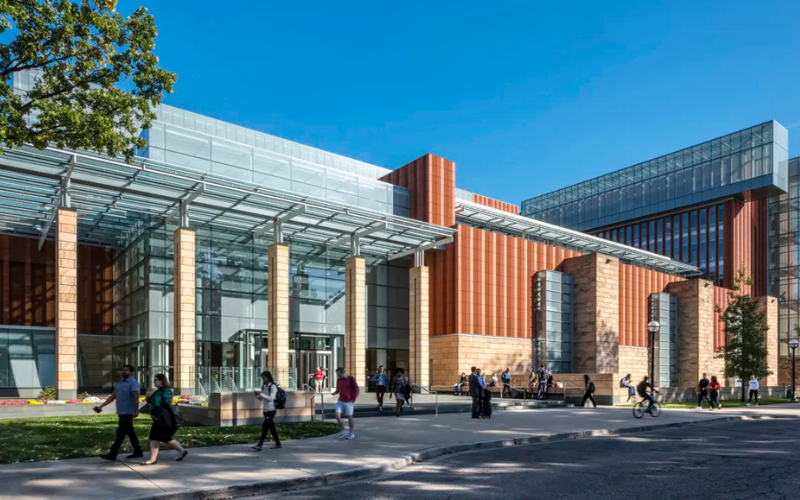
Then there's the part you can only feel on campus. The Ross building has a Wintergarden — a soaring glass atrium that catches whatever sun a Michigan February offers, and functions as the school's living room. It's where people jam eight friends around a four-person table between classes, and where the answer to "where are you?" usually is. There's a maize-and-blue 1985 school bus, DJ on the roof, that anchors the MBA tailgate and pulls hundreds of students and alumni together on game days. There are seventy-plus student organizations, case competitions, and a Thursday-night ritual at Scorekeepers that shows up in student podcasts more often than any class does. Spend an hour on the student blogs and you'll get a truer read than any admissions page can give you.
The “I got in” Instagram photo: the block M at midfield in the Big House, or the Wintergarden’s glass atrium with the maize-and-blue banners behind you. Either one tells your feed exactly where you’re headed.
Life at Michigan Ross
Start with the Saturday in autumn, because nothing else in American business school looks like it. By 10 a.m. the whole city is moving in one direction. Front lawns become parking lots. The marching band's brass carries three blocks. Then you walk into the Big House with 107,000 other people — the largest stadium in the country, and a genuinely startling thing to stand inside — and the noise arrives like weather. Michigan won the national championship in the 2023 season, and the T-shirts around town say Saturdays in Ann Arbor because locals will tell you flatly that even in a bad year it's the best day of the week. You get six or seven of these a fall. Twice, if you're lucky with your two years.
The food punches well above the town's weight. Zingerman's Deli in Kerrytown is a national institution — a forty-plus-year-old sandwich shop people plan road trips around, and worth the line at least once (save it for when your parents visit; it isn't cheap). From the same group comes Miss Kim's, chef Ji Hye Kim's Korean restaurant that pulls diners from across the Midwest. Frita Batidos does Cuban burgers under a fried egg with a tropical milkshake alongside and is a genuine rite of passage. The Brown Jug names its menu after Michigan legends. Blue Tractor smokes barbecue over Michigan cherrywood. Literati bookstore filled the hole left when Borders — an Ann Arbor original — closed. Ann Arbor is also, consistently, one of the safest and most livable small cities in America, which matters enormously if you're arriving with a partner or kids.
And you're better positioned for weekends than almost any MBA in the country, because you're in the middle of the map. Chicago is a four-hour drive or a train ride for a long weekend. Ski weekends in Colorado, January sun in the Keys, a flight home to either coast or across the Atlantic — all of it runs through Delta's third-largest hub, twenty-five minutes down I-94. In-state, Michigan is the reason people are smug about summers: the Great Lakes shoreline, the dunes, Traverse City wine country, and Mackinac Island, where cars have been banned since 1898 and everyone gets around by bicycle and horse-drawn carriage. The falls here are spectacular. The winters are real Midwestern winters — which the Wintergarden was more or less designed to fix.
The "I got in" Instagram photo: the block M at midfield in the Big House, or the Wintergarden's glass atrium with the maize-and-blue banners behind you. Either one tells your feed exactly where you're headed.
Research, Faculty, and Intellectual Identity
The practical thing to want from faculty isn't a famous name to study under — it's professors who teach well, are reachable, and remember who you are. Ross's project-based model puts you in small teams with faculty advisors, so that access is real.
That said, the intellectual center of gravity here is worth knowing, because it shapes what you'll actually be taught. Michigan is where the study of thriving organizations was invented — how you build a company people do their best work inside — and the faculty who built it still teach here. Wayne Baker's research on generosity and networks (his book is All You Have to Do Is Ask) is about a skill most ambitious people are inexplicably bad at: asking for help. Bob Quinn's Competing Values Framework is taught to managers around the world. Gretchen Spreitzer studies what makes employees thrive under pressure and organizational change.
Elsewhere: Marcus Collins in marketing, whose book For the Culture has made him one of the most-quoted voices working on how culture actually moves products. And the school still carries the legacy of the late C.K. Prahalad, whose ideas about core competence and "the fortune at the bottom of the pyramid" reshaped how global companies think about strategy and emerging markets. Around them sit centers that show where Ross invests: the Erb Institute for sustainability, Tauber for global operations, William Davidson for emerging markets, Zell Lurie for entrepreneurship.
What Michigan Ross Essays Are Actually Testing
Ross keeps the written application short: a 300-word career essay, a 200-word Impact and Growth short answer with your choice of three prompts, and an optional essay for anything that needs explaining. The restraint is itself a signal. This school would rather see you think clearly in a few hundred words than watch you perform across several thousand.
The useful move with any prompt is to ask why the school is asking it, because a prompt is a school telling you what it's worried about and what it wants proof of. Read Ross's that way and both become much easier to write.
Part 1, Career Aspirations (300 words):
"What is your short-term career goal, and how do you plan to leverage the Ross MBA and its program offerings in your first role after graduation? Please be specific and answer both parts of this question."
So what's the career essay really asking? Underneath the professional phrasing sits a plain institutional question: will this person get hired? Every school's employment report is a public scorecard, and admissions is the first line of defense on it. A candidate with a vague goal is a candidate who might spend the fall of second year unplaced. That doesn't mean your goal has to be conventional. Ross's admissions team has said that not naming consulting, tech, or finance won't count against you. What they're reading for is a goal that's intentional and grows out of your background.
Notice where the prompt points you: not to the program in general, but to your first role after graduation. Ross has stopped naming action-based learning in this prompt, so the question is open. Which parts of Ross will make you hireable for a specific job on day one? Name a concrete target (role, function, industry, the kind of firm). Then name the actual gap between where you are now and being hired for it, and the specific piece of Ross that closes it. The version that falls flat is keyword-dropping: praising Ross's hands-on learning without connecting it to anything real about you. A thousand other applicants can write that paragraph. Action-based learning is still central to the school, but it earns a place in your essay only if it's the thing that closes your gap.
Part 2, Impact and Growth, choose one (200 words):
"Michigan Ross is proud to support a community of leaders and impact makers who value growth. As a future member of this community, we want to know more about who you are and what drives you. Choose one of the following prompts to tell us more about what makes you stand out beyond your academic and work experience. List the prompt you are answering at the top of your essay."
"Think of a time something important did not go as planned. What did you do next?"
"What is something you worked on for an extended period of time (over six months) that ultimately resulted in a positive outcome? What kept you committed?"
"Share an example of a specific situation when your actions created a positive impact on your community or an individual."
Look at what the three options have in common: all of them ask what you did. When something fell apart. When something took more than six months. When your actions landed on another person. Then look at how the preamble describes the community you'd be joining: leaders and impact makers who value growth. Put it together and the school is asking for evidence rather than self-description. Do you own it when things go sideways, do you finish what you start, and are people better off for your having been there? These are the same values the whole school runs on, asked as a writing prompt. The prompt asks what makes you stand out beyond your academic and work experience, so a story from outside the office or classroom usually does more for you than a second look at your MBA résumé. Pick the story only you could tell, and show the disposition rather than announce it.
Optional (250 words):
A short space for anything in your résumé or application that warrants a brief, factual explanation, such as an employment gap, an academic outlier, your choice of recommender, or supplemental coursework you've completed. Bullet points are fine here.
Ross's application page also says you may use AI tools, as long as your essays stay original and in your own voice. With 500 words across the two essays combined, there isn't much room for any other voice to show through.
Recommendations
Ross requires one MBA recommendation, and it uses the GMAC Common Recommendation Form — which, practically speaking, makes Ross one of the easiest schools to add to a list you've already built. Your recommender likely completed this exact form for another school.
But treat that convenience carefully, because one letter changes the math. At a two-recommendation school a weaker reference hides behind a stronger one. Here, a single person carries the entire outside voice in your file. Ross asks for someone who can speak to your professional performance and work style — a current or former supervisor ideally, with a client, project manager, or professional mentor as the named alternatives.
The three questions tell you what to brief them on:
A brief description of their interaction with you and your role (50 words)
How your performance compares to other well-qualified people in similar roles, and your principal strengths (500 words)
"Describe the most important piece of constructive feedback you have given the applicant. Please detail the circumstances and the applicant's response." (500 words)
Look at that balance: the feedback question gets the same 500 words as the strengths question. Half of Ross's only recommendation is about how you take criticism. One specific, credible story about hard feedback you actually did something with will outperform a page of generic warmth. Have that conversation early.
The Interview, and What It Actually Evaluates
Ross MBA interviews are by invitation only, and the format is low-drama by design. Your interviewer is a Ross alum or a current MBA student, the conversation is built around your résumé, and it runs like a professional conversation rather than an interrogation. Invitations go out a few weeks after each deadline; in a typical cycle the first Round 1 invites appear in mid-October and Round 2 invites in January.
What it's really testing is simple: can you tell your story clearly, and would people want to work alongside you? Ross says it wants to understand how you present your experiences in a professional setting — and the honest translation is that they're picturing you in a room with four classmates and a client. Know your résumé cold, walk your path without rambling, and bring real curiosity about the school. You're not being tested on trivia.
Application Logistics
Tests: GMAT, GRE, or Executive Assessment — or no test at all, via the Statement of Quantitative Academic Readiness described above. You submit one or the other, never both; no pre-approval needed, and any applicant may use it. Scores may be self-reported, highest total is used, and Ross does not superscore across sittings.
Recommendations: one, professional, via the GMAC Common Recommendation Form.
Résumé: one page strongly suggested; Ross explicitly encourages including community involvement and hobbies.
Application fee: $250, waived for U.S. military members and veterans; Peace Corps, AmeriCorps, and Teach For All alumni; current U-M graduate students; citizens of UN least-developed countries; Fulbright Scholars; past Ross applicants from the last five years; and anyone who registers for and attends an official Ross Full-Time MBA event before submitting. That last one is worth planning around.
International applicants: English-proficiency testing (TOEFL/IELTS/PTE/Duolingo) unless your degree was taught in English — or an alternative essay demonstrating English immersion. Three-year degrees accepted where standard.
Reapplicants: an abridged application within a year — form, updated résumé, update letter — with the fee waived.
Transcripts: unofficial at application; official upon admission.
Confirm the fee and any test-policy updates when any new cycle posts.
Deadlines and Round Strategy
The 2026–2027 cycle (Class of 2029):
Round 1: September 8, 2026 — decisions expected December 2026
Round 2: January 4, 2027 — decisions expected March 2027
Round 3: March 29, 2027 — decisions expected May 2027
Applying through The Consortium? Different dates — Round 1 is October 15 and Round 2 is January 5, submitted via the Consortium application. All materials are due 11:59 p.m. Eastern on the deadline date.
On round strategy: What i tell clients
Ross is unusually direct here. It tells applicants to submit "whenever you feel it's the strongest," says it evaluates each round equally, and states that scholarships are available regardless of round — every admit is automatically reviewed for merit aid whenever they apply. To international applicants it goes further, saying admission and scholarship chances are similar across rounds. That's a stronger claim than most schools make, and it takes real pressure off the calendar.
My advice tracks it: apply when the application is genuinely at its best. If Round 1 means a career essay that hasn't yet connected your goal to anything specific about Ross, a sharper Round 2 is the better bet. Round 1 still carries the ordinary advantages — an earlier answer, more runway for housing and visas — so go if you're ready. Ross's own guidance to international applicants is to submit earlier if visa processing might run long; that's a logistics argument, and a good one. Round 3 is real but has fewer seats left, so it's the most competitive by arithmetic. Use it when your timing requires it, not by default.
Employment Outcomes, Read for What They Signal
For the Class of 2025, Ross reported a median base salary of $170,000 and a median signing bonus of $30,000, with 91% of graduates reporting a bonus. About 78% of job-seekers had an offer at graduation, 86% within three months, and 92% within six. In all, 266 companies hired Ross MBA graduates or interns that year, and 81% of accepted offers came through school-facilitated recruiting.
Where They Landed
By industry, consulting led at 33.5% with a $190,000 median base. BCG, McKinsey, Deloitte, and Bain were four of the school's top five employers overall, with Amazon rounding out the list. Financial services followed at 19.5% with a $175,000 median, then technology at 13.1% and $143,000, healthcare at 10.2% and $138,500, and consumer packaged goods at 8.9% and $125,000. Geographically, the Midwest was the largest region at about 37%, concentrated in Chicago. The Northeast drew 22%, mostly to Boston and the New York tri-state area, and the West about 20%, spread across Los Angeles, San Francisco, and Seattle.
Three signals worth reading
First, the destinations confirm the breadth: a general-management school with a deep consulting pipeline, real finance and tech placement, and genuine strength in healthcare and consumer goods. The next class's internships point the same way, with Amazon, BCG, PwC Strategy&, McKinsey, and Bain as the top internship employers.
Second, the climb from 86% at three months to 92% at six reflects a market in which employers are hiring later, a pattern that showed up across top programs this year. The more useful detail sits underneath it. The delay falls hardest on international students: about 86% of U.S. citizens and permanent residents had offers by graduation, compared with 68% of international graduates, who climbed to about 82% by three months. If you'll need visa sponsorship, that's worth weighing as a timeline question rather than a verdict. Plan for a search that may run past commencement, and use your conversations with current international students to learn how they managed it.
Third, if you're changing industries or functions, the career apparatus is built with you in mind. It starts with a more-than-40-hour career prep course before you arrive. On campus, you join a small weekly recruiting-prep group by career interest (Ross calls them FACT groups, each led by a second-year), and professional staff coaches support you throughout.
Cost and Financial Aid
Annual tuition (2026–2027): $83,946 for non-residents and international students; $78,586 for Michigan residents. These are Ross's most recently published rates. The class applying this cycle enters in Fall 2027, when rates will likely be higher, so treat any tuition figure here as a floor.
Estimated total cost of attendance (2026–2027): about $116,300 per year for a non-resident and $110,940 for a Michigan resident. That covers tuition plus registration fees, books and supplies, food and housing (about $22,300), personal expenses including health insurance, and loan fees. International students on F or J visas pay an additional $500 per term in student services fees.
Aid approach: primarily merit-based. Every admitted applicant is automatically considered, with no separate application, and awards range from $10,000 to full tuition. At the top, Dean's Fellows receive full tuition, and Dean's Impact Scholars receive full tuition plus an annual stipend for travel, leadership development, and non-tuition expenses. Forté and Consortium Fellowships are distinctions attached to a merit award, and Consortium admits are considered for funding up to full tuition.
Loan repayment: the Impact Advantage program provides up to $37,500 in loan support to graduates working in education, government, or nonprofits during their first five years out, alongside a separate loan repayment assistance program. Both require an annual application.
Two strategic points. Ross's aid is largely merit-based rather than need-gated, so a strong candidate can receive real money regardless of financial need. That's an advantage over the need-based models at Harvard and Stanford for applicants whose finances wouldn't qualify them there. And as a public school with a lower-cost college town attached, Ross quietly wins on total spend: the sticker price runs below the most expensive private programs, and Ann Arbor living costs run well below a coastal city's. Over two years, that difference is real money.
Rankings, in Context
Ross sits comfortably in the top tier. It placed 13th among U.S. business schools in the 2026 U.S. News ranking and 12th in Bloomberg Businessweek's 2026–27 U.S. ranking. In the 2025–2026 Poets & Quants composite, it finished No. 9, its highest finish ever and the biggest single-year climb in the entire top 50. That climb was a recovery: the year before, Ross had dropped sharply after missing the Financial Times ranking, which says more about how composites handle missing data than about anything at the school.
Bloomberg's sub-scores are worth a closer look, because they show how much a single number can hide. Ross ranks 13th in Compensation and 17th in Networking, the dimensions most applicants care about, 29th in Entrepreneurship, and 51st in Learning. Each index measures something narrow. Read them as separate signals, not as a single verdict on the school.
In the 2026 Financial Times Global MBA ranking, Ross placed 34th worldwide and 14th among U.S. programs. That number needs context. The FT isn't measuring prestige. It runs a formula that heavily rewards international career mobility, global diversity, and value for money, and more than half of its weighting comes from alumni surveys. Programs with high tuition and mostly domestic career outcomes are structurally disadvantaged, which is why many elite American schools sit lower here than anywhere else. Participation matters too: Stanford is absent again this year, and Columbia dropped out of the 2026 list after missing the FT's alumni survey threshold. Read the FT as one lens, not a verdict.
The relative newcomer, LinkedIn's Top MBA Programs ranking, placed Ross 32nd globally in 2026. This ranking is worth noting because it focuses almost entirely on alumni career outcomes, such as hiring, advancement, and network strength, measured with LinkedIn's own platform data. Traditional media rankings blend career criteria with academic ones like faculty, research, student reviews, and test scores. Two caveats apply to this list. It ranks U.S. and international programs together, which is why the global and domestic numbers diverge so widely. And some of its placements are contested: the Indian School of Business ranks 5th here, for example, compared with 12th in the FT.
The real story across all of it is volatility, and Ross is the case study. In a single year, one composite ranking moved it 20 places, and the cause was a data gap, not anything that changed in Ann Arbor. Use rankings to confirm Ross is in your tier, which it plainly is. Don't use them to decide between it and its closest peers. That call depends primarily on fit.
How Michigan Ross Differs from Kellogg, Booth, and Darden
The most useful comparisons for Ross are the schools where cross-admits have to make tough decisions.
Ross and Kellogg
Ross and Kellogg are genuine cousins: both collaborative, both strong in general management, both feeding the same consulting and tech firms, and — a small thing that says something — both built around a soaring glass atrium, because Midwestern winters demand an indoor town square. Kellogg leans marketing and a famously team-based culture, in a larger program in Evanston with Chicago at its doorstep. Ross leans hands-on learning and an ownership ethos, in a college town where football Saturdays are a structural part of the experience. Evanston is a suburb of a major city; Ann Arbor is its own place, forty-five minutes from Detroit and a very different environment from Chicago. Most cross-admits want elements of both, which is why this comes down to texture.
Ross and Booth
Ross vs. Booth is the sharper contrast. Booth, in Chicago, is built around analytical rigor and a famously flexible curriculum with few requirements — you assemble your own path, and the culture prizes intellectual firepower. Ross is more structured around shared experience and more insistently hands-on. Neither is harder or softer; they optimize for different temperaments. Maximum curricular freedom and a quant-forward culture in a big city points to Booth. A program that keeps pushing you into real teams and real work, with a town attached, points to Ross.
Ross and Darden
Ross and Darden share more DNA than applicants expect: big state universities, small-city settings, sports woven through the culture, and a real sense of community. The split is pedagogical. Darden runs on the case method — you'll discuss a written case nearly every session, and it's the most immersive version of that method anywhere. Ross would rather send you to the actual company. If you learn best debating a text with sixty classmates, you might prefer Darden. If you learn best with a live client and a deadline, you might prefer Ross.
Signals You Might Be a Strong Fit
MBA School Fit is hard to feel from the outside, so here are concrete signals. If two or three sound like you, you're probably reading Ross correctly.
You learn by doing. The prospect of a live client project, a real investment fund, or a crisis simulation reads as the best part of the program rather than the intimidating part.
You take ownership without being asked. You can point to two or three moments where you saw something that needed doing and simply picked it up.
You make teams better. You're who others want on the group project, and you're genuinely glad when a classmate wins. In a program this team-dependent, that's the whole texture.
You're switching careers and want reps before the leap. You'd rather test the new direction through real work than take it on faith.
The college town is a feature, not a compromise. A walkable two years, a stadium on Saturdays, money that goes further, and classmates who are actually around at 11 p.m. sound better to you than a subway commute — and you've done the math on the network that produces.
Signals You Might Not Be the Best Match
The honest counterpart. None of this means you wouldn't be a strong applicant somewhere, or that you shouldn't apply — that's your call. It means the match is worth examining before you spend a cycle on it.
It may not be the best match if you need a major city as your daily campus. Ann Arbor is a wonderful college town, not a metro. If the energy and optionality of a big city outside your door is genuinely what you want from these two years, a program that offers it may make you happier — and this is the Midwest, so if you're someone who thrives on either coast and knows it, weigh that honestly before two Michigan winters.
It's a harder fit if the case method is how you learn best. If your ideal classroom is sixty people arguing a written case three times a day, Darden and other case-driven programs are built around exactly that, and Ross isn't. Worth being honest about your learning style rather than assuming all top programs teach alike.
It's worth questioning whether the fit is right if collaborative, live-project work reads as overhead. So much of Ross runs on teams doing real work that there's no quiet corner to opt out into. If your ideal two years is more solitary and more theoretical, or if the ownership-and-collaboration ethos feels like a tax on the credential you actually came for, that's a valid way to want an MBA — it just points toward a school whose center of gravity matches yours.
If two or three of these land, treat it as a prompt rather than a verdict. Fit is a weighted sum, not a checklist. The useful next step is asking whether the schools that fit you better are ones you're genuinely as excited about — and doing that work now, while it can still shape where you apply.
When Working With Someone Helps, and When It Doesn't
Ross's application rewards a specific kind of outside help, and it isn't line-editing.
Three hundred words is not much room for a career essay that has to carry a concrete goal, a credible gap, and a specific answer to why this school. The highest-value work happens before you draft: pinning down a short-term target you can defend, then mapping the exact pieces of Ross that close the distance between your background and that role. Applicants routinely burn a third of their words praising the school's hands-on learning in language any of their competitors could have written. A good outside reader catches that before it costs you.
The single recommendation raises the stakes on recommender choice more than most applicants realize, and the constructive-feedback question rewards preparation almost nobody does. Thinking through who can tell the right specific story — and briefing them properly — is quiet, unglamorous work that changes how a file lands.
That said: no consultant can manufacture a goal you haven't thought through or ownership you haven't demonstrated. The reflection that surfaces the right material is yours. The support is in the questions that get you there faster, and in the read that catches where you've drifted into school-flattering generalities instead of showing who you actually are.
If you'd like to talk through whether your application is at the stage where outside input would help, a free consultation is a low-pressure way to find out. We'll cover where you are, what Ross is likely to weigh in your case, and whether your goal and fit story are as specific as this school rewards.