London Business School: What This School Is Looking For
London is one of the few cities that genuinely runs the global economy — a capital of finance, law, media, and culture where the headquarters of the world sit a few Tube stops from each other. London Business School sits in the middle of it, on a curve of John Nash's cream-stucco Regency terraces with Regent's Park at its doorstep. That address is not decoration; it tells you what the school is for. LBS draws its students from across the world — roughly nine in ten come from outside the UK, from more than sixty countries, with no single nationality close to a majority — and builds them into one of the most international classrooms in management education.
That classroom is the answer to "what is London Business School looking for," and it is also the part most applicants misread. The mix is not a happy accident, and it is not a statistic the school recites for show. It is the central design: a room assembled so that the range of experience inside it becomes the education. What the admissions committee reads for follows directly. The decisive question in your application is not whether your numbers clear a bar. It is whether you will add a perspective the room would be poorer without — and whether you are the kind of person who comes alive learning across cultures, whether or not your passport already carries a single stamp. That is a more demanding test than a threshold, and a more interesting one. Almost everything below follows from it.
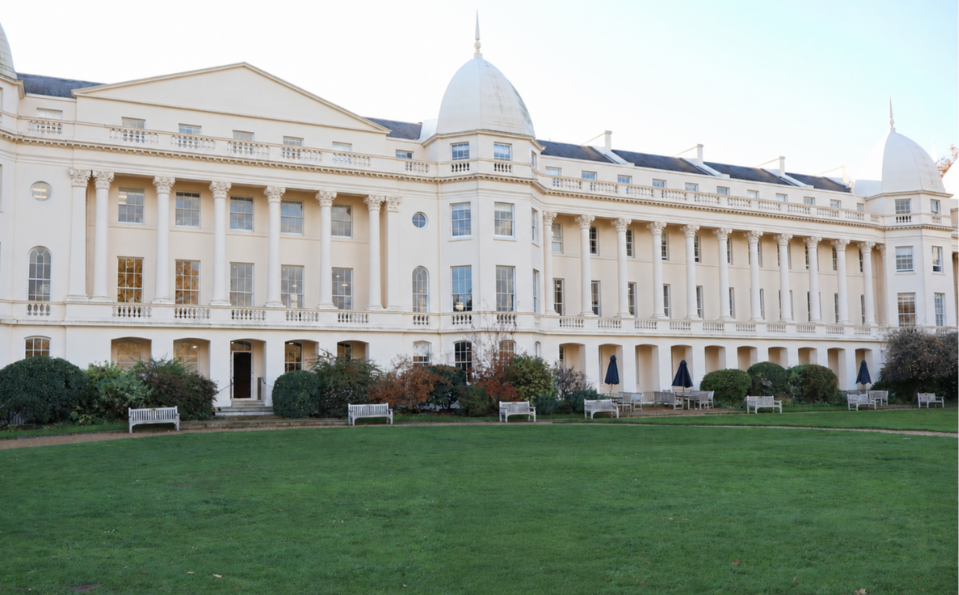
London Business School
LBS draws its students from across the world — roughly nine in ten come from outside the UK, from more than sixty countries, with no single nationality close to a majority — and builds them into one of the most international classrooms in management education.
What London Business School Is Actually Trying to Build
Most applicants arrive at LBS through one of two doors: "it's one of the best-known business schools in Europe" or "I want to work in London." Both are true, and neither tells you what the school is selecting for. (Worth noting, too, that LBS itself rarely leans on "European" as a label — it talks about being global and being in London, which is a tell about how it sees itself.) What's actually being read for sits a layer below the brand.
LBS describes its purpose as having "a profound impact on the way the world does business," and under Dean Sergei Guriev — an economist who joined in 2024 — the school has been explicit about where it's investing: staying genuinely international, staying rigorous, and pushing into innovation and the big cross-border problems (AI, climate, healthcare, development). Read past the language and the through-line is consistent. LBS is building an international community, and it reads applications for the people who will make that community work — the graduates who can sit down in a boardroom in São Paulo or Singapore and be effective by the end of the meeting. Picture the quietly capable operator who's at home anywhere; if it helps, the British archetype is James Bond, minus the casualties.
Here's the part that matters, and that scares off good candidates who shouldn't be scared: this is not a club for people who grew up on four continents. You can have spent your whole life in one city — Madison, Wisconsin, say — without a passport, and still be exactly what LBS wants, provided you bring genuine curiosity about the wider world and the appetite to learn across cultures. The diplomat's child who lived in five countries has no special claim here. What the school is reading for is the disposition, not the frequent-flier balance. At a US program, "international experience" is a differentiator; at LBS, working across cultures is simply the daily texture of the place — so the question shifts from "where have you been" to "will you throw yourself into a room where everyone brings somewhere different."
So your application's real job is decision support. It gives the reader evidence that you'll enrich a community whose value is its range — that you bring a specific perspective the class would be weaker without. That's the whole game, and it's not about you in the way most applicants assume. It's about what you add to the 500-some people you'd be joining.

Who Genuinely Belongs Here
When a client asks me whether they belong at LBS, I move them off the question they usually arrive with — "are my stats high enough?" — because that's rarely what settles it here. Two things do more work, and neither is a number.
The first is genuine curiosity about the wider world and a desire to work in it. Notice what that does and doesn't require. It does not require a passport full of stamps, an international employer on your résumé, or dual citizenship. It requires that you're the kind of person who's drawn to how business gets done somewhere other than where you grew up — and the evidence for that can come from almost anywhere. Maybe you've managed a project across three time zones; maybe you haven't, but you took international relations courses for the love of it, built real friendships with classmates from abroad, follow foreign news and foreign films, and have wanted for years to operate on a bigger stage. Both of those people belong in the conversation. What too many strong candidates do is talk themselves out of LBS because their global credentials don't look the part on paper — and that's precisely the self-elimination the application exists to prevent. Your job is to surface the genuine threads of international curiosity in your story so the reader can see them. The school's job, then, is to see the possibility in you. Give it the material to do that.
The second is clarity about why London, and why this particular program. LBS sits in a financial capital with one of the densest concentrations of multinational headquarters anywhere, and it lets you tailor when you graduate and what you study to an unusual degree. Both features reward applicants who arrive with a working sense of direction. That doesn't mean you need every answer — there's genuine room to refine once you're here, especially across the elective portfolio and the global experiences. But the applicant who can connect a concrete goal to London's particular gravity and to LBS's particular structure reads as a much easier "yes" than the one for whom LBS is a brand-name default.
There's an honest trade worth naming, and it happens to be one of the best things about the place. LBS is a real investment — London isn't cheap, and the program is long enough to be a genuine chapter of your life — and because the class comes from everywhere, your classmates return to everywhere. That's not a cohort that scatters; it's a network with global reach. It's the friend who hosts you in São Paulo, the classmate you call when you land in Bangkok, the group chat that can open a door in almost any market on earth. For most people drawn to LBS, that reach is the entire point. For someone whose ambitions sit squarely in one home market with a network concentrated in one city, it's worth sitting with whether that's the trade you actually want — not because LBS can't serve that goal, but because its real magic is pointed at a wider map.
The Class Profile, Read Honestly
The most recent confirmed class — the Class of 2027, which entered in August 2025. The headline number here isn't a test score; it's that almost no one in the room shares the same nationality:
Where They Come From
Approximate regional shares of the entering class, as reported by LBS. Just 9% are from the UK — the inverse of every U.S. program.
Where They Worked Before
Other industries include manufacturing, public sector, healthcare, energy, and media/entertainment. Bars show share of the entering class.
A few things that are easy to misread in these numbers:
The GMAT looks low next to the M7, and the obvious conclusion is the wrong one.
A ~645 GMAT Focus average sits below where the most selective US programs cluster, and it's tempting to read that as "LBS is easier." It isn't — it's measuring something slightly different. With ninety percent of the class coming from outside one national education system, LBS reads scores across a genuinely global applicant pool and weights work record, leadership, and global trajectory heavily alongside the test. A strong score still helps, particularly for applicants from over-represented pools where the bar effectively runs higher. But a score in the low 600s inside an otherwise strong, globally substantive file is workable here in a way it often isn't at the top of the US table. The number describes the class; it doesn't explain how the class was chosen.
There's no published median GPA, and that's a signal, not an oversight.
Comparing a transcript from an Indian engineering program, a French grande école, a Brazilian university, and a US liberal-arts college on a single GPA scale would be close to meaningless, and LBS knows it. The school reads academic records in their own national context — rigor, trajectory, quantitative evidence — rather than against one number. If your transcript needs context (a system that grades harshly, an upward trend, a demanding course load), that context lands here.
The work-experience range is wide on purpose.
The class spans roughly two to thirteen years, and the school looks for at least three. The point isn't a target to hit; it's that LBS reads for what you did with the time you've had, not the count — and, just as much, for genuine engagement with the wider world. Staying physically in one place isn't a mark against you if there's real evidence of international interest and outlook; a candidate with four years and a clear global curiosity reads stronger than one with eight years and no sign they've ever looked up from their own market.
Consulting and finance dominate the backgrounds — but the room is broader than that implies.
Together they're about half the class, which tracks the post-MBA destinations. Technology is the next meaningful slice — close to a tenth of the class — and it's a share the school is actively working to grow, with student-led tech and entrepreneurship activity pushing in the same direction; the numbers don't yet make LBS a tech school, but the trajectory is real and intentional. Applicants from outside the consulting-and-finance core get in every year, and the school actively wants them for the texture they add. If your background sits outside the center of gravity, that's not a strike — but you'll want to be deliberate about the international, contribution-shaped story you bring, because that's the axis on which you're most clearly additive.
Acceptance Rate
On the acceptance rate: LBS doesn't foreground it, and you should hold any figure loosely. The applicant pool is heavily self-selected and genuinely global, which makes a headline percentage a poor guide to your odds. The more useful read is that fit-matched, globally substantive candidates do meaningfully better than the raw number suggests, and that the bar is real regardless.
The profile isn't a benchmark to match line by line. It's a picture of who LBS admitted last year. Your job is to give the reader evidence that places you in that picture clearly.
Common Myths About London Business School
"A European MBA is a step below a US M7."
This is the misread that costs applicants the most, and it's mostly a measurement artifact. LBS sits in the top handful of programs globally in the Financial Times ranking and consistently in the global top ten elsewhere; its recruiters are the same firms that hire at the US M7. What differs is composition and geography, not tier. For a globally oriented career — and especially for anyone who wants to work outside the US — LBS isn't the consolation version of an M7. It's frequently the better-fit version.
"LBS is a finance school."
Finance is a major destination, but consulting has been the single largest sector for years — about 40% of the most recent graduating class — with technology now a close third. The finance reputation is a decade out of date, and the marquee alumni cut against it anyway: the school's most famous graduate is arguably Sir Jim Ratcliffe (MBA 1980), who built the chemicals giant INEOS — about as far from a trading desk as industry gets — and whose name now sits on the main campus building. Tony Wheeler (MBA 1972) went straight from LBS to founding Lonely Planet, the world's largest travel-guide publisher. The school is broader than its City-of-London image suggests.
"You can't get a job in London / the UK as an international student."
The UK's Graduate Route currently lets graduates of UK programs stay and work for two years after finishing, which materially changes the calculus for international students — it's closer to the US OPT window than most applicants assume. Visa policy can shift, so verify the current terms before you build a plan around them. But the blanket "you can't stay" assumption is out of date.
"The flexible exit point means LBS is a one-year program."
It can be — you may exit at 15 months — but most students take the 18- or 21-month path to capture a full summer internship and recruiting cycle. The flexibility is real and unusual; treating it as "the short MBA" misses that the longer paths are what most career-switchers actually use.
"The lower GMAT average means it's a safety."
Not at all. The pool is global and self-selected, and the file still has to make a credible global-contribution case. A weaker version of an M7 application doesn't become a strong LBS application just by being pointed at London.
Identity and Program Basics
London Business School, founded in 1964 and a member institution of the University of London, sits at Sussex Place on the edge of Regent's Park in central London, with a second campus in Dubai. Its home is the Ratcliffe Building — the Grade II-listed John Nash Regency terrace at the heart of campus, renamed after alumnus Jim Ratcliffe's £25 million gift secured the site — alongside the Sammy Ofer Centre, the former Marylebone Town Hall the school refurbished and opened as teaching space.
The full-time MBA is a flexible program with 15-, 18-, and 21-month exit points — a structure no other top program offers. Class size is in the 480–520 range. The school carries Triple Crown accreditation (AACSB, EQUIS, AMBA), held by a small minority of business schools worldwide, and its alumni network runs to roughly 50,000-plus across 160-plus countries. Dean Sergei Guriev, an economist, has led the school since August 2024.
The Curriculum, and What It Reveals
LBS calls its MBA the world's most flexible, and for once the marketing line points at something structurally true. The program is built around three features that, read together, tell you who it's for.
The flexible exit point.
You choose whether to graduate at 15, 18, or 21 months, and tuition is the same regardless. This is genuinely unique at the top tier, and it reveals a school that treats the MBA as a tool to be fitted to a goal rather than a fixed ritual. A career-switcher who needs a full summer internship and a complete recruiting cycle takes the longer path; someone accelerating within a field they already know can exit early. The structure rewards applicants who arrive knowing roughly what they need from the degree — which is why the goals essay does so much work.
The core, then the open field.
Year one runs Business Fundamentals plus a Tailored Core — a flexible structure that lets you shape the foundation to your needs — alongside Leadership Launch, the program's leadership-development spine. After that the program opens wide: a minimum of ten electives drawn from a portfolio of more than a hundred, chosen through a bidding system. The distinctive part is who's in those electives with you. LBS pools its elective courses across the MBA, Masters in Finance, Masters in Management, the Executive MBA, the Sloan programme, and 30-plus exchange schools — so you're learning alongside people at very different career stages, which the school calls cross-generational learning and which is hard to replicate elsewhere.
Experiential and global by requirement, not option.
Every student completes a Global Experience — a week-long immersion in an international business context (destinations rotate; recent ones have included locations across Europe, Asia, and the Middle East). London-based applied modules (LondonCAP, LondonLAB, Business Challenge Week) put students on real projects with real companies in the city. There's an Entrepreneurship Summer School for those incubating a venture — and the founder pipeline is real, not decorative: PitchBook ranked LBS a top-ten business school worldwide for VC-backed MBA founders in its 2025 list, with alumni founders having raised billions collectively (recent examples include the e-commerce financing unicorn Wayflyer, co-founded by an MBA 2013 grad). There's also an International Exchange option at a partner school — the US roster alone includes Columbia, Wharton, MIT Sloan, Kellogg, Berkeley Haas, and Yale, alongside global partners like the University of Hong Kong — though exchange students can't take the 15-month exit.
What the curriculum reveals is a philosophy
LBS hands you the controls rather than driving for you. Read together, the flexible exit, the build-your-own elective slate, and the required journey out into the world add up to a school that assumes you are an adult with a plan and equips you to execute it — not one that needs to be marched through a fixed sequence. That's a genuine advantage for the applicant who arrives with direction, and a quiet cost for the one who doesn't, because freedom only converts into a coherent two years if you've decided what you're aiming at. Which is the same reason the direction-setting work pays off before you apply, not after you arrive: at LBS, that thinking shows up in the application itself.
Culture and Community, Beyond the Marketing
The word LBS students reach for is "global," and unlike most schools that claim a culture, here it's simply arithmetic. When ninety percent of the room is international and no nationality dominates, the culture that results is genuinely cosmopolitan — and also, honestly, more dispersed than a small US cohort. London is a big city with a big-city texture; LBS is not a place where you'll know all 500 classmates by name and run into them at the only coffee shop in town. The community forms around 80-plus clubs, study groups, the elective bidding that throws you in with different people each block, and a social calendar with real anchors: Sundowners, the free-drinks-and-food gathering on the Front Lawn that's the school's most-attended fixture, and MBAT — the HEC Paris–hosted "MBA Olympics," the largest gathering of MBA students in Europe, where LBS sends teams to compete against programs from across the continent each spring.
The clearest expression of the culture is Tattoo, the school's flagship annual event — a global food-and-talent festival where forty-plus cultural and regional clubs run food booths and stage everything from Brazilian bossa nova to salsa, capped by a light show projected onto the front of the Ratcliffe Building. It isn't a marketing set-piece; it's 1,100-plus students turning the school's range of cultures into a single night's party, which is about the most honest signal of what the place is built around that you'll find.
This is where the school's cultural messaging separates from everyone else's, because it isn't aspirational. A class assembled from everywhere produces classroom debates where genuinely different national and professional assumptions collide, which is the entire point. The flip side is worth naming plainly: a longer, more flexible, big-city program whose members come from and return to everywhere asks more of you to build close relationships than a small residential program does. The closeness is available, but you reach for it rather than having it imposed by geography. For most LBS students that's the right trade. It's worth knowing which kind of community you actually want before you choose.
The “I got in” Instagram photo: the Ratcliffe Building’s Nash terrace façade with Regent’s Park behind it, or the shot from across the boating lake with the campus framed by the trees. For the version that says LBS specifically, the Tattoo light show projected across that same façade, or the park’s rose garden in bloom. And for the one that says London, walk the ten minutes to St John’s Wood and do the Abbey Road zebra crossing with your classmates, Beatles-style — four future MBAs mid-stride. Any of them tells your feed exactly where you landed.
Life at London Business School
Let's talk about what it's actually like to live here, because this is where LBS quietly wins and where the website undersells rather than oversells.
Start with the address, because it's almost unfair. The main campus — the Ratcliffe Building, a row of cream-stucco John Nash Regency terraces — sits right on the edge of Regent's Park, meaning the school backstops onto 400 acres of royal parkland, rose gardens, the boating lake, the open-air theatre, and the London Zoo a short walk away. Students run and picnic in the park between classes. It is one of the genuinely beautiful business-school settings anywhere, and it's a five-minute walk from Baker Street station — yes, that Baker Street; Sherlock Holmes's address is around the corner.
Now the honest part. London is expensive — there's no softening that, and you should budget seriously for rent on top of tuition. And the weather is exactly what you've heard: grey, damp, and dark by mid-afternoon in deep winter. If you need year-round sun, London will test you. But what you get in exchange is one of the great cities on earth as your campus extension. Green space everywhere — one friend's partner said he preferred London to Boston for the parks alone — plus West End theatre a short ride away around Covent Garden and Piccadilly Circus, world-class museums (many of them free), and a restaurant scene that spans every cuisine on the planet. Weekends can mean a long lunch in a centuries-old Cotswolds pub with scones and clotted cream, strawberries at Wimbledon, afternoon tea at Claridge's, a concert at Wembley, or a fast train that puts Paris two and a half hours away and most of Europe within reach. If you like sport and the easy ritual of a Friday pint outside a pub with your classmates as the evening warms up, you will feel immediately at home.
The food and the neighborhoods reward exploration. Marylebone, just south of campus, is a village-in-the-city of independent shops and good restaurants — Daunt Books on the High Street, the original Edwardian travel bookshop, is worth a wander whether or not you buy anything (fitting, given the Lonely Planet pedigree). The stalls of Borough Market down by London Bridge are the city's best grazing; Brick Lane in the East End is the place for late-night curry, Sunday markets, and a salt-beef bagel from the 24-hour Beigel Bake at 2 a.m. Closer to home, students live and cycle through Marylebone, St John's Wood, and Camden, and the towpath along Regent's Canal runs from Camden Lock past the park — a walkable, bikeable seam through the city that most tourists never find.
The "I got in" Instagram photo: the Ratcliffe Building's Nash terrace façade with Regent's Park behind it, or the shot from across the boating lake with the campus framed by the trees. For the version that says LBS specifically, the Tattoo light show projected across that same façade, or the park's rose garden in bloom. And for the one that says London, walk the ten minutes to St John's Wood and do the Abbey Road zebra crossing with your classmates, Beatles-style — four future MBAs mid-stride. Any of them tells your feed exactly where you landed.
Here's the thing to understand about all of it: London is the curriculum's silent partner. The reason the school can put students on live projects with major companies and draw the recruiters it does is that the global firms are right here — the City, London's historic financial "Square Mile," is about fifteen minutes east by Tube, and Canary Wharf, where the big banks tower over the old docks, is a little beyond that. There's also a quieter dividend the website won't sell you: living and working in London sharpens your polish. Britain is a place where people are mindful of being correct. You'll absorb some of it from your classmates, your interviewers, and frankly a five-minute trip to Marks & Spencer or Harrods (where the online order form includes options for Lord and Lady alongside Mr. and Ms.) The expense and the grey skies are real. The city you get in return — equal parts global trading floor and the London of Bridgerton's terraces and the British Museum's Rosetta Stone — is most of why people choose LBS in the first place.
Research, Faculty, and Intellectual Identity
LBS's intellectual reputation is strongest in finance and economics — it's long been one of the most respected finance faculties in the world, to the point that the standard global corporate-finance textbook, Brealey and Myers's Principles of Corporate Finance, was co-written by a longtime LBS professor. The depth isn't just historical. Alex Edmans, a finance professor named Poets & Quants' MBA Professor of the Year, has built a public following around a genuinely accessible question — whether companies can do well and do good — in his book Grow the Pie and TED talks viewed millions of times; his more recent May Contain Lies is about how to read statistics and studies without being fooled, which is close to a life skill for the analytically serious. Andrew Scott, an economist, co-wrote The 100-Year Life, the book that reframed how a generation thinks about long careers and longevity — squarely relevant to anyone weighing what an MBA is for.
Beyond finance and economics, the school is investing visibly in entrepreneurship, strategy, and the cross-border problems the dean has flagged as priorities (AI, sustainability, development), with research centers spanning asset management, corporate governance, and the Wheeler Institute for Business and Development, funded by the Lonely Planet founder to apply business to emerging-market problems.
For an MBA applicant, the practical point isn't a marquee name to study under — it's whether faculty teach well and are reachable, and whether the school's intellectual investments line up with where you're headed. LBS's finance and economics depth is a genuine draw for applicants targeting investing, markets, or economics-adjacent strategy roles; the entrepreneurship and innovation infrastructure backs the venture-curious. Read the faculty's current research themes as a signal of where the school is putting its energy, and weigh that against your own direction.
What LBS Essays Are Actually Testing
For the 2025–2026 cycle, LBS asks one required essay and one optional essay. (Confirm current prompts on the LBS site before drafting; the school revises wording between cycles.)
Required (500 words)
"What are your post-MBA goals and how will your prior experience and the London Business School programme contribute towards these?"
This is a classic MBA goals essay, and its simplicity is deceptive — it's carrying all the weight that other schools spread across three or four prompts. It's asking three things at once: do you know where you're going, has your experience credibly prepared you for it, and have you understood what LBS specifically offers that gets you there. Because LBS has no separate "Why London Business School" essay, this single prompt is also your "why LBS" — so the program-fit work that other schools isolate has to live inside these 500 words.
Where this tends to go wrong is the version that spends a third of its length describing how prestigious and international LBS is. The Admissions Office knows their own school. Every sentence you spend flattering the program is a sentence you're not spending helping them understand who you are and what you'd add. The stronger move is to name a specific, credible goal, connect it to what you've actually done, and then point to the particular LBS resources that serve it — a named concentration, the kind of Global Experience that fits your trajectory, the flexible exit point and why your goal calls for the path you'd choose. Specificity about the program, in service of a specific goal, does the persuading. And underneath it all, the LBS-shaped version of the question: where does your international perspective fit, and what does it add to the class.
One reassurance worth internalizing, because it changes how you write this essay: the school knows perfectly well that people's goals shift during the program, and it is not holding you to this as a contract. The point of asking isn't to lock you in or test your loyalty to a five-year plan — it's to confirm that your direction is coherent enough that LBS can actually help you get somewhere. Admissions readers aren't only gatekeepers; they're closer to coaches who want their candidates to succeed once admitted. Yes, strong outcomes help the school's numbers — but the people reading your file also genuinely want you to thrive, and a clear, honest goal makes it easy for them to believe they can help you do it.
Optional (500 words)
"Is there any other information you believe the Admissions Committee should know about you and your application?"
Use this for genuine context — a gap, a transcript that needs explaining, a circumstance a reader might otherwise wonder about. When a reader doesn't know why something happened, the mind tends to fill the silence with a negative assumption, so when there's a real reason, give it to them. The flip side: this isn't a second essay to show off in. If nothing on your record needs context, leaving it blank is the stronger move.
Note also the Kira-style asynchronous video questions, which selected candidates complete before the live interview — short prompts with brief prep time and a single take. They test whether the person comes through on screen the way they do in writing. More on the interview below.
Recommendations
LBS requires one professional reference, ideally from a current or former supervisor (a colleague or long-standing client is acceptable if asking your employer isn't feasible). That single-reference requirement carries an implication worth absorbing: with only one letter, it carries more weight than any individual letter does at a two-recommendation school. Choose accordingly. The strongest recommenders speak to specifics — your leadership behavior, how you work across cultures and teams, concrete instances of impact — rather than offering warm but generic praise. One of the school's recommendation questions has historically asked the recommender what they imagine you doing in ten years' time, which tells you LBS is reading for trajectory and potential, not just present performance. Brief your recommender on the global, contribution-shaped story your application is making, so their letter reinforces rather than drifts from it.
The Interview, and What It Actually Evaluates
LBS runs one of the more distinctive interviews in MBA admissions, and it's worth understanding before you're in it.
It's conducted, in most cases, by an LBS alumnus rather than an admissions officer — frequently one matched to your region or industry — which gives the conversation a peer-to-peer texture and means your interviewer genuinely knows the program from the inside. It's non-blind: the interviewer has read your application (though not your video responses). Interviews run anywhere from about 45 minutes to over an hour, in person in your home region or virtually, and cover the expected ground — your CV in detail, leadership and teamwork, global outlook, and "why an MBA / why LBS / why London."
The distinctive piece is the presentation. You'll be given a topic — picked by the interviewer from a provided set, sometimes a mini business case, sometimes an opinion question — with roughly five minutes to prepare and five minutes to present. It isn't a consulting case and doesn't reward memorized frameworks. What it actually evaluates is how you think on your feet and communicate under mild pressure: can you structure a view quickly and deliver it clearly to a room? That's a proxy for exactly what you'll do in an LBS classroom and in the careers LBS feeds. Prepare by practicing structured, time-boxed thinking out loud — not by trying to predict the topic.
What the MBA interview is really doing, taken whole, is the next reader's job: deciding in real time whether the globally capable, clear-thinking contributor described in your file is the same person across the table.
Application Logistics
Tests: GMAT or GRE required (LBS is not test-optional). No formal minimum, though very low scores require the rest of the file to carry significant weight. GRE accepted on equal footing.
CV: One page.
Essays: One required (500 words) plus one optional (500 words).
Video interview: Kira-style asynchronous questions for selected candidates, ahead of the live interview.
Recommendation: One professional reference, submitted through the school's system (no pre-written or general letters).
English proficiency: Required for applicants whose prior education wasn't in English; check current waiver criteria.
Application fee: £200.
Short, scannable, and refreshed annually — confirm each item on the LBS site for the current cycle before you submit.
Deadlines and Round Strategy
For the 2026–2027 cycle (entry August 2027), LBS has three application rounds:
Round 1: September 3, 2026
Round 2: January 6, 2027
Round 3: March 22, 2027 — final decisions released June 3, 2027
All deadlines are 17:00 UK time, and LBS typically posts the next cycle's dates over the summer; confirm current-cycle deadlines on the admissions site before you plan.
On round strategy
The dominant rounds are R1 and R2, and the practical guidance for LBS is sharper than usual because of two factors specific to the school. First, scholarships: admitted students are considered automatically, and earlier rounds generally see more scholarship capacity available, which matters at LBS's tuition level. Second, international logistics: LBS draws a heavily international class, and visa processing for a London move takes real time — applying in R3 compresses an already tight window between decision and an August start.
What I tell clients
What I tell clients about round timing in general applies cleanly here: apply in the earliest round in which your application is genuinely strong, not the earliest round on the calendar. A rushed R1 file helps no one. But if you're ready, R1 or R2 is the call at LBS — and if your timing only allows a later round, a strong R3 application is still worth submitting, with the visa and scholarship trade-offs understood going in.
Employment Outcomes, Read for What They Signal
For the Class of 2025 (488 graduates, with 98% reporting):
88% had received a job offer within three months of graduation and 86% had accepted one.
21 graduates started a business or other venture.
Top destination industries
Consulting (40%)
Finance (25%)
Technology (24%)
Industrials, consumer and retail, energy, healthcare, and others (11%)
Mean base salary landed around £92,000, with most graduates reporting additional bonus or compensation on top; consulting paid the highest base on average. Top recruiters included McKinsey, BCG, Bain, Deloitte, and Accenture in consulting, alongside firms like Goldman Sachs, Amazon, and Google — with BCG recently the single largest recruiter.
What this signals
The numbers worth reading for signal, though, aren't the salaries — they're the switching figures. In the Class of 2025, 45% of graduates changed sector, 44% changed location (country), and 32% changed both at once. That last number is the one to sit with. Nearly a third of the class executed a simultaneous industry-and-country pivot through the program — the hardest move in career terms — and that, more than any salary line, is what LBS is actually selling. This is a career-transformation engine, and a particularly effective one for the international candidate who wants to change what they do and where they do it.
A grounded caveat the school itself acknowledges: a double switch (new sector and new country) is the most challenging path, and outcomes in any given year track the global economy. Recent cycles have been softer than the peak years across the industry, LBS included. The placement strength is real; so is the reality that a cross-border, cross-sector pivot asks the most of both you and the market.
So: if your goal is to operate globally, or to switch industry, geography, or both, LBS's outcomes and structure are built for exactly that, and few programs do it better. If your goal is a single domestic US market with a US-concentrated network, a strong US program may put you closer to that specific gravity — worth weighing honestly against what LBS uniquely offers.
Cost and Financial Aid
Tuition (2026 intake): £123,950, covering the full program regardless of which exit point you choose
Student Association fee: £400
Estimated total cost including London living expenses: commonly cited above £155,000
Aid approach: Primarily merit-based; all admitted students are automatically considered, and most awards require no separate application. Named scholarships include the London Business School Fund awards, women's leadership scholarships (including Laidlaw and Forte partnerships), and various external and foundation-funded awards.
Two practical points. First, the flat tuition across exit points means an early (15-month) exit can meaningfully reduce total cost — though, as noted, most career-switchers use the longer paths for the full recruiting cycle, so weigh the saving against what you'd give up. Second, LBS's merit-based model works differently from the need-based aid at HBS or Stanford: strong candidates can receive awards regardless of financial need, which often produces better outcomes for applicants whose finances wouldn't qualify them for need-based aid at the top US programs. Budget seriously for London either way — the city's cost of living is a real part of the decision, not a footnote.
Rankings, in Context
LBS sits in the top handful of MBA programs globally and consistently first or second in Europe. In the most recent Financial Times Global MBA ranking it placed near the top of the global list (around #4 in the 2026 ranking, up from #7 the prior year); QS placed it around #6 globally for 2026; Poets & Quants ranks it at or near the top of its international (non-US) list. These positions move year to year and the publications weight different things, so treat any single number as directional.
My read on rankings applies with particular force here: don't let a US-centric ranking lens talk you out of LBS, and don't let LBS's strong global rankings talk you into it if the fit isn't there. For an internationally oriented career, LBS's standing is unambiguous — it's a peer of the US M7, not a tier below. The decision should turn on fit and goals, not on a place on a table.
How London Business School Differs From INSEAD
This is the comparison most LBS applicants are actually running, because INSEAD is the other obvious European powerhouse — and the differences are real and worth laying out rather than resolving for you.
Program length and rhythm
INSEAD is a true accelerated program — about ten months, intense and compressed. LBS is flexible across 15 to 21 months, which gives you a fuller recruiting cycle, more electives, and room for exchange and global experiences. If you want in and out fast and you're confident in your direction, INSEAD's compression is a feature. If you want a longer runway to switch careers and recruit deliberately, LBS's length is the point.
Location and texture
INSEAD's center of gravity is its Fontainebleau campus (with Singapore and Abu Dhabi), more campus-centric and immersive. LBS is embedded in central London — a major financial capital, with everything that means for recruiting access, internships, and big-city life and cost. There's also a language-and-lifestyle dimension worth being honest about: INSEAD offers continental immersion, the Emily in Paris fantasy of living and working on the Continent (with the language curveballs that come with it); LBS offers a taste of Europe from inside an English-speaking global capital — the Bridgerton version, all Regency terraces and parkland, but with a modern, global cast. For some applicants the Continental adventure is the draw; for others, doing it all in English in a world city is the deciding advantage. Neither is better; they're different experiences.
Recruiting gravity
Both place graduates into consulting and finance worldwide, but the emphasis differs. INSEAD is, above all, a consulting machine — MBB placement is its signature, and few programs on earth feed McKinsey, Bain, and BCG offices across Europe, Asia, and the Middle East as reliably. You can absolutely land in consulting from LBS, and many do; but LBS's distinctive gravity is its finance ecosystem and its physical place in the City of London, with McKinsey London and BCG London right on the doorstep alongside the banks. If consulting is the whole goal, INSEAD's pipeline is hard to beat. If you want a finance-forward base in a global capital with strong consulting access too, that's LBS.
The cross-admit decision
Applicants choosing between them usually decide on time (ten months vs. a longer, flexible program), on place (a campus in Fontainebleau vs. a city in London), on language and lifestyle (Continental immersion vs. an English-speaking world city), and on whether consulting is the singular goal or one strong option among several. Most cross-admits genuinely want elements of both, which is why this is worth sitting with rather than sorting with a clean rule. Neither is the lesser school; they optimize for different things.
Signals You Might Be a Strong Fit
MBA School Fit is hard to feel from the outside, so here are concrete, checkable signals. If two or three sound like you, you're probably reading LBS correctly.
You're genuinely curious about how business works beyond your own market, and the idea of a classroom where everyone brings somewhere different sounds energizing rather than intimidating. This is the core signal, and it doesn't require a well-traveled résumé — just a real pull toward the wider world.
You're energized, not unsettled, by being one perspective among many. A room where your own background is in the minority sounds like the point of going, not a discomfort to manage.
You can say why London, specifically. Not "Europe" or "a global city" in the abstract, but a concrete reason the city's industries, position, or access serve where you're headed.
You want a network with genuine global reach — the classmate who hosts you in São Paulo, the one you call when you land in Bangkok, the group chat that can open a door in almost any market. That kind of reach reads as the prize, not a cost.
You can already sketch how you'd use the flexible structure — roughly which exit point fits your goal and why, and the kind of electives or global experience you'd reach for.
When your international curiosity does show up in something you've done — a cross-border project, a market you helped enter, even a formative experience outside work — you can name the specifically cross-cultural part of it, not just that it happened somewhere far away. (A bonus signal, not a prerequisite: strong LBS students arrive wanting this exposure rather than already holding it.)
Signals You Might Not Be the Best Match
The honest counterpart to the section above. None of this means you wouldn't be a strong applicant somewhere, or that you shouldn't apply here — that's your decision. It means the specific match with LBS is worth examining before you spend a cycle on the application.
It may not be the best match if your goal is a single domestic US market with a US-concentrated network. LBS can support US ambitions, but you'd be working against the recruiting gravity rather than with it — and the network you build will reach across the world rather than concentrate in one US city. Worth weighing US programs that sit closer to that specific goal.
It's a harder fit if you're drawn to LBS mainly as the "European M7" without a real reason for London or for a global path. The single goals essay and the alumni interview both probe exactly this, and a brand-default motivation tends to show. If you can't yet say why London and why global, that's worth resolving before you apply rather than papering over in the essay.
And it's worth questioning whether the long, big-city, come-from-everywhere format suits you if what you actually want is a small, tight, residential cohort where geography forces closeness. LBS's community is real but you reach for it; the city won't hand it to you the way a small town does. If that's what you're after, programs built around a small residential cohort are worth an honest look alongside LBS.
If two or three of these land, treat it as a prompt rather than a verdict. The most useful next step is to ask whether the schools that fit you better are programs you're genuinely as excited about — and to do that fit work honestly now, while it can still shape where you apply.
When Working With Someone Helps, and When It Doesn't
LBS's application has a specific feature that makes outside input valuable: it asks one 500-word essay to carry the entire load. With no separate "why school" prompt and no room to spread your case across multiple essays, getting that single MBA essay to do three jobs at once — goal, preparation, program fit, all inside an international-contribution frame — is genuinely hard, and most early drafts I see either under-specify the goal or spend too much real estate flattering the school. The alumni interview, with its on-your-feet presentation, is another place a second perspective and some structured practice earn their keep.
There's a particular way an outside reader helps with LBS, and it goes back to the inclusivity point from the top of this page. Many strong candidates assume their "international story" has to be an international degree, a global employer, or dual citizenship — and because they don't have those, they leave the genuine threads on the cutting-room floor. Those threads are easy to miss from the inside: growing up in a blended family with half-siblings from another country, the high-school exchange trip that quietly set the whole trajectory in motion, a childhood pen pal, a hometown that turned out to be more globally connected than it felt at the time. A good reader's job is partly to go digging for those, because they're often the most honest evidence of exactly the curiosity LBS is reading for. (And a smaller point worth naming: if polish is something you want to build, two years of doing business in London — where manners are practically a competitive sport, and you'll pick up cues from your classmates, your interviewers, and a quick run to Marks & Spencer — is a quietly excellent place to do it.)
That said — no consultant can manufacture clarity about your direction or invent a story you haven't lived. If you don't yet know why London, why this program, and what international perspective you add, the work before the essay is figuring that out. The essay then becomes a record of that thinking rather than a substitute for it.
If you'd like to talk through whether your application is at the stage where outside input would help, a free consultation is a low-pressure way to find out. We'll talk about where you are, what LBS is likely to weigh in your case, and what matters most before you draft.