INSEAD: What This School Is Looking For
Picture a classroom where no nationality holds a majority — where the person beside you might have run logistics in Lagos, traded rates in Tokyo, or built a startup in São Paulo — and where, ten months later, you'll all scatter back across the globe to do it at a higher altitude. That room is INSEAD: the world's leading one-year MBA, taught across campuses in Fontainebleau, France and Singapore (with a third in Abu Dhabi), and known without much exaggeration as "The Business School for the World." In 2026 the Financial Times ranked it #2 globally.
So what is INSEAD looking for? Above all, someone who makes that room better — who brings a genuinely distinct perspective to the most international classroom in business, and who has the maturity to move fast in a program with no slow lane. That's the reframe worth making early. The instinct most applicants arrive with is to ask whether their numbers clear a bar. The more useful question turns on the format itself: what is a ninety-nationality, ten-month program actually built to do, and are you the kind of person who comes alive inside it rather than fighting it? Almost everything below — the curriculum, the culture, who flourishes and who finds it a stretch — follows from those two facts: one year, and the most international room in the business-school world.
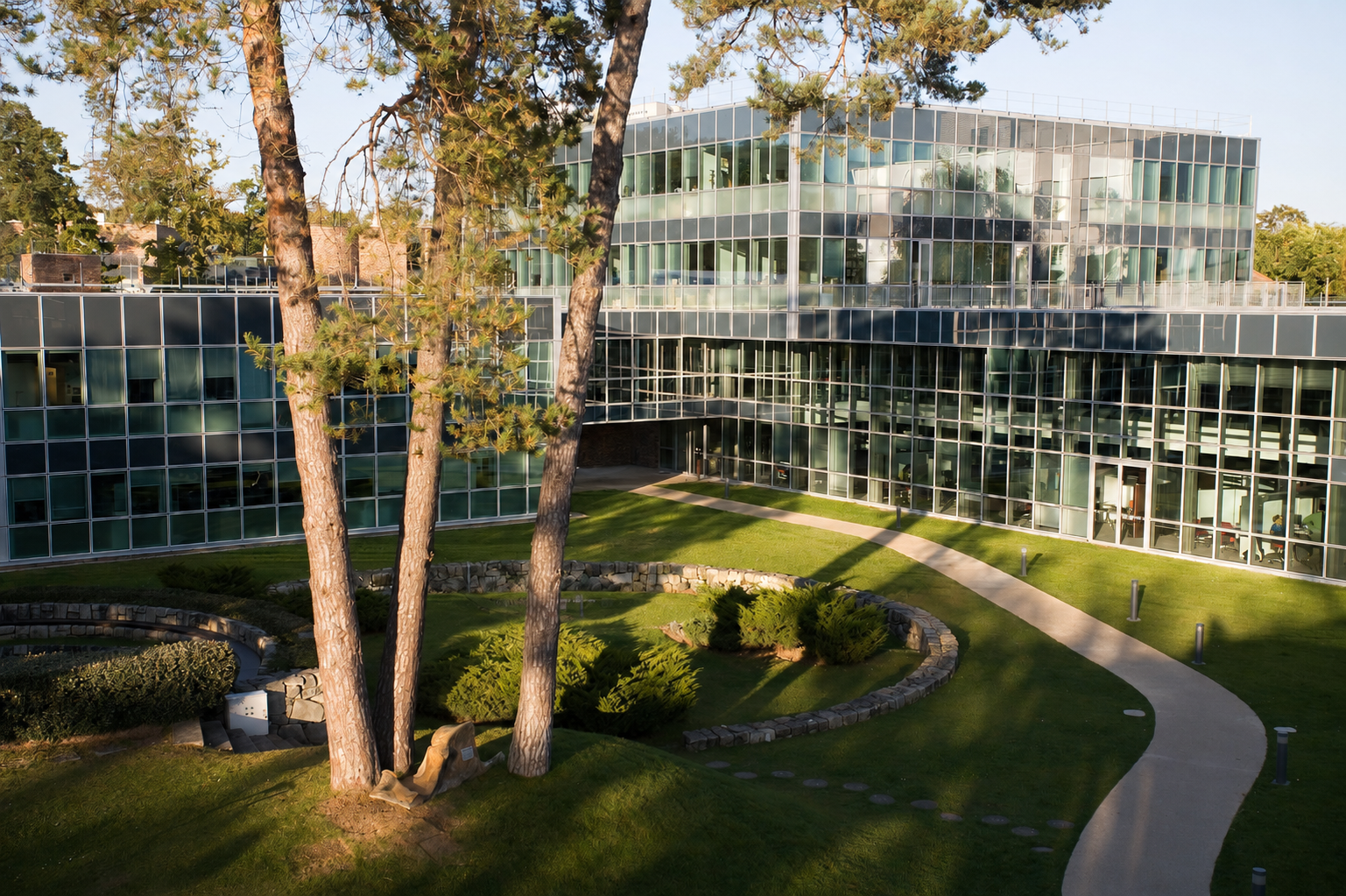
INSEAD
Above all, INSEAD is looking for someone who makes the room better — who brings a genuinely distinct perspective to the most international classroom in business, and who has the maturity to move fast in a program with no slow lane.
What INSEAD Is Actually Trying to Build
Ask what INSEAD is looking for and the honest answer starts with what INSEAD is for. The school's own framing is that it brings together people, cultures, and ideas to develop responsible leaders who transform business and society. That sounds like most mission statements until you hold it against the structure, where it turns out to be unusually literal.
Internationalism isn't a value here; it's the operating system. A typical class runs roughly 900–950 students across two intakes, with around 90 nationalities and no single dominant national group — a genuine rarity at the top of MBA education, and even the faculty fit the pattern (some 160 professors drawn from around 40 countries). INSEAD has people, employer relationships, and alumni infrastructure across Europe, Asia, and the Middle East simultaneously, and increasingly in the Americas through its San Francisco hub. Rhoda Yap, who runs INSEAD's Career Development Centre, has described that multi-regional footprint as a structural advantage in a fragmented global economy — not a marketing line, but the thing the place is organized around. When the school reads applications, an international mindset isn't a nice-to-have. It's close to the threshold.
The one-year format selects for maturity and clarity. A ten-month MBA is roughly 80% of a two-year program compressed into a single year, with no long summer to "find yourself" between semesters (an internship window exists, but only for one of the two intakes — more on that below). That compression has a consequence the school is quietly selecting for: INSEAD works best for people who arrive with a working sense of where they're headed and the professional maturity to move fast. The class skews slightly older and more experienced than US peers — average age around 29, work experience commonly in the three-to-eight-year band — and that's not an accident. The format rewards people who already know how to operate.
The diversity is the curriculum, and the careers prove it. In a class with 90 nationalities and no majority, your seat isn't measured by how impressive you are in isolation — it's measured by what genuinely distinct perspective you add to a room already full of accomplished people. The school's own alumni tell that story better than any brochure: Tidjane Thiam, who went from a French engineering education and McKinsey to running Prudential and then Credit Suisse, and on to government in his native Côte d'Ivoire and a seat on the International Olympic Committee; Frédéric Mazzella (MBA 2008), who founded the global carpooling platform BlaBlaCar; Niels Christiansen (MBA 1993), CEO of the LEGO Group. INSEAD has produced more chief executives of large European companies than any other business school — a direct dividend of assembling rooms like this one. So your application's real job is decision support: give the reader evidence that the cohort is sharper, broader, and more globally textured with you in it. That's the whole game, and it's not about you in the way most applicants assume. It's about what your particular vantage point adds to the other 900.
One thing to know going in: INSEAD asks more of you than most schools — two career essays, two personal essays, an activities essay, a video interview, and, later, two separate alumni interviews. That can feel like a lot, and it's fair to wonder partway through whether it's worth it. It is, and the reason is the same cohort logic above. A school assembling a room this international and this accomplished wants to understand you from several angles before it hands you one of those seats, and what you get in return is the single thing INSEAD graduates talk about for the rest of their lives: a year spent learning alongside some of the most interesting people they've ever shared a classroom with. The work on the front end buys that.
INSEAD’s own alumni tell that story better than any brochure: Tidjane Thiam, who went from a French engineering education and McKinsey to running Prudential and then Credit Suisse, and on to government in his native Côte d’Ivoire and a seat on the International Olympic Committee; Frédéric Mazzella (MBA 2008), who founded the global carpooling platform BlaBlaCar; Niels Christiansen (MBA 1993), CEO of the LEGO Group. INSEAD has produced more chief executives of large European companies than any other business school — a direct dividend of assembling rooms like this one.

Who Genuinely Belongs Here
When a client asks me whether they belong at INSEAD, I move them off the question they usually arrive with — "are my numbers good enough?" — because at INSEAD, more than almost anywhere, that's rarely what settles it. What settles it is your global outlook. Two things do more work than the rest, and neither is a score.
The first is a genuinely international orientation. This is the real currency at INSEAD, so it's worth being precise about what it means — because the worry I hear most often is some version of "I'm American, and I haven't traveled much outside the country." Here's the reassuring part: it has very little to do with the stamps in your passport. What the school is reading for is a demonstrated ability to operate across cultures — to lead teams that don't all look or think alike, to move toward unfamiliar contexts rather than away from them. Plenty of strong INSEAD candidates have spent their whole careers in one country. The school is reading for the disposition, not the mileage: evidence that you come alive when the room is full of difference rather than retreating from it. If that's you, a passport without many stamps is not the obstacle you think it is — and surfacing the genuine threads of international curiosity already in your story is exactly the work to do before you apply.
The second is readiness to move at speed with a clear direction. The compressed year rewards people who can hit the ground running. That doesn't mean you need every answer — career changers are the norm here, not the exception, and the program is explicitly built to support pivots. But the more clarity you bring about the direction you're pivoting toward, the more the ten months work for you. The applicant who arrives still searching for a field from scratch can certainly get value from INSEAD; they'll just be doing that searching against a faster clock than a two-year program would give them. It's worth knowing which you are before you apply.
A useful self-test: picture the rhythm. Five eight-week periods, a study group of five or six people deliberately assembled to be as different from one another as possible, a campus that might sit at the edge of a storybook forest an hour from Paris or in the heart of Singapore, the option to switch continents partway through, and recruiting compressed into the same window as everything else. If that reads as exhilarating, you're probably reading the school correctly. If it reads as relentless, that's worth sitting with honestly — not as a disqualifier, but as real information about whether the format suits the way you do your best work.
The Class Profile, Read Honestly
INSEAD publishes a "typical class" profile rather than a fresh breakdown each cohort, so these figures describe the representative class across both the January and August intakes. There is no dominant nationality here — no group runs more than about 11–12% of the room:
INSEAD doesn't publish an undergraduate GPA or an official acceptance rate; the admit rate is commonly estimated around 30%. There's no stated minimum on age, work experience, or test score — the school is explicit that scores are read in context, not against a cutoff.
Where They Come From
Typical class, by region
Approximate regional shares of a typical class. No U.S. program comes close to this spread — it's the core of what INSEAD is selecting for.
Where They Worked Before
Most recent intake (25J)
From the August 2025 (25J) intake of 486 students. Consulting's one-third share is the single defining feature of INSEAD's pre-MBA mix. Shares sum past 100% where backgrounds overlap.
A few things that are easy to misread in these numbers:
The acceptance rate
An estimated ~30% looks dramatically more forgiving than M7 single digits, and for a fit-matched candidate that gap is real. But a higher rate is not lower selectivity — it reflects a heavily self-selected, deeply international pool. People who specifically want a two-year American program with a long internal job search don't tend to apply to INSEAD; the ones who want the one-year, multi-continent, career-transformation model do. The result is a pool where the marginal applicant is already a serious fit, and the decision is closer than the headline suggests. The odds are genuinely better for the right candidate. The bar is still high.
The GMAT
An average around 700–710 sits below the very top US programs, and INSEAD states no minimum. The school recommends roughly the 70th percentile or above in both sections, which is a recommendation, not a cutoff — a strong overall file can absorb a test score somewhat below the average in a way that's harder at the most score-driven programs. One honest note specific to INSEAD: the test cannot be waived. Every applicant submits a valid GMAT or GRE, full stop. So unlike a number of US schools now offering waivers, there's no route around the test here; if testing isn't your strength, the answer is to prepare for it, not to plan around it.
The (absent) GPA
INSEAD doesn't publish a median GPA or set an academic floor, and it reads transcripts in context — which makes sense for a class drawn from dozens of national education systems that don't map cleanly onto a 4.0 scale. The question the school is answering is whether you can handle a quantitatively intense year, and your transcript is one input toward that, read alongside your test scores and trajectory rather than against a single number.
The experience band
INSEAD describes its MBA work experience as "typically 3–8 years," and it sometimes admits more senior candidates as well. The band isn't a rigid cutoff, and there's no hard three-year minimum — but it's an honest description of where the program fits. The school is reading less for a specific number on the clock than for what you did with the years you've had: trajectory, responsibility, evidence you've led. Among candidates in the band, four years with a real record of consequence can read as strongly as eight years of steadier tenure. The one caution worth naming: if you're well under three years out of university, INSEAD will often see your profile as a better match for its Master in Management (MIM) than for the MBA, so it's worth being clear-eyed about which program your experience actually fits before you invest a cycle in the application.
The profile is a picture of who INSEAD admitted, not a benchmark to match line by line. Your job is to give the reader evidence that places you in that picture on the dimensions that actually decide it — chief among them, what you'd add to a room of ninety nationalities.
Common Myths About INSEAD
"A one-year MBA must be the 'lite' version."
It's the reverse. The ten months are widely described as roughly 80% of a two-year curriculum compressed into a single year, which makes the experience more intense, not less. What you trade away is the long internal job search and the summer-internship runway a two-year program builds in — not academic depth.
"You have to be trilingual to get in — or to graduate."
Not so. INSEAD's requirement is two languages: fluency in English plus practical ability in a second language. For most non-native English speakers, your native language plus your English already satisfy the whole thing. Native English speakers need to show a practical second language — worth planning for, but a long way from "trilingual." (Full detail in the language section below.)
"It's mostly a consulting feeder."
Consulting is the single largest destination — around half the most recent graduating class — and that concentration is real. But technology, media and telecom (around 18%), corporate sectors (around 17%), and financial services (around 15%) together make up the other half, and the school's whole identity is built on career change across sectors and geographies. The consulting gravity is true; "only consulting" is not.
"INSEAD doesn't really do entrepreneurs."
Tell that to Frédéric Mazzella, who built BlaBlaCar into one of Europe's best-known consumer startups after his INSEAD MBA — and he's one of many. The school ranks among the very top programs worldwide for alumni who go on to found venture-backed companies, has a dedicated Centre for Entrepreneurship, and runs an entrepreneurship-and-family-enterprise stream through the electives. The consulting reputation is loud enough to drown this out, but the founder pipeline is real.
"It's a European school, so it's for people who want to work in Europe."
INSEAD graduates take jobs across the widest geographic spread of any leading MBA — 57 countries in the most recent report. Western and Northern Europe is the largest single destination, but only about a third of the class; the rest scatter across Asia, the Middle East, Africa, Southern Europe, and beyond. If anything, the school's distinguishing feature is that it doesn't funnel its graduates into one or two markets. For a US applicant specifically, there are real paths home: the global firms that recruit most heavily at INSEAD — McKinsey, BCG, Bain, and the rest — all have major US offices, INSEAD runs a San Francisco hub, and the program offers a term-long exchange with US schools including Wharton and Kellogg (more on that below). An INSEAD MBA isn't a one-way ticket out of the US; for the globally minded American, it's a way to build an international profile and still come back.
"A January start and an August start are basically the same."
They're not, and the difference is worth understanding before you choose. The January intake runs about twelve months with a two-month summer break built in — which gives you a genuine summer-internship window, the try-before-you-buy step that matters most if you're switching industries (INSEAD explicitly steers anyone targeting investment banking toward January). The August intake is ten consecutive months with no internship break — leaner and faster, well suited to people continuing in their field or arriving with clear goals. Pick the one that fits your plan, not the one with the nearest deadline.
"INSEAD is unfriendly to reapplicants."
This reputation is outdated. INSEAD welcomes reapplicants who come back with a genuinely stronger case — a higher score, a promotion, sharper goals, more reflection. What it discourages is the copy-paste resubmission that hasn't changed since last cycle. If you reapply, the optional essay is the place to show what's different and what you've learned; a thoughtful reapplication can read as resilience, which is a trait the school actively values (see the stress essay below).
Identity and Program Basics
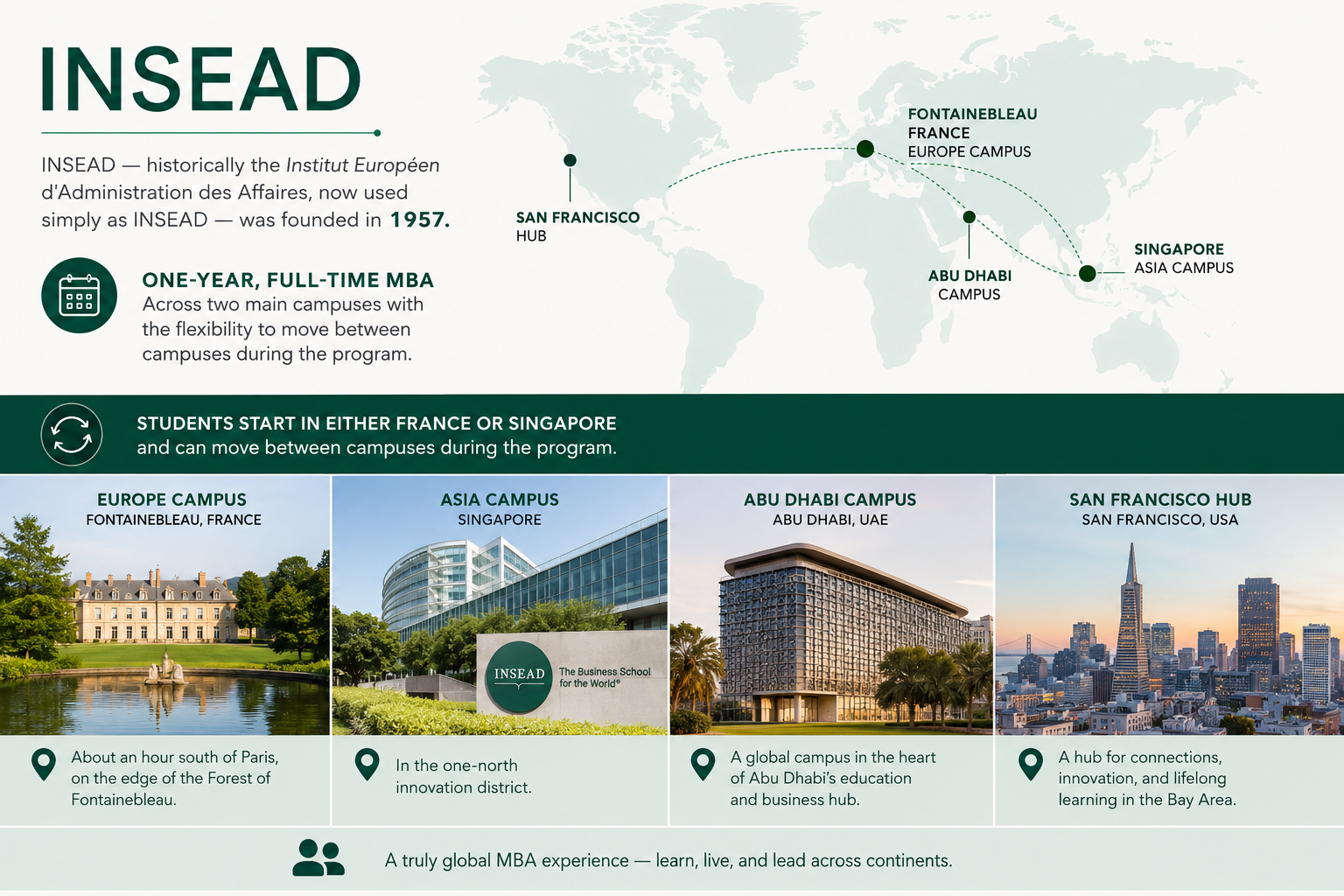
INSEAD — historically the Institut Européen d'Administration des Affaires, now used simply as INSEAD — was founded in 1957. It runs a one-year, full-time MBA across two main campuses: the Europe campus in Fontainebleau, France (about an hour south of Paris, on the edge of the Forest of Fontainebleau) and the Asia campus in Singapore, in the one-north innovation district, with a third campus in Abu Dhabi and a hub in San Francisco.
Students start in either France or Singapore and can move between campuses during the program. There are two intakes a year, in January and August, each around 480–500 students, for a combined class of roughly 900–950. The alumni network runs past 70,000 across more than 170 countries — one of the most globally distributed in management education.
The Curriculum, and What It Reveals
INSEAD's curriculum is organized into five periods of roughly eight weeks each. The first periods are a dense core — around fourteen required courses covering the management fundamentals (financial accounting, organizational behavior, strategy, finance, operations, markets, and the rest) — and from the third period on, students personalize the year with electives drawn from a catalog of 75-plus across ten academic areas. The defining structural unit early on is the study group: five or six students assembled to maximize diversity of nationality, industry, gender, and background, who carry each other through the core.
A nice illustration of what's on offer: the Blue Ocean Strategy elective, taught on both campuses, comes straight from the framework's creators, who are INSEAD professors (more on them below). You're not reading the case; you're taking the course from the people who wrote the theory.
The exchange architecture is part of the point. Students can spend a period on the other home campus (Fontainebleau or Singapore), rotate through the Middle East campus, or take an exchange with partner schools including Wharton, Kellogg, and CEIBS. Few programs let you change continents mid-degree as a built-in feature; INSEAD treats it as ordinary, and the break around the mid-program exchange is when a lot of the class scatters across Asia or Europe together.
What the curriculum reveals: INSEAD assumes velocity. There's no slow ramp, and there's no two-year cushion to course-correct. The design hands experienced, directed people a compressed, rigorous, globally mobile year and expects them to use it deliberately. For the applicant who arrives with a working sense of direction, that compression is the entire value — a faster, denser path to the pivot. For the applicant still deciding what they want, the same structure simply leaves less room to wander, which is why doing some of that direction-setting work before you arrive pays off more here than almost anywhere else.
Culture and Community, Beyond the Marketing
INSEAD's culture is usually summarized in three words the school uses without irony: "work hard, play hard." The intensity is genuine — the academic load is heavy and the clock is short — and so is the social density. With a class drawn from ninety nationalities living through a compressed year together, often in the same small towns or neighborhoods, the bonds form fast and run deep. Students even have a name for the all-consuming pull of the experience: "the Bubble."
The rituals tell you what the community organizes around. National Weeks (the Cultural Festivals) hand the calendar over to the class to showcase their home regions through food, music, and dance — Latin America one week, "Dragon Week" for China and Taiwan the next, the "Heart of Europe" crowd after that. On Dash Day, the entire class shows up to a normal day of lectures in full costume, the more committed the better. The Robin Hood Campaign has each class raise scholarship money for future students who need it — the school's "business as a force for good" ethos turned into a class project. Around 40 student clubs run treks, speaker series, and marquee conferences (the Private Equity Conference, the Women in Business Conference, the Global Luxury Forum), and roughly 30% of students arrive with partners, which makes for a large, genuinely involved partners community.
This is where INSEAD's diversity messaging separates from the schools that merely advertise it. A lot of programs say "global." INSEAD backs it with arithmetic — no national majority, two continents, a built-in expectation that you'll spend the year in close quarters with people whose assumptions don't match yours. The cultural dexterity the school talks about isn't a seminar; it's the daily condition of the place. For the right person that's the whole appeal. For someone who quietly wants a cohort that mostly shares their reference points, it's worth noticing that this isn't that — and the pace and constant motion (new campus, new electives, recruiting, language requirement, all at once) mean the year really can feel like a sprint. Students who thrive are energized by exactly that.
The “I got in” Instagram photo: for the Fontainebleau crowd, it’s the façade of the Château de Fontainebleau, or the whole study group scattered across a boulder in the forest; for the Singapore crowd, it’s the campus against the one-north skyline, or the Marina Bay waterfront lit up at night. Either one tells your feed, in a single frame, that you joined the most international classroom in the business-school world.
Life at INSEAD
Let's talk about what it's actually like to live this for a year, because there are two very different answers depending on where you start — and that choice is real, so it's worth picturing both.
Fontainebleau
The Europe campus sits on the edge of one of the most beautiful forests in France, a short ride from a small town built around a genuine royal palace — the Château de Fontainebleau, centuries of French kings, a UNESCO World Heritage site, right there in the centre. The Forest of Fontainebleau is a world capital of bouldering ("Bleau" is a pilgrimage for climbers), and weekends fill with trails, sandstone, and the kind of green quiet that makes the academic pace survivable. Life is small and dense on purpose: most students live in shared houses in and around town — Club 16, a legendary 16-bedroom house a fifteen-minute walk from campus, has been the cohort's after-party headquarters for years — and cycling is less a commute than a way of life. The Fontainebleau market runs three times a week with oysters and a glass of white before noon, paella by the pan, and rotisserie chicken to carry home; the campus bar, Freddy's, handles the rest. When the sun's out, half the class ends up on the grass with a pint or a glass of wine and a problem set nobody's quite doing. The honest tradeoff: this is a town, not a city. Paris is about forty minutes by train — reachable, a real escape, but a trip rather than a Tuesday night. If you need a major city at your door, Fontainebleau is the more pastoral of the two starts (and the nearby villages of Barbizon and Samois-sur-Seine are the kind of place you didn't know you'd come to love).
Singapore
The Asia campus is the opposite energy: urban, tropical, relentlessly convenient, sitting in the one-north innovation district right beside the Buona Vista MRT, fifteen minutes from the financial district and thirty from Changi. Step across the road and you're at Timbre+, a hawker-style food-and-music gastropark where a lot of lunches and late nights happen. The social heart of the cohort is Holland Village — "HV" to everyone who lives there — Singapore's most established expat enclave, a couple of MRT stops away, full of restaurants, cafes, and a relaxed bar scene; when half your class lives within walking distance of each other, running into classmates becomes the texture of the year rather than a coincidence. For a livelier night, the river bars of Clarke Quay are the move. The weather is hot and humid year-round (no winter to plan around, and none to enjoy, depending on your taste), the hawker food is some of the best and cheapest eating anywhere on earth, and the city is a hub for Asian business — which matters enormously if your post-MBA goals point toward the region.
The two campuses aren't interchangeable, and you can experience both — many students switch for a period, and the mid-program exchange often turns into a group trip through Southeast Asia. Choosing your start (and whether to move) is one of the more genuinely consequential decisions in this program, and it's worth weighing against where you want to recruit, not just where you'd rather spend a year.
The "I got in" Instagram photo: for the Fontainebleau crowd, it's the façade of the Château de Fontainebleau, or the whole study group scattered across a boulder in the forest; for the Singapore crowd, it's the campus against the one-north skyline, or the Marina Bay waterfront lit up at night. Either one tells your feed, in a single frame, that you joined the most international classroom in the business-school world.
Research, Faculty, and Intellectual Identity
INSEAD's intellectual identity is built, fittingly, on ideas that travel. The clearest example is Blue Ocean Strategy — the framework that reframed how a generation of managers thinks about competition, with more than four million copies sold and teaching materials adopted by thousands of universities. It was born at INSEAD, and its creators, strategy professors W. Chan Kim and Renée Mauborgne, still teach there and co-direct the school's Blue Ocean Strategy Institute in Fontainebleau; in 2023 Harvard Business Review named them two of the four most influential thinkers of its first hundred years, alongside Michael Porter and Clay Christensen.
On the leadership side, Manfred Kets de Vries, INSEAD's longtime clinical professor of leadership development, more or less pioneered bringing psychoanalysis to the study of how executives actually behave — which is exactly the intellectual lineage behind the school's insistence that you look honestly at yourself (see the essays below). The same human, identity-centered tradition runs through Jennifer and Gianpiero Petriglieri, a married pair of organisational-behaviour professors both on the faculty: Jennifer's work on dual-career couples (her book Couples That Work) and Gianpiero's on leadership and how adults learn and grow speak directly to people using an MBA as a hinge point in both their careers and their lives — which is most of the class.
For an MBA applicant, the useful read on faculty isn't a marquee name to study under — it's whether professors are reachable, teach well, and bring a genuinely global lens to the classroom. INSEAD's faculty are unusual in how internationally oriented their research and cases are; the school built deliberate expertise in Asian and emerging-market business long before that was common, which shows up in what gets taught. The Nobel laureate or the bestselling author is part of the intellectual atmosphere you're choosing; the teaching faculty you work with week to week — and the global lens they bring — are what you're really buying.
What INSEAD Essays Are Actually Testing
INSEAD refreshed its MBA essay set recently (the changes were introduced for the January 2026 intake and signed by the admissions leadership), and the current set is unusually revealing about what the school weighs. There are two career/"job" essays, two personal essays, an extra-professional question, and an optional essay — plus a separate video interview, covered in the interview section below. (Confirm current prompts and word limits on the INSEAD site before drafting.)
Career essay 1 — your story so far (500 words)
"Provide a summary of your career since graduating from university, explaining the rationale behind your key decisions and career progression…"
This isn't a résumé in prose. The operative word is rationale: INSEAD wants to see that your path has logic — that your moves were intentional, chosen rather than drifted into. Where this goes flat is a chronological recitation. The stronger version connects the dots — why this field, why that move, what each step was building toward.
Career essay 2 — where you're headed (300 words)
"Describe your short- and long-term career aspirations, including your target geography, industry, and function. How do you plan to bridge the gap… and how will INSEAD help you achieve them?"
This is INSEAD's goals-and-fit essay, and it's tighter than most. Naming a specific geography, industry, and function is the point — the school is testing whether your direction is concrete enough for a ten-month program to actually serve. More on executing this one in the next section.
Candid description of yourself as a person and a leader (500 words).
"…emphasising the strengths and weaknesses you recognise in yourself. Explain how you are actively working on your development…"
The school enhanced this prompt specifically to foreground self-awareness. The misread here is treating "weakness" as a humblebrag ("I work too hard"). What lands is genuine self-knowledge — a real limitation, named plainly, with evidence you're working on it. INSEAD is reading for whether you can see yourself clearly, because people who can't tend to struggle in a feedback-dense, multicultural cohort.
A highly stressful situation (400 words)
"…how you managed it. What did this experience teach you about yourself and your interactions with others?"
Recently re-pointed toward the lessons rather than the drama. This one matters more than its length suggests: INSEAD reads it for resilience — the ability to absorb a setback, learn from it, and bounce back — which is exactly the trait employers prize in uncertain markets, and one the school's own admissions team flags as highly valued. The weaker version narrates a crisis; the stronger one is mostly reflection — what the episode revealed about how you operate under pressure and with other people. The situation is the setup; the self-insight is the answer.
Extra-professional activities (300 words)
A newer addition: "…explain how they have enriched your life (skills developed, personal growth, community impact)."
This exists because INSEAD is assembling a cohort, not a spreadsheet of job titles. It's a direct invitation to show the texture you'd bring to the room beyond your work. Treat it as real, not as filler.
Optional essay
Unchanged, and genuinely optional — but useful in a few specific situations. It's the right place for a significant update if you're reapplying, for context on a gap or anomaly a reader might otherwise wonder about, and — for a more senior applicant — for addressing head-on why a full-time MBA now and how you'd integrate with a cohort that skews younger. Used for one of those jobs, it's valuable. Used as a sixth essay because you felt you should write something, it dilutes. If nothing on your record genuinely needs it, leaving it blank is the stronger move.
Read together, the set is striking for how much it weights self-awareness, motivation, and contribution over raw achievement — which is exactly what you'd expect from a school whose entire premise is the cohort. And yes, by this point you may be doing the math and thinking: that's a lot of essays. It is. But it's worth remembering what all that writing is for. INSEAD isn't collecting busywork; it's reading you from five or six different angles because it's trying to assemble a class of genuinely interesting people who will make each other's year. The depth of the application is the front-end cost of the thing you're actually buying — a cohort worth all of it.
What the Career-Goals Essay Should Actually Do
INSEAD's 300-word goals essay (career essay 2) is where the most "why this school" intent lives, and it's where I see applicants struggle most — because the word limit punishes vagueness. The version that falls flat hedges: a soft goal, a vague geography, a generic line about INSEAD's "global network." With 300 words, there's nowhere to hide a fuzzy plan.
The version that works does three things in very little space. It names a specific destination — geography, industry, function, concretely enough that the reader can picture the job. It makes the gap between where you are and where you're going legible, so the MBA reads as the logical bridge rather than a detour. And it ties INSEAD's specific features — the one-year speed, the campus that sits in your target region, the international recruiting reach — to that bridge in a way that could only be written by someone who's actually thought about how this program serves this goal. A line about the alumni network convinces no one; a sentence about why a Singapore start and INSEAD's Asia recruiting calendar fit your pivot into a regional role is load-bearing.
There's a deeper way to think about this essay, and it's the one I keep coming back to with clients. Your scores, your GPA, your MBA résumé — those are the proven facts, the part of you that already happened. But admission is a bet on the part that hasn't: your future. So the real job of the goals essay is to help the reader see that future — to paint a portrait vivid and credible enough that they can picture you already in the role, already doing the work, and want to be the one who helped you get there. Concrete beats abstract every time, because you can't picture an abstraction. Make them see it.
The underlying job is the one that runs through everything Barbara writes: make it easy for the reader to advocate for you. Walk them from your goal to INSEAD's resources so efficiently that, when your file is sitting alongside others with similar profiles, yours is the one they can argue for without effort.
Recommendations
INSEAD requires two professional MBA letters of recommendation, ideally including your current direct supervisor. The school's culture rewards recommenders who can speak to how you operate with other people — across teams, across cultures, under pressure — rather than ones who simply confirm you hit your numbers. Generic praise underserves you; specific, behavior-grounded examples do the work. Brief your recommenders on the kind of evidence INSEAD reads for: leadership that shows up in how others respond to you, and the cross-cultural adaptability the whole program is built around.
The Interview, and What It Actually Evaluates
INSEAD's process has two distinct MBA interview components, which trips up applicants who conflate them.
The video interview comes first, as part of the application itself. After you submit, you'll get a link to Kira — the asynchronous video platform a number of top schools now use — and complete a short exercise: four video questions (45 seconds to prepare, 60 to answer each) and one written question (five minutes), about 15–20 minutes in all. There's nothing to schedule and no live interviewer; you record on your own, which is exactly why it's worth understanding. It does not replace the alumni interviews. Treat it as a chance to show personality and motivation under mild time pressure; the constraint is the point, and over-rehearsed answers read as exactly that.
Two things worth knowing about Kira right now. First, the question set has leaned into AI — applicants increasingly report a prompt about where artificial intelligence will have the most impact, so come in with an actual view rather than a platitude. Second, and more telling: the timed, unscripted format is partly INSEAD's answer to AI-written applications. The school's stance on using AI in your application is refreshingly direct — it's acceptable, even useful, but treat it the way you'd treat quoting a book or an article: for inspiration, not copy-and-paste. The video is where the real, unscripted you has to show up, which is exactly why it can't be outsourced to a chatbot.
The two alumni interviews come only if you're pre-selected, which INSEAD typically communicates about a month after the round closes. You'll interview with two separate INSEAD alumni, usually in your country of residence, and their feedback goes back to the Admissions Committee for the final decision. The full process runs up to about ten weeks from submission.
By now you may be tallying the effort — essays, a video, and now two interviews — and wondering whether any school is worth this much. Here's the reframe: this is the road test, and the license is the part you actually want. Ask almost any INSEAD graduate what made the year, and they won't lead with the curriculum — they'll talk about the people. The two-alumni process is a big part of how the school protects that. Two independent readers reduce the noise of any single off conversation, and alumni — people who've actually lived the cohort — are uniquely able to judge the thing INSEAD cares most about: whether you'd genuinely add to, and thrive in, an intensely international, fast-moving class. In other words, the rigor isn't a hoop; it's the school being careful about who you'll spend the year with. When you picture your own classmates, you want them to have cleared the same bar. The interviews themselves are conversational — your career logic, your motivation for INSEAD specifically, how you've operated across cultures — and the job on your side is simple: be the same person in the room that you were on the page.
Application Logistics
Tests: GMAT or GRE required, accepted equally, and not waivable — a deliberate stance, because the one-year program is intense and the school wants assurance you can handle the pace. Review is holistic and section-level: there's no minimum, INSEAD reads individual sections (a strong Data Insights score can reassure on a weaker Quant, for instance), and if you've sat the test more than once it weights your highest result and will even credit strong sections across different sittings. A genuinely low section may prompt a retake request rather than a rejection. Scores are valid five years.
English certification: Required for non-native speakers (TOEFL, IELTS, or PTE Academic). It can be waived not only by a degree taught in English but — newly — by a full one-year academic exchange taught entirely in English, which widens the exemption meaningfully.
Recommendations: Two professional letters.
CV: One page.
Application fee: €250, non-refundable.
Campus preference: You select France, Singapore, or either; the assignment is generally final after admission.
Video interview: Kira (asynchronous), completed within 48 hours of the deadline.
The Language Requirement
This is the single most-searched source of anxiety about INSEAD, and for most applicants it's far more manageable than the rumor. INSEAD's requirement is two languages:
English, fluent. The language of instruction. Non-native speakers certify it with a TOEFL, IELTS, or PTE Academic score — or, increasingly, with a waiver: a degree taught in English, or now a full one-year academic exchange taught entirely in English, both qualify.
A second language, practical. Roughly a B1 level — enough to communicate on everyday matters. Here's the part that quietly resolves most of the anxiety: if English isn't your native language, your native language is your second language, and the combination of the two satisfies the requirement with nothing further to prove. Only native English speakers need to actively certify a second language.
INSEAD also offers language courses on campus, and plenty of students take the chance to pick up some French in Fontainebleau or a bit of Mandarin in Singapore — not because they have to, but because a year inside the most global school in the world is a natural moment to add a language. Think of it as an opportunity the environment hands you, not a hurdle.
The practical upshot: for the large majority of INSEAD's international class, the language requirement is effectively satisfied the moment they prove their English. If you're a monolingual native English speaker, you'll need a practical second language, so plan for that early. For nearly everyone else, what's often imagined as a real barrier turns out to be a formality.
Deadlines and Intake Strategy
INSEAD runs four rounds per intake, for two intakes a year (January and August), so the calendar is busier than a US school's single annual cycle. Within each round, applications are reviewed on a rolling basis. (Confirm current dates on the INSEAD site before you plan; the figures below were the published deadlines as of this writing.)
August 2027 intake (Class of July 2028):
Round 1: 16 September 2026
Round 2: 4 November 2026
Round 3: 20 January 2027
Round 4: 10 March 2027
January 2027 intake (Class of December 2027):
Round 1: 17 March 2026
Round 2: 21 April 2026
Round 3: 30 June 2026
Round 4: 4 August 2026
On Intake and round strategy
Two decisions matter here, and they're different from the usual R1-vs-R2 question.
First, the intake. The two are not interchangeable. The January intake runs about twelve months with a two-month summer break, which gives you a genuine summer-internship window — the try-before-you-buy step that matters most if you're switching industries, and the one INSEAD explicitly recommends for anyone targeting investment banking. The August intake is ten consecutive months with no internship break: leaner and faster, and a natural fit if you're continuing in your field or arrive with clear goals. So if an internship is part of your plan, the January intake is the one to aim for; if speed and a quick return to work are the priority, August. Either way, choose against your goals rather than your impatience.
Second, the round. As at most schools, earlier is generally better — Rounds 1 and 2 give you fuller access to INSEAD's 180-plus scholarship funds, more runway for visa processing and relocation across continents, and a less compressed timeline. Round 3 remains a real option, and Round 4 is genuinely late, with scholarship access narrowing as the rounds progress.
What I tell clients:
If you're competitive for scholarship and your file is ready, apply in Round 1 or Round 2 of whichever intake fits your goals. If another month of work would meaningfully sharpen your essays — especially that tight 300-word goals essay — a strong Round 2 beats a rushed Round 1. Treat Round 3 as a legitimate choice when your timing genuinely calls for it, and Round 4 as the option you take when the alternative is waiting a full intake. The thing to avoid is letting the nearest deadline, rather than your readiness or your goals, pick your intake for you.
Employment Outcomes, Read for What They Signal
For the most recent reporting class (the December 2024 and July 2025 graduates, 929 in total):
902 — about 97% — sought employment
81% had at least one offer within three months of graduation
Around 5% started their own companies
Median base salary was roughly €100,000 (about US$110,000), with a mean near €102,200 and a median signing bonus around €28,900.
The sector mix
Management Consulting (~50%), split between new hires and people returning to pre-MBA employers
Technology/Media/Telecom (~18%)
Corporate sectors (~17%) including healthcare, energy, manufacturing, luxury, and more.
Financial Services (~15%)
Top employers were the usual consulting heavyweights — McKinsey, BCG, Bain, Strategy&, Accenture.
But the data point that actually defines INSEAD is geographic. Graduates took roles across 57 countries — the widest spread of any leading MBA — hired by more than 250 companies. Western and Northern Europe was the largest single destination at around a third of the class, followed by Asia-Pacific (around 23%), Africa and the Middle East (around 18%), Southern Europe, South America, and only about 6% in North America. Roughly two-thirds of the class changed sector, country, or function, and around one in seven pulled off a "triple jump" — changing all three at once.
What this signals
INSEAD's outcomes don't concentrate in two or three high-pay markets the way a US program's do; they fan out across the globe, which both reflects and produces the school's identity — the same identity that turns out leaders like Thiam and Christiansen who run global institutions far from where they started. The signal for fit is straightforward. If your goal is a global or cross-border career — consulting with international mobility, a regional role in Asia or the Middle East, a pivot that changes your country as well as your job — INSEAD's network runs with you, and few schools can match its reach. If your goal is specifically a US role, read the 6% honestly: it's achievable from INSEAD, but you'd be working against the current rather than with it, and a US program would put you closer to that market's recruiting gravity. The consulting concentration is the other genuine signal — half the class — so if consulting is the plan, this is fertile ground; if it's emphatically not, you'll want to be deliberate about using the school's resources differently from the median student.
One more thing worth saying about outcomes, because applicants fixate so heavily on the first job out: the more durable asset is the network and the lifelong-learning access that come with the degree. INSEAD's 70,000-plus alumni across 170-plus countries are unusually engaged precisely because the program is short, intense, and global — you finish having lived the same demanding year as everyone else, and that bonds people. The school leans into this deliberately, with alumni access and executive-education opportunities that continue long after graduation. The first role matters, but it's one data point on a forty-year curve; the network is the thing that keeps compounding. It's the long-view version of the same "it's not about the immediate transaction" idea that runs through everything here.
Cost and Financial Aid
Tuition (August 2026 and January 2027 intakes): approximately €109,860. (Tuition is quoted per intake and rises over time; confirm the figure for your intake. It covers course materials, library and IT access, language tuition and testing, gym, and health insurance.)
Living expenses (school estimates): roughly €32,000 in Singapore and €30,000 in Fontainebleau with a car lease (about €26,100 without), bringing the all-in cost into the €135,000–€145,000 range depending on campus and lifestyle.
Scholarships: 180-plus scholarship funds, with 41% of the most recent August class receiving an award averaging around €22,000. A meaningful share of students — around a fifth in recent classes — are also employer-sponsored. You can apply for up to four scholarships, so target the ones where you fit best.
Two things worth understanding about INSEAD's aid. First, scholarships are available across all rounds, but applying early gives you full access to the funds and more time before the relevant deadlines pass — a practical reason, beyond admissions odds, to apply in Round 1 or 2. Second, the one-year structure is itself the financial story: a compressed program means roughly half the tuition and, often more significantly, half the opportunity cost of a two-year MBA, since you're out of the workforce for one year rather than two. For candidates weighing INSEAD against a two-year US program, that opportunity-cost difference frequently dwarfs the tuition difference, and it belongs in the decision.
Rankings, in Context
INSEAD sits consistently at the very top of the global tables. The Financial Times placed it #2 in its 2026 Global MBA ranking (up from #4 in 2025, and #1 as recently as 2021), and it ranks among the top handful worldwide across QS and Bloomberg's international measures. It also ranks at or near the top globally for alumni entrepreneurship in Europe.
The relative newcomer LinkedIn Top MBA Programs 2025 ranked INSEAD 3rd globally — and first among all non-U.S. schools — notable because this ranking focuses almost entirely on alumni outcomes (such as hiring success, career progression, and network quality) using LinkedIn's own platform data. Traditional media ranking methodologies blend job/career criteria with academic criteria like faculty, research, reviews, and test scores. Read alongside its #2 finish in the Financial Times, the LinkedIn result tells a consistent story: on the measures that track where graduates actually end up, INSEAD lands at the very top of the global field.
The useful read on rankings here is the one Barbara gives for every school: they're an input, not a verdict, and the FT's heavy weighting on alumni salary three years out tends to flatter programs with strong consulting and finance placement — which INSEAD has. What the tables can't capture is whether the one-year, multi-continent, ninety-nationality model is the right fit for your goals and the way you work. A school can be #2 in the world and still be the wrong school for a particular applicant. Use the ranking to confirm INSEAD's caliber, which is not in question; use the rest of this page to decide whether it's yours.
How INSEAD Differs from London Business School
The most useful comparison for most INSEAD applicants isn't with an American M7 — it's with London Business School, the other elite European program these candidates most often weigh. The differences that matter are structural.
Program length and rhythm.
This is the big one. INSEAD is one year (ten months); LBS is flexible but typically 15–21 months, with most students taking around 18. LBS builds in a true summer internship for everyone and more room to explore; INSEAD compresses everything into a single intense year. If you want the faster, lower-opportunity-cost path and you arrive with direction, INSEAD's compression is the appeal. If you want internship runway and time to pivot more gradually, LBS's longer format does that work. Many strong applicants want elements of both, which is worth sitting with rather than resolving too quickly.
Geography and texture
LBS is in central London — a global financial capital, a true city campus, with the recruiting gravity that comes from sitting inside one of the world's major markets. INSEAD is dual-campus (a forest town near Paris and a district of Singapore), with the ability to switch continents mid-program. There's a lifestyle dimension worth being honest about, too: INSEAD offers continental immersion — a year of living and working on the Continent (or in Asia), language curveballs and all — while LBS offers a taste of Europe from inside an English-speaking world city. For some applicants the Continental (or Asian) adventure is the draw; for others, doing it all in English in a global capital is the deciding advantage.
Language
This one is easy to overlook and matters more than people expect. LBS operates entirely in English; English is all you need. INSEAD requires a second language — and while most non-native English speakers are covered automatically by their native tongue, a native English speaker has to show practical ability in another language. If you're a monolingual English speaker weighing the two, that's a real, concrete difference: at LBS it's a non-issue, at INSEAD it's something to plan for (and, for many, part of the appeal).
Recruiting gravity
Both place graduates into consulting and finance worldwide, but the emphasis differs. INSEAD is, above all, a consulting machine — few programs on earth feed McKinsey, Bain, and BCG offices across Europe, Asia, and the Middle East as reliably. LBS's distinctive gravity is its finance ecosystem and its physical place in the City of London. If consulting is the singular goal, INSEAD's pipeline is hard to beat; if you want a finance-forward base in a global capital with strong consulting access too, that's LBS.
The cross-admit decision
Applicants choosing between them usually decide on length (one intense year vs. a longer, flexible program), on place (Fontainebleau and Singapore vs. London), and on whether consulting is the singular goal or one strong option among several. Most cross-admits genuinely want elements of both, which is why this is worth sitting with rather than sorting with a clean rule. Neither is the lesser school; they optimize for different things.
INSEAD vs. a Two-Year U.S. Program
A related decision deserves a word: INSEAD versus a two-year US program (HBS, Wharton, and the rest). The honest framing isn't ranking-against-ranking. It's that a two-year US MBA offers a longer transformation, a built-in internship, and the deepest access to the US job market, at roughly double the time and opportunity cost; INSEAD offers a faster, more globally mobile year that places far less heavily into the US. If your future is in the US, the American programs sit closer to that market. If your future is global — or you simply value the one-year model — INSEAD was built for exactly that, and the comparison shouldn't be read as one school being a lesser version of the other.
A practical note on cost, since it weighs on this decision more than almost anything else: the one-year structure often makes INSEAD the lower total cost — one year of tuition and one year out of the workforce, rather than two of each. But don't run that math in a vacuum. Scholarships are the great equalizer, and they vary enormously from applicant to applicant and school to school. The right move is to apply, see what offers actually come back, and compare real numbers — your INSEAD package against your US packages — before you let the headline one-year-versus-two-year difference decide anything.
Signals You Might Be a Strong Fit
MBA School Fit is hard to feel from the outside, so here are concrete, checkable signals. If two or three of these sound like you, you're probably reading INSEAD correctly.
You light up around the wider world — you don't just tolerate it. This is more than being comfortable with "difference"; plenty of schools offer that. It's a genuine pull toward the global. You'd pick the Ethiopian place over another burger. You enjoy the World Cup or the Olympics partly for the parade of flags and countries. Hearing a language you don't speak makes you want to learn it, not wish everyone would switch to English. If that's instinctively you, a room of ninety nationalities reads as the whole point.
You can name your destination in three words. Geography, industry, function — you can fill those in concretely, and you can defend the path between here and there. That clarity is what the compressed year and the tight goals essay reward most.
You have zero FOMO about a second year. Finishing in ten or twelve months and getting on with your career sounds like a win, not like missing out while classmates post another year of campus photos. You'd rather move fast, with direction, than stretch the experience out.
Your goals are global or cross-border. You want a career that crosses countries — a regional pivot, an international consulting path, a move that changes your geography as well as your job. INSEAD's 57-country placement spread is the network you actually want.
You already operate like someone mid-flight. You have a track record of leading, adapting, and delivering across contexts, and you're ready to use an MBA to accelerate rather than to discover a direction from scratch.
Signals You Might Not Be the Best Match
The honest counterpart to the section above. None of this means you wouldn't be a strong applicant somewhere, or that you shouldn't apply here — that's your decision. It means the specific match with INSEAD is worth examining before you commit a cycle to it.
The big one: it may not be the best match if the global stuff above just doesn't move you. If a room full of different passports, languages, and assumptions sounds more exhausting than exciting — if you'd rather your classmates mostly shared your reference points — that's worth taking seriously. It isn't a character flaw; it's a preference, and it happens to run against the grain of the one thing INSEAD is built around. A strong domestic program might simply suit you better.
It may not be the best match if your goal is specifically a US-based career. INSEAD can get you there — graduates do land in North America — but only about 6% of a recent class did, and you'd be working against the recruiting current rather than with it. One real lever if the US is your target: INSEAD offers a term-long exchange with US schools including Wharton and Kellogg, which puts you on a US campus and in front of US recruiters for a period. It's a genuine bridge, but it's a few months, not a relocation — so if a US career is the whole point, weigh a two-year US program honestly, since it sits much closer to that market's hiring gravity.
It's a harder fit if you're still searching for your direction from scratch. The compressed year rewards people who arrive with a working sense of where they're headed. If you're earlier in that process, that's not a reason to rule INSEAD out — but it's a reason to do some direction-setting work before you apply, or to consider whether a longer program's extra year of exploration would serve you better while you sort it out.
It's worth questioning whether the format suits you if you want a slower, more gradual transformation. Even the longer January intake is an intense year with a single summer break, not a two-year arc with lots of room to change your mind partway through. If maximum time to explore and course-correct matters to you, a longer program — LBS, or a two-year US school — does that more naturally, and that's a real tradeoff rather than a verdict on either.
And it's a harder fit if you want a big-city base but Singapore isn't it. Be clear-eyed about Fontainebleau: it's a genuinely beautiful spot about an hour from Paris, but it is forest and a small French town — cobblestones, a château, a market, and a lot of green — not cafés-and-skyscrapers-on-every-corner urban life. Paris is a weekend trip, not your front door. (Start in Singapore and the equation flips entirely; this is really a question about the Fontainebleau half of the experience.) If a major city outside your classroom window is non-negotiable, factor that in.
If two or three of these land, treat it as a prompt rather than a conclusion. The most useful next step is usually to ask whether the schools that fit you better are programs you're genuinely as excited about — and to do that fit work honestly now, while it can still shape where you apply.
When Working With Someone Helps, and When It Doesn't
Here's what actually makes outside input valuable for INSEAD, and it's particular to this school. Most programs ask for one or two essays; INSEAD asks for a whole stack of pieces — two career essays, two personal essays, an activities essay, a video, two interviews. The hard part isn't any single one of them. It's that, taken together, they have to add up to one coherent person. Each piece shows the reader a different angle of you, and if those angles don't line up — if the goals essay implies one person and the self-awareness essay another — the reader comes away confused, and confusion is what sinks strong files. The real work is making all of it cohere: the same authentic person, seen from several sides, telling one story. It's like turning a pile of chapters into an actual book. That's the job a good outside reader does — holding the whole arc in view while you're down in the individual pieces, the way a coach paces you through a marathon you can't quite see the end of.
The narrower craft matters too — the 300-word goals essay punishes vagueness, and the "candid" self-portrait tends to come out sounding impressive rather than honest until someone pushes — but those are chapters. The book is the point.
That said — no consultant can manufacture an international orientation or hand you a clear direction you haven't done the work to find. If you don't yet know the geography-industry-function destination you're aiming for, the work before the essays is figuring that out. They then become a record of that thinking rather than a substitute for it.
If you'd like to talk through whether your application is at the stage where outside input would help, a free consultation is a low-pressure way to find out. We'll talk about where you are, what INSEAD is likely to weigh in your case, and what matters most before you draft.