Georgetown McDonough: What This School Is Looking For
Look closely at almost any business story that matters right now — a drugmaker deciding what a heart medication should cost, a hospital system waiting to learn where reimbursement lands, an energy company holding its breath on a permit, a bank that answers to its regulators before it answers to anyone else — and the same current runs underneath all of them: business and government, wired together, each one constantly moving the other. That current now touches nearly every industry worth entering. And one top MBA program is tailor-made for exactly these waters.
That program is Georgetown McDonough, and studying business here means studying it where so much of it actually gets decided. The campus sits on a hill above the Potomac — Gothic spires, brick and cobblestone, older than the country around it — a fifteen-minute ride from the World Bank, the IMF, the U.S. Treasury, and the scores of embassies that make Washington the one city on earth where global business and government share a street corner. So what is Georgetown McDonough looking for? In its own words, it develops principled leaders with a global mindset, in service to business and society — a precise way of saying it wants people who understand that business never happens in a vacuum, who can move fluently between the private sector and the public one, and who measure their work by the good it does and not only by what it returns.
That last part isn't ornament, and it sets up the shift that should change how you approach this entire application. It's natural to read a page like this as a bar to clear — the right score, the right title — and to turn your essays into a case for how impressive you are. But Georgetown isn't ranking a stack of résumés. It's assembling a community of people who will spend two years shaping one another and then carry a particular set of values out into the world. So the question that actually moves the needle isn't "am I good enough?" It's "what would I add to this class, and what would I do with what I take from it?" That shift — from proving yourself to showing how you'd enrich the cohort — is the whole game, and it's the thread running through everything below. It's not about you in the way the instinct assumes. It's about what you'd add.
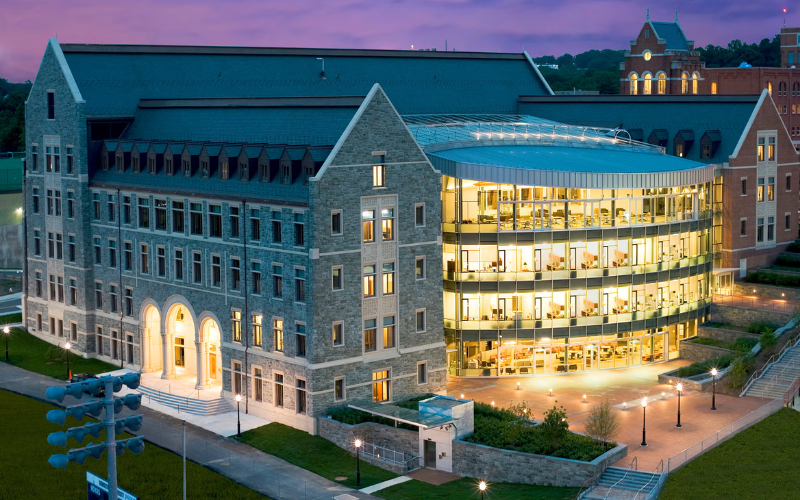
Georgetown McDonough
What is Georgetown McDonough looking for? In its own words, it develops principled leaders with a global mindset, in service to business and society — a precise way of saying it wants people who understand that business never happens in a vacuum, who can move fluently between the private sector and the public one, and who measure their work by the good it does and not only by what it returns.
What Georgetown McDonough Is Actually Trying to Build
Most applicants arrive at this page asking some version of "what do I need to get in." The more revealing question turns it around: what is Georgetown organizing itself around, and who does that design reward?
Start with the thing that makes this school genuinely different, because it's easy to hear it too narrowly. Washington means proximity to government, yes — but the real asset isn't a pipeline to federal jobs. It's fluency in the public-private seam that runs through modern business itself. Most MBA programs teach regulation as one external factor among many, a box on a slide. Georgetown teaches you to treat government as what it actually is in most industries: a stakeholder in your strategy, sitting at the table alongside your customers and your investors.
Look at where the interesting problems really live. Financial services is shaped every day by regulators and central banks. Healthcare and pharma rise and fall on the FDA, on reimbursement decisions, on the politics of a single price. Energy runs on subsidies, permits, and policy. Defense, aerospace, infrastructure, and an entire economy of firms sell primarily to the government. Tech now spends as much executive attention on antitrust, privacy, and AI rules as on product. Even the mission-driven world — development finance, global health, impact investing — lives exactly where capital meets public purpose. Here's the part applicants miss: none of this competes with your finance, consulting, or tech ambitions. It compounds them. Whatever you want to do, understanding how business and government move each other makes you better at it, and few programs are positioned to teach it the way this one is.
And Georgetown doesn't merely claim this — it builds it into the requirements. In the redesigned MBA launching in fall 2026, the foundational core includes a course called Ethics, Policy, and Global Engagement, and the strategy core offers Geopolitics and Geostrategy. The elective shelf reads like a map of the seam: Washington, Business, and the World; Strategies Beyond the Market; Antitrust & Business Strategy; The Business of Healthcare; National Security & the Global Economy; Corporate Social Responsibility. Those aren't garnish. They reflect a philosophy — that competitive advantage often depends on reading the political and regulatory environment as well as the market. You can even earn a certificate in nonmarket strategy, a phrase most business schools don't have a course in, let alone a credential.
The city does the rest of the teaching. Students consult for the World Bank rather than reading about it; they take the meeting downtown, attend the embassy event, sit in on the hearing. On one campus visit I walked past the career services office and saw a sign for U.S. Secret Service coffee chats happening that afternoon — the kind of detail no marketing produces, and a small, precise illustration of the point. The public-private door here swings both ways, wide enough that a federal agency comes to campus to compete for business talent alongside the banks and the consultancies.
Then there's the second half of Georgetown's identity, and it's where the school parts ways with most of its peers: the values are load-bearing. This is the oldest Catholic and Jesuit university in the country, and its guiding ideas — cura personalis, care of the whole person, and educating "women and men for others" — show up in requirements rather than mottos. The redesigned program opens with a two-week term the school calls The Hoya Way, built around ethical principles, global mindset, and policy-driven decision-making before you touch a single finance class. There's a core Ethical Leadership course carrying the Ethics Project, a year-long team assignment with a disarmingly plain prompt: think of something good to do, and do it. Hold that up to the light and the school's self-description — principled leaders, global mindset, in service to business and society — stops reading like a tagline and starts reading like an admissions rubric.
Dean Paul Almeida frames the place around "do well and do good," and has aimed its strategy at what he calls the fields of the future: AI and the future of work, the business of health, the business of sustainability. Notice that every one of those is, at its core, a public-private problem.
So when Georgetown talks about principled leadership, it isn't a soft phrase bolted onto a hard program; it's the actual selection criterion. The school is assembling people who are analytically serious, globally fluent, at home in the seam between business and government, and genuinely oriented toward others — and it reads the application for the parts a transcript can't show, which is most of them. Your file's job is decision support: give the reader the evidence to advocate for you as someone who will enrich this specific cohort and carry its values outward. It isn't about proving you're impressive in a vacuum. It's about what you'd add, and what you'd do with it.

Who Genuinely Belongs Here
When a client asks me whether they belong at Georgetown, I move them off the question they usually lead with — "are my numbers good enough?" — because at a school this deliberate about values and global reach, the numbers are the entrance to the conversation, not the conversation itself.
The better question is whether the intersection Georgetown lives on is the one you want to live on. The people who thrive here tend to share three things.
The first is real global curiosity — not "I studied abroad once," but a genuine pull toward how business works across borders, cultures, and systems. In a class that's 44% international drawing from forty countries, that curiosity isn't an essay theme; it's the daily texture of your study team.
The second is an appetite for the seam where business meets government and society. You don't have to want a career in government — most McDonough graduates go into consulting and finance — but the applicant who's energized by the fact that regulation, geopolitics, and public institutions shape every industry will feel at home in a way the pure-P&L operator might not.
The third is the disposition behind cura personalis — care of the whole person. It's worth pausing on, because it's the least understood thing about this school and probably the most important. It means Georgetown is interested in you as a full human being rather than a bundle of metrics: your health, your family, your convictions, what you do on a Saturday, who you look after. That cuts in two directions. It's what the admissions committee extends to you, and it's what the school expects you to extend to the people around you. If you're the person who notices when a teammate is drowning and does something about it, you already speak the language here.
You can see all three in the class Georgetown actually admits. Business majors sit next to engineers, economists, humanities graduates, and people who came out of government and international studies; former consultants sit next to teachers and veterans. This is not a school with one type of student, and it isn't trying to become one.
Here's a useful self-test. Two of McDonough's three essay options ask you to write about caring for another person or contributing to a community, rather than about your most impressive win. If your reaction is "finally, a place to show that side of me," your instincts already match the culture. If your reaction is "where's the achievement essay?" — there is one, and it's a perfectly good choice — it's still worth sitting with why the school leads with the other two.
The honest version of the fit question, then: Georgetown wants someone who experiences principled, global, and public-private not as limits on ambition but as the shape ambition takes. Get that right and you're reading the school correctly. And there's a real bonus for the applicant who does, which we'll come back to below: the odds of admission here are more favorable than at most schools of this caliber.
The Class Profile, Read Honestly
The most recent confirmed class — the Full-time MBA Class of 2027, entering Fall 2025. Among the most international classes of any top U.S. program — a direct expression of McDonough's "business and society" mission and its place in the nation's capital:
Where They Worked Before
Bars show share of the entering class. Government's 10% share runs far higher than at most programs — the clearest data signal of McDonough's D.C. location and public-purpose pull.
What They Studied
Bars show share of the entering class. A government/international-studies major bloc is rare among peer programs — another marker of who Georgetown draws.
A few things that are easy to misread in these numbers:
The GMAT is an average, not a floor.
Georgetown reports a 700 average and reports the GMAT Focus separately at 625, so match your score to the edition you took and don't let the two scales rattle you. With a middle 80% running down into the 660s, a score in the high 600s sits comfortably inside this class, and a coherent, well-argued file can carry it. The GMAT, GRE, and Executive Assessment are all accepted — and Georgetown accepts expired GMAT and GRE scores, which almost no peer does. The right test is simply the one that shows you best. And, as the logistics section explains in detail, there's a real chance you don't have to take one at all.
The international share is the story, not a footnote.
At 44% international from forty countries, with recent second-year classes running near half, McDonough is consistently among the most global full-time programs in the country. If you're applying from abroad, that isn't a diversity statistic; it's a signal that your perspective is core to what the school is building. And the city amplifies it in a way no other American campus can match. Washington hosts more than 175 embassies — you can walk Massachusetts Avenue past a dozen flags in twenty minutes — and at Dulles the diplomatic lane at passport control is a permanent fixture rather than a curiosity. The practical upshot: Georgetown offers something rare, a genuinely global environment inside a top American MBA, in the American city most organized around the rest of the world. (The STEM-designated Management Science pathway, which extends post-graduation work authorization, matters here too.)
The undergraduate mix rewards an unusual background.
Business is the single largest major at 30%, but the other 70% spreads across STEM, humanities, economics, and government — which tells you an atypical academic record is something to position, not something to apologize for.
The acceptance rate
And a word on the acceptance rate, since it's the number everyone wants. Georgetown doesn't publish one, and I'd rather not anchor you to a third-party estimate that may not be accurate. Here's what's true and more useful. The door here is more open than at schools of comparable caliber, and that isn't a discount — it's a disposition. A school built on caring about the whole person is a school inclined to look at the whole person and to open its doors as wide as it responsibly can, while keeping the standards, the outcomes, and the brand exactly where they are. Think of it the way you'd think of accessible luxury: nothing about the quality is compromised; it's the access that's deliberately less rarefied. What follows from that is a two-way test rather than a hurdle. Georgetown is genuinely looking for fit — its fit for you as much as yours for it — and for the applicant who has it, this is one of the best opportunities in the top 25.
The profile isn't a checklist to clear line by line. It's a portrait of who Georgetown admitted last year. Your job is to give the reader the evidence that places you clearly inside it.
Common Myths About Georgetown McDonough
"Georgetown is only for people who want to work in government."
The most common misread, and it gets the direction backward. The two largest destinations for recent graduates were consulting and financial services, each about a quarter of the class. Washington doesn't funnel you into government; it hands you a lens that travels straight into finance, consulting, tech, healthcare, energy, and corporate strategy, because every one of those is shaped by regulation, policy, and global forces. Government is a door Georgetown opens especially wide. It is not the only room in the building.
"You have to go to Silicon Valley for tech."
This is the one that surprises people, international applicants especially. Drive west from campus on the Dulles Greenway and you pass through the most concentrated data center market on the planet: Loudoun County's "Data Center Alley," where by most estimates something like 70% of the world's internet traffic passes through on a given day, and where roughly a third of the world's hyperscale data centers sit — Amazon, Google, Microsoft, Meta — in buildings the length of several football fields, set back behind the tree line, humming, one after another after another. This isn't an accident of tax policy alone: Northern Virginia was one of the physical birthplaces of the commercial internet, and the fiber never left. In an AI economy that runs on compute, that's not a historical footnote. It's why the AI build-out, and the fights over its power and water, are happening in Georgetown's backyard.
The corporate map matches. Amazon put HQ2 in Arlington, a few Metro stops from campus. Boeing moved its headquarters there too, and RTX is around the corner. Capital One and Booz Allen anchor McLean; General Dynamics, Leidos, and CACI sit in Reston; Northrop Grumman is in Falls Church. Greater Washington counts twenty Fortune 500 headquarters. It's a different kind of business town than New York or the Bay Area — more policy-shaped, more international, more institution-dense — but "not a business town" isn't a description anyone who has worked there would recognize.
"A more favorable acceptance rate means it's less prestigious."
It doesn't, and the outcomes say so plainly. Georgetown places directly into McKinsey, BCG, Bain, Goldman Sachs, Deloitte, Amazon, Microsoft, and the World Bank. Its alumni run serious things: Laurence Tosi (JD/MBA'94) was CFO of Blackstone and then of Airbnb before founding WestCap, a private equity firm managing billions; Zachary Leonsis (MBA'15) is president of media and new enterprises at Monumental Sports & Entertainment, which owns the Capitals and the Wizards; Dewey Awad (MBA'96) is a partner at Bain Capital. The speaker roster tells the same story — the Stanton Distinguished Leaders Series has brought Indra Nooyi, David Rubenstein, Colin Powell, Goldman Sachs president John Waldron, and Disney Experiences chairman Josh D'Amaro to campus, and Jamie Dimon sat for a fireside chat with Georgetown's own Reena Aggarwal. Prestige is not the thing Georgetown is short of. What it has is a front door that's genuinely open to the right person.
"You have to be political to fit in."
You don't. What helps is being interested in how the public and private sectors interact, which is a different thing from holding strong partisan views. Plenty of McDonough students arrive with no political ambitions at all and simply want to understand the forces shaping the industries they're entering.
"There's nothing to do in D.C. but look at monuments."
The monuments are wonderful and you will absolutely take your parents to the Lincoln Memorial. But the reason people who move to Washington tend to stay is everything else. The city has become one of America's best food towns, the museums are free, and the region is a genuinely great place to have a weekend: Virginia horse country and the vineyards of Loudoun and Fauquier are an hour west, Annapolis and the Chesapeake sailing scene about forty-five minutes east, the Blue Ridge a morning's drive, the Atlantic beaches about three hours. More on all of this below. It's a real part of the pitch, not a consolation.
Identity and Program Basics
The Robert Emmett McDonough School of Business at Georgetown University, on the university's historic Hilltop campus in the Georgetown neighborhood of Washington, D.C. Two-year, full-time, cohort-based MBA; the full-time program dates to 1981, and the school is named for alumnus and benefactor Robert Emmett McDonough. Class size around 248, taught in cohorts of roughly 50–70. The MBA's home is the Rafik B. Hariri Building.
Most people are surprised the first time they visit. They expect a business school; they find an 18th-century neighborhood. Georgetown predates the capital that grew up around it, and the campus reflects that — Healy Hall's spires above the front gates, Dahlgren Quad, brick and cobblestone streets running down the hill toward the Potomac, Federal townhouses in every direction. It is one of the genuinely beautiful places to spend two years in American graduate business education, and the improbable part is that a global capital starts at the end of the block.
The full-time program is STEM-designated through its Management Science pathway, which matters for international students' post-graduation work authorization. Sitting inside Georgetown University opens distinctive dual-degree options — most notably the MBA paired with the Walsh School of Foreign Service, widely regarded as the best in its field, plus MBA/JD and MD/MBA — and cross-campus resources in law, public policy, medicine, and global affairs. McDonough also runs Flex (part-time), Online, and Executive MBA formats, along with a deep bench of specialized master's programs.
The Curriculum, and What It Reveals
Here's the thing to know if you're applying now: Georgetown rebuilt its MBA, and the new curriculum launches in fall 2026 — which means it's the program you'd actually enroll in. This wasn't a cosmetic refresh. It came out of roughly eighteen months of work with employers, students, and alumni, and it aims squarely at three things the school believes will define the next decade: AI and data fluency, ethics, and career readiness.
It opens with The Hoya Way, a two-week term of intensive instruction in ethical principles, global mindset, and policy-driven business decision-making, layered with an immersive AI bootcamp using industry tools. Read the order of operations, because it's the whole school in miniature: before you touch a balance sheet, Georgetown teaches you how to think about ethics, the world, and government — and how to use AI. As Senior Associate Dean Sudipta Dasmohapatra has put it, ethics is the basis of all AI conversations, and the school's bet is that its values-based tradition is exactly what qualifies it to teach responsible AI practice.
From there the foundational core runs through Ethics, Policy, and Global Engagement; Leadership Communication; Managerial Statistics; Accounting Fundamentals; Managerial Economics; Global Economics for Managers; Ethical Leadership; and the Global Business Experience. You then choose a course from each of several areas — AI (AI for Leaders or Applied AI Lab), finance, organizational behavior, analytics, accounting, strategy (where Geopolitics and Geostrategy sits alongside Business Strategy), marketing, and operations. AI is embedded across the curriculum rather than quarantined in one elective, and the stated goal is that every graduate leaves data and AI literate.
The other major change is personalization. After the opening term you can shape the timing and focus of core and elective courses around where you're actually headed — which, as the admissions team has said plainly, is designed to get career-relevant coursework in front of you before recruiting ramps rather than after. There are 70-plus electives and certificates in consumer analytics and insights, global real estate, the business of healthcare, nonmarket strategy, and sustainable business.
The signature experience remains the Global Business Experience — a required international consulting project where teams solve a live problem for a real company, then travel abroad to present their findings to executives. It has run across dozens of countries and cities since 1995, and it's the mission made operational: you learn global business by doing global business. Around it sits a genuinely applied ecosystem. The Executive Challenge is a day-long role-play case competition that serves as the final exam of the Leadership Communications course, with more than a hundred alumni and corporate partners coming to the Hariri Building to judge. The Small Business Corps sends student teams to consult for under-resourced small businesses across the D.C. region. There's a Real Estate Clinic where students underwrite real investments, and a Venture Fellows apprenticeship program with VC and PE firms. Before you even arrive, you take a summer career course to define your plan and build your search roadmap.
What the structure reveals:
Put it together and the curriculum says exactly what the mission says. The program opens with ethics, global mindset, policy, and AI. Its strategy core includes geopolitics. Its signature course flies you abroad to advise a real company. Its clinics point outward at communities. This is a program for people who want an MBA that's experiential, international, and connected to something beyond the spreadsheet, and it's engineered to produce the collaborative, globally fluent, service-minded leader the admissions committee is reading for. The redesign tells you something else, too: this is a school willing to take itself apart and rebuild when the world changes. That's its own kind of signal about where it's going.
Culture and Community, Beyond the Marketing
Live in this city long enough and it stops being abstract. You'll be at the hair salon and realize the Speaker of the House is two chairs down — I have. You'll watch a sitting senator climb into a taxi outside Union Station, under the Columbus Fountain, like anyone else catching a train — I have. You'll be in a shop on Wisconsin Avenue and clock a senator browsing the racks — that one too. It does something to a student's sense of scale. The people who run things aren't abstractions here. They're in line ahead of you.
Now the part that's harder to say and matters more. Georgetown is a Jesuit school, and if you're not Catholic — if you're a Jewish kid from New York or a Muslim engineer from Istanbul or someone with no religion at all — it's fair to wonder what that means for you. The honest answer: much less about faith than you'd expect, and much more about a value system that turns out to be remarkably easy to share.
Set the theology aside and the Jesuit tradition is a set of propositions about people. That everyone is owed equality and respect. That a person is more than their output. That you're obligated to the people around you. That your worth is measured by what you do in the world rather than by the status on your LinkedIn profile. That a life spent partly in service to others is a life well spent. Plenty of institutions are talking about caring for the whole person now; the Jesuits have been doing it for close to five centuries. You don't have to be Catholic to want that in a school. You just have to want it.
That's what cura personalis looks like on the ground, and it's why the community skews collaborative rather than cutthroat, why students describe it as unusually warm, why the "One McDonough" model threads career support and community together, and why the Hoya identity outlives graduation by decades. There are more than fifty student-run clubs, and most students take a leadership role in one or two. With a class this international, your study team is cross-cultural by default, and friendships form across lines that don't get crossed as easily elsewhere.
Where applicants over-read the culture: some hear "values-driven" and "care of the whole person" and picture a gentle, unhurried two years. It isn't that. The core is quantitatively serious, and consulting and finance recruiting are as intense here as anywhere in the top 25. What the values change is the direction of the ambition, not its temperature. Where applicants under-read it: some treat the Jesuit language as marketing and never engage with what it means, which shows up in an application that reads as generically ambitious and in an interview that can't answer why this community. The values are the product. Engaging with them seriously is part of the work.
The “I got in” Instagram photo: Healy Hall — Georgetown’s clock-towered, Flemish-Romanesque landmark, spires against the sky, the image that comes up first when anyone Googles the university. Frame it behind you from the front gates or Dahlgren Quad and your feed knows exactly where you landed.
Life at Georgetown McDonough
Let's talk about what it's actually like to spend two years here, because Georgetown is one of the more livable and full-of-character places you can do an MBA, and the neighborhood is a genuine part of the pitch.
Start with the setting. The campus sits on a hill above the Potomac, all Gothic spires and red brick, in the historic Georgetown neighborhood — cobblestoned streets, Federal townhouses, and the C&O Canal running through it. This is where John F. Kennedy lived as a young senator before the presidency; you can walk past the house on your way to dinner. Washington gives you four real seasons: humid, green summers; a spectacular spring when the cherry blossoms come out along the Tidal Basin and the whole city photographs itself; crisp falls; and winters that are cold and occasionally snowy but nothing like the Northeast or Midwest deep freeze. And this is a monumental city — the Mall, the memorials, the Kennedy Center, and the museums (most of them free) are the backdrop to ordinary weekends. It's also a city that has come a long way from its 1990s reputation; Georgetown itself is about as pleasant and walkable a neighborhood as exists in urban America.
Then there's the food and the hangouts, and here the neighborhood earns its reputation. The Tombs is the one every Georgetown alum names first — a below-ground tavern in a Federal townhouse just off the front gates, opened in 1962, rowing oars on the walls, and the real-life inspiration for the bar in St. Elmo's Fire (a scene from The Exorcist was filmed there too). It's where you'll end up watching a Hoya basketball game over a pitcher. A block away, Wisemiller's — "Wisey's" to everyone — has fueled generations of students with overstuffed sandwiches; the Chicken Madness is campus legend. Martin's Tavern has been serving since 1933, and its booths are named for the people who sat in them: JFK proposed to Jackie in Booth 3, and the plaque is still there. Café Milano is where Washington's power lunch happens, and it's worth walking past just to see who's at the window. For the modern D.C. version, Call Your Mother does the cult bagels a couple of blocks from campus, and Baked & Wired by the canal is the beloved coffee-and-cupcake stop — ask a student about the tourist line outside Georgetown Cupcake down the street and watch them point you here instead. When you want the rest of the city, the reinvented Wharf on the waterfront, Union Market, and the restaurants and nightlife of 14th Street are a short ride away.
For the walkable-quirky hall of fame: the Exorcist Steps — the steep stone staircase at 36th and Prospect that the movie made famous — is two minutes from campus and a rite of passage to run. The Georgetown Waterfront and the C&O Canal towpath are where people run, bike, and decompress. From the waterfront you can catch a water taxi down the Potomac to Old Town Alexandria — George Washington's home city, cobblestones and 18th-century storefronts, with Mount Vernon just beyond. And when the Marine Corps Marathon comes through Georgetown each fall, the whole neighborhood turns out to cheer.
The "I got in" Instagram photo: Healy Hall — Georgetown's clock-towered, Flemish-Romanesque landmark, spires against the sky, the image that comes up first when anyone Googles the university. Frame it behind you from the front gates or Dahlgren Quad and your feed knows exactly where you landed.
Here's the thing to understand about all of it: Georgetown gives you a rare combination — a contained, historic, genuinely beautiful campus community and a world capital at the end of the block. In a city like this, your classmates aren't your only option for an evening, so the cohort closeness is something you build on purpose. For most McDonough students, that trade — real community plus real access to the world — is exactly the appeal.
Research, Faculty, and Intellectual Identity
Georgetown's intellectual center of gravity clusters where the location points it: financial markets and policy, global and international business, business and public policy, and increasingly sustainability and the business of health. The school runs roughly a dozen centers and initiatives — the Psaros Center for Financial Markets and Policy, the Center for Business and Public Policy, the Baratta Center for Global Business, the Steers Center for Global Real Assets, and the Business of Sustainability Initiative among them — most designed to pull Washington's institutions into the academic conversation. When McDonough and the School of Foreign Service co-host something like a U.S.–Ukraine reconstruction and investment forum, that isn't an extracurricular. That's the thesis.The point isn't celebrity for its own sake. What MBA applicants actually want from faculty isn't a marquee name to study under — it's professors who are reachable, teach well, and stay with you — and at Stern the biggest names are, by reputation, also among the best teachers.
A few faculty make the identity concrete. Reena Aggarwal — Robert E. McDonough Professor of Finance and founding director of the Psaros Center — is a globally recognized authority on financial markets, IPOs, corporate governance, and institutional investors; she has served as an academic fellow at the SEC and a visiting scholar at the IMF, and she's the one who sat across from Jamie Dimon for a fireside chat on campus. That's about as clean an expression of Georgetown's finance-meets-policy identity as a faculty roster can produce. Pietra Rivoli, a longtime professor and vice dean, wrote The Travels of a T-Shirt in the Global Economy, which follows a single T-shirt around the world to illuminate how globalization actually works and what it costs; she's also the professor who moderated Indra Nooyi's conversation on campus. There may be no better embodiment of what "business has no borders" means in a classroom. Vishal Agrawal, who holds the Blommer Family Endowed Chair in Sustainable Business and directs the sustainability initiative, anchors the school's work on sustainable operations and business models — one of Almeida's fields of the future.
The practical point for an applicant is worth keeping in view. What you want from MBA faculty isn't a marquee name to study under; that's a PhD applicant's concern. What you want is professors who are reachable, teach well, and know who you are, and whose work keeps the program plugged into the live conversations in finance, policy, and global business. At Georgetown's scale, and with cura personalis extending to the faculty-student relationship, that access is real.
What Georgetown McDonough Essays Are Actually Testing
Georgetown's application is deliberately lean, and the school says so: one written essay, one video essay, one recommendation, unofficial documents. That's a deliberate act of respect for your time. But lean doesn't mean easy. Every piece is doing pointed work.
The written essay: choose one of three (500 words)
The preamble states the intent plainly — pick the prompt that best showcases the value you'd bring to the community. Each option is a different door into the same room, which is what you'd add. The associate dean of admissions has said the mistake she sees most is the simplest one: not proofreading, and not fully answering the question asked. Her test before you submit is a good one — can you say in a sentence what you want the committee to understand about you after reading this?
Georgetown Community. This one leads with the Jesuit principles of equality and respect and an ethos of caring for the whole person, and asks how your educational, familial, cultural, economic, and social experiences will contribute to the diversity of perspectives at Georgetown. Choose it if your distinctiveness comes from perspective — a vantage point that would sharpen the conversation around you. Where it goes wrong is when the essay simply states the facts of a background: "I'm a first-generation college graduate," full stop. That's a label, and a label isn't an argument. It isn't enough to say you're first-gen; you have to show why it matters. The strong version shows what the background gave you — how being the first in your family to navigate an institution taught you to read rooms nobody had explained to you, and what that means for the classmate beside you when a case turns to a market neither of you grew up in. Not who you are on paper. What it lets you see.
Cura Personalis. This names the value directly and asks for a specific instance where you supported a teammate or coworker: what you did, what changed, and how you'd bring that to the collaborative environment at McDonough. It's the clearest test of the others-first disposition the school is built on. Choose it if your strongest material is about lifting someone else. The misstep is making yourself the hero of a story that's supposed to be about care. The strong version keeps the other person in focus and lets your character show through what you actually did.
Achieving Excellence. The achievement essay, for people whose best material is a concrete, measurable professional result. Describe the experience, the strengths that produced it, and how those qualities would help you leave a legacy at Georgetown. Choose it if you have a genuine, specific win — and note the move the prompt requires at the end: connect the excellence forward to what you'd contribute, not just backward to what you did.
Whichever you choose, notice what Georgetown does not ask: there's no standalone career-goals essay and no traditional "Why Georgetown" essay. That's a design choice, and it changes your job — your goals and your fit have to come through the résumé, the one essay you pick, the video, and the interview. Every piece has to pull more weight than it would at a school with a dedicated goals prompt.
The video essay (required, one minute)
The current prompt is warmer than most applicants expect: in one minute, share what has recently brought you joy outside of work — a new hobby, an adventure, or a simple pleasure. That's cura personalis turned into a format. The school wants the person behind the résumé.
A few things are worth knowing, because the admissions team has been unusually direct about them. They assess content, communication style, presence, and personality. They explicitly do not assess production quality; most applicants record on a laptop or a phone, and that's completely fine. So the thing that sinks a video isn't a low budget. It's stiffness. Don't read from notes. A person reciting a script on camera reads exactly like a person reciting a script on camera, and it defeats the entire purpose of the exercise. The school asks for unscripted and conversational, and means it. Know your two or three beats, appear on camera yourself, and talk to the reader like a human being who genuinely loves the thing you're describing. Joy is hard to fake and easy to recognize.
The optional essay (300–350 words)
For genuine context: a gap, a dip in performance, a recommender choice that needs explaining. Use it only when something would otherwise raise a question, because when a reader doesn't know why something happened, the mind fills the silence with a worse story than the truth. If nothing needs explaining, leaving it blank is the stronger move. (Reapplicants complete a separate 300–350 word essay on how they've strengthened their candidacy, and Georgetown treats reapplicants generously — a fee waiver, coaching between cycles, and permission to reuse prior essays that still hold up.)
One more thing, and it's genuinely Georgetown.
The school publishes a Responsible Use of AI policy for applicants: AI is welcome as a collaborator for brainstorming and refining, and explicitly not welcome for writing your essays, fabricating experiences, or misrepresenting you. Read that next to a curriculum that now teaches responsible AI from the opening term and you'll see a school practicing on its own front porch what it teaches inside. Take it at face value: use the tools to think, not to speak for you. The people reading can tell, and at a school that selects for authenticity, that's the shortcut that costs the most.
What Your "Why Georgetown" Story Should Actually Do
Because there's no dedicated "Why Georgetown" essay, the fit argument lives inside the essay you choose, the video, and the interview — and it's where applicants most often go generic. The misstep is praising what everyone praises: the D.C. location, the global focus, the collaborative culture, all in the abstract. Everyone writes that, and it persuades no one. What a strong Georgetown fit argument does is connect a specific, demonstrated trait of yours to a specific feature of how the school works — the Global Business Experience if your edge is cross-border; the Small Business Corps or a particular club if service is your thread; the nonmarket-strategy world if you've watched a regulator reshape your industry. Write less about why Georgetown is good for you and more about why the cohort is better with you in it. That's the version that hands the reader something to advocate with.
Recommendations
Georgetown requires exactly one letter of recommendation, and it accepts the GMAC Common Letter. Read the school's own language and you'll find something unusually candid: it discourages additional letters, along with letters from faculty and family members. That's not a logistics note. It's a philosophy, and it's a favor to you.
Here's the thinking. Applicants agonize over MBA recommendations — whether a second letter would help, whether a bigger title would tip it, whether to chase the alumnus who barely knows them. Georgetown is quietly telling you not to. In an era when recommenders lean on AI to draft, letters have drifted toward a uniform, competent blandness, and a stack of them tells a reader less than you'd hope. The school's answer is to ask for one, from someone who has actually watched you work, and to signal clearly that piling on more won't move the needle. So stop optimizing for volume or for titles. What matters is how well your recommender knows you and how specific they're willing to be.
The questions themselves tell you what to look for. Georgetown asks how you compare with other strong people in similar roles and — tellingly — asks your recommender to describe the most important piece of constructive feedback they gave you and how you responded. That's a cura personalis question in disguise: it reads for self-awareness, coachability, and growth. Pick the supervisor who can answer it with a real story, and give them the context to do it well.
The Interview, and What It Actually Evaluates
Interviews are by invitation only, extended after each deadline, and required for admission. An invitation is meaningful: it means you've cleared the initial read.
Two details shape how you should prepare. First, who's across the table varies — it might be an admissions committee member, a current MBA student, or an alumnus. Second, and more important, the interview is double-blind: you won't know your interviewer in advance, and your interviewer has not read your file. Georgetown does this deliberately to reduce bias. In practice, the interviewer typically has your résumé and little else, which is both a gift and a responsibility. You're not defending your essays; you're introducing yourself from scratch, on your own terms. It also means your résumé has to invite good questions, and that you should never assume the person across from you knows the story you told in your essay. Tell it again, fresh.
The conversation is behavioral, designed to assess the qualities that predict success in the program and in the Georgetown community. What it's really evaluating is whether the person in the room matches the person on paper, and whether you'd fit a collaborative, service-minded culture. You can interview by Zoom, on campus, or at a recruiting event anywhere in the world, and the school says all formats are weighted equally — so choose the one where you'll be most yourself. The applicants who find this hardest are the ones who absorbed Georgetown from a rankings page and never engaged with what the place values, because warmth and specificity are difficult to manufacture in real time.
Application Logistics
Tests: GMAT, GRE, or Executive Assessment. Georgetown also accepts expired GMAT and GRE scores — an unusually forgiving policy worth knowing if you tested years ago. Test waivers are available; see below.
Recommendations: One required. Additional letters discouraged.
Application fee: $175, with automatic waivers for a notably broad list — U.S. military (active duty, reserve, veterans), Consortium (CGSM) members, Management Leadership for Tomorrow fellows, Forté MBA Launch participants, Peace Corps, AmeriCorps and Teach for America, reapplicants, current and recently separated federal civil employees and contractors, and citizens of countries on the UN's least-developed list. A reduced $100 fee applies to Forté members and lower-income applicants, and attending a qualifying admissions event earns a reduction code.
Résumé: Current, matching the employment section of your application, with months and years in each role.
Transcripts: Unofficial at application; official only if admitted.
Video essay: Required (see above).
STEM designation: Through the Management Science pathway.
Confirm the fee and any test-policy updates whenever a new cycle posts.
The Test Waiver, in Detail
This deserves more than a footnote, because a lot of strong candidates don't realize they may not need to sit an exam at all. Georgetown's position is that the test is one way — not the only way — to show you can handle quantitative coursework. If other parts of your file demonstrate that, you can apply for a waiver.
The school publishes what it looks for, and it's refreshingly concrete. Candidates most likely to succeed have one or more of:
Grades: a cumulative GPA of 3.1 or higher in business, science, engineering, technology, or math; or 3.3 or higher in other majors, with the rigor of your institution and major considered.
Coursework: at least two rigorous, non-introductory quantitative courses — finance, accounting, statistics, calculus, advanced math, engineering, computer science, physics — with a B or better.
Certifications: CPA, CFA, or an international equivalent, or another quantitatively rigorous credential.
Work experience: substantial post-undergraduate work in a role where the majority of your responsibilities require rigorous quantitative analysis. Georgetown is explicit that Excel and pivot tables for simple analysis don't qualify.
Demonstrated grit: professional and academic experience showing you can succeed in demanding quantitative work.
The process has one wrinkle worth getting right: you start — but don't submit — an MBA application, then submit the separate test waiver application and wait for a decision before submitting the main one. (Consortium applicants are the exception and shouldn't start a Georgetown application first.) The school can still ask for syllabi, additional proof, extra coursework, or ultimately a test score. Deferred-admission applicants and current undergraduates aren't eligible unless they're nontraditional with significant work experience.
My honest read for a client: the waiver is a real option and a genuine kindness, especially if you're a CPA or CFA, an engineer, or someone whose day job is analytical. But make the call strategically rather than reflexively. If your profile is quant-light and the test is the cleanest way to prove you can handle the core, a strong score still does work no waiver can do. And in some recruiting channels — parts of consulting and finance especially — employers ask for scores. A waiver solves the application; it doesn't always solve the job search. Decide against where you're headed, not just against how much you'd rather not study.
Deadlines and Round Strategy
Georgetown runs an Early Action round plus numbered rounds, followed by a rolling period. The most recent cycle McDonough has published on its own site (2025–2026) ran:
Early Action: September 9, 2026 — decision October 29, 2026 (binding; first-choice applicants only)
Round 1: October 1, 2026 — decision December 10, 2026
Round 2: January 6, 2027 — decision March 19, 2027
Round 3: April 1, 2027 — decision May 13, 2027
Round 4: May 17, 2027 — decision June 4, 2027
Applications are due by 11:59 p.m. Eastern Time on the deadline date.
International applicants are encouraged to apply no later than Round 2 to allow sufficient time for visa processing.
On round strategy: What i tell clients
Two features deserve real thought.
First, Early Action is binding, and it's built for applicants whose first choice is genuinely Georgetown: admitted EA candidates commit to attend and withdraw their other applications. Georgetown attaches a real incentive — the Dean's Fellowship, its flagship award, is offered only to Early Action applicants. So EA is a strategic decision, not just an early deadline. It makes sense when Georgetown is the school you'd choose over your alternatives anyway, and when a top scholarship would be decisive. It's the wrong call if you want to compare offers, because binding means surrendering that leverage. If aid comparison drives your decision, a regular round keeps your options open.
Second, a general way to think about rounds: a school building a class is a bit like a host planning a party — they want to know who's coming, and roughly how many, as early as they can. Round 1 and Round 2 are the dominant, fully competitive rounds. Later rounds stay open and can work for a strong, ready profile, with the understanding that seats and scholarship dollars tighten as the cycle runs on. International applicants should aim for Early Action, Round 1, or Round 2 to leave time for I-20 and visa processing. (Georgetown also runs the MBA Advanced Access Program, a deferred-enrollment path for current final-year students without full-time work experience — a different track from the one this page is written for, but worth consideration if it aligns with your timing and goals.)
Employment Outcomes, Read for What They Signal
For the Class of 2025: an average base salary of $146,265 and an average signing bonus of $33,768, with 78% of graduates receiving an offer within three months of graduation. The industry breakdown:
Consulting: ~25%, with a median around $175,000 — tied for the largest destination
Financial services: ~25%, median around $150,000 — the co-leader
Technology: ~16% — roughly double the prior year's share
Real estate: ~8% — cracking the top five, ahead of manufacturing
Manufacturing: ~6%, healthcare: ~5%, hospitality: ~5%, among others
Top employers included Amazon, Bank of America, Boston Consulting Group, Bristol Myers Squibb, Deloitte, EY, Jefferies, JPMorganChase, M&T Bank, McKinsey, Microsoft, and PwC, alongside U.S. government and public-sector roles.
What this signals about fit. Consulting and financial services together take about half the class, and Georgetown places directly into the firms applicants associate with both. The D.C.-specific strength — government-services consulting, policy-adjacent finance, international development — is an edge you won't find in the same concentration anywhere else. The World Bank relationship makes it vivid: it has hired roughly 290 Georgetown MBA consultants across nearly a hundred projects over the past decade, much of it through the Global Business Experience.
Real estate deserves its own paragraph, because it's one of the most underrated things about this school and one of the most common reasons my clients choose it. I've worked with applicants who picked Georgetown specifically for real estate, and the infrastructure behind that choice is deep: the Steers Center for Global Real Assets, a certificate in global real estate, a Real Estate Clinic where students underwrite actual investments, a full slate of electives spanning real estate private equity, private debt, and public equity, and a dedicated M.S. in Global Real Assets alongside the MBA. Real estate took about 8% of the most recent class — a striking share for a school whose reputation is built on other things. If real assets are your path, Georgetown belongs on your list on the merits, not as a hedge.
Technology is likewise stronger than the reputation suggests, and the Northern Virginia map explains why. The international outcomes hold up well for a class this global: international graduates posted an average base near $144,500, with 72% receiving offers within three months.
Cost and Financial Aid
Annual tuition (2025–2026): approximately $70,100
Total cost of attendance: meaningfully higher once fees and Washington living costs are added.
Aid approach: Primarily merit-based. Completed applications are considered for merit scholarships, and Georgetown is regularly cited among the stronger programs for scholarship availability. The Dean's Fellowship, the flagship award, is offered only to Early Action applicants.
The strategic point is the merit-based model. Because aid isn't gated primarily on demonstrated financial need, strong candidates can earn substantial scholarship regardless of family finances — which often produces better outcomes than need-based programs for applicants whose circumstances wouldn't qualify them for need-based aid at schools like HBS or Stanford. If scholarship matters to your decision, that structural difference is worth weighing, and it's also why the binding Early Action round and its exclusive Dean's Fellowship deserve a careful look rather than a reflexive yes or no.
Rankings, in Context
Read across the full set rather than one list at a time and Georgetown reads consistently: a strong top-25 program that punches well above its overall rank on precisely the things that reflect its mission — international business, global reach, and salary growth. Rankings outside the top handful move around every year on methodology rather than substance, so the honest way to use any of them is to look for the pattern across several years and several methodologies, the way you'd weigh a hotel's reviews over a decade rather than this quarter's alone.
- Financial Times (2026): #23 in the U.S. and #49 globally, with a top-5 U.S. placement for salary increase and a top-10 U.S. showing for international faculty and global student diversity.
- Bloomberg Businessweek: #22 overall, and #21 for compensation.
- LinkedIn (2025): #28 in the U.S. and #55 globally.
- QS: Around #22 globally.
- U.S. News: #31 in the most recent edition, and around #11 nationally for careers in international business — a specialty placement that tracks the school's identity precisely.
The newer entrant is worth understanding on its own terms. LinkedIn's Top MBA Programs ranking is built almost entirely from real alumni outcomes on LinkedIn's own platform — hiring demand, how quickly graduates reach director- and VP-level roles, and the strength and connectivity of the alumni network — rather than the input metrics (test scores, acceptance rates) and reputation surveys that drive the traditional media rankings. In other words, it measures what happens to graduates after the degree rather than how selective the front door was. Georgetown's placement there tells a consistent story: a program whose graduates land well and rise, anchored by a network that mobilizes for its own.
The read I'd give a client: Georgetown is clearly a top-25 program with distinctive strengths — global business, the business-government intersection, international placement, real assets, and a genuinely loyal network. Use rankings to confirm a school is in your range, not to break a tie between programs you're actually choosing between. For that decision, the comparison below does more honest work than any number.
How Georgetown Differs From Its Peers
The useful comparisons are with the schools Georgetown genuinely resembles — strong general-management programs with real cultures and distinct identities. Read what follows as fit reasoning, not a ladder.
Georgetown and Duke Fuqua
Both are top-25 general-management programs with warm, collaborative, values-forward cultures, and both compete for many of the same applicants. The clearest differences are place and emphasis. Fuqua's signature strength is health-sector management, taught inside a team-based first year in a livable mid-size Southern city; Georgetown's is the global-and-government intersection in a world capital, with an unusually international class. If healthcare is your through-line, Fuqua's depth is hard to beat — though it's worth noting that Georgetown counters with its own Business of Health initiative and a healthcare certificate, and that health is among the most regulated industries on earth, which is Georgetown's home field. If your goals touch global business, international development, government, regulation, or real assets, Georgetown is the more natural home. Both are genuinely collaborative. The choice is really about which world you want at your doorstep.
Georgetown and UVA Darden
Two programs within a couple of hours of Washington, both explicitly values-driven. Darden is built almost entirely on the case method, with a famously demanding daily rhythm, set on Thomas Jefferson's Lawn in Charlottesville. Georgetown blends pedagogies and puts you inside a global capital and its institutions. Both campuses are beautiful in ways people write home about — Darden's is Jefferson's neoclassical vision framed by the Blue Ridge; Georgetown's is Gothic spires and 18th-century cobblestone above the Potomac. (History buffs genuinely can't lose: it's Jefferson's university or the Jefferson Memorial.) If the all-in case method in a contained college town energizes you, Darden leans harder into it. If you want your MBA plugged into a capital's business, government, and global organizations, that's Georgetown. Two different experiences; the right one depends on how you learn and where you want to be.
Where Georgetown stands alone.
For careers that live at the seam of business and the wider world — international development, global strategy, trade and regulation, government-adjacent consulting, policy-shaped finance, national-security-adjacent industry — there isn't a true peer. Sitting fifteen minutes from the World Bank and the IMF, with a class drawn nearly half from outside the United States, a core that requires geopolitics, and a mission pointed at service, is a combination no other program can honestly claim. If that's the work you want to do, the comparison mostly resolves itself.
A practical word for anyone weighing these: apply to the ones that fit and decide later, when you can see admits and scholarships side by side. The one caveat circles back to Georgetown's binding Early Action, which takes the school off the comparison table on purpose — right when you're sure, and worth thinking twice about when you're not.
Signals You Might Be a Strong Fit
MBA School Fit is hard to feel from the outside, so here are concrete, checkable signals. If two or three sound like you, you're probably reading Georgetown correctly.
The business-meets-government-meets-world intersection genuinely excites you. Not "I'd tolerate the policy angle" — you actively want to understand how regulation, geopolitics, and global institutions shape the industries you care about. Weigh this one first.
You want an international experience without leaving the U.S. A class that's 44% international from forty countries, in a city with more than 175 embassies, gives you a genuinely global education on an American campus, with an American degree and American recruiting.
You can point to moments where you cared for or lifted someone else — not "I led the team to a result," but "the person next to me was better off because I was there." That's the cura personalis disposition the whole application reads for.
Washington appeals to you — the access, the institutions, the international energy, a capital's worth of things to do — and two years there sounds like a gift rather than a commute.
You want your MBA to be experiential and global — a program where a required consulting project flies you abroad to present to executives is a feature you'd use, not endure.
Signals You Might Not Be the Best Match
The honest counterpart. None of this means you wouldn't be a strong applicant somewhere, or that you shouldn't apply here — that's your call. It means the specific match with Georgetown is worth examining before you spend a cycle on it.
Georgetown may not be the best match if you're indifferent to spending two years in the nation's capital and what you actually want is a pure finance or pure tech program, with no particular interest in how the public sector and global forces move markets. The DNA here runs through everything, right down to a required geopolitics course. An applicant who feels no pull toward it may spend two years watching the school's center of gravity sit somewhere other than their own.
It's also worth questioning whether Georgetown is the right fit if what drives you is individual achievement rather than contribution. Everyone is drawn to a good ranking; that's human, and it isn't disqualifying on its own. But the essays, the interview, and the culture are all built to surface whether you measure a good year by what you accomplished or by what you helped others accomplish. Both kinds of people succeed in business. Only one of them is what this school is organized around, and the gap is hard to paper over in a 500-word essay about caring for a colleague.
And, lightly: if you're picturing a quiet, rural, everyone-on-one-quad MBA, this isn't it. Georgetown is a busy place inside a busy city — the marathon runs through the neighborhood, the motorcades are real, and the pace of the capital is part of the deal. That's precisely the appeal for most people who choose it. It's worth being honest with yourself if it isn't for you.
If two or three of these land, treat it as a prompt rather than a verdict. The most useful next step is to ask whether the schools that fit you better are ones you're genuinely as excited about — and to do that fit work honestly now, while it can still shape where you apply.
When Working With Someone Helps, and When It Doesn't
A few features of Georgetown's application genuinely benefit from an outside reader.
The three-way essay choice is the first real strategic decision, and the hard part usually isn't picking — it's translation. Say you're on Wall Street working eighty-hour weeks. You have the résumé. What you may not have is a way to show a school built on cura personalis who you are when the model is closed: the analyst you stayed late to teach when nobody was watching, the deal you flagged a problem on because it was the right call, the reason three people on your floor ask you for advice. That material is almost always there. It's rarely on the résumé, and it rarely surfaces without someone asking the right question. An outside reader earns their keep in exactly that gap — helping you translate a demanding professional life into evidence of the service mindset this school selects for, without turning you into someone you're not.
The absence of a "Why Georgetown" and a goals essay is the second place help pays. Because your fit and direction have to come through the résumé, one essay, a one-minute video, and a double-blind interview, someone needs to check whether those pieces together make the case. On a first pass, they usually don't. And the binding Early Action decision, with the Dean's Fellowship attached, is exactly the kind of high-stakes call where an outside perspective is worth having — both in weighing the trade and in making sure the application shows, concretely, why they should give one of those seats to you.
That said: no consultant can manufacture genuine fit with a values-driven, globally oriented culture, or decide for you whether Georgetown is the school you'd choose over your alternatives. If you don't yet know whether the business-and-government intersection is where you want to build, the work before the essay is figuring that out honestly. The application then becomes a record of real fit rather than a performance of it.
If you'd like to talk through whether your application is at the stage where outside input would help, a free consultation is a low-pressure way to find out. We'll talk about where you are, what Georgetown is likely to weigh in your case, and what matters most before you draft.