Cambridge Judge: What This School Is Looking For
A seventeenth-century pub called the Eagle sits barely a seven-minute walk from where Cambridge MBAs take their first finance class. There in February 1953, around lunchtime, two local scientists walked in and announced they had just worked out the structure of DNA. That “short walk to the pub” famously sums up the Cambridge Judge experience.
At Judge you spend your year learning business inside a university that has been making discoveries like that one for eight hundred years — and, more to the point, inside a city that has learned how to turn discoveries into companies. Crick and Watson worked out the code of life a few streets from here. Today those same streets hold Europe's densest technology and life-sciences cluster: the company whose chip designs run most of the world's smartphones, the AI cybersecurity firm, the robotic-surgery company, the battery company chasing a five-minute charge. Somebody has to build the businesses around discoveries like these. That is the job Cambridge Judge is training people to do.
So the question is whether you're that kind of person — and it happens to be roughly what the admissions committee is asking too.
What Cambridge Judge is looking for is someone who already has real professional momentum and wants one intense, high-leverage year to redirect it — not two years to work out where they're headed. The average admit arrives with six years of experience. The program runs twelve months across four terms, with four live client projects and a specialization you choose in the spring. And the school states plainly that it reads for "confidence, resilience, ambition," and people who "thrive under pressure." Which, if you think about the two men in the pub, is not a bad description of what it takes to chase something hard and finish it.
Here's the part worth sitting with before you go further. Cambridge is one of the most revered research universities on earth, and its business school is comparatively new — it only opened in 1990. So a fair question is whether a place best known for physics, poetry, and Nobel Prizes is really the place to learn to run a business. It's a reasonable thing to wonder, and the answer is the most interesting thing about this school. Imagine showing Crick and Watson what sits around their old pub now: an AI industry, a genomics industry, quantum computing, autonomous vehicles, drug discovery run by machine learning. Twenty-seven companies founded here have passed a billion-dollar valuation. In 2025 alone, companies in the Cambridge cluster raised more than $2 billion in venture funding. The lab and the market are no longer separate places. A business school that sits between them, borrowing freely from both, is not an odd fit for a university like this one. It's arguably the most natural thing Cambridge could have built.
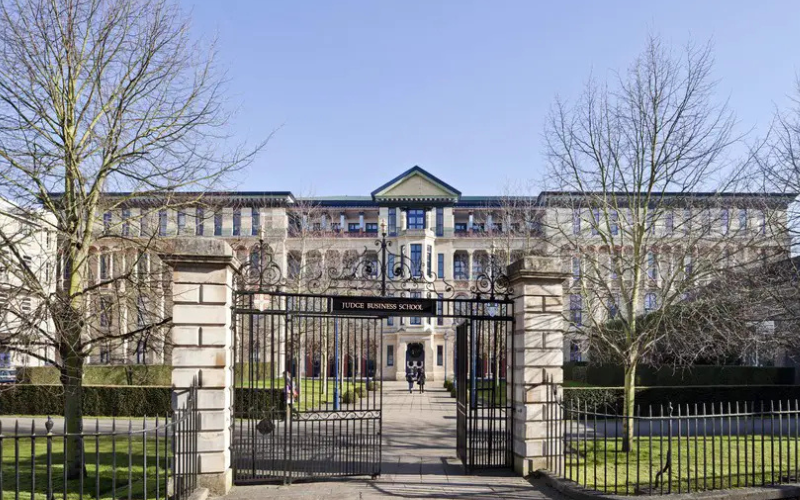
Cambridge Judge
Cambridge Judge is looking for someone who already has real professional momentum and wants one intense, high-leverage year to redirect it.
At Judge you spend your year learning business inside a university that has been making breakthrough discoveries for eight hundred years, inside a city that has learned how to turn discoveries into successful companies.
What Cambridge Judge Is Actually Trying to Build
Two things pull most applicants toward Cambridge: the name, and the fact that you can be done in a year. Both are perfectly good reasons, and neither describes what the admissions committee actually weighs. What the school is building sits underneath them.
For eight centuries, Cambridge has been producing breakthroughs. The business school is how it turns them into businesses. Newton worked out the laws of motion here. Darwin studied here. Turing laid the foundations of computing here. Keynes reinvented macroeconomics here. And yet the university did not get around to opening a business school until 1990 — eighty-two years after Harvard launched the first MBA. That gap is not an embarrassment. It's a clue. Cambridge built a business school at the moment it became obvious that the hardest commercial problems were about to stop being purely commercial — that they'd be commercial-plus-AI, commercial-plus-climate, commercial-plus-biotech, commercial-plus-frontier-science. The school's bet is that an MBA embedded in a university producing genuine advances in all four of those is worth more than an MBA sitting on its own. That's why Cambridge Judge draws faculty, ideas, and collaborators from across the wider university rather than staying in its own building. Judge is not a business school with a famous university attached. It's a business school plugged into one.
You get Cambridge without having to be a physicist. Most people who walk these courts spent three or four years earning their way in as undergraduates. The MBA is a twelve-month door into the same institution — the same colleges, the same libraries, the same dining halls, the same eight hundred years of it. That's not a small thing, and it's worth saying out loud because applicants rarely think about it that way.
What the year actually selects for is intensity, not length. If you're American, a one-year MBA can sound compressed; in the UK and across Europe, it's simply what an MBA is, and nobody experiences it as a shortcut. The honest version is that Cambridge is intense rather than abbreviated. Four terms, four client projects, a concentration, fifty-plus electives, recruiting, and — for most students — a college social life you'll actually want to show up for, with very little slack anywhere. That filters people before anyone reads an MBA essay. Applicants who look at that calendar and feel a lift usually flourish here. Applicants who feel their shoulders rise are getting useful information about themselves, and that signal is worth heeding.
The room is more experienced than you'd expect, and from further afield than you'd expect. Six years of average work experience runs a year or two ahead of most US full-time programs, which means fewer people finding their feet and more people who have already run something. And 43 nationalities across 217 seats, with roughly nine in ten students coming from outside the UK and no nationality anywhere near a majority, means almost nobody in the room built that experience in the same country as the person next to them. That combination — accomplished, and from everywhere — is the actual product.
All of which shapes what your application has to do. It isn't a highlight reel. It's decision support: evidence, for a reader who has never met you, that you have enough momentum for one year to be the right amount of time, and that the room genuinely gets broader with your particular vantage point in it. That second part is the one applicants underplay, and it isn't about you in the way most people assume. It's about what your presence does for the other two hundred people in the cohort.

Who Genuinely Belongs Here
Most applicants start by asking whether their numbers clear the bar. It's a reasonable question and it's rarely what settles things here — Cambridge publishes no minimum score and describes its process as genuinely holistic. The questions that do more work are harder and more useful, and there are two of them.
Before those, one signal that sorts people quickly. If you're the kind of person who solves problems by pulling in angles from outside your own field, this is an unusually good place to do it. At most business schools your world for two years is other MBAs. Here you belong to a college as well as a cohort, which means your daily orbit includes engineers, medics, historians, and astronomers who are not thinking about your industry at all. For some applicants that's pleasant background. For the ones who genuinely think across disciplines, it's the reason to come.
Do you already know roughly where you're going? Not every detail, and not irrevocably. And it's worth clearing up a common assumption here: a one-year program does not mean you have to arrive already sorted. Career changers are the norm at Cambridge, not the exception — 88% of the most recent graduating class changed country, function, or sector, and three-quarters changed sector specifically. You do not need two years to pivot. But there's a real difference between pivoting toward something and searching for something. Twelve months has no long summer in the middle to reconsider; the concentration decision lands in the spring, and recruiting runs alongside everything else rather than after it. If you arrive knowing the shape of the next chapter, this format gives you enormous leverage. If you're still deciding between consulting, product, and investing, you can absolutely get value here — you'll just be deciding against a faster clock. Worth knowing honestly which one you are. If it's the second, that's an argument for doing the thinking now, not a reason to rule Cambridge out.
Do you actually want to be in a room where you're one perspective among forty-three? Here's the reassuring part, because this is where good candidates talk themselves out of applying: it has very little to do with the stamps in your passport. Someone who has spent an entire career in a midwestern town in America can be exactly what Cambridge wants, as long as the curiosity is real. The school is reading for disposition — whether you move toward unfamiliar contexts or away from them, whether a room where your own assumptions are in the minority sounds like the reason to go or something to endure. Those threads are usually already in your story. The work before you apply is surfacing them, not manufacturing an international résumé you don't have.
Here's a more honest self-test than any stats comparison. Picture a Thursday in your Lent term. You spend the afternoon on a consulting project for a genuinely large client who has no reason to be gentle with a student team. Then you walk ten minutes to your college, put on a gown, and sit down to dinner at a long wooden table under a hammer-beam roof and portraits of people who have been dead for four hundred years, next to a plant scientist and someone building quantum hardware, neither of whom wants to talk about your recruiting pipeline. Then somebody suggests the pub. If that day sounds like the best year of your life, you're reading this school correctly. If it sounds exhausting, that is real information worth weighing — not a disqualifier, but not a detail to wave away either.
And it's worth naming plainly that the people who thrive here are a wider group than the consulting-and-finance default suggests. The Class of 2025 included an Olympic gold-medal rower who came to Cambridge more or less straight from the podium in Paris, a Pakistani entrepreneur building a curl-care beauty brand, a former US Marine Corps officer on a military scholarship, and a run of scientists and consultants making very deliberate moves. What they share isn't a résumé. It's the instinct to use one intense year, inside a serious research institution, to make a specific move rather than a general one.
One more thing, for anyone drawn to venture energy who assumes that means California. Silicon Valley is not your only option. Cambridge is one of the world's genuinely top-tier technology clusters, and it's a different flavor — deeper in life sciences, semiconductors, and hard science than in consumer apps. Before you decide, go look at what's actually being built here. If the problems on that list are the ones you find interesting, that tells you something a ranking never will.
The Class Profile, Read Honestly
The most recent confirmed class — the Class of 2025, which entered in September 2025. As a one-year programme, Judge names its class by entry year, so this cohort graduates in 2026. A small, intensely international room where no single nationality comes close to a majority:
Judge asks for a bachelor's degree equivalent to a high UK 2:1 rather than reporting a GPA, and it doesn't publish an acceptance rate — outside estimates put it in the 25–31% range. The school also cites lower average GMAT means on some scales (around 680–690 Classic); the headline 700 above is Judge's own figure. There are no test waivers: a GMAT, GMAT Focus, or GRE score is required to be read at all.
Where They Worked Before
Approximate pre-MBA sector mix from Judge's recent reporting. "Industry" is the single largest bucket — a different centre of gravity from the consulting-and-finance tilt of most U.S. programs.
A few things that are easy to misread in these numbers:
A few things here are easy to misread, particularly if you're used to reading American class profiles.
The two GMAT averages describe the same bar, not a strict one and a soft one.
Cambridge reports a mean of 680–690 on the Classic scale and a mean of 625–635 on the GMAT Focus Edition. Focus uses a different point system entirely; the two figures translate to roughly the same level of competitiveness. Don't read the lower number as a back door.
Experience is an asset here, not a liability.
Six years of average work experience means the room skews toward people who have already led something. If you're applying at three years out, you're not disqualified — the minimum is two — but your file needs to show readiness rather than potential, because your classmates will have more track record than a typical two-year cohort does on arrival. And if you're at seven or eight years and have been quietly wondering whether you're too far along for a US two-year program: that worry mostly dissolves here. This is an institution that has been around for eight centuries. It does not treat age and experience as problems to be managed.
Being international isn't a category here. It's the norm.
When 90%-plus of the class comes from outside the UK across 40-plus nationalities, the unusual profile in that room is the domestic British one. For anyone specifically looking for a classroom where you genuinely cannot guess the next person's nationality by playing the odds, that is rare air even among elite programs.
Cambridge is not median-driven the way US programs are.
No minimum score is stated, and the school describes real weight on career direction, self-awareness, and fit — which is exactly what the four essays and the faculty interview are built to test. A number slightly under the average genuinely doesn't settle this, and a number well over it doesn't either.
Common Myths About Cambridge Judge
"It's a place for thinkers, not operators."
You picture tweed, a seminar on Keats, and someone gently disagreeing with you for an hour. Then you look at where the class actually goes: Google, PwC, TikTok, an AI firm called Model ML, alongside the strategy houses and investment shops. Eighty-two percent of job-seeking graduates had a full-time offer within four months, in roles across 24 countries. The tweed is real. So is the recruiting.
"One year means I'm getting half of what my friends at HBS and Stanford get."
This is the fear underneath most one-year hesitation, so let's take it seriously. You are getting fewer months. You are not getting less content — Cambridge fits four terms of core, four client projects, a concentration, and an elective slate into twelve months by removing the slack, not the substance. What you're genuinely giving up is time: a second summer, a longer runway to change your mind, a second year of campus life. What you're genuinely gaining is a year of salary you don't forego and a year of tuition you don't pay. That's a real trade with real numbers on both sides, and it deserves a spreadsheet rather than a feeling.
"A school this reverent about tradition can't be serious about innovation."
Cambridge does love its traditions — the gowns, the Latin graces, the terms named after medieval feast days. And it is also sitting inside a technology cluster that produced twenty-seven billion-dollar companies and raised over $2 billion in venture funding in 2025 alone. The employment data follows the second fact, not the first: 55% of the most recent class went into industry roles across technology, healthcare, energy, and e-commerce; 23% into finance, and much of that toward venture capital and private equity rather than banking; 19% into consulting. The gravity here points toward the science park, not the trading floor.
"I'd need to like fish and chips and afternoon tea to fit in."
The tea is genuinely excellent and you should try it. But Cambridge is a city where a fifth of the population is a student and most of the MBA cohort is from somewhere else, and the food follows. Mill Road alone runs Turkish, Korean, Bangladeshi, Portuguese, Chinese, and Ethiopian within a few hundred yards, plus the grocers to cook any of it yourself. You'll be fine. And you'll still end up at the pub, because everyone does.
"With a class of 217, the network must be small."
This is the myth most worth demolishing, because the opposite is true in a way that's specific to Cambridge. You graduate into three overlapping networks, not one: the business school, the wider University of Cambridge, and your college. That last one is the sleeper. Colleges are cross-disciplinary by design — you'll live and eat alongside medics, historians, astronomers, and engineers rather than only business students — and dining isn't limited to your own college, so the pool of people you can actually meet over dinner is far wider than your cohort. It functions like an extended cohort of a few thousand, most of whom aren't doing what you're doing. If you're the kind of person who gets ideas from outside your own field, that structure is worth more than a bigger MBA class would be.
Identity and Program Basics
The degree is simply "the Cambridge MBA," awarded by Cambridge Judge Business School within the University of Cambridge. One year, full-time, September to September, across four terms. Recent class sizes have run 200–225.
By Cambridge standards, the business school is brand new. The university dates to 1209. The business school opened in 1990 — which makes it younger than the Sony Walkman, and eighty-two years younger than the first MBA program at Harvard. There's something quietly funny about the institution of Newton, Darwin, Turing, and Keynes being a late arrival to anything. But it also explains a lot: Cambridge didn't build a business school to keep up with a trend. It built one when the logic became overwhelming, and it built it plugged into the arts and sciences rather than walled off from them.
It's named for Sir Paul Judge, whose gift — alongside Lady Judge and the Monument Trust — funded its home on Trumpington Street: a genuinely striking building designed by architect John Outram on the site of the old Addenbrooke's Hospital, with a light-filled, Art Deco-influenced atrium, opened by Queen Elizabeth II in 1996. It looks like nowhere else, which is a small honest signal about an institution comfortable doing things its own way.
Gishan Dissanaike, the Adam Smith Professor of Corporate Governance, has been Dean since December 2024, succeeding Mauro Guillén and, before him, Christoph Loch. Alongside the full-time MBA the school runs Executive MBA programs in Cambridge-based and Global formats, a Master of Finance, a Master of Accounting, an MSt in Entrepreneurship, an MPhil in Management, and doctoral programs — a deep bench for a school this size, and the reason a 217-person MBA can draw on faculty and infrastructure built for something far larger. The school holds EQUIS accreditation; in the UK's most recent Research Excellence Framework (2021) it was ranked first in the country for Business and Management Studies research by Times Higher Education; and its Executive Education arm became a certified B Corporation in 2024.
The Curriculum, and What It Reveals
Four terms, four client projects, nine concentrations, fifty-plus electives, an international study trip, and an optional internship — inside twelve months.
A note on the term names before we go further, because they confuse almost everyone the first time. Cambridge calls its terms Michaelmas (October–December), Lent (January–March), and Easter (April–June), followed by a Summer term. These are medieval calendar labels the university has used for centuries — the academic equivalent of naming months after Roman gods. They carry no religious requirement or expectation whatsoever, and the MBA cohort is one of the more religiously and culturally varied rooms in business education. They're just what the terms have always been called.
Michaelmas: core, plus a real client almost immediately.
The term opens with a full core — finance, strategy, marketing, analytics, operations, organizational behavior — running alongside the Cambridge Venture Project, where small teams work directly with an early-stage UK company on a live market or growth question. That's deliberate. Most programs ease you in with cases before letting you near a real client. Cambridge puts you in front of genuine commercial uncertainty inside your first eight weeks, which tells you something about who it thinks it's admitting.
Lent: the Global Consulting Project.
Core continues while teams take on a consulting engagement with a major international organization — recent projects have placed student teams with names including Google and the World Bank Group. This is where the consulting skills the school talks about get tested against a client who is not grading on a curve.
Easter: your concentration, and a board-level question.
You choose one of nine concentrations — Creative Industries in the Digital Age, Digital Transformation, Energy and Environment, Entrepreneurship, Finance, Health Strategies, Marketing, Social Innovation, and Strategy — each with a dedicated coach, attached electives, and a Concentration Project advising a real senior leadership team. For recruiting purposes this beats a major. A candidate targeting healthcare strategy who took the Health Strategies concentration and advised an actual organization inside it has a story with evidence attached, not a stated interest.
Summer: you don't actually have to choose between the one-year degree and the internship.
This is the part applicants get wrong most often, so here it is plainly. The assumption is that a one-year MBA costs you the summer internship — the thing US two-year programs are built around. At Cambridge, the summer term is yours to spend: a short internship, a dissertation, an independent project, or a focused short course (a Six Sigma Green Belt certification has been among recent options). So the internship is available; it just isn't compulsory, and it isn't the single event your whole career strategy hangs on, because the Venture Project and the Global Consulting Project have already put real client work on your CV and full-time recruiting runs all year rather than through one window. Whether that's a fair swap depends on your target sector — in some, a long internship-to-offer conversion is still the most proven route, and that's worth checking honestly against your own plan.
What the structure reveals:
Cambridge doesn't think you need two years to be tested against real ambiguity. It thinks you need to be tested against it straight away, repeatedly, at rising stakes. Which is a design for people who learn by doing rather than by rehearsing — and a good deal if you already know roughly what you want from the year.
Culture and Community, Beyond the Marketing
The most distinctive thing about student life here isn't in the business school at all. Every Cambridge MBA becomes a member of one of the university's 31 colleges, and that gives you a second identity alongside your cohort.
Picture what that means on an ordinary evening. You put on a gown over your clothes — everyone does, it stops feeling strange by week two — and walk into a hall with a high timbered roof, stained glass, candles on long dark wooden tables, and portraits of former members watching from the walls. Three courses, served. Someone reads a short grace in Latin. And you might think you've just spotted Professor McGonagall sweeping past in academic robes, but it's actually your operations lecturer, and she's headed for the table at the front. This happens on a weeknight, several times a term, and it is not staged for visitors. It's just dinner.
You can also dine at colleges other than your own, which matters more than it sounds. Your table on any given night might hold a medic from Addenbrooke's, an astronomer, a historian, and somebody two years into a PhD on soil microbes. None of them care about your recruiting timeline, all of them are interesting, and that is a genuinely different social experience from eating with two hundred people doing exactly what you're doing. Nobody arrives expecting the college to matter as much as it does. Almost everybody leaves saying it did.
Then walk out of that dinner and into the other Cambridge. The school's Entrepreneurship Centre, founded and co-directed by Professor Stelios Kavadias, runs Accelerate Cambridge — an in-house accelerator that has taken dozens of ventures toward investment — plus Enterprise Tuesday, a long-running lecture and networking series that pulls founders and investors in from the surrounding cluster. That's the thing about this place: the candles and the accelerator are two hundred yards apart and nobody finds the combination odd. Reverence for eight hundred years of tradition and a serious appetite for what happens next, running side by side, is not a contradiction here. It's the house style.
The commitment to gender balance is sustained rather than a good year: 43–47% women across recent cohorts, supported by Forté Foundation Fellowships — in one recent intake the school made 27 Forté Fellows awards, including four full fellowships. And the student-led interest groups span sustainability, social impact, and a wide set of regional and sector clubs, which reflects a cohort organizing itself around genuinely varied professional identities rather than one narrow lane.
The honest flip side: a twelve-month program means the community forms fast and then disperses across 24 countries. That's a real trade against a two-year residential cohort where friendships have longer to settle. What you get in exchange is unusual intensity — people who go through a compressed year together tend to come out genuinely bonded — plus three networks instead of one. Worth deciding which you want before you apply, not after.
The “I got in” Instagram photo: the classic is punting on the Cam with King’s College Chapel rising behind you — the single most recognizable Cambridge frame there is. For the version that says business school, stand under the Judge building’s Art Deco-influenced atrium ceiling, which looks like nowhere else on earth. And for the shot nobody else will have: black tie at 3 a.m. at a May Ball, fireworks over a college court. Any of them tells your feed exactly where you apparated.
Life at Cambridge Judge
Let's talk about what a year here is actually like, because the setting is unlike any other business school and it's worth picturing properly.
Cambridge is a small city built around an eight-hundred-year-old university, which means your walk to a morning lecture may take you past buildings older than most countries. The Judge building sits on Trumpington Street, minutes from the market square and the river. The visual density is what people underestimate: King's College Chapel's fan-vaulted ceiling, the Bridge of Sighs, and the Backs — the stretch of green where the Cam runs behind the oldest colleges — are all a short walk from where you'll sit for core finance. The Cam, incidentally, is the river the city is named after, and punting is the thing everyone does on it: you stand on the back of a flat-bottomed boat and push off the riverbed with a long pole, steering more or less by feel. It is a cliché precisely because it is also completely worth doing — ideally as the one holding the pole, rather than the one who paid a student £30 to do it badly on your behalf.
Silicon Fen is why the location matters commercially. It's the nickname for the Cambridge technology and life-sciences cluster, and it is the most successful technology entrepreneurship cluster in Europe — roughly 5,000 companies, with more than $2 billion in venture funding raised across the cluster in 2025 and twenty-seven companies that have passed a billion-dollar valuation. ARM, whose chip architectures sit inside the overwhelming majority of the world's smartphones, grew up here. So did Darktrace, the AI cybersecurity company, and Raspberry Pi, whose credit-card-sized computers taught a generation to code. AstraZeneca moved its global headquarters and R&D centre here. And the current crop is the interesting part: CMR Surgical building AI-assisted robotic surgery systems, Nyobolt chasing ultra-fast battery charging, Healx using machine learning to find treatments for rare diseases, Quantinuum working on quantum computing. Microsoft and Apple keep operations here. All of which becomes very tangible the first time your Venture Project client turns out to be a spinout from a university lab two streets over.
Now the honest part about living here. Winters are grey, damp, and dark by mid-afternoon. This is England, not California. And a small city is a small city; if you need a metropolis at your door, Cambridge will feel compact. But London is about fifty minutes by train from King's Cross, which makes it a genuine escape rather than a commute, and the compactness cuts the other way too. Nearly everything is walkable, and more accurately, cyclable — Cambridge is a bicycle city in a way few places in Britain are, and you will own a bike within your first fortnight whether you planned to or not.
The food and the rituals reward exploration. Fitzbillies on Trumpington Street has been selling its famous sticky Chelsea buns since the 1920s and is a genuine institution rather than a tourist trap in costume. The Eagle, from the top of this page, still has the wartime ceiling where RAF pilots burned their squadron numbers with lighters and candles. On a warm weekend, a walk or a punt upriver through Grantchester Meadows brings you to the Orchard Tea Garden, where Rupert Brooke and the Bloomsbury set took tea under the apple trees and where you can do exactly the same. And May Balls — confusingly, held mostly in June — turn individual colleges into all-night black-tie events with bands, fireworks, and funfairs until sunrise. If you have watched Bridgerton and wondered whether anyone still throws a ball in a candlelit hall with a string quartet and a queue of people in full evening dress, the answer is yes, several colleges do, and you will be invited. This is not a thing that happens at business schools anywhere else on earth.
Sport runs deep, and not decoratively. Rowing is close to a civic religion: the Boat Race against Oxford on the Thames has been run since 1829 and is watched by millions, and the Varsity cricket match between the two universities is one of the oldest fixtures in the sport. This is not a spectator-only culture, either. Tom Ford, MBA 2025, rowed for the University of Cambridge squads during his MBA year — a serious commitment for anyone, and rather more so for someone who had just won Olympic gold in the men's eight at Paris 2024 and bronze at Tokyo 2021. Asked why he chose Cambridge, he pointed at the Venture Project and the Global Consulting Project — the chance at "real-life experience" — and at the range of nationalities and backgrounds in the cohort. That's a decent summary of what the place actually sells.
The "I got in" Instagram photo: the classic is punting on the Cam with King's College Chapel rising behind you — the single most recognizable Cambridge frame there is. For the version that says business school, stand under the Judge building's Art Deco-influenced atrium ceiling, which looks like nowhere else on earth. And for the shot nobody else will have: black tie at 3 a.m. at a May Ball, fireworks over a college court. Any of them tells your feed exactly where you apparated.
Research, Faculty, and Intellectual Identity
Cambridge Judge's faculty work at the point where serious research meets actual practice, which is worth knowing before you assume "elite research university" means "removed from the real world."
Jaideep Prabhu, the Jawaharlal Nehru Professor of Indian Business & Enterprise, co-wrote Jugaad Innovation — the book The Economist called the most comprehensive treatment yet of frugal innovation, the practice of doing more with less that emerged in resource-constrained markets and has since been picked up by companies including Apple and 3M. His follow-up, Frugal Innovation, won the Chartered Management Institute's Management Book of the Year, and the research keeps moving: a 2026 paper in PNAS examines what India's frugal approach to space technology can teach other emerging economies. If you're heading into an emerging market or a capital-starved startup, that's thinking you can use on Monday.
Stelios Kavadia, the Margaret Thatcher Professor of Enterprise Studies in Innovation & Growth, founded the Entrepreneurship Centre and still co-directs it — the same operation running Accelerate Cambridge. He edits the Entrepreneurship & Innovation department of Management Science, one of the field's most influential journals; his work on how firms structure innovation portfolios has run in Harvard Business Review; and he has led sponsored research for organizations including Barclays and AT&T on how innovation pipelines really get managed rather than how they're supposed to be.
Christopher Marquis, the Sinyi Professor of Chinese Management, arrived in 2022 from Cornell and, before that, a decade at Harvard Business School. He wrote Better Business: How the B Corp Movement Is Remaking Capitalism and Mao and Markets: The Communist Roots of Chinese Enterprise, a Financial Times Best Book of 2022, and both feed straight into what he teaches. He also sold his car — a Porsche, which he admits to slightly sheepishly — the week before leaving the United States, and now bikes around Cambridge like everyone else. A small detail, but a real one about someone who treats sustainability as a practice rather than a subject.
The practical point has nothing to do with finding a marquee name. You're not choosing a dissertation advisor. It's whether the school's intellectual investments line up with where you're going — and Cambridge's line up most obviously for people pointed at technology, innovation, life sciences, sustainability, emerging markets, and China. Read the faculty's live research themes as a signal of where the institution is putting its energy, then weigh that against your own direction.
What Cambridge Judge Essays Are Actually Testing
Four essays, and together they're testing something more specific than "tell us about yourself." (Confirm current prompts on the Cambridge Judge site before drafting; this set has been stable for several cycles, but schools revise wording.)
Career objectives (up to 500 words)
The prompt asks for your post-MBA plans and specifies what it wants: short- and long-term objectives; how the Cambridge MBA specifically equips you; what research you've done into how your target industry, role, and location actually recruit MBA talent; how confident you genuinely feel about the short-term goal; and what skills and preparation you already have in motion.
That research element is the one applicants underweight, and it's the most revealing thing in the application. Cambridge is asking you to show your homework on the hiring market itself — not "consulting appeals to me," but evidence you understand how firms in your target function, sector, and geography actually recruit, and what their screens reward. That question exists because a twelve-month program cannot rescue someone who discovers in March that their target market doesn't hire the way they assumed.
Where this essay goes wrong is the version that spends a third of its length admiring how prestigious and historic Cambridge is. They know. Every sentence spent flattering the school is a sentence not spent helping a reader understand who you are and what you'd add. The stronger move connects a specific Cambridge mechanism — a named concentration, the Global Consulting Project, a particular elective — to a specific next step, with evidence you've researched that step.
A professional mistake (up to 200 words)
Tell us about a time when you made a professional mistake. How could it have ended differently?
Almost every applicant is afraid of this one. The worry is that naming a real mistake hands the committee a reason to say no, so the instinct is to find something safe — which produces the disguised strength ("I cared too much about quality and missed the deadline") or the mistake that turns out, on inspection, to be someone else's fault. Turn it around and the fear dissolves. An ambitious person with several years of real responsibility and no mistakes is not impressive; they are implausible. We all make them, and the committee knows it. What they are actually reading for is in the second half of the prompt: what you would do differently with another go at it. That said, some discretion is sensible — this is a question about judgment, and choosing an example that raises a genuine ethical question about you does not demonstrate the reflection they want to see. Pick a real one, with real consequences, that taught you something you still use. Two hundred words barely covers context, mistake, and resolution, so choose something that needs almost no setup.
The best team (up to 200 words)
Tell us about the best team you worked with. What made the team successful?
Read against the curriculum, this stops looking generic. You'll be on a client-facing team inside your first eight weeks and stay on one most of the year. The strongest answers explain what made the team work — the mechanism — rather than narrating a good outcome at which you happened to be present.
Someone else's impact (up to 200 words)
Provide an example of when someone else positively impacted your life. What did you learn from this experience?
The quietest of the four, and the one most often wasted. Notice the operative word: impact. Cambridge admits people it expects to make one, and this question asks you to show that you understand what impact actually looks like from the receiving end — because someone did it for you. Answer it well and you reveal two things at once: the influences that made you who you are, and an implicit sense of how you will influence other people, without ever having to claim you will. The temptation is to make the mentor a supporting character in your own success story. The better version keeps them in focus and shows what genuinely changed in you as a result.
Across all four the through-line is self-awareness under a genuinely tight word count. And with three 200-word essays, you have almost no room for repetition: if the same story or the same quality shows up twice, you've spent a quarter of your space saying one thing.
Recommendations
Cambridge asks for a single professional reference for the MBA program, normally from a current or recent manager or supervisor. Academic references and references from peers or colleagues aren't accepted. If you're an entrepreneur, run your own business, or work in a family business, a supplier or client can stand in.
One reference carries an implication worth absorbing: with only one voice vouching for you, that letter carries far more weight than any individual letter does at a two- or three-recommendation school. Choose the person who can speak concretely — to a specific moment of growth, a real leadership call, how you behave when a project goes sideways — over the most senior name available to sign something warm and general. And brief them on the story your application is telling, so the letter reinforces it rather than drifting alongside it.
The Interview, and What It Actually Evaluates
Cambridge does something genuinely uncommon: MBA interviews are conducted by faculty — the people who actually teach on the MBA — not by admissions officers or alumni, which is the more typical model elsewhere. The school has said this is deliberate, on fairness and consistency grounds.
The format is a 30-minute, one-on-one conversation, conversational rather than adversarial, covering your goals, your reasoning, and your fit with the way Cambridge teaches. Interviews can be taken on campus or virtually, run over a roughly two-week window in each round, and typically produce a conditional decision within about three weeks. Separately, all shortlisted candidates attend a Virtual Interview Day for their round — a half-day event with a Q&A involving the MBA admissions and careers teams, virtual networking with current students and alumni, and time with fellow candidates, some of whom become classmates. For the 2026–2027 cycle these fall on September 25, November 6, February 12, April 16, and May 28.
Here's what the faculty format changes for you, and it cuts both ways. The good news: it's a real conversation rather than a form being worked through, and a professor will follow whatever is genuinely interesting in your answers. The part to prepare for: you are being questioned by a Cambridge academic who may well be a leading authority on the very subject you are about to discuss. If you say something loose about your industry's economics, you may get a genuinely probing follow-up rather than a polite nod. That is not a reason to be nervous — it's a reason to be fluent. Know your own reasoning well enough to defend it, be willing to say "I don't know" where you don't, and come with a question whose answer you genuinely want. Rehearsed talking points get found out here faster than they would in a structured interview.
Application Logistics
Tests: GMAT, GMAT Focus Edition, or GRE — all three accepted with no stated preference. No waivers are offered, and an application can't be reviewed without a score report.
Score benchmarks: No stated minimum. Means run 690–700 previous GMAT, 625–635 current GMAT, 76th verbal / 60th quantitative GRE.
Academics: Bachelor's degree equivalent to a good 2:1 on the UK scale.
Experience: Minimum two years by the start of the intake; the average admit brings around six.
Essays: Four — one at 500 words, three at 200 words each.
Reference: One professional reference, requested automatically through the application form.
English proficiency: Required for applicants who don't meet Cambridge's English-language exemption criteria; IELTS, TOEFL and Cambridge English C2 are accepted. Check the current policy for thresholds and exemptions.
Application fee: £165.
Visa: Applicants from outside the UK or Ireland will normally need a Student visa. Under current rules, eligible graduates applying for the UK's Graduate visa from January 2027 receive 18 months of post-study permission; immigration policy can change, so verify current terms when planning.
Short, scannable, refreshed annually. Confirm each item on the Cambridge Judge site for the current cycle before you submit.
Deadlines and Round Strategy
Cambridge runs five rounds — more than most peer programs. For the 2026–2027 cycle (September 2027 entry):
Round 1: 24 August 2026
Round 2: 5 October 2026
Round 3: 4 January 2027
Round 4: 22 March 2027
Round 5: 4 May 2027
Each round has its own interview window and Virtual Interview Day, and applicants have generally been invited to interview within roughly three to six weeks of the deadline.
On round strategy: What I tell clients
Two things drive the advice here, and they pull in slightly different directions.
The first is money. Cambridge's scholarship and bursary capacity is deepest early and narrows as the cycle runs; the school itself encourages applying early if you're relying on scholarships, bursaries, or loans. At £86,250 in tuition, most applicants are relying on at least one. Rounds 1 and 2 are meaningfully stronger positions for funding.
The second is that the later rounds are real entry points, not a formality — five of them exist because this is a heavily international class applying on many different timelines. The trade-off is logistics: a Round 5 admit still needs a UK visa, funding, and an international move sorted before a September start, which is a compressed window.
What I tell clients applies cleanly here: apply in the earliest round in which your application is genuinely strong, not the earliest round on the calendar. A rushed Round 1 file helps nobody. A Round 3 application from someone who used the extra months to turn a vague career-objectives essay into a specific one will beat it — with the funding trade-off understood going in.
Employment Outcomes, Read for What They Signal
The 2026 employment report covers the MBA 2024/25 class:
82% of job-seeking graduates received a full-time offer within four months of graduation
Roles taken across 24 countries
Average base salary £71,216, USD equivalent of about $134,000 adjusted for purchasing power parity
Most active recruiters included Google, PwC, TikTok, and the AI firm Model ML
By sector: 55% into industry (technology, healthcare, energy, e-commerce), 23% into finance (weighted toward venture capital and private equity), 19% into consulting
A note on that salary figure, because it's easy to misread — especially from the US.
The school reports £71,216 alongside a US-dollar equivalent of about $134,000. That second number is not a straight currency conversion. It's a purchasing power parity adjustment, a standard practice among European business schools (London Business School does the same), which restates the salary in terms of what it actually buys rather than what the currency markets say it is worth. At market exchange rates, £71,216 is closer to $90,000. Neither number is wrong; they answer different questions. The PPP figure asks what standard of living the salary supports, which matters because UK living costs run well below those of most major US cities. The market-rate figure is what you'd want if you were planning to service a dollar-denominated loan. If you're comparing this against US MBA salary reports, compare like with like — and remember that US programs report unadjusted dollars against US costs, and that you're also comparing one year of tuition against two.
The sector split is the line worth sitting with, because it corrects an assumption most applicants bring. If "British MBA" made you picture a banking pipeline, this is the data that should update it. More than half this class went into industry, and the finance share leans investment-side rather than banking-side. Which tracks exactly with the school's location: fifty miles from the City, and a ten-minute walk from Europe's densest technology cluster.
But the numbers that reveal what this program is for are the switching figures. Eighty-eight percent of the class changed at least one of country, function, or sector. Seventy-five percent changed sector. Sixty-seven percent changed function. Forty-five percent changed country. That's not a placement statistic; it's the product description. Cambridge is a career-transformation engine, and the one-year format is what makes the economics of that transformation work.
One more figure with real practical value: among those who changed geography, 74% stayed in the UK. If your goal is specifically to build a career in the British market after your MBA, Cambridge's own graduates overwhelmingly do exactly that — a more useful data point than any ranking.
The honest caveat the school itself names: this cohort entered one of the more demanding recruiting markets in recent years, and outcomes in any cycle track the global economy. A cross-border, cross-sector pivot is the hardest move in career terms and asks a lot of both you and the market. Read 82% as a strong number in a real market, not a guarantee.
Cost and Financial Aid
Tuition (September 2027 entry): £86,250
Application fee: £165
Estimated living costs: roughly £19,860–£20,000 for a single student without dependents (the 2027/28 figure publishes closer to the intake)
Cambridge alumni discount: £10,000 off tuition, applied automatically for anyone who previously took a Bachelor's, Master's, or PhD at the University of Cambridge
Aid approach: merit- and diversity-based rather than need-based, across more than ten awards
Named awards include the Wider Cambridge MBA Scholarship for Regional Diversity and its companion for Professional Diversity, Forté Foundation Fellowships supporting women (up to £32,000), a Global Impact Scholarship (up to £45,000), the Boustany MBA Cambridge Scholarship (75% of tuition plus internship travel support, with preference for candidates of Lebanese descent), and military scholarships supporting veterans — Joshua Hodge, a US Marine Corps officer, joined the Class of 2025 on the Cambridge Military Scholarship.
Three practical points
Run the arithmetic on the format, not the sticker. A one-year program costs one year of tuition and one year of foregone salary. A two-year program costs two of each. Put Cambridge's roughly £106,000 all-in against a US two-year program's full cost including that second year of lost earnings, and the gap narrows considerably. Sometimes it reverses.
Living costs here are genuinely lower than at most peer schools. Cambridge is not a cheap city by British standards — a university town with constant housing demand rarely is — but it runs meaningfully below London, and well below New York or Boston, on rent and day-to-day costs. A compact, cyclable city also quietly removes a transport line from your budget. Get current figures before you plan, but the direction of the comparison is reliable.
Be realistic about scholarships. Awards generally run from around £10,000 up to £45,000, and no single one covers full tuition. Most funded students combine a partial award with savings, employer sponsorship, or a loan. Build your plan around that rather than around one award closing the gap — and apply early, because the pool is deepest in the first rounds.
Rankings, in Context
Cambridge Judge sits solidly in the global top tier, with genuine variation across methodologies that's worth understanding rather than cherry-picking.
- Financial Times 2026: #17 globally, and first among one-year MBA programs in the UK
- QS 2026: #7 globally, up from #12 — one of the largest sustained climbs of any European program in recent cycles
- Bloomberg Businessweek 2025-26: #11 among European and Middle Eastern schools, down three places, with strong component ranks (8th in Networking, 9th in Entrepreneurship, 10th in Compensation)
- Times Higher Education /REF 2021: #1 in the UK for Business and Management Studies research
- LinkedIn 2025): #30 globally.
The relative newcomer LinkedIn Top MBA Programs 2025 ranked Cambridge Judge 30th globally — notable because this ranking focuses almost entirely on alumni outcomes (such as hiring success, career progression, and network quality) using LinkedIn's own platform data. Traditional media ranking methodologies blend job/career criteria with academic criteria like faculty, research, reviews, and test scores.
The spread between #7 on QS and #30 on LinkedIn is real, and worth reading honestly rather than picking whichever number flatters. One likely explanation is scale: LinkedIn's methodology rewards large, long-established alumni populations with deep director-level representation, and at roughly 200 graduates a year, Cambridge's MBA population is a fraction of the size of the US programs filling LinkedIn's top fifteen. That's a structural effect rather than a verdict on outcome quality — and a good illustration of why any single table is directional at best.
My read on rankings applies with force here. Cambridge's position is unambiguous on the measures weighting academic strength and career-outcome quality, and softer on the one weighting raw network scale. Neither should decide this for you. The fit questions on this page will tell you far more about whether this program serves your goals than any place on a table will.
How Cambridge Judge Differs From London Business School
Cambridge Judge, London Business School, and Oxford Saïd are all top-tier UK MBAs, and applicants building a UK shortlist usually end up weighing them against each other. Cambridge and LBS come up together most often in my consults, because the choice between them is the most structural one: twelve months in a research-university town, or a longer, flexible program in the middle of a global financial capital. Both are excellent, and they are less alike than a shared label suggests. (Oxford Saïd, which shares a great deal with Cambridge and rather less with LBS, gets its own comparison below.)
Length, and what it costs
Cambridge is twelve months, full stop. LBS is flexible across 15, 18, or 21 months, and most career-switchers take the longer paths to capture a full summer internship and recruiting cycle. That is the central trade. LBS gives you a longer runway and a conventional internship season; Cambridge gives you a year of salary you don't forego and a year of tuition you don't pay. Neither is the right answer in the abstract — it depends entirely on how much runway your particular pivot needs.
City versus town
LBS sits in central London, on Regent's Park, in one of the few cities that genuinely runs the global economy — with all that means for recruiter access, industry events, and big-city living costs. Cambridge is a compact green town fifty minutes up the line, where you will cycle everywhere and know your classmates' faces within a fortnight. London puts the market at your door. Cambridge puts a research university and a technology cluster at your door, and the market an hour away.
Where the gravity pulls
LBS's distinctive strength is its finance and consulting ecosystem and its physical place in a global capital; consulting has been its largest sector for years. Cambridge's gravity pulls toward Silicon Fen — technology, life sciences, deep tech, venture — and its most recent class sent 55% into industry roles. If your target is a London finance or consulting seat, LBS is the more direct route. If your target is technology, healthcare, or building something, Cambridge sits inside the ecosystem you want.
Scale of cohort and network
LBS enrolls around 500 a year against Cambridge's roughly 200–225. That is a real difference in alumni-network size. Cambridge's counter is structural rather than numerical: you graduate into three networks — the business school, the university, and your college — and the college one reaches across every discipline the university teaches.
The cross-admit decision
It usually comes down to how much time you need and what kind of year you want to live. Both are unambiguously top-tier, both are overwhelmingly international, and cross-admits typically want elements of both. Worth sitting with rather than sorting with a rule.
How Cambridge Judge Differs From Oxford Saïd
The rivalry is nine centuries old and the comparison is genuinely close: both are one-year, intensely selective, extraordinarily international MBAs inside ancient research universities, both use a residential college system, and both land within a few spots of each other on most tables in most years. The differences are about character, not tier.
The organizing idea
Oxford Saïd's defining feature is GOTO — Global Opportunities and Threats: Oxford — a community-wide, project-based module applying systems thinking to challenges like climate change and technological disruption. It's the curricular expression of Oxford's "leading with purpose" identity, and it runs a shared intellectual project through the whole cohort's year. Cambridge's defining feature is proximity to Silicon Fen: an in-house accelerator run by your own faculty, four sequenced live client projects, and a nine-concentration structure that gives you a specialization you can name in a recruiting conversation.
Structure and emphasis
Oxford allows more customization — roughly eight required courses and ten electives, plus optional co-curricular Labs in Finance, Consulting, and Social Impact — against Cambridge's more prescribed core with a formal concentration on top. The elective strengths differ too: Oxford runs deep in impact investing, ESG, and sustainability; Cambridge in venture capital, technology, entrepreneurship, healthcare, and media, which follows directly from the university's research strengths and the cluster outside the door.
Cohort size
Oxford's recent classes have run around 350 against Cambridge's 200–225. A larger cohort means a broader alumni network and more people among whom to find your niche; a smaller one tends to produce tighter bonds and a room where you'll know everyone by June. Both draw 90%-plus international classes from 45-plus nationalities, so this is a density difference rather than a diversity one.
The towns, and the rivalry
Oxford is the bigger, busier city — more retail, more traffic, a wider spread of neighborhoods. Cambridge is smaller, flatter, greener, and built around its river; the Backs, the stretch of open lawns and gardens where the Cam runs behind the oldest colleges, has no real Oxford equivalent at that scale, and neither does the punting culture. Both sit about an hour from London by train. And whichever you choose, you inherit a side: the Boat Race on the Thames has been rowed since 1829 and is watched by millions, the Varsity cricket match is among the oldest fixtures in the sport, and there are Varsity matches in nearly everything else besides. Not a decision criterion, but one of the pleasures.
The cross-admit decision
Applicants usually decide on organizing idea (a shared inquiry into global problems versus a specialization built beside a technology cluster), on structure, on cohort scale, and on town. Most cross-admits genuinely want elements of both. These are two of the most powerful, instantly recognizable brands in the world — anywhere you go, in any market, both names land. Choose on which year you actually want to live.
Signals You Might Be a Strong Fit
MBA School Fit is hard to feel from the outside, so here are concrete, checkable signals. If two or three sound like you, you're probably reading Cambridge correctly.
The idea of walking past a fifteenth-century chapel on your way to a lecture on venture capital doesn't feel like a contradiction. It feels like the entire reason to go. If you read that sentence and something in you sat up, pay attention to it — that's the Cambridge experience in a line. Candles and quantum computing, Latin grace and a Series A, all inside the same week. Not everyone wants that. The people who do rarely find it anywhere else.
You already know the shape of your next chapter. Not every detail, but enough that one year is the right amount of time — you're accelerating a direction rather than searching for one.
A live client problem in your first eight weeks reads as the point, not the pressure.
You want a room where you can't guess the next person's nationality — where "international" means closer to borderless than to "international, but mostly one country."
You're comfortable being among the more experienced people in the room rather than among the least, and you'd rather learn from peers who have already run something.
You get your best ideas from outside your own field — and the thought of dinner with a medic, an astronomer, and a historian sounds like a feature rather than a detour.
You can already sketch which concentration you'd choose and why, and connect it to a specific post-MBA move. That's the same muscle the career-objectives essay tests.
Signals You Might Not Be the Best Match
The honest counterpart. None of this means you wouldn't be a strong applicant somewhere, or that you shouldn't apply here — that's your call. It means the specific match is worth examining before you spend a cycle on it.
It may not be the best match if you're using the MBA to discover your direction rather than accelerate one. Twelve months leaves considerably less room for exploration — no long summer to reconsider, and the concentration decision arrives in the spring. If you genuinely don't yet know whether you want consulting, industry, or investing, a two-year program may serve that search better. Worth weighing honestly rather than hoping the year will sort it out.
It's a harder fit if a large-scale, on-campus, US-style recruiting pipeline is central to your plan. Cambridge's recruiting works, but it's built around a 200-person cohort and a UK-and-Europe-weighted employer base. If your target is a specific large American employer with a heavy on-campus US MBA tradition, that pipeline runs more naturally through certain US programs — and the fact that 74% of Cambridge's geographic switchers stayed in the UK is a data point worth reading in that light.
It's worth checking whether the optional summer works for your pivot. The internship is available but short and optional rather than the centerpiece. If your career-change strategy depends on a long internship-to-offer conversion, look hard at whether the Venture Project and Global Consulting Project can do that job in your specific target sector. In some, clearly yes. In others, a traditional two-year internship remains the more proven route.
And two things about the year itself that people underestimate until they're living it. The weather is genuinely grey — damp, overcast, dark by mid-afternoon for a good stretch of the winter. It's one year, and you'll be indoors for much of it, but if sunlight is load-bearing for your mood, know that going in. Here's a practical test worth more than any amount of speculating: Cambridge is glorious from April through August, and every photograph you have seen of it was almost certainly taken then. Book your campus visit for January instead. If you love the place in the damp and the dark at four in the afternoon, you will love it in June. And British life is more formal than American life. Gowns at dinner, a certain reserve in how people talk to each other, understatement where you might expect enthusiasm, a general sense that being correct matters. Plenty of people find that charming and pick it up quickly. But this is not California, and if the formality sounds tiresome rather than fun, that's worth weighing.
If two or three of these land, treat it as a prompt rather than a verdict. Fit is a weighted sum of preferences, not a set of deal-breakers — and the useful next step is asking whether the programs that fit you better on these dimensions are ones that genuinely excite you as much.
When Working With Someone Helps, and When It Doesn't
Cambridge's application has a particular shape that makes outside input useful, and it isn't about polishing prose.
First, there's an allocation problem. Four essays, three of them capped at 200 words, plus a single reference carrying outsized weight. Across roughly 1,100 total words, which mistake, which team, which person, and which career goal each reveal something different about you, without saying the same thing three ways? Most early drafts I see spend two of the short essays making the same point about collaboration and leave a whole dimension of the candidate invisible. That's a strategy problem, and it is much easier to see from outside the draft than from inside it.
Second, there's the gravitas question, and it's specific to this school. Cambridge is a seriously academic institution — first in the UK for business and management research, and a university whose whole identity is built on intellectual rigor going back eight centuries. When the admissions committee reads your file, and when a faculty member sits across from you for thirty minutes, part of what they're assessing is whether you can carry that weight. Not whether you have a high score. Whether you think carefully, hold a position under questioning, know the difference between what you know and what you assume, and could hold your own in a room of people for whom that is a profession. That quality is genuinely hard to see in your own writing, and it's one of the things a good outside reader exists to catch.
Third, the career-objectives essay has a hidden difficulty: its demand that you show research into how your target market actually recruits. Plenty of strong candidates can articulate a goal and can't yet demonstrate they understand the hiring machinery around it — and in a twelve-month program, that's precisely what the school is screening for, because there's no second year to correct it.
That said — no consultant can manufacture clarity you don't have. If you don't yet know what one intense year is supposed to do for you, the work before the essays is figuring that out. The essays then become a record of that thinking rather than a substitute for it.
If you'd like to talk through whether your thinking is at the stage where outside input would help, a free consultation is a low-pressure way to find out. We'll talk about where you are, what Cambridge is likely to weigh in your case, and what matters most before you draft.