UNC Kenan-Flagler: What This School Is Looking For
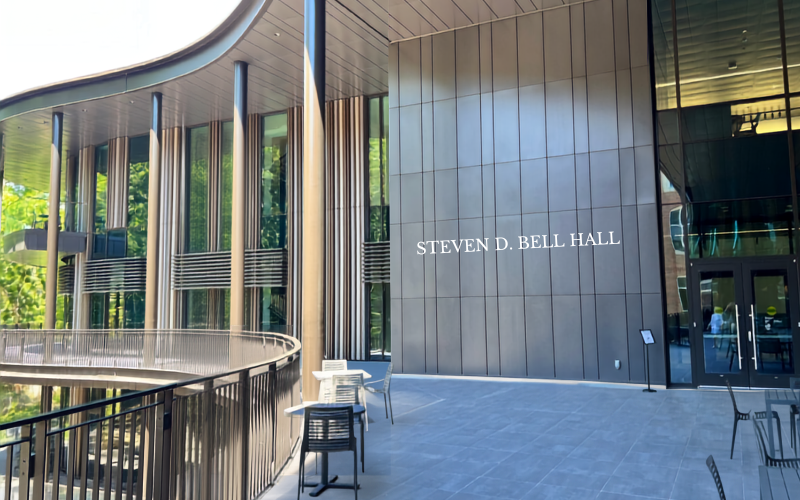
There's a particular energy in a school that's betting on its own future, and right now UNC Kenan-Flagler has it in spades. This spring it opened a gleaming new home — Steven D. Bell Hall, all glass and light and Carolina-blue sky — and began rebuilding its entire MBA around the moment that matters most to the people who enroll: the job, and the life, waiting on the other side of the degree.
So what is UNC Kenan-Flagler looking for? People who will make a genuinely collaborative class better, and who know enough about where they want to go that a program built around career outcomes can actually take them there. That's the short answer, and it sits underneath the reputation — the real strength in finance, consulting, real estate, and healthcare, and one of the most livable settings in American graduate business education.
The second half of that answer is where a lot of very smart applicants put the emphasis in the wrong place. It's easy to read a page like this as a bar to clear — the right score, the right title — and to turn the application into a case for how impressive you are. But Kenan-Flagler isn't ranking a stack of résumés. It's assembling a class, and then making good on a promise to launch every person in it. So the question that actually moves the needle isn't "am I good enough?" It's "what would I add to this cohort, and can this school picture itself getting me hired?" That shift — from proving yourself to helping them see how you fit and where you're headed — is the whole game, and it's the thread running through everything below.
Kenan-Flagler
There's a particular energy in a school that's betting on its own future, and right now UNC Kenan-Flagler has it in spades. This spring it opened a gleaming new home, Steven D. Bell Hall, and began rebuilding its entire MBA around the moment that matters most to the people who enroll: the job, and the life, waiting on the other side of the degree.
What UNC Kenan-Flagler Is Actually Trying to Build
Most applicants arrive at this page asking some version of "what do I need to get in." The more revealing question turns it around: what is Kenan-Flagler organizing itself around right now, and who does that design reward?
I got my answer on a bright Carolina morning not long ago, on the kind of day when the whole campus seems to be showing off. I'll confess I came for the building — Bell Hall really is that good, and you feel the difference the moment you walk in, all that light and space and the sense of possibility a brand-new building carries. But the building shrank to a footnote the minute Dean Mary Margaret Frank started to speak. Frank is a triple Tar Heel who came home to run the b-school at her alma mater after two decades at UVA Darden, and what she described wasn't a real-estate project. It was a school that had taken its whole curriculum apart and rebuilt it around the student's journey — with the destination, triumphantly, being a great job. One detail stuck with me: they deliberately put MBA students and undergraduates on the same project teams, so that by the time you graduate and find yourself leading people a few years earlier in their careers, you've already done it. I'd never heard of a program engineering that on purpose. It's the kind of move you make when career readiness isn't a slogan but the organizing principle.
Hold the school's four stated values up to that light — impact, innovation, inclusion, and integrity — and they stop reading like a banner in a lobby and start reading like a hiring rubric. This is a school making a bet that the MBA's real job is to develop people who contribute, adapt, and lead well in a market that keeps changing, and it is rebuilding the path from admission to offer to be as direct as it can make it. For the applicant in front of me, that translates into two things the school is genuinely reading for: whether you'll strengthen a collaborative cohort, and whether the school can credibly get you where you say you want to go. Your file's job is to give the reader the evidence to advocate for you on both counts. It isn't about proving you're impressive in a vacuum. It's about what you'd add — and whether Carolina can see itself putting you to work.

Who Genuinely Belongs Here
When a client asks whether they belong at Kenan-Flagler, I try to move them off the first question they tend to lead with — some version of "are my numbers in range?" — because that's rarely what settles it. The better question is whether this is the right next chapter for where you're headed, and what you'd bring to a community that takes collaboration literally.
Start with the thing that gets people genuinely excited once they see it: the range of places a Kenan-Flagler MBA actually goes. Real estate, healthcare, capital markets, consulting, corporate finance, business analytics, sustainable enterprise — these aren't a generic elective menu. This is the school that sends more of its class into real estate than any other major MBA program, on the strength of alumni who went out and built the firms (more on them below); the school whose finance lineage runs from Charlotte's rise as a banking capital to a roll call of investors you've heard of; the school with one of the country's deepest benches in the business of healthcare. If you can already feel one of those pulling at you — if you can picture the recruiting track you'd point yourself toward — that's a strong sign you're reading the place correctly.
That clarity is what the program is built to reward, and it's the disposition that matters most on two axes. The first is collaboration. Kenan-Flagler was among the earliest schools to build "team" into the core of how it teaches, and the claim survives contact with reality — group work, team-based learning, the integrated undergrad-graduate project teams I saw described firsthand. The applicant who does their best work making the people around them better fits here by instinct. The second is direction. You don't need every answer; there's real room to refine your thinking once you arrive, and the program is designed to help you do it. But the more of a working sense of direction you bring, the more a career-built curriculum can do for you. If the concentration list reads like a menu you'd browse rather than a path you'd choose, that's worth noticing — and worth doing some of that direction-setting work before you apply rather than after.
The Class Profile, Read Honestly
The most recent confirmed class — the Class of 2027, entering Fall 2025. At just over 200 students, this is one of the smallest full-time classes among top programs — and that scale is the point, not a footnote to it. The numbers below describe who's in the room; the room itself is small enough that you'll know most of it:
UNC doesn't publish an acceptance rate; the ~37% here is a U.S. News-derived estimate and runs meaningfully higher than M7 rates — one reason a strong-fit applicant shouldn't count Kenan-Flagler out on selectivity. Worth knowing: roughly a third to half of students receive merit fellowships, awarded automatically with admission, with no separate application. For an applicant whose finances won't qualify them for need-based aid at a wealthier school, that's a real, checkable advantage.
What They Studied
Bars show the largest single majors. Grouped more broadly, business-related backgrounds (about 45%) just edge out STEM (about 40%) — a genuinely balanced class, not the engineering-heavy pipeline the top major might suggest.
A few things that are easy to misread in these numbers:
The acceptance rate
A rate in the high 30s is meaningfully more generous than M7 figures, and for applicants who genuinely fit Kenan-Flagler, that gap is real and useful — the odds here are better. But a higher acceptance rate is not lower selectivity. It reflects a more self-selected pool: many of the people applying here largely want this school specifically, which means the marginal applicant is already a credible fit and the decision is closer than the headline suggests. The advantage is real for fit-matched candidates. The bar still has to be cleared.
The test scores
Lead with the scale, because the numbers look different depending on which one you're reading. On the GMAT Focus Edition the average is 652; the same class read about 710 on the older scale. Either way, the band is wide, which tells you scores don't decide outcomes here on their own — a strong overall file can absorb a test score below the average in a way that's harder at the most selective programs. And testing is unusually flexible at Kenan-Flagler: GMAT/GRE waivers are available to new applicants who can demonstrate analytical readiness another way (a quant-heavy transcript, an advanced degree, a CFA or CPA, several years in an analytical role), and the most recent Round 4 was test-optional outright. One honest caveat the school itself raises: some employers in finance and consulting screen on test scores during recruiting, so a waiver can solve the application without fully solving the job search. Weigh it against where you're headed, not just whether you'd rather skip the test.
The GPA
An average around 3.44 is more flexible than at most top-15 peers, and the school reads transcripts in context — rigor of program, trajectory over time, what you were balancing. The question is whether you can do the work; the GPA is one input toward answering it, not the answer. If your record has a soft spot, the optional essay exists to give the reader context rather than leaving them to guess.
The academic backgrounds
With engineering the single largest undergraduate major and STEM and business backgrounds nearly even, this isn't a class drawn from one mold. The program is STEM-designated, which matters for international students weighing post-graduation work options, and the mix signals that an atypical academic background is an asset to position, not a liability to explain away.
The profile isn't a benchmark you need to match line by line. It's a picture of who Kenan-Flagler admitted last year. Your job is to give the reader evidence that places you in that picture clearly.
Common Myths About UNC Kenan-Flagler
"It's a finance school." Or: "It's a marketing school."
Both reputations float around, and neither is the whole picture. Financial services was the single largest destination for the most recent class, but consulting, healthcare, and tech each took meaningful shares, and the school carries genuine, distinctive strength in real estate — it places more of its class into the field than any other major MBA program. Kenan-Flagler is broader than any one of its reputations.
"Chapel Hill is too quiet to launch a career from."
This one collapses the moment you look at the map and the numbers. Chapel Hill anchors the Research Triangle alongside Raleigh and Durham, and at its center sits Research Triangle Park — 300-plus companies and more than 50,000 workers, from Cisco to GlaxoSmithKline — about a half-hour from campus. Zoom out and the whole state is on a tear: CNBC named North Carolina America's Top State for Business in 2025, the third time in four years, with GDP growth among the strongest in the country and one of the highest rates of in-migration of college-educated workers anywhere. Amazon committed another $10 billion to data centers here; pharma and biotech keep planting plants. This is the Sun Belt growth story in miniature. The setting reads sleepier than the regional economy actually is.
"A public school MBA means a weaker network or weaker recruiting."
The recruiting pulls many of the same firms that hire at higher-ranked private programs, and the alumni base is large and notably engaged — more than 51,000 alumni across nearly 100 countries. The "state school" framing undersells both the network and the placement.
"A more collaborative culture means a less rigorous one."
These get treated as a trade-off, and they aren't. The team-based model is demanding precisely because your work is visible to and dependent on the people around you. Collaborative and rigorous describe the same place.
Identity and Program Basics
UNC Kenan-Flagler Business School at the University of North Carolina at Chapel Hill, in Chapel Hill, NC. Two-year, full-time, residential MBA; STEM-designated. Founded in 1919 as the university's commerce department; named in 1991 for the Kenan and Flagler families. Entering full-time class around 200. As of spring 2026, the program's new home is Steven D. Bell Hall, a roughly 400,000-square-foot building — funded in part by a $26 million gift from alumnus Steven D. Bell — that brings the school's undergraduate, Master of Accounting, MBA, and PhD programs under one roof and was built to some of the most ambitious sustainability targets in higher education. (Its previous home next door, the McColl Building, is named for Hugh McColl, the Bank of America chief and Carolina business graduate — which tells you something about where this school's gravity has long run.) The dean is Mary Margaret Frank.
The Curriculum, and What It Reveals
Kenan-Flagler runs its academic year in four seven-week modules across the fall and spring of both years. The first-year core builds the fundamentals — data analytics and decision-making, global economics, ethics and corporate responsibility, business strategy — and the second year opens into electives and 13 concentrations: real estate, healthcare, capital markets and investments, consulting, corporate finance, entrepreneurship, business analytics, marketing, operations, sustainable enterprise, energy, and more. The school refreshes a slice of its electives every year to keep pace with where business is actually going.
What distinguishes the place is how much of the learning is hands-on. STAR — Student Teams Achieving Results — puts MBA teams on real consulting engagements with real clients, and many of those clients turn around and recruit the students. The experiential side runs deep: Kenan-Flagler launched what it describes as the first student-run private equity fund in the world, and the student-managed UNC Real Estate Investment Fund is a one-of-a-kind student-run real-estate private equity fund. Students put real outside capital to work for real returns in the PNC Capital Markets Lab, run funds and pitch competitions, and take Global Immersion Electives that drop teams into companies abroad. This is a program that wants you doing the work, not just studying it.
And it's about to do more of that, more deliberately. The school is rolling out an ambitious Full-Time MBA redesign, launching in the 2026–2027 academic year, built explicitly around the student's career journey — the redesign Dean Frank described, with the path to a strong internship and a strong first job treated as the spine of the curriculum rather than an outcome the school hopes follows from it. The integrated undergraduate-graduate project teams are part of the same instinct: engineer the experience so that by graduation, you've already practiced what you'll be paid to do.
What the curriculum reveals:
Kenan-Flagler assumes you'll engage, contribute to a team, and aim at a destination. For the applicant ready to do that, the structure compresses real preparation into two years and pulls you into recruiting early. Arrive without a working sense of direction and the same structure does less for you — which is exactly why the direction-setting work is worth doing before you arrive.
Culture and Community, Beyond the Marketing
Every business school says "collaborative." Kenan-Flagler is one of the places where the word is doing real work. The school was an early adopter of team-based learning as a core element, and the culture that produced that choice is still the operating reality: students describe a place where the default in a study group is to help rather than to compete, where people genuinely want each other to land the offer.
The useful read for an applicant is that this is a fit signal, not a personality you can perform. A culture this team-oriented shows up fast in an MBA interview and in recommendations — readers can tell the difference between someone who collaborates by instinct and someone who has learned to say the word. If you're the person others reach for when a group is stuck, make that visible in your file. If you're not, be honest with yourself about it, because two years here means a great deal of close work with the same people.
There's a second current running under the academics, and it's worth naming because it genuinely shapes the experience: this is a big-time college-sports campus, and the school spirit is real. Carolina basketball is close to a civic religion, the rivalry with Duke eight miles away is one of the best in American sport, and a fall Saturday at Kenan Stadium is part of the social fabric. That energy does something useful for an MBA class — it gives a cohort a shared identity outside the classroom, a reason to show up together, a "we" that team-building exercises can't manufacture. If Tar Heel blue in the stands sounds like fun, you'll find your people quickly. If big-crowd, rah-rah school spirit leaves you cold, it's worth knowing that it's part of the deal here.
And because this is North Carolina, the community organizes some of its life around the state's great civic passion after basketball: barbecue. Fair warning — you're walking into a genuine feud. North Carolina is effectively two barbecue nations: the Eastern style (whole hog, dressed in a thin vinegar-and-pepper sauce) and the Lexington or Piedmont style (pork shoulder, with a little tomato in the sauce), and locals hold the distinction with a seriousness usually reserved for politics. Pick a side by second semester; you'll need one.
The “I got in” Instagram photo: the Old Well, the small neoclassical rotunda on McCorkle Place that’s the university’s signature landmark — tradition says a sip from the fountain on the first day of classes brings good luck. For the business-school version, it’s the bright glass-and-wood atrium of the new Steven D. Bell Hall. Either one tells your feed exactly where you landed.
Life at UNC Kenan-Flagler
Let's talk about what it's actually like to live here for two years, because this is one of the real pleasures of the place, and it's easy to underrate from a distance.
Start with what you'll see out the car window, because it sets the tone. This corner of North Carolina is deep, green, and forested — tall pines and hardwoods closing over the roads, the drive between Chapel Hill and Durham genuinely one of the prettier commutes in the region. Head an hour or two west and you're in furniture country, the High Point and Hickory towns that have made hardwood and craftsmanship a regional identity for a century. There's a warmth and a woodsy calm to the whole area that photographs never quite capture and that residents come to love.
Then there's the weather, which is a legitimate selling point almost nobody leads with. Chapel Hill gets four mild seasons — long, warm springs and falls, a winter that mostly behaves itself, the kind of climate where being outside is the default rather than a production. After a couple of northeastern winters, that alone reorders some people's school lists.
The heart of town is Franklin Street, running right up to campus — a walkable strip of restaurants, coffee shops, and bars that functions as the social center of gravity. A few worth knowing your first week: Top of the Hill, the rooftop brewery that's been the student living room for decades; Lantern, the nationally recognized restaurant just off the main drag; Sutton's Drug Store, a lunch counter slinging burgers since the 1920s with student photos papering the walls; and Caffé Driade, a coffee garden tucked into the woods that locals guard a little jealously. Cross into neighboring Carrboro and Weaver Street Market is the communal lawn where half the town seems to land on a Saturday morning. For the grown-up occasion — parents in town, a celebratory dinner — the Carolina Inn, the historic hotel right on campus, has been the place since 1924.
The campus itself is one of the most photogenic in the country: old brick, deep shade, the Old Well rotunda, and the Dean E. Smith Center — the "Dean Dome" — where a basketball game is an experience even if you don't follow the sport. The North Carolina Botanical Garden and the Morehead Planetarium are both a short walk away, and Raleigh-Durham International is about twenty minutes out when you need to fly for a recruiting trip or a weekend away.
The "I got in" Instagram photo: the Old Well, the small neoclassical rotunda on McCorkle Place that's the university's signature landmark — tradition says a sip from the fountain on the first day of classes brings good luck. For the business-school version, it's the bright glass-and-wood atrium of the new Steven D. Bell Hall. Either one tells your feed exactly where you landed.
Here's the throughline: Chapel Hill is livable in a way that compounds. The forests and the mild weather, the walkable town, the campus you actually want to be on, the shared thrill of a big-time sports culture — they lower the daily cost of two demanding years and make the collaborative community easier to sustain, because people are around, outside, together. It reads as quality of life. It functions as the connective tissue of the class.
Research, Faculty, and Intellectual Identity
Kenan-Flagler's research and centers cluster where the school's teaching strengths are: real estate, through the Leonard W. Wood Center for Real Estate Studies; finance and capital markets; sustainability and the business of energy; entrepreneurship; and the business of healthcare. These aren't peripheral — they're the intellectual backbone of the concentrations that drive the school's placement.
Two faculty give a sense of the range. David Hartzell — the Steven D. Bell and Leonard W. Wood Distinguished Professor and director of the Wood Center — is the figure most associated with the school's real estate identity; he advises the student-run real estate fund and co-wrote a global property-investment text used by students and practitioners alike, and his presence is a big part of why Kenan-Flagler is consistently ranked among the country's top real estate programs. In marketing, Jan-Benedict Steenkamp — the Knox Massey Distinguished Professor and one of the most-cited marketing scholars in the world — anchors the school's global-branding and marketing-strategy work. You may or may not end up in either professor's classroom, and that isn't quite the point: a school's intellectual gravity shows up in whose work is shaping the conversation, and these are people doing that.
For an MBA applicant, though, the right thing to know about faculty isn't a list of marquee names to study under — that's a science-PhD concern, not an MBA one. What matters is access and teaching quality, and that's where a program of this scale has a real advantage: faculty are reachable, office hours are usable, and professors tend to know who you are. The collaborative culture extends to the front of the classroom. That access matters more than it sounds, because the relationships you build with faculty are the ones that turn into recommendations, references, and advice when you're navigating recruiting.
What Kenan-Flagler Essays Are Actually Testing
Here's a strategic point worth making before the prompts: applying to Kenan-Flagler asks less of you than applying to many of its peers. Two short required essays, one MBA recommendation, a brief video — measured in hours and energy, the cost of applying here is genuinely lower than at schools demanding three or four long essays and multiple recommenders. That's not a reason to apply on a whim. But if Kenan-Flagler looks like a real fit, the modest lift is a point in its favor when you're building a target list — a well-respected program you can add without blowing up your fall. Applicants sometimes overlook that math, and it's worth doing.
Now the prompts. For the most recent cycle, the application asked for two required essays of 250 words each, an optional third, a video essay, and a brief reapplicant essay. (Confirm current prompts on the admissions site before drafting — short prompts change wording more often than long ones.)
Essay 1 — goals (250 words)
"We value the different paths and aspirations that each student brings to the UNC Kenan-Flagler community. Please share your goals for pursuing an MBA, or the path you're considering, and how they reflect your unique background or perspective."
Read this one in light of everything else on this page: it's a career-outcomes school asking a career-outcomes question. The subtext is can we help you get where you're going? Kenan-Flagler makes a real commitment to placing its graduates, and it wants to admit people it can actually deliver for — so a clear, credible goal isn't box-checking, it's the school checking whether its promise and your plan line up. The version that falls flat spends its scarce words admiring the school. Remember that the reader already knows their own program; every sentence describing Kenan-Flagler is a sentence not spent helping them understand you and picture your path. With only 250 words, specificity is the whole game.
Essay 2 — core values (250 words)
"UNC Kenan-Flagler is guided by four core values that shape who we are: impact, innovation, inclusion, and integrity. Which one of these Core Values resonates most deeply with your professional journey? Please share an example that demonstrates how this value has influenced your actions or decisions."
This is a fit essay wearing a values prompt. The instinct is to pick the value that sounds most impressive; the better instinct is to pick the one where your material is richest — the one you can ground in a specific, true story where the outcome mattered to someone other than you. Pick the value your evidence supports, not the one you wish defined you.
Essay 3 — optional (250 words)
Space to add something the rest of the application didn't capture, or to give context for a gap or an inconsistency. When there's something a reader might otherwise wonder about — a dip in the transcript, a gap in the timeline — give them the explanation rather than leaving the silence to fill itself with a worse assumption. But if nothing genuinely needs context, this isn't a mandatory fourth essay, and a thin "optional" essay can dilute a strong file. Use it when you have a reason to.
The video essay
Two questions, two minutes total, a 20-second prep window, and two attempts (only one submitted). Short and low-drama, but real: the school uses it to confirm the person in the file is the person in the room — clear communication, the presence your essays promised. Prepare enough to be natural, not enough to sound scripted.
A note on the Vetter Dean's Fellows essays
Applicants who opt into consideration for the Vetter Dean's Fellows Program — a selective fellowship carrying scholarship funding, tailored leadership programming, personalized career coaching, and a funded global experience — complete three additional short essays within the application. They read for leadership, navigating ambiguity, and lifting others beyond your formal role. If the fellowship interests you, treat these as part of your core application, not an afterthought.
Because Kenan-Flagler folds its "why this school and this path" question into Essay 1 rather than running a separate "Why Kenan-Flagler" essay, the fit argument lives in how specifically you connect your goals to what the program offers — not in a paragraph of admiration.
Recommendations
Kenan-Flagler requires just one professional letter of recommendation, submitted through the GMAC Common Letter of Recommendation (with the option to add one additional endorsement if you'd like). The single-letter requirement reflects a broader shift across MBA admissions — more schools moving from two MBA recommendations to one — and the logic is telling. Schools know applicants are busy, and know that chasing two recommenders is one of the friction points that keeps good candidates from applying at all; asking for one lowers the barrier without giving up what matters. They still want to know who you are and how others see you. They've just made it easier to show them. The practical implication for you is that with only one letter, it carries more weight, so choose carefully: the strongest recommender here is a supervisor who can speak in specifics to how you work on a team and lift the people around you — not the most senior name you can find, and not someone who'll praise you warmly in generalities.
The Interview, and What It Actually Evaluates
Kenan-Flagler interviews are by invitation, and the school also offers an open-interview option on campus early in the fall for applicants who want to take the initiative. Interviews are conducted by the admissions committee, in person or virtually — the school states no preference — and are résumé-based, meaning the interviewer works from your résumé rather than your full file. Two practical consequences: your MBA résumé needs to be a clean, conversation-ready summary rather than a dense list, and you should be ready to walk your story without assuming the interviewer has read your essays.
Worth knowing who's building this process. The school's director of full-time MBA admissions, Katy Radoll, came to Carolina after leading associate recruiting at McKinsey and a long run in admissions at MIT Sloan — which means the person shaping how UNC evaluates applicants has sat on the other side of the table, hiring MBAs into one of the firms those applicants most want to work for. That background is a tell about the whole institution: this is a school so serious about placement that it prepares students intensively for recruiting, and it's natural that some of that rigor shows up in the admissions interview itself. If the conversation feels more substantive than a getting-to-know-you chat, that's not a bad sign — it's the same career-first seriousness that will be working on your behalf the day you start recruiting. What it's evaluating: whether the person in the room matches the person in the file, whether your goals hold up under a few questions, and whether you read as someone who'll strengthen a collaborative cohort.
Application Logistics
Tests: GMAT or GRE accepted, no stated preference; GMAT/GRE waivers available to new applicants who can demonstrate analytical readiness another way. Unofficial scores self-reported at application; official scores required only after admission. The most recent Round 4 was test-optional.
Application fee: $150, with waivers available for U.S. military, Peace Corps, AmeriCorps, Teach for America, Forté, MLT, and Access participants.
Résumé: One page preferred, two at most; reverse-chronological.
Transcripts: All undergraduate and graduate work; official copies required upon enrollment.
Enrollment deposit: $1,500, the same regardless of admit round.
Confirm the fee and any test-policy updates when the new cycle posts.
Deadlines and Round Strategy
For the 2026–2027 application cycle (Fall 2027 entry), UNC Kenan-Flagler has four application rounds:
Round 1: September 30, 2026 — decision December 9, 2026
Round 2: January 6, 2027 — decision March 10, 2027
Round 3: March 3, 2027 — decision April 21, 2027
Round 4: April 21, 2027 — decision May 19, 2027
Applications are due by 11:59 p.m. ET. Round 3 is the final deadline for international applicants.
Confirm the current cycle's dates on the admissions site before you plan. If you're seeking a test waiver, note that the waiver request has its own earlier deadline within each round — roughly three weeks ahead of the submission date — so work backward from that.
On round strategy and what I tell clients
The conventional wisdom is that earlier is stronger, and it's at least assumed to be — earlier rounds give the school more runway, and merit money tends to tighten as the class fills, so if your application is genuinely ready, there's little reason to wait. International applicants should treat Round 3 as their real deadline, since it's the last round open to them.
But the more interesting thing about UNC's rounds is what they say about the school. Four rounds, a genuinely active late window, an open-interview option, a review process built to be navigable — this is a program that treats the applicant like a person with a life, not a supplicant working around the institution's calendar. A lot of prestigious programs still run on an old-school posture, where the school's convenience and the gatekeeper's authority set the terms. Kenan-Flagler runs the other way: market-driven, attentive to the realities of the people it's trying to attract, and consistent from the application through the curriculum through placement in treating the student's journey as the thing to design around. When you're weighing where to spend your fall, that responsiveness is worth reading as the signal it is.
Employment Outcomes, Read for What They Signal
If this page has a one-word thesis, it's the one Kenan-Flagler would choose for itself: jobs.
For the Class of 2025, 88% of seeking graduates had accepted an offer within three months of graduation, at a mean base salary around $139,637 (median $140,000) plus a mean signing bonus near $32,558. The class spread across financial services (25%), consulting (18%), healthcare (14%), technology (13%), and energy and real estate (8% each).
What this signals
Read those destinations as strengths, not as a spread to apologize for. This is a school that leads in places that matter: real estate, where it places more of its class than any major program in the country; healthcare, one of the fastest-growing sectors in the American economy and a field where Carolina's depth — anchored in the Research Triangle's life-sciences boom — is a genuine differentiator; and corporate finance and consulting, the workhorse MBA tracks, where it places into the firms applicants recognize. If your ambitions live in any of those, Kenan-Flagler isn't a compromise. It's a specialist.
And the proof is in the alumni, who are worth more than a name-drop. Hugh McColl (BSBA) built NationsBank into Bank of America through more than 50 acquisitions, turning Charlotte into the country's second banking capital more or less by force of will — one reason a Carolina MBA still carries real weight in Southeastern finance. Julian Robertson founded Tiger Management and became one of the most influential hedge-fund investors of his generation, seeding the "Tiger Cubs" who run many of today's marquee funds — among them fellow alum Lee Ainslie, whose Maverick Capital has managed billions. Gary Parr (BSBA) became one of Wall Street's most sought-after advisers to financial institutions as a deputy chairman at Lazard. And the real-estate lineage is its own story: Steven D. Bell (Bell Partners), Leonard W. Wood (Wood Partners), and Leo Horey (AvalonBay) built major firms and then built the program that now trains the next generation. These aren't participation trophies. They're evidence that a Kenan-Flagler degree launches careers with the same ceiling as any school in the country.
Geography deserves an honest word, in both directions. The class concentrates in the South — Charlotte's banks, the Research Triangle's tech and healthcare and life sciences, Atlanta's corporate headquarters — and if that's the region you want to build in, the alumni density and on-the-ground recruiting relationships are a real advantage most schools can't match there. Roughly a fifth of the class heads to the Northeast, and graduates land on the coasts and abroad every year, so this is not a school that can only place you within a day's drive. But if your single non-negotiable is a Manhattan banking seat or a Bay Area founder network, you'd be working somewhat against the recruiting gravity rather than with it — worth weighing honestly against programs sitting inside those hubs. For most applicants, the more useful frame is the one the numbers support: Kenan-Flagler is a jobs machine, strongest in a region that happens to be the fastest-growing part of the country.
Cost and Financial Aid
Annual tuition (2025–2026), approximate: about $55,400 for North Carolina residents; about $74,100 for non-residents
Estimated total cost of attendance: roughly $84,000 (resident) to $102,000 (non-resident) per year
Aid approach: Primarily merit-based fellowships, awarded at admission; no separate scholarship application required for most awards
Named fellowships: The Vetter Dean's Fellows Program (funding plus tailored programming, by opt-in within the application); Consortium fellowships for eligible members
The strategic point is the merit-based model. Because most aid isn't gated on financial need, strong candidates can receive substantial awards regardless of their family finances — which can beat what a need-based program offers an applicant whose finances don't qualify them for need aid. Layer public-university tuition on top, and the total cost of a Kenan-Flagler MBA can land well under a higher-ranked private peer's. That gap matters more than applicants fixated on rank tend to notice, and it's a live part of the ROI case this page makes in the rankings section below. Tuition and fees are set each summer; confirm current figures and residency rules before you budget.
Rankings, in Context
Let's reframe the whole rankings conversation, because the usual version does Kenan-Flagler a disservice. The school sits firmly in the top 25–30 nationally — 21st (tie) in the most recent U.S. News reading, top-20 among U.S. schools in the Financial Times, mid-teens in Forbes, and near the top of the country in the U.S. News real estate specialty. The reflex in MBA admissions is to treat anything outside the top 10 as a consolation prize. That's a distortion. There are hundreds of accredited business schools in this country; a program that lands consistently in the top 25–30 is, by any honest accounting, genuinely elite. You may not be carrying the single most expensive bag in the room — but a top-25 MBA is a very fine bag, and it looks even better paired with a great job.
One newer ranking is especially relevant here: LinkedIn's Top MBA Programs, which focuses almost entirely on alumni career outcomes—hiring, advancement, network strength, and leadership reach—using LinkedIn's own platform data. I've called it a welcome addition because no organization has better visibility into MBA career trajectories. In the latest rankings, UNC Kenan-Flagler placed 24th in the U.S., reinforcing its reputation as a program that delivers strong career outcomes while remaining more accessible than many peers ranked nearby.
Here's the value proposition the rankings only hint at. Kenan-Flagler is one of the best business schools in the fastest-growing region of the country — and it's affordable in a way the coastal names aren't. An MBA's real cost isn't only tuition; it's the two years of salary you give up and the cost of living while you do it. Chapel Hill is dramatically cheaper to live in than New York, Boston, or Chicago, and public-university tuition compounds the advantage. If you're going to take the genuine risk of stepping away from a paycheck for two years, the math works unusually well here: a well-respected MBA, strong placement, and a far lower bill for the privilege. Put differently — if the worst happens and a job takes longer than planned, the downside is a lot gentler in Chapel Hill than it would be in a city where rent alone can rival tuition.
How UNC Kenan-Flagler Differs From Duke Fuqua
This is the comparison applicants search most, and for good reason — the two schools sit eight miles apart, both lean on collaborative culture, both place heavily into consulting and finance, and the basketball rivalry gives the whole thing an edge. The differences that matter are real but subtle, and they reward sitting with rather than sorting quickly.
Culture, and what each school leads with
Both are genuinely collaborative; the flavor differs. Fuqua's "Team Fuqua" identity is intense and explicit, and the school foregrounds community and inclusion as central to how it presents itself. Kenan-Flagler's collaboration is a little quieter and woven through the team-based academics — and what Carolina tends to wear on its sleeve is career outcomes. It's a more traditional environment than Fuqua in temperament; diversity and inclusion are real here, and campus feels as welcoming as any, but the school's loudest, most consistent message is jobs. Neither emphasis is better. They're different centers of gravity, and different applicants will feel more at home in each — which is exactly the kind of thing a visit to both will settle faster than any description.
Public and private
Duke is a private university; UNC is a public flagship, and the difference shows up in texture. Carolina is a big-time state-school environment — the sports culture, the school spirit, the sheer scale of a public university around you. Some applicants love that energy; others want the smaller, more contained feel of a private campus. Worth knowing which you are.
Curricular emphasis
Both are flexible, experiential programs. Kenan-Flagler's reorganization around career readiness and its STAR consulting model give it a distinctly outcomes-forward stance right now. Fuqua, for its part, has been leaning hard into classroom technology — including a much-discussed experiment that uses expanded microphones and an in-house AI system to analyze class discussion and grade participation, which has drawn both real interest and real debate on campus. If that sounds like the future you want a front-row seat to, it's a genuine point of differentiation; if it sounds like surveillance, that's a reaction worth taking seriously too. Different applicants will read it differently.
Reputation and placement
While Fuqua tends to sit a few rungs higher in the rankings and carries a slightly stronger national-consulting reputation, Kenan-Flagler carries distinctive depth in real estate and in Southeastern placement — and "Southeastern" undersells the reach. Charlotte's banking towers are just down the road, Atlanta and Washington are close, and Miami — a short flight away — is fast becoming a financial center of its own. Both schools place into top firms; the honest question isn't which name ranks higher but which community and which career market fit you.
And the setting, which they share
Both campuses sit in the same beautiful, deeply forested corner of North Carolina — tall pines and hardwoods, the pretty drive between the two, furniture country an hour west, a woodsy warmth that surprises visitors expecting generic Southern suburb. For cross-admits, the choice usually comes down to that culture-feel and to public-versus-private texture more than to any measurable gap. Neither is wrong; they optimize for slightly different things.
Signals You Might Be a Strong Fit
MBA School Fit is hard to feel from the outside, so here are concrete, checkable signals. If two or three sound like you, you're probably reading Kenan-Flagler correctly.
You do your best work making a team better. Not "I'm a team player" on a résumé, but a real pattern — you're the one who gets a stuck group moving, and you can point to specific moments. The team-based model rewards that directly.
You can name the recruiting track you'd point yourself toward. Consulting, real estate, healthcare, corporate finance, capital markets — you don't need the company picked, but you can describe the destination, which is exactly what a career-organized program is built to serve.
A career-first MBA is what you actually want. You're here to get hired and to grow, not to spend two years in the abstract. This school's whole design is pointed at outcomes, and that resonates with you rather than feeling reductive.
The Southeast is a place you'd genuinely want to build a career, or start one. Carolina's placement runs deep across the fastest-growing region in the country, and seeing that as an opportunity rather than a limit means you're reading the outcomes data correctly.
A big-time sports-and-spirit campus sounds like a feature, not a distraction. You want the shared identity and the electricity of a great state-school community around your MBA — the reason a cohort feels like a "we."
You'd get an edge from working alongside undergraduates. The integrated project teams appeal to you — learning early how to lead and collaborate across experience levels and generations, which is exactly what you'll be doing the day you start.
Signals You Might Not Be the Best Match
The honest counterpart to the section above. None of this means you wouldn't be a strong applicant, or that you shouldn't apply — that's your decision. It means the specific match with Kenan-Flagler is worth examining before you commit a cycle to it.
It may not be the best match if you're not especially career-outcomes focused. This is a school built, top to bottom, for people who want a great job on the other side. If what you're after is a more abstract, ideas-for-their-own-sake, stay-in-the-ivory-tower experience, the program's relentless practicality may feel like the wrong fit — and there are schools that lean more that way worth weighing alongside it.
It's a harder fit if you'd rather be measured purely on individual output. The culture and the curriculum are built around teams, and two years here means a great deal of close collaborative work. If that energizes you, it's the point of the place; if it drains you, that's worth knowing before you apply.
And it's worth questioning whether it's right if a rah-rah, big-time-sports state-school campus isn't your scene. Some people are energized by the school spirit and the crowds; others want a quieter, more private-campus feel. Neither is wrong — but this is unmistakably the former, and if that leaves you cold, a program like Fuqua or a smaller private school might suit you better.
If two or three of these land, treat it as a prompt rather than a verdict. The most useful next step is to ask whether the schools that fit you better are ones you're genuinely as excited about — and to do that fit work honestly now, while it can still shape where you apply.
When Working With Someone Helps, and When It Doesn't
Here's something I'll say plainly, because it's true and most consultants won't: because Kenan-Flagler's application is a lighter lift than many, plenty of applicants can get further here on their own. Two short essays and one recommendation don't require the same scaffolding a five-essay M7 application does. So the honest version of where outside help earns its keep is narrower — and more strategic. It's making sure the whole application ties together into one coherent story rather than two disconnected essays. It's working through a genuinely sticky problem — a career pivot that's hard to explain, a soft spot in the record, a goal you can't yet make specific. And it's the strategic work underneath all of it: is this school actually a fit for you — maybe one you hadn't seriously considered — and does your application make a reader believe you'll be hired on the other side?
There's a Kenan-Flagler-specific angle here worth understanding. At a lot of schools, career services is a separate office you visit. At Carolina, career readiness is stitched into the whole experience — the curriculum, the redesign, the way the place is built. An application that reflects that you understand and want that — that you're coming to be launched, not just credentialed — reads as a genuine fit. Helping you find and make that case is exactly the kind of strategic work a good consultant does, and it's the opposite of polishing prose.
If you'd like to talk through whether your application is at the stage where outside input would help, a free consultation is a low-pressure way to find out. We'll talk about where you are, what Kenan-Flagler is likely to weigh in your case, and what matters most before you draft.