What Matters Most to Stanford GSB
No business school on earth is harder to get into than Stanford GSB. Roughly six applicants in a hundred make it — the lowest admit rate anywhere — and the difficulty is wrapped in a particular romance. The campus sits minutes from the venture firms of Sand Hill Road and the garages where the last few decades of technology got built; walking onto The Farm can feel like stepping onto the set of the movie everyone in business wants to be in. Thousands of people apply each year partly to stand in that scene.
Which sets up a real decision, because Stanford asks more of an applicant than any other school. There's the famously searching personal essay, a second essay, and a set of "optional" short answers that stop feeling optional the moment you understand how they're read. Before you hand over a season to all of that, the fair question is whether it's worth your time. The honest answer runs two ways: it's the most selective admit in the world, and you also can't get in if you don't apply.
So if you're going to apply, apply with the right focus. What is Stanford GSB looking for? Stanford isn't selecting for the most impressive résumé in the stack. It's selecting for something harder to fake — and it tells you exactly what, in the one question it has asked, essentially unchanged, for decades:
What matters most to you, and why?
That isn't a writing prompt. It's the whole filter. Almost everything below — the curriculum, the culture, who thrives and who struggles — follows from it.
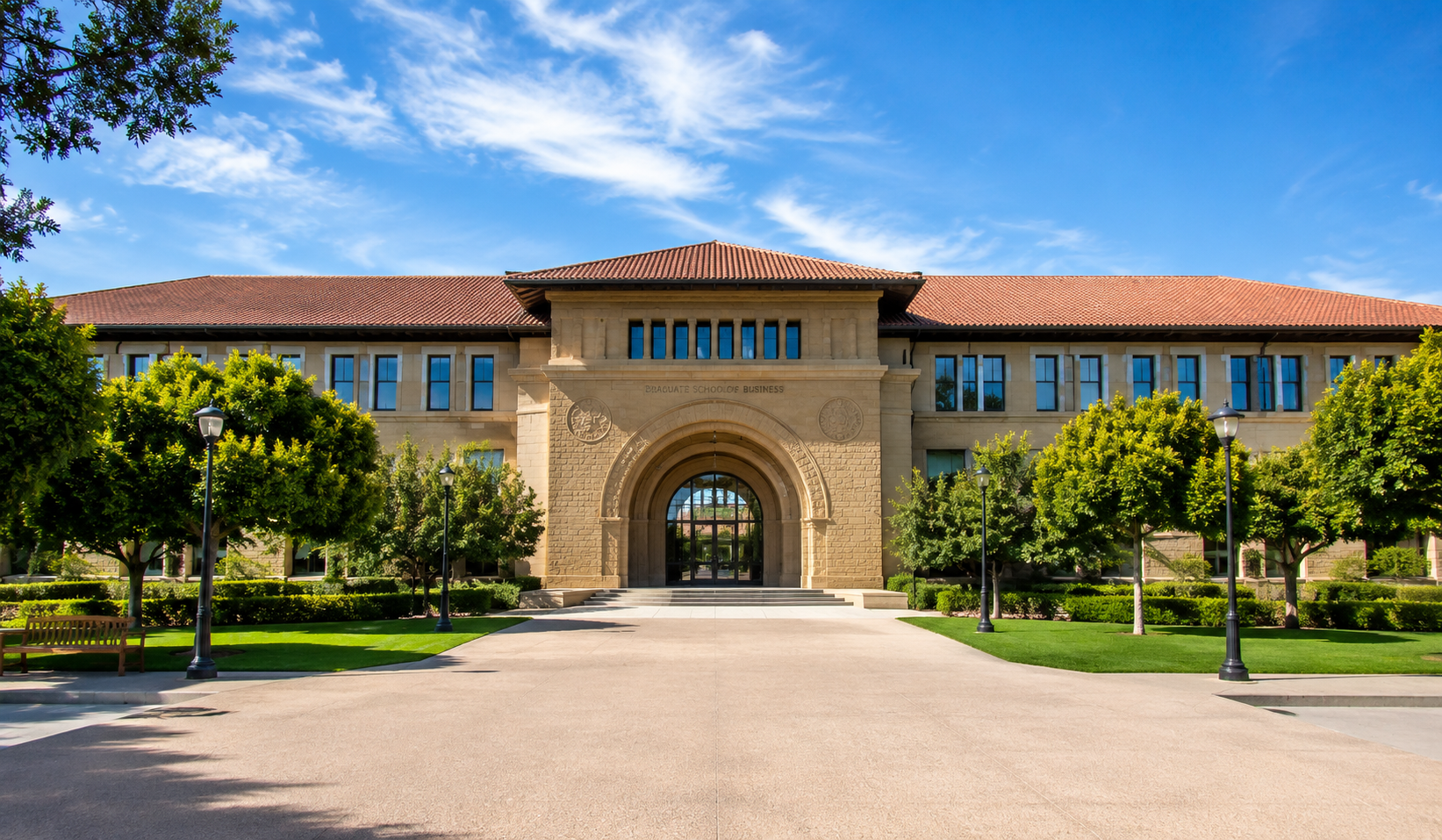
Stanford GSB
Stanford isn't selecting for the most impressive résumé in the stack. It's selecting for something harder to fake — and it tells you exactly what, in the one question it has asked, essentially unchanged, for decades: What matters most to you, and why?
What Stanford Is Actually Trying to Build
It's the question thousands of applicants turn over every year, usually meaning some version of "what do I have to do to get in." The more useful version turns the question back on the school: what does Stanford actually weigh, once you get past the stats?
The answer has stayed remarkably consistent, and the school said it plainly again at a recent admissions webinar. Stanford is doubling down on the three things that have always defined it — leadership, innovation, and community — and its message was that these matter more during periods of rapid change, not less. If you want to understand what Stanford is reading for, read for those three.
Leadership at Stanford is less about titles than about how people respond to you. Dean Sarah Soule has described the school's leadership model as resting on a handful of human dimensions — self-awareness, perspective-taking, decision-making, communication, and reading the context around you accurately. Notice what's missing from that list: seniority, headcount, a corner office. Stanford reads for whether people follow you and why, not for how high you've climbed.
Innovation is partly geography and partly disposition. Stanford sits in the middle of Silicon Valley, and the school is leaning hard into its position at the center of the AI conversation right now — the view being that there's no better place to be when scientific discovery, entrepreneurs, and business leaders all converge on one campus. But the disposition matters more than the zip code. Stanford reads for people who are energized by what's being built next, not unsettled by it.
Community is the constraint that makes the rest work. The class is small — roughly 430 — by deliberate design. With a cohort that size, the school isn't filling seats; it's assembling a small group of people who will spend two years shaping each other. That's the frame the rest of this page sits inside. Your application's job isn't to prove you're impressive in isolation. It's to give the reader evidence that you'll enrich this particular small community — and that the seat you'd take is one you'll genuinely use. It's not about you in the way most applicants assume. It's about what you'll add to the 430.
Who Genuinely Belongs Here
When a client asks me whether they belong at Stanford, I move them off the question they usually arrive with — "are my stats good enough?" — because at Stanford, more than almost anywhere else, that's not what settles it. Two traits do more work than the rest, and neither is a number.
The first is impact. Not impressiveness — impact. Stanford reads for evidence that you've already changed something: a team, a product, a community, an outcome that wouldn't have happened without you. Titles and brand-name employers don't establish this; consequences do. The strongest files show a through-line of someone who has consistently made things better around them, at whatever scale they had access to. And the school reads forward as well as back — it wants a credible sense of the impact you intend to have, which is exactly what the optional short answers are built to surface. The applicant who can show impact already made and impact genuinely intended is speaking Stanford's first language.
The second is a willingness to go inward. This is the trait that’s easy to underestimate, and it's where Stanford diverges most sharply from its peers. The school's signature experience — Interpersonal Dynamics, universally known as "Touchy Feely" — is the closest thing business school has to group therapy: a small-group course built on honest, real-time, sometimes uncomfortable interpersonal feedback. It is the most-requested class on campus. It tells you most of what you need to know about how Stanford thinks leadership develops: through self-knowledge first. The applicant who's energized by the idea of learning how they actually come across to others — and who can tolerate the discomfort of hearing it — fits the culture. The applicant who finds that prospect draining rather than fascinating should sit with that honestly before applying. It isn't a small feature of the place. It's close to the center of it.
Read against the larger frame, both traits point the same direction. Stanford is assembling a small community of people who've shown they can move the world a little and who are committed to understanding themselves well enough to lead. That's the next chapter the school is built to be — not a credential you collect, but a transformation you're ready to undergo.
The Class Profile, Read Honestly
The most recent confirmed class — the Class of 2027, entering Fall 2025:
Where They Worked Before
Other backgrounds include healthcare and consumer products (about 7% each), plus military, media, and more. Fifteen percent of the class already hold an advanced degree. Bars show share of the entering class.
A few things that are easy to misread in these numbers:
This matters, because at first glance the numbers make it easy to interpret Stanford almost exactly backwards.
The test scores aren't driving the decisions
It's tempting to look at a 738 average GMAT and conclude Stanford is a stats school that happens to ask soulful essays. It's the reverse. Stanford selects for achievement and impact first, and the high score range is largely a byproduct of who that selection attracts — high-impact people tend to test well — not the thing being selected for. The clearest evidence is in the numbers themselves. The GMAT range runs all the way down to 540, and there is no minimum GPA. A school that led with scores wouldn't have a floor that low or a policy that open. Those two facts are the tell: the stats describe the class Stanford built; they don't explain how it built it.
The GPA reads in context, not against a cutoff
A 3.76 average is high, but with no stated minimum, the school is signaling that it reads the whole academic record — trajectory, rigor, quant evidence — rather than a single number. A lower GPA paired with a strong upward trend, a demanding major, or clear quantitative ability can be absorbed by a file that's strong elsewhere. The question Stanford is answering is "can this person do the work and has this person done something with their abilities," not "did they clear a line."
Work experience tracks impact, not a clock
The 5.3-year average isn't a target to hit. Stanford is looking for impact commensurate with experience — what you did with the years you've had, not how many you've accumulated. A candidate with four years and a genuine record of consequence reads stronger than one with seven years of competent coasting.
The background mix is broader than the reputation
Consulting and finance lead, but public service is a real and defended thread at 9%, and the class spans far more than the tech-founder stereotype suggests. Stanford admits across a wide range — but every admit, whatever their background, tends to share the impact-and-introspection profile above.
The profile is a picture of who Stanford admitted last year. It's not a benchmark to match line by line. Your job is to give the reader evidence that places you in that picture on the dimensions that actually decide it.
Common Myths About Stanford GSB
"You need a 740+ to be competitive."
The average GMAT is 738, which means roughly half the class came in below it — and the range runs down to 540. A strong application with a 720 beats a weak application with a 760. The score is a threshold question, not a ranking.
"Stanford wants quirky."
No. Stanford wants specific. In my experience, manufactured quirkiness rarely lands the way applicants hope it will, while honest writing about ordinary-seeming things you genuinely care about tends to do far better. The school can tell the difference between a personality and a performance.
"You have to have a tragic backstory."
This one quietly damages good applications. The "What matters most" essay rewards depth of reflection, not severity of hardship. An applicant writing with real insight about an ordinary life will outperform one straining to dramatize suffering they didn't have. Stanford is reading for how you think and what you value — not for how much you've endured.
"It's a founder school, so I need a startup."
Entrepreneurship is real at Stanford, but it's a minority path (around 16% at graduation), and the center of gravity is high-impact roles across tech, PE, VC, and consulting. You don't need a company. You need evidence of impact, in whatever form your path has taken.
"AI focus means it's only for techies."
Stanford's AI push is school-wide, not a track for engineers. The flagship AI@GSB initiative is built to give every student a working toolkit regardless of career path. You don't need to be technical to fit the moment — you need to be the kind of person who leans into change rather than away from it.
Identity and Program Basics
Stanford Graduate School of Business, on the Stanford campus in Stanford/Palo Alto, CA. Two-year, full-time MBA. Class size approximately 430 — small by design, and a fraction of its closest peers (HBS enrolls around 930, Wharton around 870). Cohort-based first year with a flexible core; an almost entirely elective second year.
The Curriculum, and What It Reveals About the School
Stanford's first-year core is structured but flexible. Students take versions of core courses calibrated to their background, so an experienced finance professional isn't sitting through introductory accounting. The second year is almost entirely elective.
The signature experiences reveal the priorities. Interpersonal Dynamics — "Touchy Feely" — is a small-group course built around honest, real-time interpersonal feedback; it's the most-requested class on campus, and it tells you most of what you need to know about how Stanford thinks leadership develops. The Global Experience Requirement is non-negotiable for every MBA: Stanford treats international exposure as foundational, not optional. Startup Garage turns the curriculum toward venture creation for the students pursuing it.
What's newest is the AI layer, and it's worth understanding because it reveals where the school is heading. AI@GSB is a dean's initiative built to give every student — not just the technical ones — a practical toolkit for using AI in any business context, through hands-on workshops and direct access to the people building the technology a few miles away. Stanford's claim here is straightforward: located in the middle of Silicon Valley, with scientific discovery, founders, and business leaders converging on one campus, there's no better place to learn to lead through this particular moment of change. Read against the curriculum as a whole, the AI initiative isn't a pivot — it's the same innovation-forward disposition the school has always had, pointed at the technology of the moment.
Cross-registration with Stanford Engineering, Law, the d.school, and the Medical School is unusually deep. Students who use it build educations that look nothing like a standard MBA; students who don't tend to underuse the school.
What the curriculum reveals: Stanford assumes you'll customize. It hands you a small core and a large menu. If you arrive without a sense of what you want to build, you'll spend the first quarter figuring it out, and the experience compresses accordingly.
Culture and Community, Beyond the Marketing
Stanford's stated culture is collaborative, mission-driven, and intentionally small. The reality mostly matches the marketing, with caveats worth knowing.
The small class makes relationships dense and inescapable — you'll see the same people repeatedly across two years. The honor code is taken seriously and shapes how peer work happens. And Touchy Feely's emphasis on feedback bleeds into daily life: Stanford students talk about themselves, and to each other, in ways that students at other top schools sometimes find self-indulgent. For the right person, that's exactly the appeal.
There's one cultural point the school is genuinely proud of and that's worth folding into how you understand the place: Stanford describes itself as student-led, staff-supported. AI@GSB is the cleanest example — a major school initiative shaped and run by students (the Applied AI Scholars), with the dean and faculty in a supporting role rather than a directing one. That's not a throwaway line. It tells you the school expects students to build the things they want to exist rather than wait to be served them, and it rewards applicants who arrive with that instinct.
For fit research, the clubs and conferences worth knowing include the GSB Show, the AI Club (now one of the largest student organizations on campus), the Africa Business Club, Women in Management, the Stanford Venture Studio, and the affinity groups; the student-led conferences draw real industry attention and signal where the class's energy goes.
The “I got in” Instagram photo: Palm Drive framing the Main Quad and the foothills behind it, or Hoover Tower at golden hour. Either one tells your feed exactly where you landed.
Life at Stanford GSB
Let's talk about what it's actually like to live here for two years, because the campus tour shows you palm trees and sunshine and quietly skips the part where you'll need to think hard about money and a car.
Start with the obvious pleasures, because they're real. The weather is amazing — sun most of the year, mild winters, the kind of climate that makes a February problem set bearable. The campus, "The Farm," is genuinely beautiful: sandstone and red tile, the Main Quad, Hoover Tower over everything, palm-lined Palm Drive as the approach. The Knight Management Center is the GSB's own modern complex, and the Schwab and other graduate residences put a lot of your classmates within walking distance — which, in a class this small, means your social and academic lives blur together fast. The Dish loop in the foothills is the campus run-walk-think route; you'll end up there.
Now the honest part. This is a champagne-caliber bubble — a premier, polished, expensive one — and the polish has a price tag. Palo Alto is one of the most expensive places to live in the country, and the surrounding Valley is a string of pleasant, sleepy, costly suburbs rather than a dense city. You will want a car. San Francisco is about 45 minutes north and worth the trip, but it's a trip, not a Tuesday night. If your image of business school is a downtown campus with a city at your door, that's not this — and it's better to know it now than to spend a year wishing you'd weighed it.
What the bubble buys you is proximity to the thing itself. Sand Hill Road's venture firms are minutes away. The companies your classmates will join — or start — are next door. Tahoe is a few hours for skiing; the coast is closer. For the applicant who wants to be at the center of how technology and business actually get built, the location isn't a compromise. It's the whole point.
The "I got in" Instagram photo: Palm Drive framing the Main Quad and the foothills behind it, or Hoover Tower at golden hour. Either one tells your feed exactly where you landed.
Research, Faculty, and Intellectual Identity
Stanford's faculty research spans entrepreneurship and venture finance, organizational behavior, political economy, and increasingly the economics and strategy of AI — the last reinforced by serious computing infrastructure and the school's nexus position in Silicon Valley. Faculty access at Stanford's scale is genuinely strong, and what MBA applicants actually want from faculty isn't a marquee name to study under — it's professors who are reachable, teach well, and remember who you are. At a class size of 430, that access is real.
That said, part of what defines a school's intellectual identity is the presence of thinkers whose work shapes the broader business conversation. At Stanford, Jennifer Aaker — whose work on meaning, story, and how narrative moves people is widely read well beyond campus — is one example of the kind of intellectual gravity the school carries. You may or may not end up in a given professor's classroom, and that's not really the point. The point is that studying on a campus where the people shaping today's business and behavioral-science conversations actually work is its own kind of education. That gravity is part of what you're choosing when you choose Stanford.
What Stanford Essays Are Actually Testing
Per the school's recent admissions webinar, no major essay changes are planned for the coming cycle — the prompts below reflect the most recent published set, with only minor "cosmetic" changes to the application for clarity. Confirm current wording on the GSB site before drafting.
Essay A — "What matters most to you, and why?" (roughly 650 words)
This is the most famous prompt in MBA admissions, and the one applicants can easily get stuck on by overthinking it.
It's worth understanding why Stanford asks it the way it does. The school has been open that the question grew out of studying its own alumni — graduates kept saying Stanford made them better leaders, and when the school dug into why, it landed on a set of human dimensions with self-awareness at the front. The essay is the school's first read on exactly that: not what you've accomplished, but what you've examined. The prompt asks "what matters most," and then — crucially — "why," because the why is where self-awareness either shows up or doesn't.
Where this essay goes wrong is in answering the wrong question. Applicants may be tempted to treat it as "what's the most impressive thing about me" and produce a polished achievement reel. Stanford isn't asking that. It's asking what you actually value and whether you understand how you came to value it. The strongest versions are often about ordinary things examined with unusual honesty. The weakest are about extraordinary things described without reflection.
Essay B — "Why Stanford?" (roughly 350 words)
The complement to A: where A is about who you are, B is about why this specific school is the right place for your next chapter — and how you'll contribute to it.
This is where most "why school" essays fall flat, and the fix is specificity. (More on that in the next section.) The version that wins is the one that shows you've engaged with Stanford at the level of a student preparing to use it — and, ideally, to add to it. Given how proud the school is of being student-led, an essay that shows you'd be one of the people building things on campus, not just consuming them, lands especially well here.
Optional short answers (impact)
These are "optional" the way the personal essay is optional — which is to say, not for strategic applicants. They're where you make the forward-looking case for the impact you intend to have, and the savvy applicant treats them as a core part of the file. One caveat worth taking seriously: this isn't a box to fill at any cost. An answer manufactured because you felt you had to put something down is worse than leaving it blank — don't make the reader spend time on an example that isn't worth reading. The goal is a real one, told well. If you have it, use the space — and most strong applicants do.
What "Why Stanford" Essays Should Actually Do
The first job of a "Why Stanford" essay is to be specific in a way that could only be written by you. A general line about a faculty member or a club convinces no one — every applicant can name a professor and a club. The connection has to be earned. If you've spent years in food and agriculture and the Food & Agribusiness Club is where you'd keep building that work, that clicks, because the link is real. If Jeffrey Pfeffer's work on power genuinely changed how you read your own organization, say so and say how — that's a connection with a history behind it. The test is whether the detail is load-bearing or decorative. Decorative details read as research; load-bearing ones read as fit.
And resist the temptation to justify Stanford by its ranking. Nobody sees the GSB as a generic top-five school — it's the prize, the hardest admit in the world. "I'm applying because it's number one" isn't a reason; it's the absence of one. The school knows where it sits. What it wants to know is why this place, for you.
Here's the frame I'd use for Stanford specifically. At most schools, I tell clients the goal is to make the reader's job easier — walk them efficiently from your goal to the program's resources so they can advocate for you more compellingly. Stanford is selective enough that the bar is higher than "easy to advocate for." With 430 seats and the world's most competitive pool, the reader has to be convinced you're someone who will use the seat — who will go on to do the things in the school's mission, to change lives, organizations, and communities. Every seat that goes to someone who won't is a seat wasted. Your essay's job is to make the reader confident you're not that risk.
The cleanest way to think about it: a Stanford admit is less like getting picked for a team and more like being handed a grant. The people giving it out aren't asking who'd make a fine recipient — they're asking who'll do the most with it. That's the target — not "I'd be a good student here," but "back me, and watch what I do with it."
Recommendations
Stanford requires two letters and uses a structured format with specific questions about leadership behavior. One should come from a current direct supervisor (or your closest equivalent); the other from someone else who has supervised your work.
Stanford's culture rewards recommenders who can speak to why people follow you. That's the heart of it. Recommenders who only catalog what you delivered underserve you, because Stanford's leadership model is about influence, not output. The strongest letters answer questions like: How does this person lead others? Do they change the temperature of a room when they walk into it? And — the one that really lands at Stanford — what happens after they leave the room? Influence that persists in your absence is exactly the kind of impact Stanford is reading for. Brief your recommenders to tell those stories, not to recite your résumé back in prose.
The Interview, and What It Actually Evaluates
Stanford interviews are by invitation only, conducted by alumni, blind (the interviewer has your résumé but not your full application), and typically 45 to 60 minutes. The format is behavioral.
What it's actually testing: whether the person in the room is the same person on the page. By the time you're invited, readers have a strong working sense of who you are, and the interview functions largely as a check against that picture — the notes come back and either support what the committee already believes or raise an eyebrow. A disconnect between your essays and your in-person self isn't usually a clean "fail"; it's more that it introduces a question mark where there wasn't one, and at Stanford's level of selectivity, a fresh question mark is not what you want late in the process. The fix is simple to say and harder to do: make sure the self you present on the page is one you can actually be in a room.
Application Logistics
Tests: GMAT, GMAT Focus, or GRE accepted, with no preference. No minimum score.
Application fee: $275; fee waivers available for active U.S. military, demonstrated financial need, and certain national-service programs.
Video component: None required.
Transcripts: Self-reported at application; official copies required upon admission.
A note worth knowing as you plan: the school said at its recent webinar that it's actively trying to lower the psychological barrier that keeps strong applicants from applying — most assume they won't get in. Between live application workshops and a growing library of admissions resources, Stanford wants applicants to feel supported through the process. If self-doubt is holding you back from applying, the school itself is telling you not to let it.
Deadlines and Round Strategy
Stanford typically opens the application in June and runs three rounds, with decisions roughly 11 to 13 weeks after each deadline.
The most recent confirmed cycle (2025–2026, Class of 2028):
Round 1: September 9, 2025 — decision December 10, 2025
Round 2: January 7, 2026 — decision April 2, 2026
Round 3: April 7, 2026 — decision May 28, 2026
Stanford posts the next cycle's deadlines in early summer; confirm current dates on the GSB site before you plan.
On round strategy
"Stanford R1 vs R2" is among the most-searched questions about this program, and the honest answer is that round matters less than readiness. Stanford explicitly encourages R1 or R2 and is open that it prefers a polished R2 application to a rushed R1 one. There are concrete advantages to applying earlier — more runway for international visa processing, eligibility for the on-campus housing lottery, and access to Welcome Weekend (not held for R3 admits).
What I tell clients deliberating between R1 and R2
If your essay drafts aren't yet doing the work Stanford's prompt demands, R2 is the right call. The round disadvantage, if any, is smaller than the disadvantage of submitting before your essays have landed. The applicant who pushes a half-formed essay into R1 out of fear of "R2 odds" is usually trading a real problem for an imagined one.
R3 is a different conversation. Stanford fills most of the class through R1 and R2, and R3 spots tend to go to applicants who fill a specific gap the cohort still has. R3 makes the most sense when the timing genuinely works best for you right then — the candidate who only recently secured funding or hit a milestone that made this the right year to go, and who'd rather move now than wait a full cycle. And if R3 is simply where you are in the cycle, that's not a verdict on your candidacy. The only question worth answering is whether the application can be genuinely ready by the deadline. If it can, there's a real case for going now; if it can't, a strong R1 next cycle is the better use of the same materials. Either way, the round you're in doesn't change what the application has to do.
Employment Outcomes, Read for What They Signal
For the Class of 2025 (426 graduates), 63% sought traditional employment; of those, 66% had an offer by graduation and 90% within three months, with 81% accepting. Technology was the top destination at 35% — with a notable surge into enterprise and AI-related roles (product management, go-to-market, customer success) — followed by finance at 33% (private equity 16%, investment management and hedge funds 8%, venture capital 6%) and consulting at 11%. Finance roles carried the highest pay, around a $200,000 median. Roughly 16% pursued entrepreneurship at graduation (down from 18% the prior year), most of those ventures in technology, with search funds a notable second. Median base salary held at $185,000, with an average of $190,901 and a median signing bonus of $30,000.
The geography skews West. The majority of employed graduates stay in the West — the Bay Area above all — with the Northeast a distant second. That West Coast concentration is the single most important employment data point for fit. If your goal requires New York, Boston, or London, you can absolutely get there from Stanford, but you'll be working against the current: Stanford's network is densest where its graduates cluster, and they cluster in Silicon Valley.
What this signals: Stanford is a finance-and-tech school as much as it is a founder school. The entrepreneurship narrative is true at the margins — 16% is a real number — but the center of gravity is high-paying, high-prestige roles in tech, PE, VC, and consulting. If your goals match that center, the program runs with you. If they don't, you'll need to be deliberate about using Stanford's resources differently from the median student.
Cost and Financial Aid
Annual tuition (2025–2026): $85,755
Estimated total cost of attendance: approximately $135,771 per year for a single student
Aid approach: Need-based. Stanford does not offer merit scholarships in the traditional sense.
Average aid: Stanford's need-based fellowships have recently averaged in the range of $90,000–100,000 over two years.
Stanford's aid philosophy is consistent with its mission positioning: the school doesn't buy stats with merit money. Aid is genuinely need-based, and admission is need-blind.
Rankings, in Context
Stanford GSB sits consistently at or near the very top across US News, the Financial Times, Bloomberg, and Poets & Quants, with small and largely meaningless year-to-year variance. It's in the conversation with HBS and Wharton on every meaningful measure of selectivity, faculty quality, and outcomes. The school worth comparing it against is HBS — not the school three spots below.
How Stanford Differs From Harvard Business School
This is the most-searched comparison in MBA admissions, and the one most often misframed. The two schools are roughly matched on selectivity, outcomes, and starting pay. The differences that matter sit a layer below.
Pedagogy
HBS is built on the case method: ~500 cases over two years in a section of 90, with cold-calls and graded participation, and a daily rhythm of prepping the next morning's cases. It develops decision-making under uncertainty, in groups, at scale. Stanford uses cases too, but its signature pedagogy is experiential and small-group — Touchy Feely, Startup Garage, the Global Experience Requirement, the customizable core — and it develops self-knowledge and originality before management instinct. If the introspective, feedback-heavy style sounds like the point, that's Stanford; if it sounds like overhead, that's a real signal.
Class size and texture
HBS enrolls roughly 930; Stanford roughly 430. At HBS your section of 90 is your central community, with the broader class as a professional layer above it. At Stanford the whole class is effectively the section. Both are communities — just different ones. HBS feels like a large, structured organization; Stanford feels more like a startup — small, intense, self-directed, with the expectation that you'll help build what you want to exist.
Essay style
HBS's short, criteria-mapped prompts reward strategic, operational framing. Stanford's "What matters most" rewards reflective writing about who you are. Both are uncomfortable in different ways. I tell clients deciding between them to draft a rough version of each and notice which one came out feeling more like them.
Signals You Might Be a Strong Fit
Fit is hard to feel from the outside, so here are concrete, checkable signals. If two or three of these sound like you, you're probably reading Stanford correctly.
You can point to impact, not just achievement. You have two or three situations where something is genuinely different because you were there — a team, a product, a community changed by your involvement, not just a title you held.
The idea of learning how you actually come across energizes you. Touchy Feely sounds like the best part, not the price of admission. You'd rather know how others experience you — even when it stings — than not know. You're willing to be uncomfortable and to be, for two years, something close to an open book.
You could see yourself doing a TALK. TALK is a hallmark GSB tradition — twice a week, students share a 20-to-30-minute version of their life story in front of classmates. Stanford's culture includes moments like this, where you speak openly about yourself in front of the class. If you can picture doing that — nerves and all, which everyone has — that's a signal. If the whole idea makes you want to opt out, that's a signal too.
The mission actually speaks to you. "Change lives, change organizations, change the world" reads as a description of what you want, not as marketing you'd tolerate. If it doesn't resonate and something else drives you, that's worth noticing.
You're drawn to what's being built next. You're the kind of person who sees a driverless taxi pull up and thinks I want to be where that's happening, not I wish things would slow down. Every school talks about innovation; Stanford, sitting in the middle of Silicon Valley in a way no other M7 can match, genuinely feels that way — and the right applicant feels it back.
Signals You Might Not Be the Best Match
The honest counterpart to the section above. None of this means you wouldn't be a strong applicant somewhere, or that you shouldn't apply here — that's your decision. It means the specific match with Stanford is worth examining before you spend a cycle on the application.
It may not be the best match if the introspective, feedback-heavy culture sounds draining rather than fascinating. Touchy Feely and the broader "know thyself" ethos aren't a side dish at Stanford; they're close to the main course. If trading candid personal feedback with peers, or speaking openly about yourself in front of others, sounds like something to endure rather than lean into, a more case-driven or analytically-driven program may fit the way you like to work better — and that's worth weighing honestly.
It's a harder fit if the mission doesn't resonate with you. Stanford reads for people who genuinely want to change lives, organizations, and communities. If your real motivation is somewhere else — comp, prestige, a specific functional pivot — that's a perfectly valid reason to get an MBA, but it may point you toward a school whose center of gravity matches yours more closely.
It's worth questioning whether the vibe suits you if you want the traditional, button-up experience. Stanford isn't the brick-sidewalk, old-ivy feel of an HBS or a Tuck — it's Californian, innovation-forward, comfortable with rapid change. The person who's energized by being at the front edge of what's new thrives here; the person who finds that unsettling and prefers established tradition may be happier somewhere with that texture. It's less about right and wrong than about how you relate to progress.
If two or three of these land, treat it as a prompt rather than a verdict. The most useful next step is usually to ask whether the schools that fit you better are programs you're genuinely as excited about — and to do that fit work honestly now, while it can still shape where you apply.
When Working With Someone Helps, and When It Doesn't
Stanford is one of the few cases where an outside reader can genuinely change outcomes — but not in the way most applicants expect. The "What matters most" essay isn't a writing problem; it's a self-examination problem wearing a writing problem's clothes. A good outside reader doesn't fix the prose. They ask the questions that force you to go deeper into what you actually value and why, until the essay has something real at its center.
That said: no consultant can hand you your "what matters most." If you haven't done the underlying reflection, no amount of editing will produce a strong essay. The work is yours; the support is in the questions that get you there faster and take you further.
If you'd like to talk through whether your application is at the stage where outside input would help, a free consultation is a low-pressure way to find out. We'll talk about where you are, what Stanford is likely to weigh in your case, and what matters most before you draft.